Swainson’s Thrush, Common Yellowthroat and Yellow-rumped Warblers

Yellow-rumped Warbler

My house, Burlington, ON. May 18 2020.  I could easily have written off today as a washout, literally and metaphorically. It has been raining for nearly 24 hours as I write, and another 12 hours of steady rain is forecasted.  In the normal course of things, we take cover on days like this and expect little more than a lot of grass cutting in the days ahead. But it’s May, the much-delayed spring migration is in full swing and the birds have an urgent mission. So, on this soggy and overcast day there was a lot of bird activity. Friends called or wrote with stories of unexpected sightings including: Swainson’s Thrushes, a Golden-winged Warbler and an American Bittern, all good stuff.
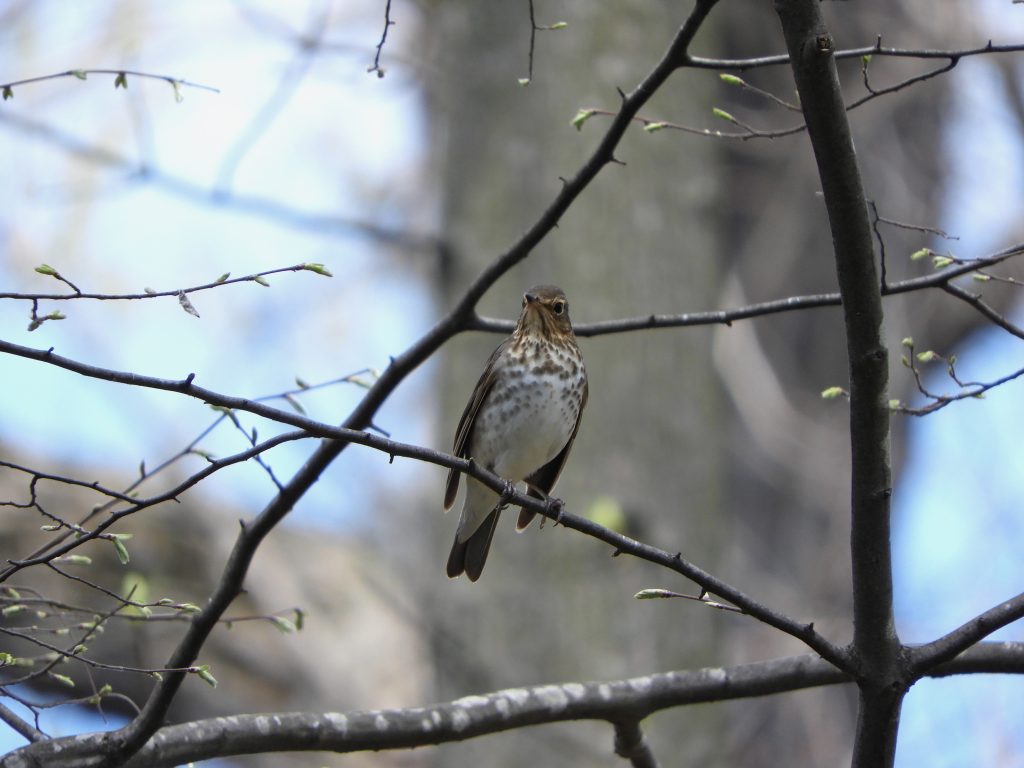
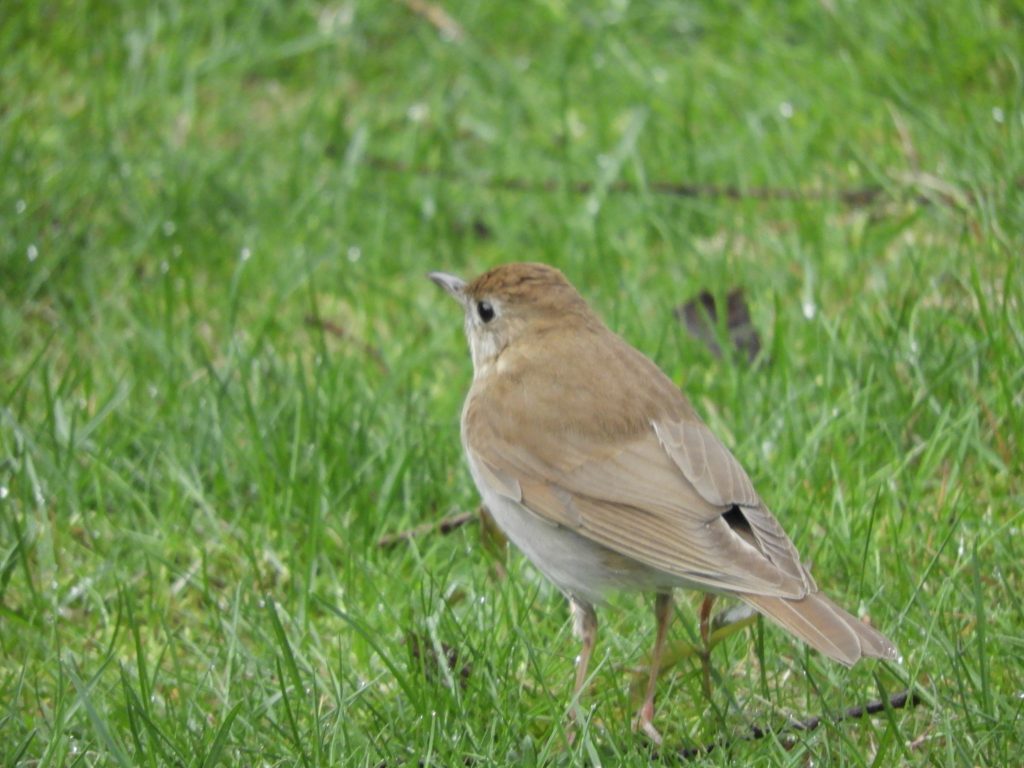
Swainson’s Thrush on a drier day

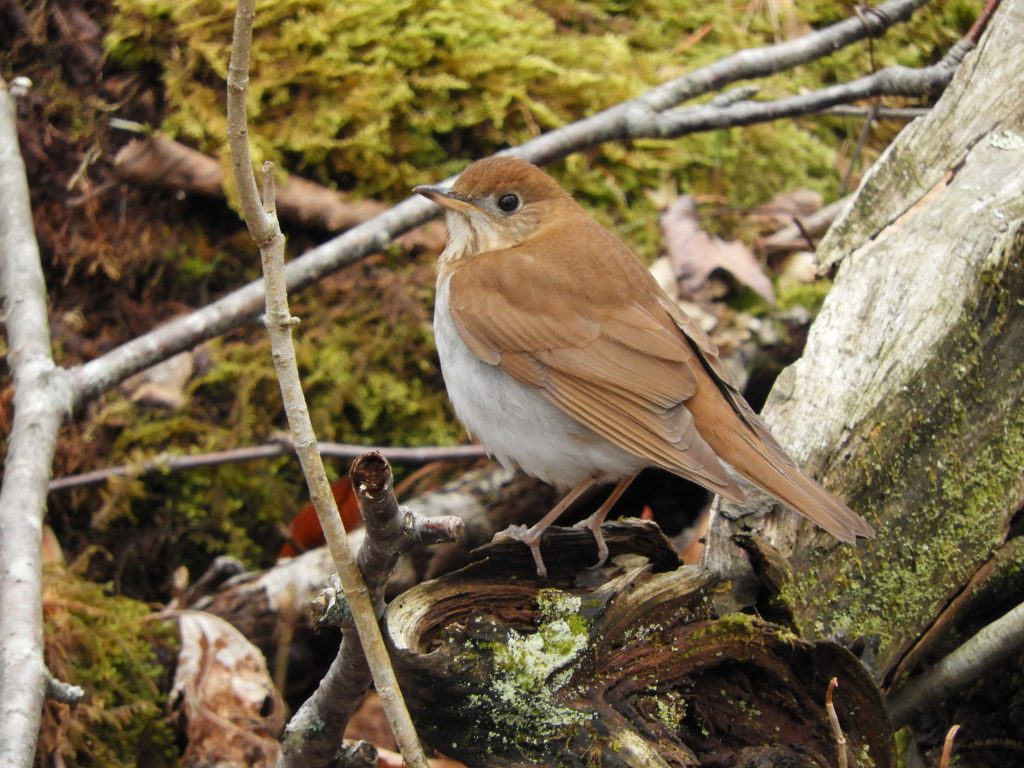
At my front window I was looking at nothing in particular until a quick movement caught my attention, and there, now I had a Swainson’s Thrush too! It was hard to make out, it’s grey/brown back blended so perfectly with the leaf litter it was searching through.  Happy to have been treated to this little bit of urban wildlife I went to share the good news with my wife and noticed something flit quickly across my back yard and lo, a Common Yellowthroat to add to my wet-day collection!
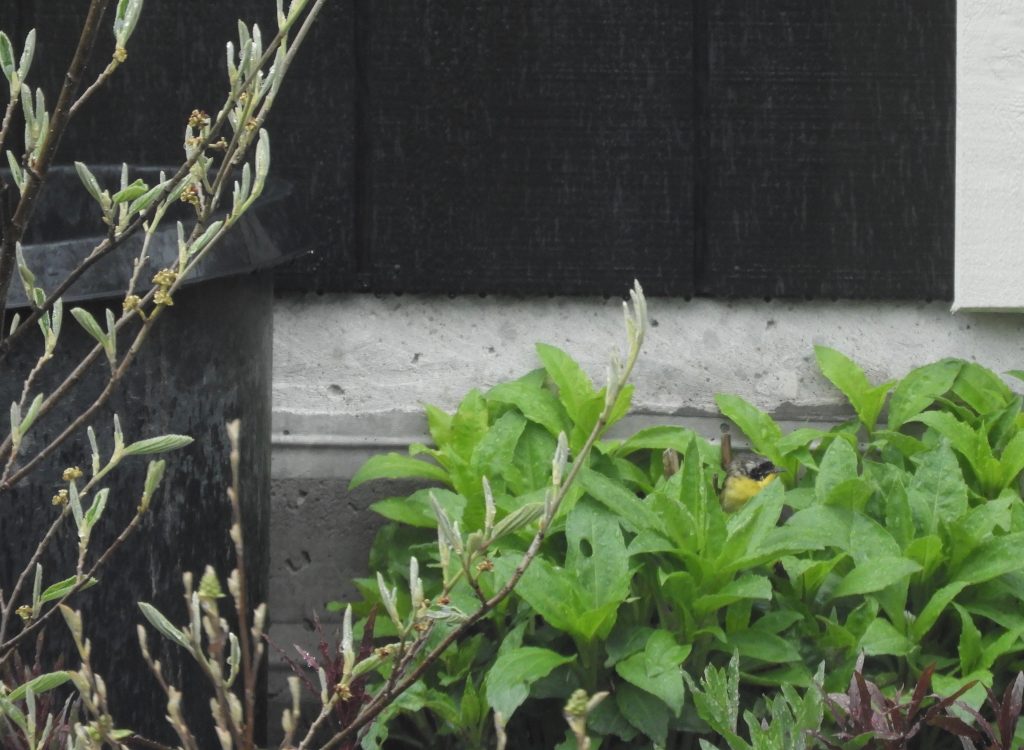
Somewhere along the way, it had had a near-death experience I think, for it had no tail feathers, perhaps it had been ambushed by a cat or fox and barely escaped, leaving the predator with a mouthful of feathers. Here are a couple of long-shot photos of it, one where it is peering out of some early growth of Woodland Sunflowers (above), the other to show its disconsolate tailless condition. Not great photos, simply for-the-record, in case word gets out and people don’t believe me. 
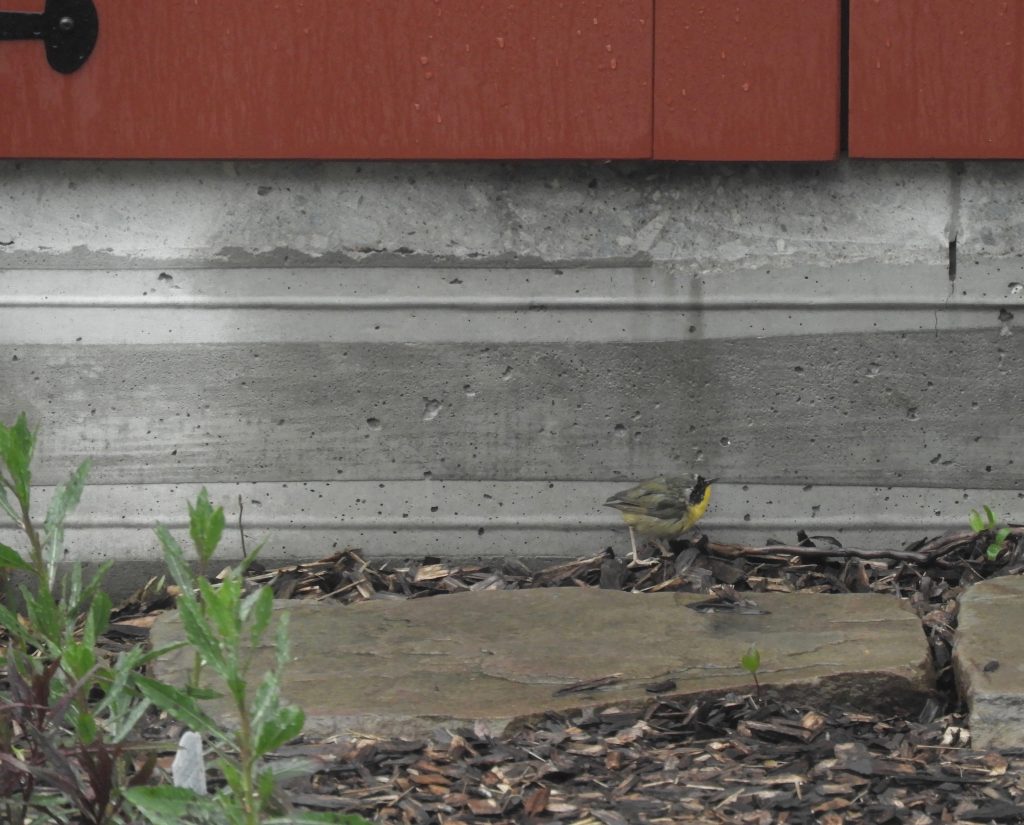
Disconsolate Common Yellowthroat, sans tail

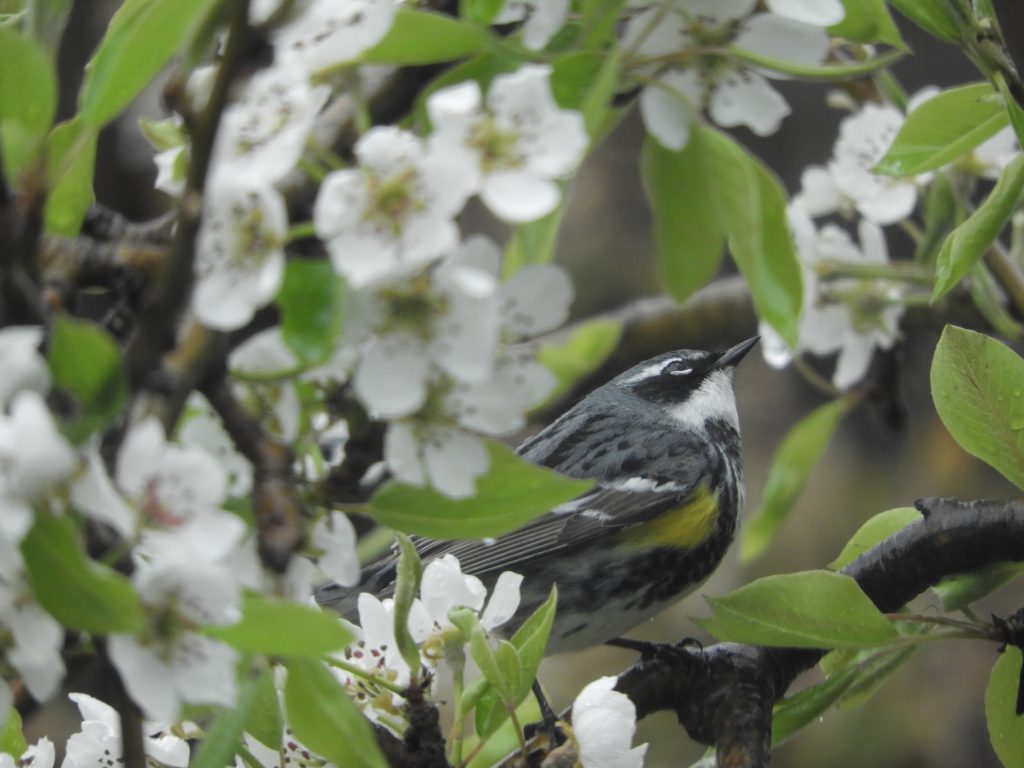
There was more to come: two brightly dressed, male Yellow-rumped Warblers foraging in my floriferous old pear tree, looking almost like calendar photos – and might have been had I not had to photograph them through two panes of window glass. We celebrate Yellow-rumped Warblers as first to arrive among warblers but then they become a bit pedestrian, outshone by the likes of Black-throated Green, Blue-winged, and Blackburnian Warblers. But today they were stars in the gloom, all three are Birds of a rainy Day: Swainson’s Thrush, Common Yellowthroat and Yellow-rumped Warblers.
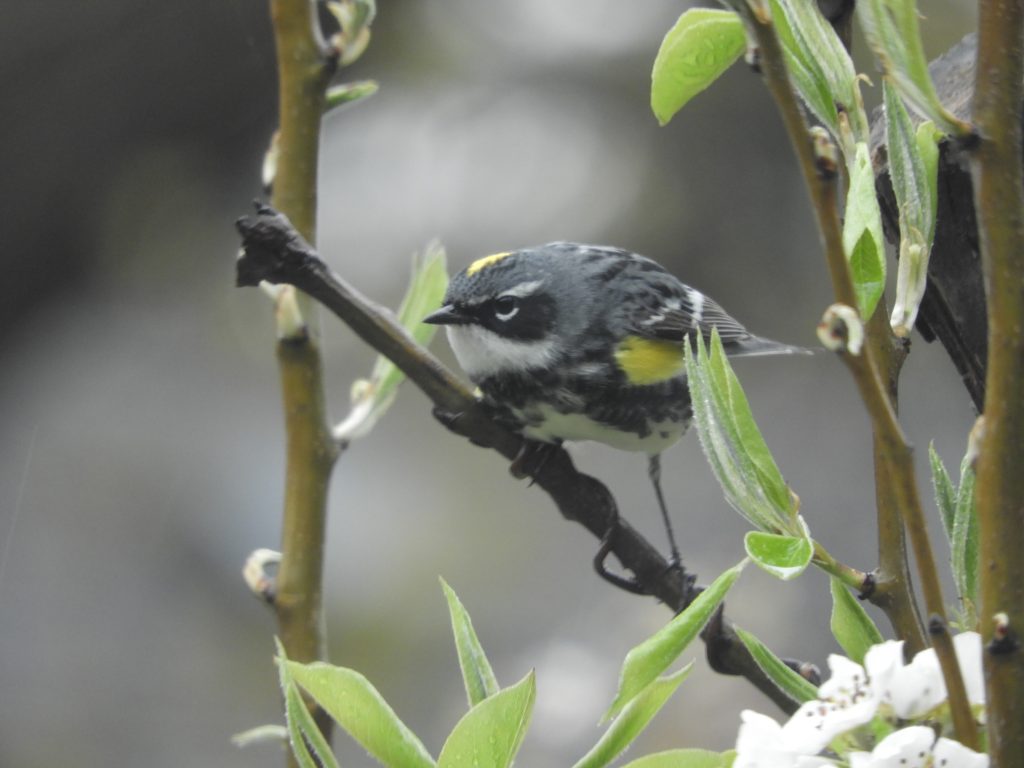
Yellow-rumped Warbler

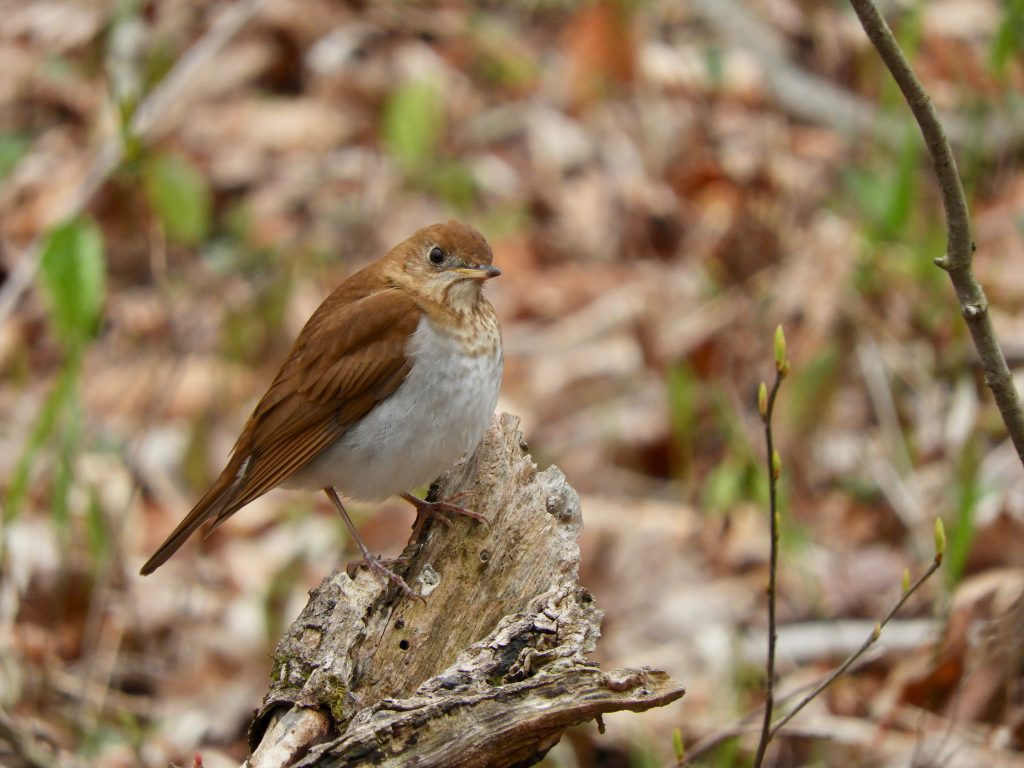
Veery

Paletta Park, Burlington, ON. May 15 2020.  You know how how some people look like their dog? You’ve seen those pictures. I once met a woman who bore a striking resemblance to her poodle; lanky and a bit pointy, but I didn’t say anything. My wife’s family really liked English Bulldogs and I’m glad to say the operative word is liked not likeness. This is a rather rambling way of tackling a thought that came to me as I ate my breakfast toast: that some birds’ songs seem appropriate to their appearance. You could, in a pinch I suppose, draw a parallel between the bright boldness of a Blue Jay with its characteristic shriek or the dry wheeze of a Pine Siskin to its streaky browns. It’s a stretch I’ll admit but…

Well this morning, before anyone else was up and about, and with a big bank of wet weather making its way from the west I went birding. What else is there after all? It had been a wet night and I was not terribly optimistic but the birds absolutely have to get on with their northward migration, and damn the torpedoes. It was early, barely first light, and heavily overcast.

The birding was good, if challenging, and I learned a lot about the limits of my camera, of about fifty photos taken only two or three are keepers. New to me this year were a couple of Ovenbirds and at least two, maybe more, Veerys, which brings me back to my point about poodles and bird song.

Veery, now there’s a bird! At risk of being unoriginal, I’ll quote from my my post of June 2013. ‘Veerys aren’t often seen, they’re delicate, subtle and elegant and there’s not much in the way of visual fireworks about them, it’s mostly about their song, they seem to prefer the depths of a forest to sing their “Veer-veer-veer-vv tktktkt” song.  It starts emphatically, quickly fades and tapers as if, really, it’s a secret.  It has a rolling cadence that makes you think it might be trickling down a long, cast-iron drainpipe; it’s obviously hard to describe.  I used the adjective ethereal, one that every writer seems to fall back on; nothing else quite captures the breathless will-o-the-wisp essence of this song – a song that can stop me dead in my tracks.’

Today I watched and photographed a pair of Veerys close to me on the lawn and it struck me that their natural beauty is so understated, so ethereal too. Plain yes, but not the slightest touch of lip-gloss, blush or eyeliner needed. Birds of the Day – so far anyway. The rain has stopped and I’m going back out, damn the torpedoes.

Great-crested Flycatcher

Paletta Park, Burlington, ON. May 14 2020.  This was a morning we’d been waiting for, finally a day not dominated by Arctic weather, finally a day to meet some southern migrants. Those migrants were perhaps more desperate to be here than we were to see them, they’ve been on their way north for weeks from tropical spots like El Salvador, Panama, Columbia and even Brazil, they have a breeding agenda, an appointment to keep with the future.

Our eight-strong warbler tally was Black-throated Blue, Black and White, Black-throated Green, Nashville, Chestnut-sided and Blue-winged Warblers, Northern Parula, and Northern Waterthrush, not bad. The last four were new to me this year.

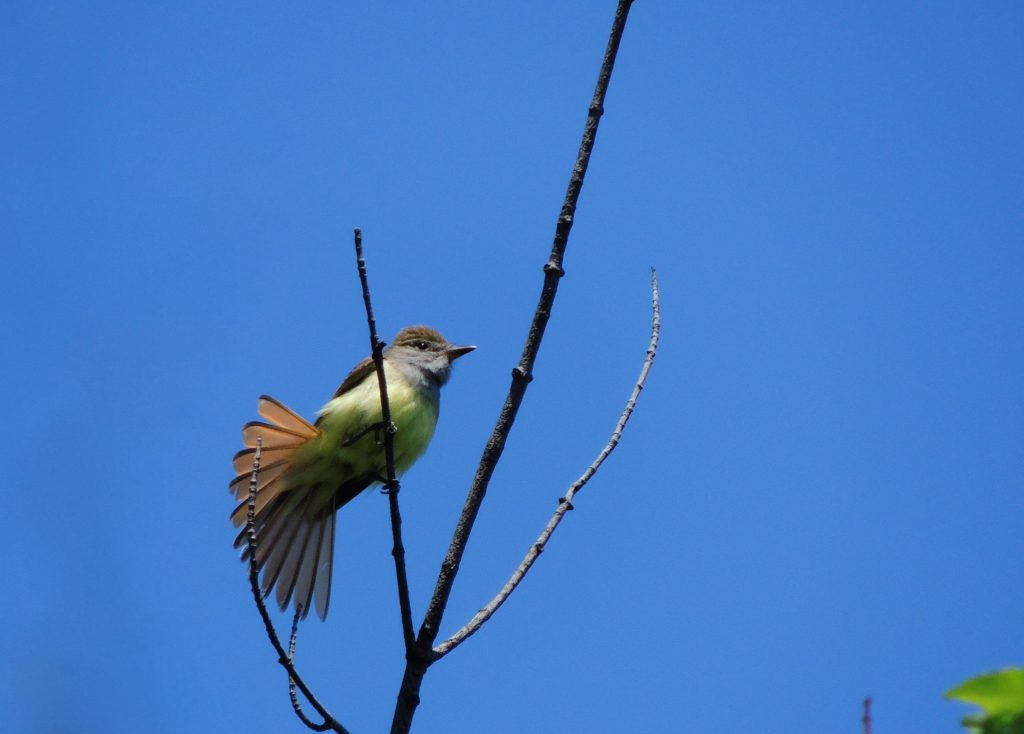
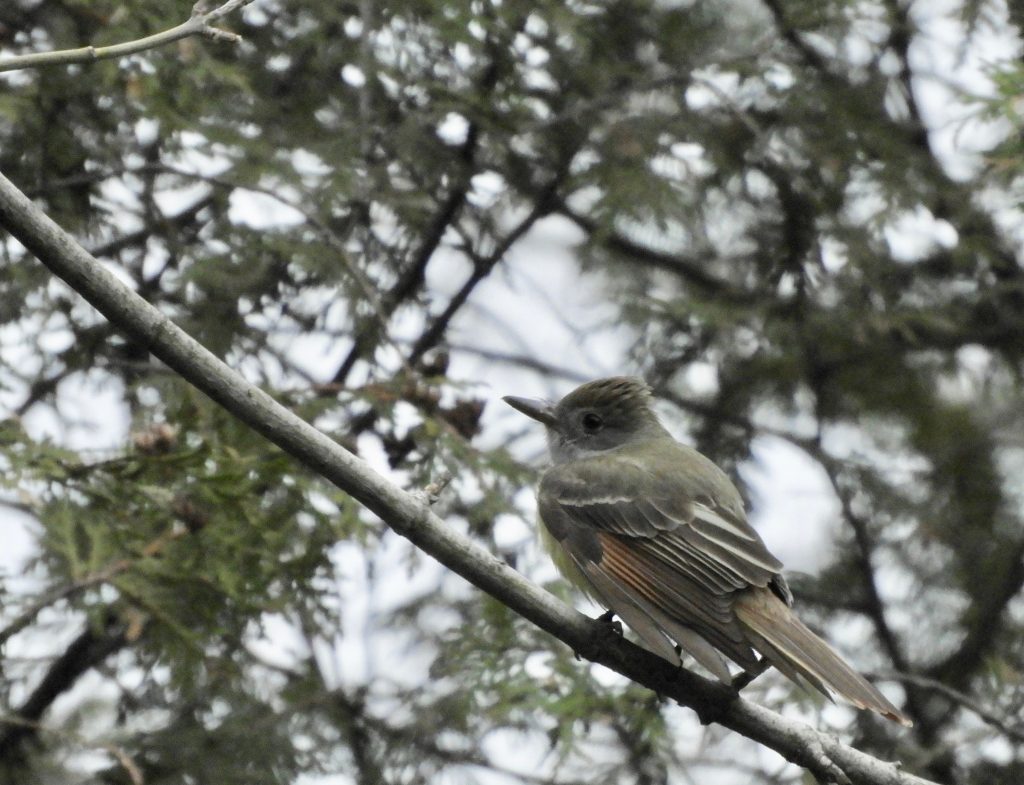
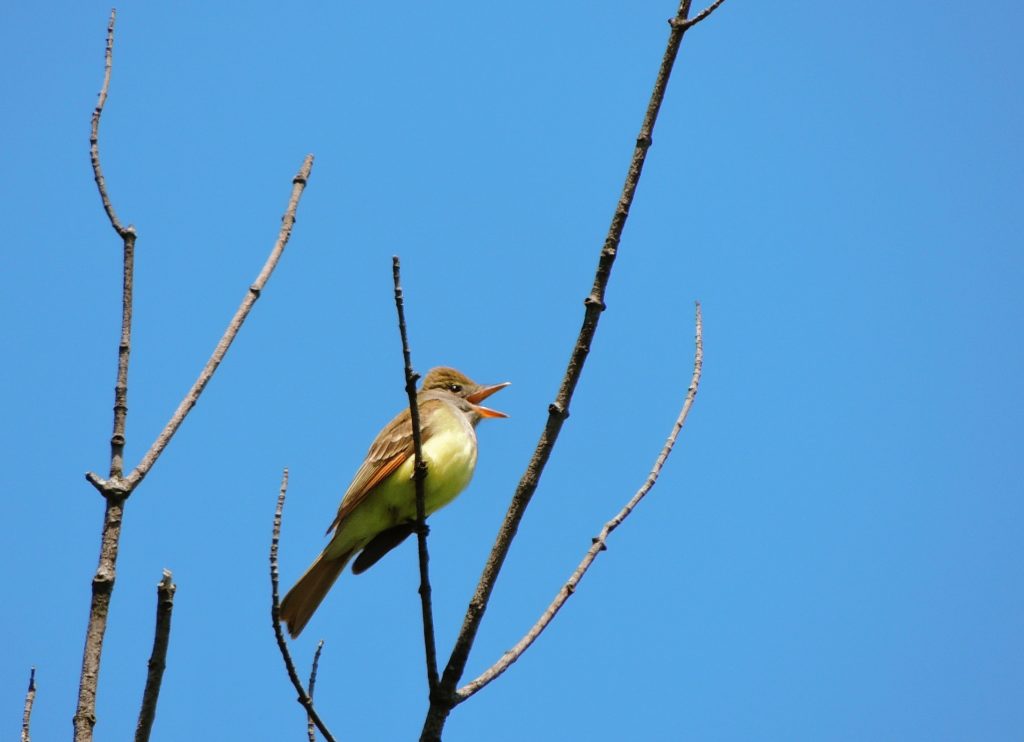
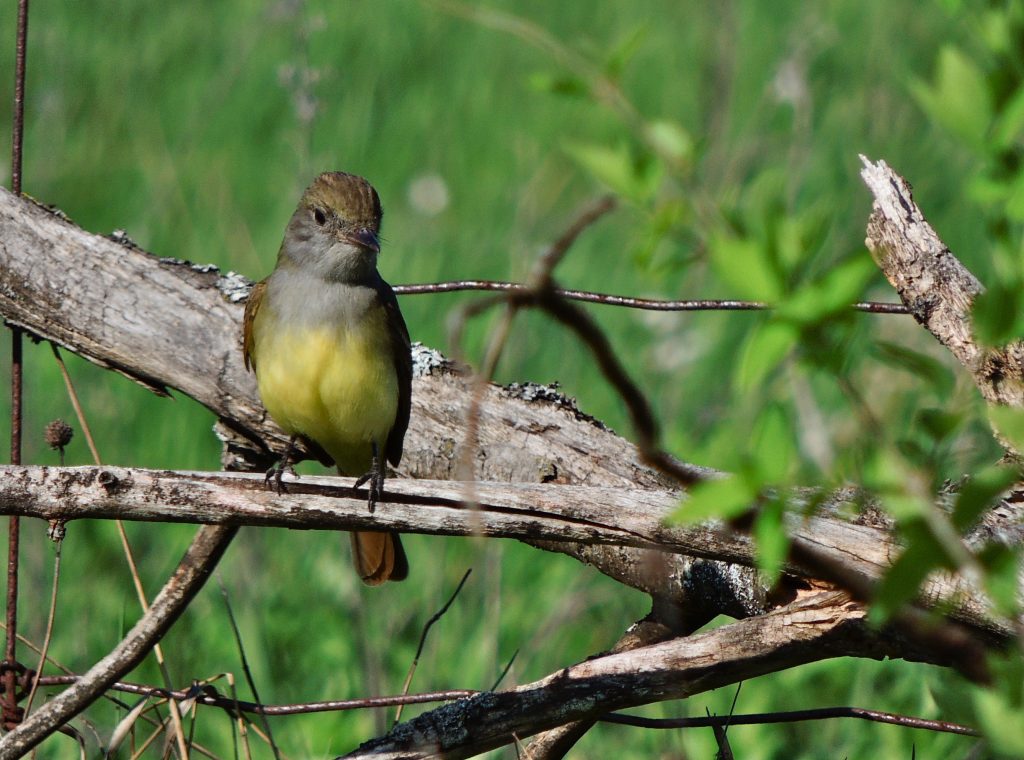
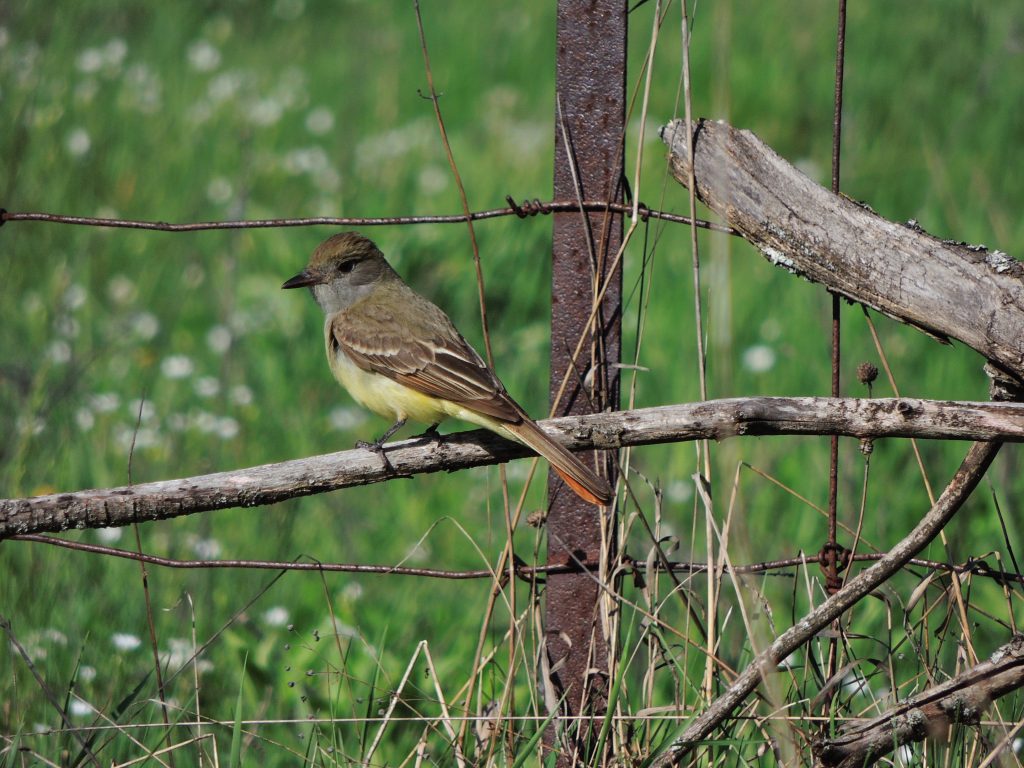
It’s not all about warblers though, and I was more taken by a Great-crested Flycatcher than anything else, it was my Bird of the Day on a day most will remember for the warblers. It’s one of those birds with attitude, self-assured and a touch pugnacious.  Later, after all this migration fuss is over, I’ll probably encounter Great-crested Flycatchers again in their wet-woodland territory. They really like soggy, mosquito-marshy clearings in deciduous forests, places with plenty of dead and dying trees, any of which might have a suitable hole for a nest site.

Above is a shot of today’s bird but the light was difficult and the cedar branches don’t help. Below are photos from other days that do justice to the subtle beauty of this creature, that lovely chestnut in the tail and wings and the sulphur yellow breast.

Ruffed Grouse

Waterdown ON. May 8 2020. It was an unusual morning of birding for a couple of reasons. I blame the weather for part of it, we are being swept by a strong system bringing Arctic air and snow flurries (!). It is likely to cause considerable mortality among the many insectivorous birds newly arrived from the south. But it’s not unprecedented as you’ll see if you review my post of May 15, 2016.  

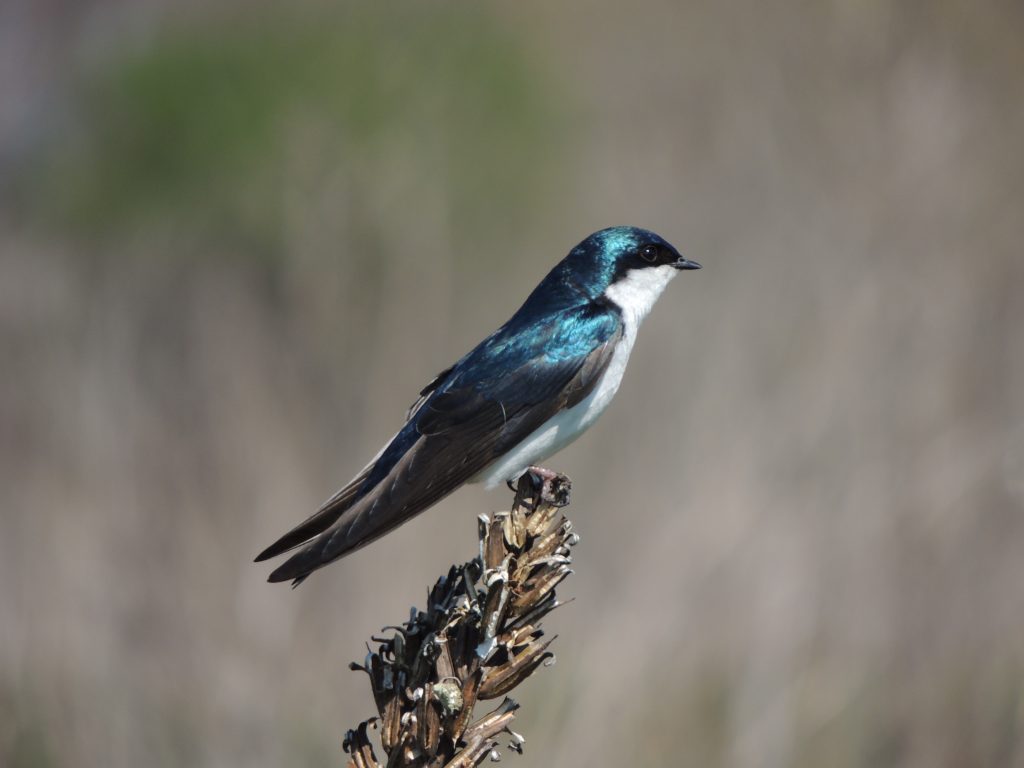
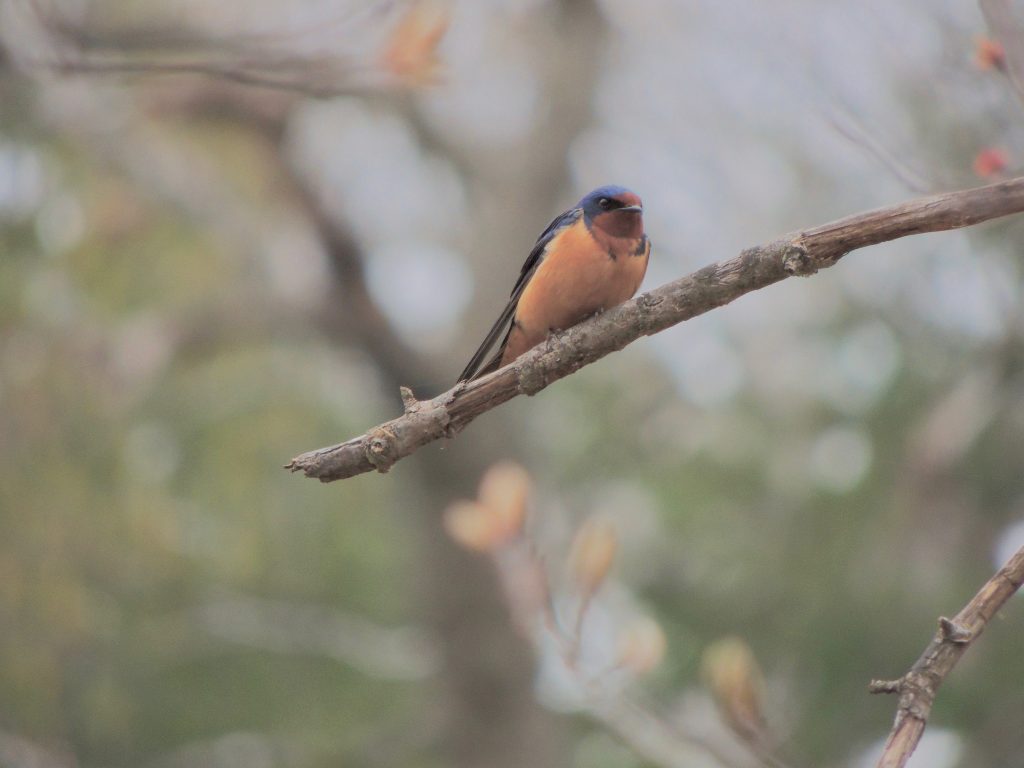
 My warbler-hopeful spots were as quiet as I’d expected, which is to say deadly. I found large aggregations of Barn Swallows and Tree Swallows gathered on lakeside trees, hoping, I suppose, to pick hatching insects from the lake’s surface. They were a disconsolate sight, interesting but a bit saddening to watch. I stayed for a while but it was too cold to spend very long there so I decided to explore a couple of rural back-roads in an effort to fill some gaps in the map I carry in my head.

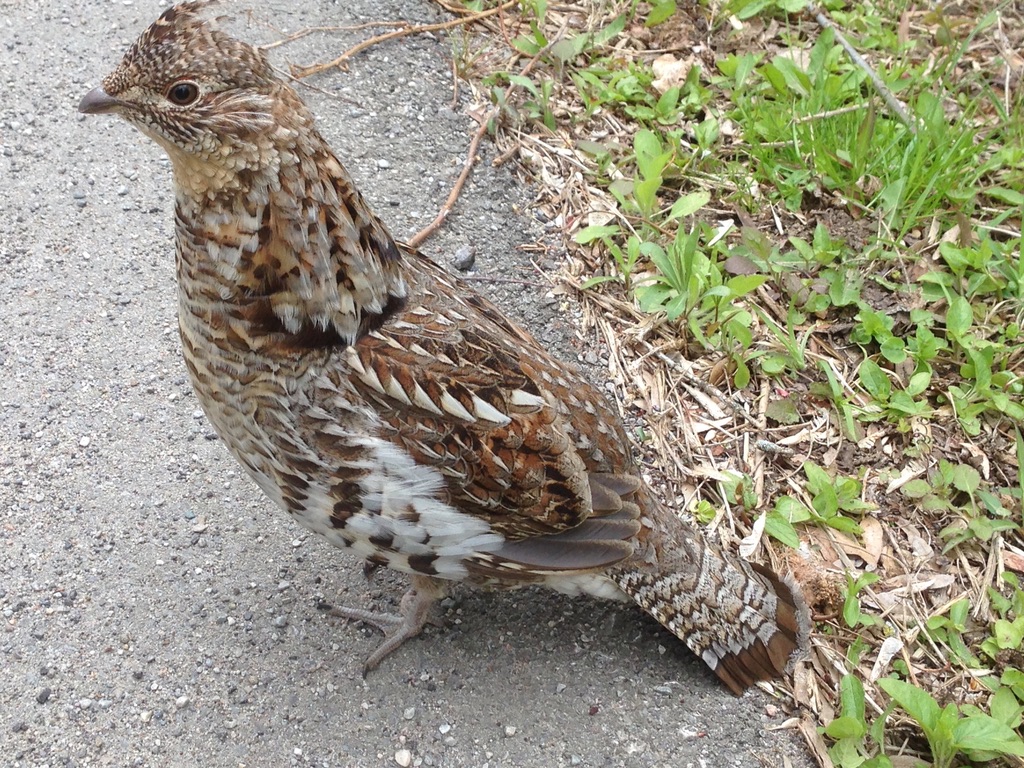
I was not surprised to meet up with a small group of Wild Turkeys, but was very surprised to meet a Ruffed Grouse. It was an encounter reminiscent of my Golden Pheasant incident some years ago, it may help in your appreciation of today’s meeting if you will take a look at that Golden Pheasant story first.  

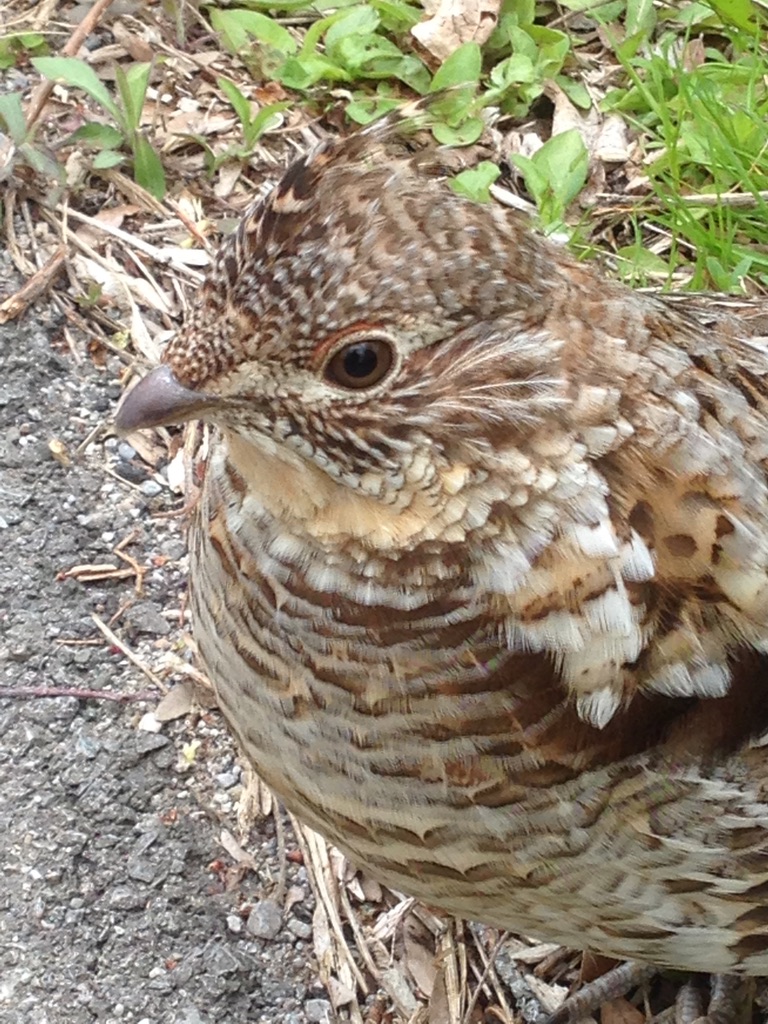
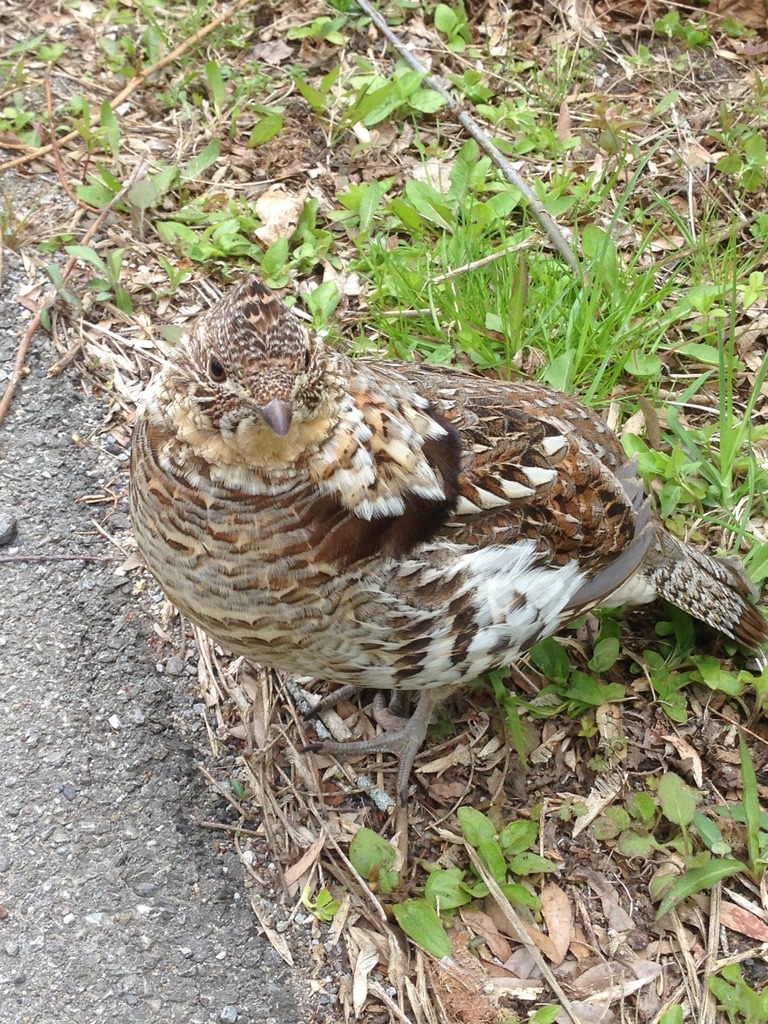
It was on a very quiet, dead-end road, a rural backwater. I had pulled aside to listen carefully for any sounds from that group of turkeys when I saw a small movement near the edge on the other side of the road. It looked like a Ruffed Grouse taking off into the tangled undergrowth. I couldn’t be sure, so I silenced the car and all of its associated noise and got out to investigate. To my surprise that bird, now certainly a Ruffed Grouse, came back up from the ditch and walked purposefully towards me as if it was a pet expecting a handout. There may well be some truth in that, for there were a couple of houses within a couple of hundred meters or so, perhaps someone had hand-reared it; it certainly identified me as a friend not a foe. I took several pictures with my iPhone and after a few minutes went to leave; astonishingly it followed me to the car!

Now I was really intrigued and turned back to approach it again, carefully and closer, until I was able to pick it up. It didn’t care for that so I opened my hands to let it go and, rather than fly, it fluttered back down, it had no fear of me. Something is very wrong with this picture, almost as wrong as that Golden Pheasant eight years ago. If it makes a difference, they’re in the same family of birds, phasianidae.

Ruffed Grouse are birds of upland forests with plenty of undergrowth for cover. Their plumage is cryptically patterned to make them all but invisible, it almost vanishes in the photo below. This meet-up was a once in a lifetime opportunity for me to appreciate that rich deliberate perfection. See what you think. My Bird of the Day of course.

Northern Rough-winged Swallow

Northern Rough-winged Swallow

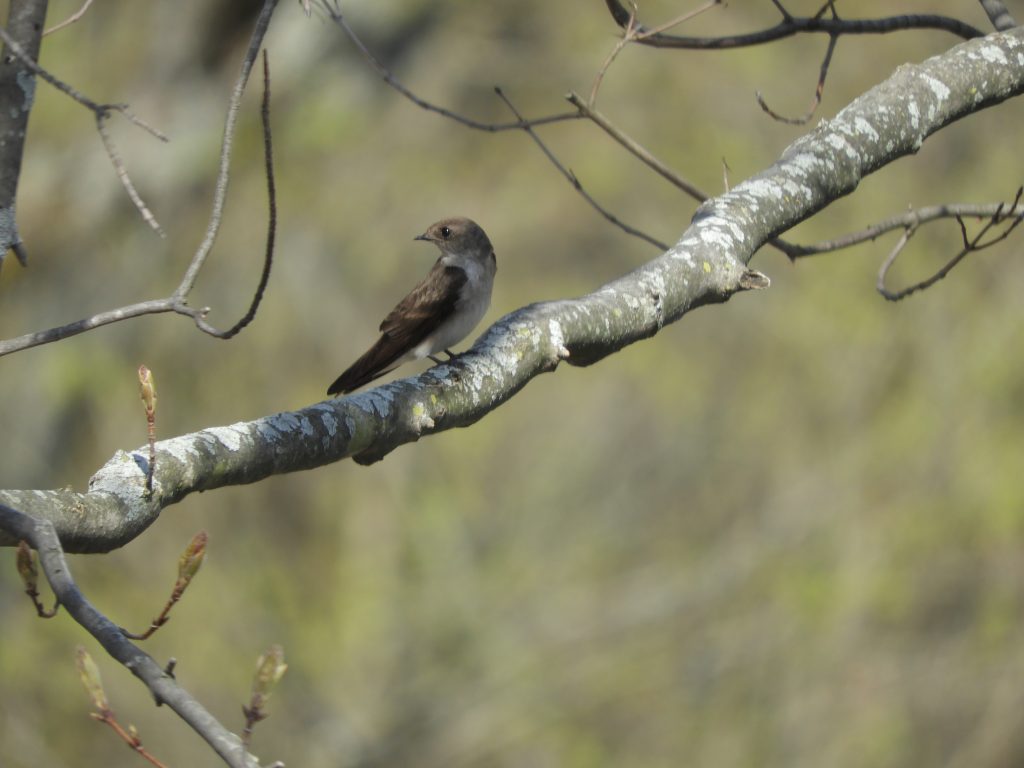
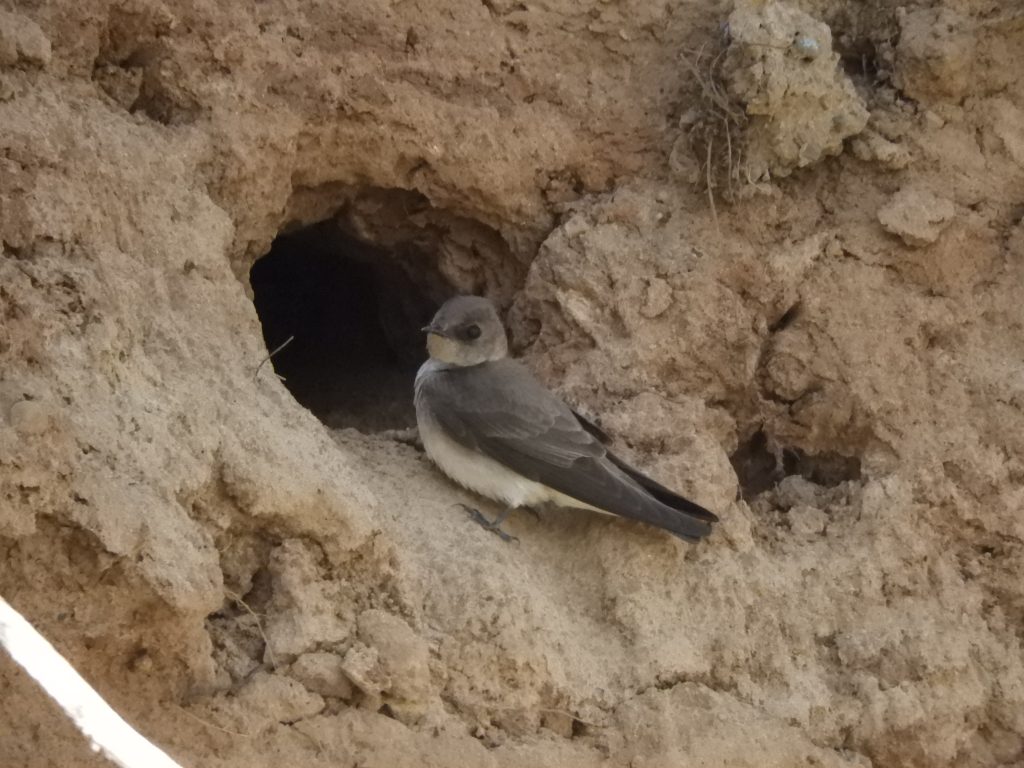
Burlington ON. May 6 2020. Northern Rough-winged Swallows are not particularly notable sighting around here, but perhaps they deserve a bit more attention. I found a pair today who had moved in to set up home in a newly-exposed cliff face.

A couple of things about Northern Rough-winged Swallows:  They are a drab looking bird certainly the least visually attractive among our swallow species, the competition is overwhelming: Barn Swallows, Tree Swallows and Cliff Swallows, all are handsome birds (See a couple of them below). It’s also interesting, I think, to consider that unusual name, Rough-winged: it refers to a unique characteristic of their primary feathers. The barbs of the leading edge of outer primaries of adult males are recurved into small hooklets, or in the case of females tiny points. So, should you have one of these birds in your hand you’d find that the edge of the wing has a file-like roughness, rough-winged actually.  No -one seem to know why this should be.

What made today’s birds a little bit more intriguing is that they have appropriated this exposed cliff face as the ideal spot to excavate a nesting burrow. The cliff face was exposed by a landslide that ripped a chunk out of a steep valley edge. I’ve been intrigued for a while by the nature of the landslide and its various impacts and was checking to see how plants and the valley in general were adjusting and adapting.

Tree Swallow
Barn Swallow

According to Aristotle, Nature abhors a vacuum, so this pair of Northern Rough-winged Swallows is apparently nature at work and that makes them My Birds of the Day.  I look forward to seeing which plant species will gain a toehold on the new terrain in the growing season ahead.