Solitary Sandpiper

August 29. 2025. Hendrie Valley. Royal Botanical Gardens, Burlington, ON. Canada.  Our study of bird populations on Royal Botanical Gardens’ properties resumes this week. We start in the tail end of August, go through September and October and sample the first few days of November too. Those two end-snippets are gathered to round the data.

From here I predict that September will be beautiful but frustrating, a pleasure to be outdoors although there won’t be nearly enough birds, then October, although glorious for the first two weeks, will be frantic as the big pulse of southbound migration sweeps through.
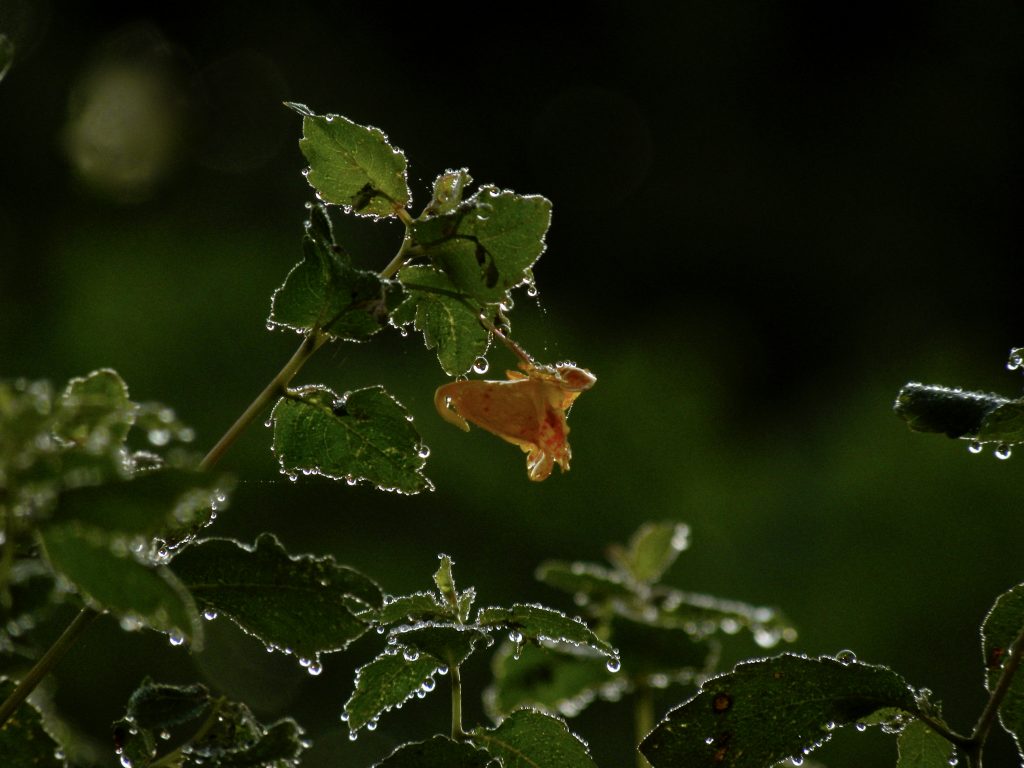
Spotted touch-me-not or Pale Jewelweed

Today was something of a summer stroll in the nicest of places. I found about thirty bird species, almost all of them to be expected and still a pleasure. It included a handful of fluttering warblers that made my head spin as I tried for an i.d., I clinched Magnolia, and Blackthroated Green Warblers, and wrestled with Yellow and Chestnutsided Warblers; fall can be so tricky with these mites.  I enjoyed fleeting moments watching pairs of Rubythroated Hummingbirds seemingly kissing the tubular flowers of Pale Jewelweed or Spotted touchmenot, a common plant in the valley and a source of nectar for high energy hummingbirds.
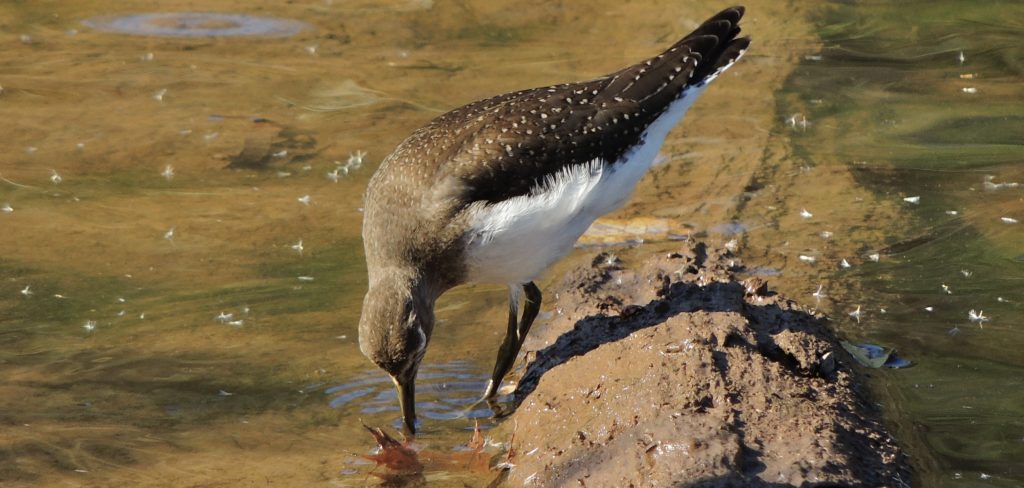
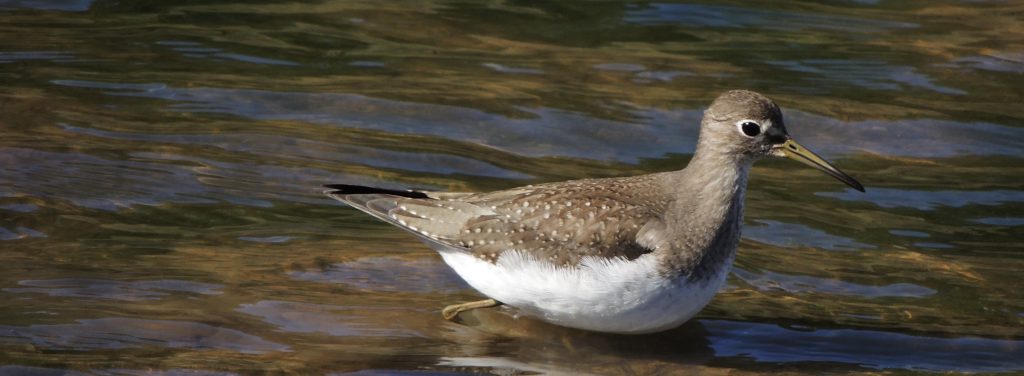
Solitary Sandpiper

My Bird of the Day was a Solitary Sandpiper working the muddy margins of the large creek that defines the valley.  Solitary Sandpipers always seem to be minding their own business, quietly getting on with life, invariably alone, as their name suggests. They are not dramatic in any way, none of the high drama you get with Spotted Sandpipers. They have a clear white eye-ring and are handsomely spotted along the length of their head and back. There’s something reassuring about Solitary Sandpipers, as if everything is under control. I was happy to enjoy this one for many minutes.
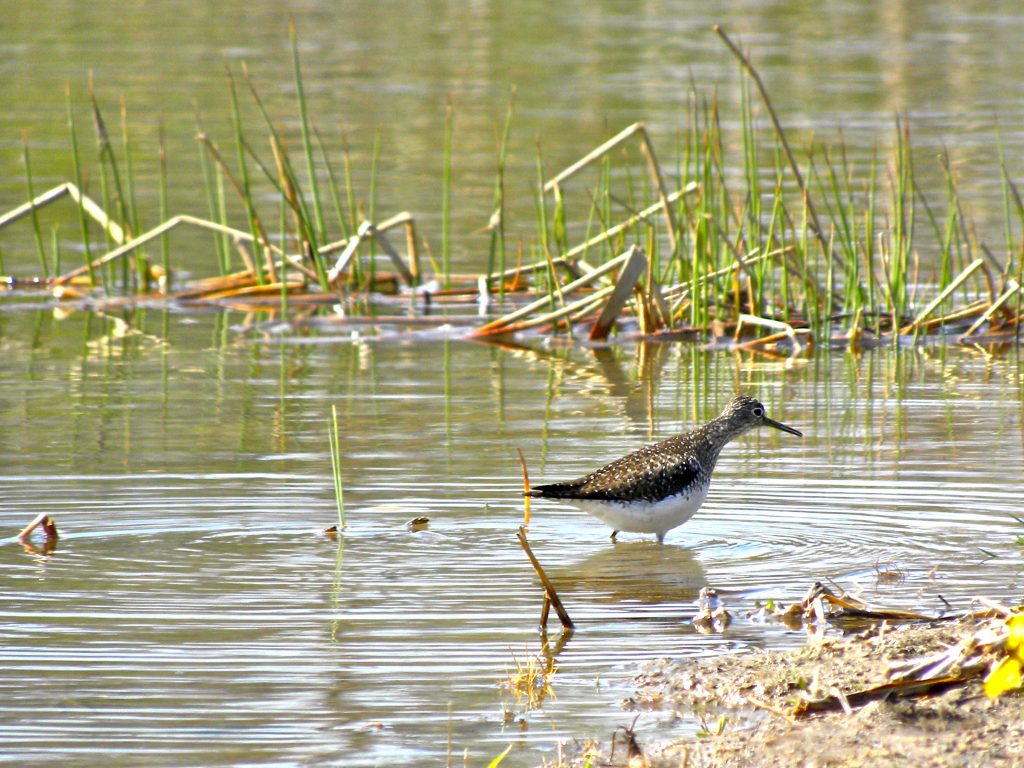
Solitary Sandpiper ( a spring photo)

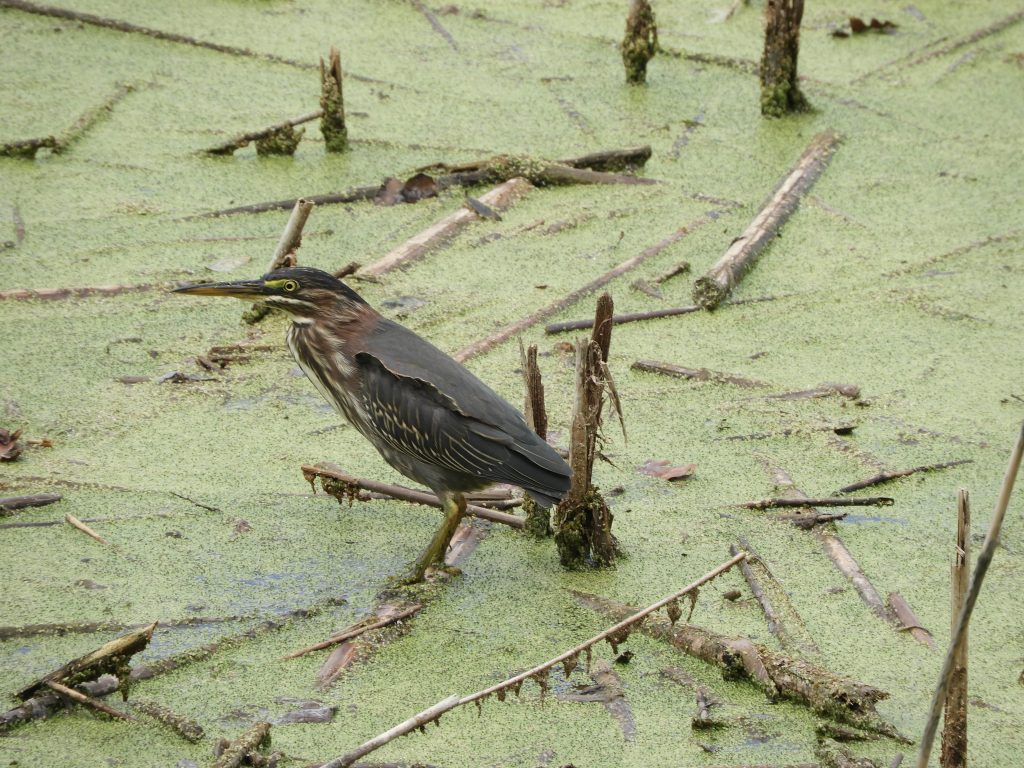
Green Heron

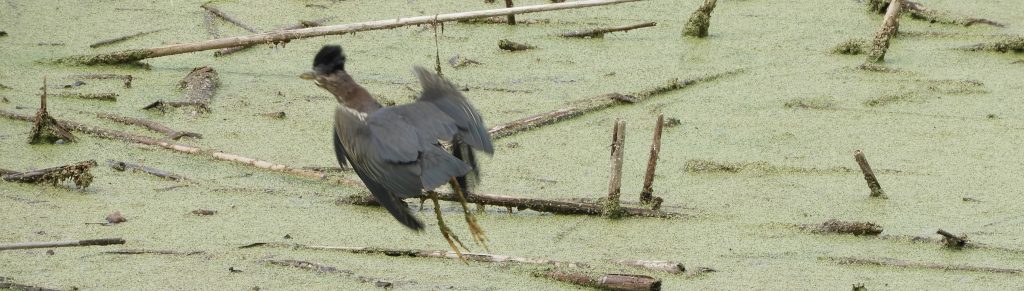
Green Heron at take off

August 25, 2025. Grimsby, ON. Canada. With a change in the air, a shift towards fall, I thought I should dust off my binoculars and camera and visit a few favourite spots. After a couple of tries I went to where activist naturalists have converted an old sewage settling pond into a vibrant wetland comprising  two large and two small ponds. I anticipated the unexpected having been inspired to post sightings from there previously.  See Virginia Rail and Common Gallinule.

Green Heron

It was a little quiet this morning, perhaps I’d jumped the gun.  The largest pond was almost dry, even so I was happy enough watching a young Green Heron. It was one of three out there but much closer to me than its friends and, as Green Herons do, it stood almost motionless for a long while. I waited, camera-ready for movement, hoping it would start stalking prey or even take wing. It did both in the end and I was content with a few decent shots.

It seemed to be a safe spot to sit quietly, them and me. I found a handful of Killdeer whiling away the time, not exposed where a peregrine or sharp-shinned predator might grab them but pressed up close to an old log or clump of something or other. A Spotted Sandpiper explored the odd patch of higher ground and several Wood Ducks paddled where water depth allowed. It was very late-summer quiet.

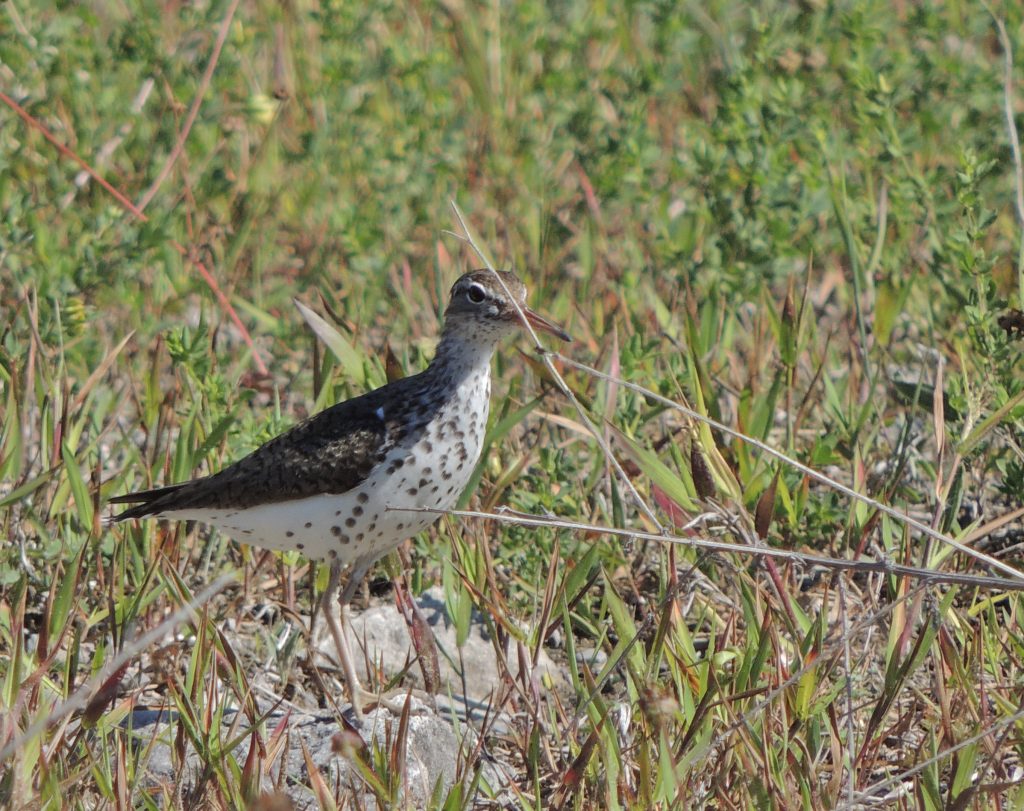
Spotted Sandpiper

I am intrigued by Spotted Sandpipers. We know them here as captivating little shoreline breeders. In spring their breasts are boldly spotted but by late summer those distinctive marks have vanished. Then they look just like their old-world cousins the Common Sandpiper.  Their behaviour is much the same too, same tight fluttery flight and bobbing walk. They are clearly closely related,  Cornel Labs’ Birds of the World sites has this to say about that,  “…it is clear that the sister species of A. macularius (Spotted Sandpiper) is A. hypoleucus, the Common Sandpiper of Eurasia ….. These two species are strikingly similar in general size, structure, and behavior and are ecological replacements on either side of the Atlantic or Pacific oceans.” Just as I thought.

Common Nighthawk

August 21. 2025. Peterborough, ON. Canada. With August drifting to an end we were called away for a bit of baby-sitting. Birding was not on my mind but I habitually watch anything airborne and birdlike, often it’s only gust-blown leaves.  Late in this day, driving a moderately busy country road, I noticed a few gliding and swooping birds some way ahead. My quiet, inner thought was Barn Swallows although perhaps a little oversize and a touch erratic. Moments later, we’d slowed and they were overhead, not just one or two and not swallows, it was a flock of Common Nighthawks, ten maybe, then twenty, thirty, who knows.
I don’t see nighthawks often but now is when they gather in migratory or even pre-migratory flocks. Dusk is their favoured flight time.  It’s a mesmerizing experience to watch them on the move.

A bit of research tells that they have a long flight ahead of them: from here to Florida, across the Gulf of Mexico to the Yucatan Peninsula, then continuing south to half way down the length of South America into southern Brazil, Paraguay and Uruguay where they’ll spend our winter; roughly 10,000 kilometres and all on a diet of insects caught in mid-air. Reportedly, they often move in big, leaderless flocks, sometimes in long rectangular formations, adding local birds, pied-piper style, as they go. Curious and incredible.

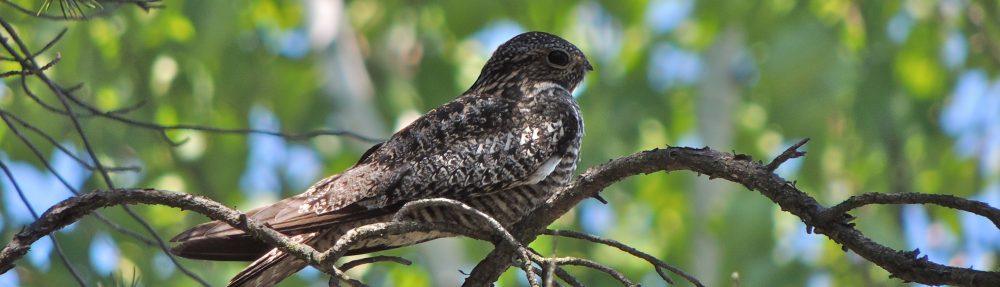
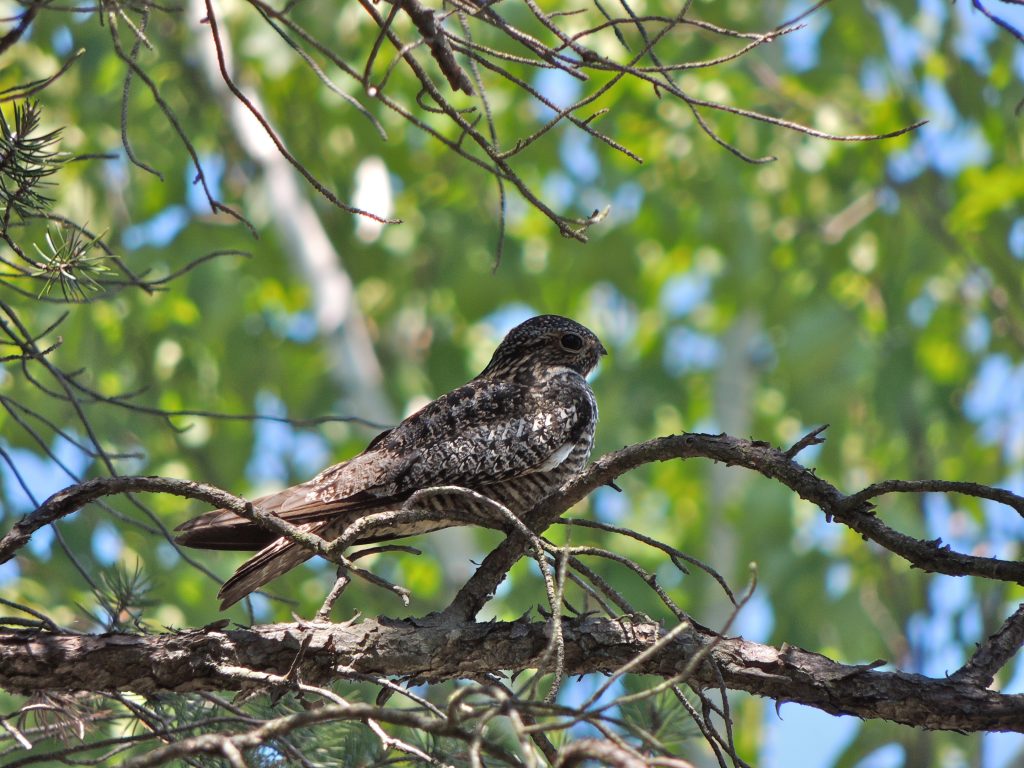
It is unusual to see a Common Nighthawk anywhere other than overhead because by day they remain hidden and, like all members of the Nightjar family, they are cryptically patterned. Several years ago, we disturbed one on its forest-floor nest, it flew moth-like to a nearby branch and sat, waiting for us to go and hoping not to be seen. Here it is.

Common Nighthawk

Nelson’s Sparrows

Nelson’s Sparrow

August 5. 2025. Castalia Marsh, Grand Manan, New Brunswick, Canada. Three years ago, Dan, a friend from British Columbia, and I made a road trip to Maine in search of new birds. Our ‘success’ list included Saltmarsh Sparrow, Common Eider and Atlantic Puffin. Our ‘missed’ list was Bicknell’s Thrush.  It was a good trip even though Dan and I had slightly divergent birding goals; you can read a bit about our trip and particularly the Saltmarsh Sparrow here.  Which brings me to the point of this post.

Ruth and I recently made a return trip to the Atlantic shore, not a birding trip, staying firmly within Canada in New Brunswick. Our destination was Grand Manan a large island in the Bay of Fundy, a reach of the Atlantic roughly opposite where Maine touches up against New Brunswick.  Grand Manan is a rocky place with many scattered islands, islets and shoals and lots of tree cover inland. Its rural coastal economy was for decades underpinned by the abundance of Atlantic Herring, but they’ve more or less vanished (fished out?) leaving the American Lobster harvest (now diminishing as the waters warm) and Atlantic Salmon farming offshore.

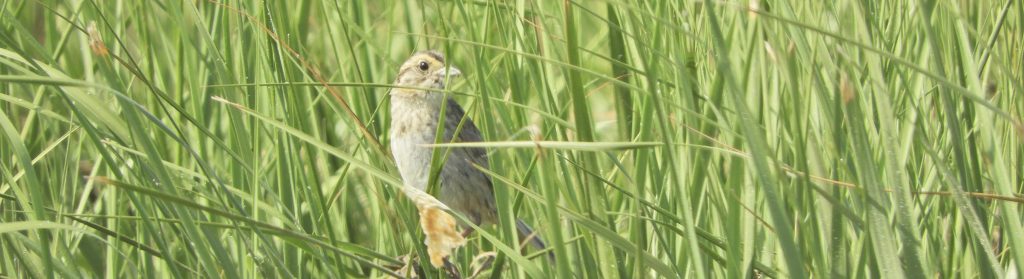
I made a few early morning birding expeditions and in Castalia Marsh (a tidal wetland) I was pleased to see a few familiars not as easily found in Ontario: Willet, Least Sandpipers and Blackbellied Plovers. Remembering those days in Maine I thought I should be on the alert for Saltmarsh  Sparrow, after all Dan thought they were worth crossing the country for.  I could see sparrows of some kind working the thick grass cover, made a mental note that some could be Savannah Sparrows, so not to get too excited, but there were other sparrows moving around including one with a very orangey yellow throat and breast. I looked harder, weighing the possibilities and with a bit of reference checking found that I was seeing Nelson’s Sparrows, the orangey breast was that of a recent fledgling. Well, this was new to me, and I spent much of the pre-breakfast hours seeking and studying them.  It helped when I confirmed the song I could hear, their short burst sounds like the quick sizzle of water on a hot frying pan. As far as I could tell Nelson’s Sparrows was a lifer for me, easily My Bird of the Day.  And the Seaside Sparrow? It’s a slightly more southern species, not found in New Brunswick so promptly taken off the agenda.

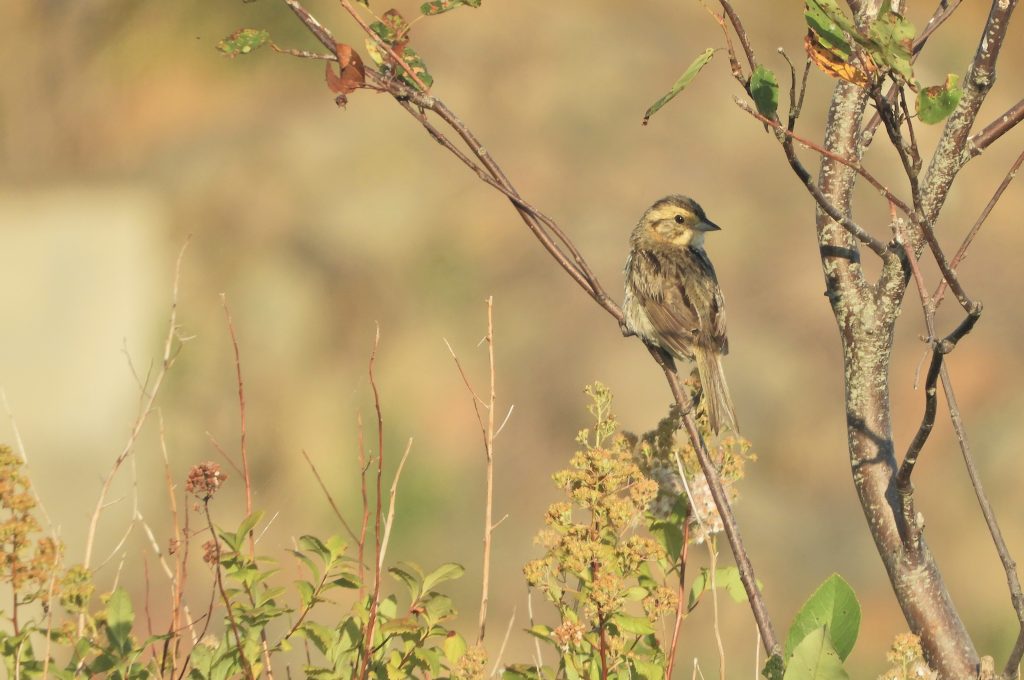
I returned a few times trying for a decent photo, they are worth the effort with a subtle but clearly marked face pattern. There are three distinct populations of Nelson’s Sparrows scattered widely across North America, this coastal population is somewhat less boldly marked than its inland cousins.

Nelson’s Sparrow. Formerly called Nelson’s Sharp-tailed Sparrow, so note the pointed tail feathers

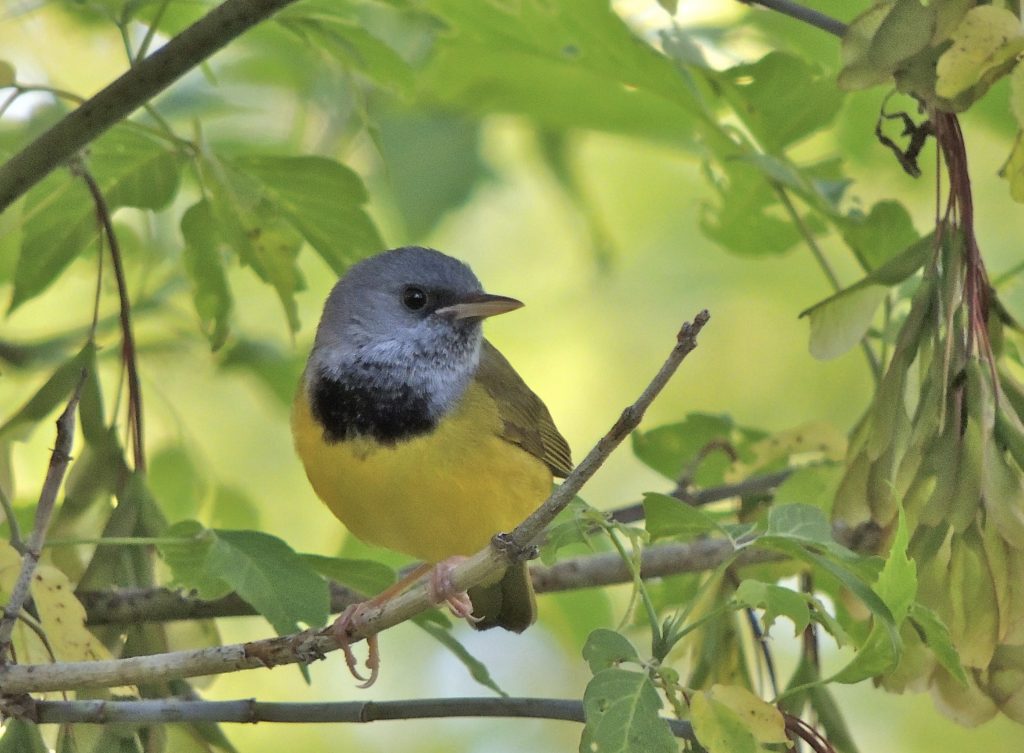
Mourning Warbler

Mourning Warbler

May 19. 2025. Churchill Park, Hamilton, ON. Canada.  I’m writing this while the thrill of finding a Mourning Warbler is still aglow.  To get right to the point, my companion and I were two-thirds of the way around a transect route, we paused to listen for a hinted-at Great-crested Flycatcher struggling to tease apart the cascade of bird sound and song around us.  Straining, I caught a clear three or four note chant that brought me up with a start. I couldn’t quite bring it to mind (and it was not the flycatcher) although in my mind’s eye I could nearly picture it.  Turning on Merlin, the bird song app, I hoped for help; Mourning Warbler it said, and yes between us we nailed it.

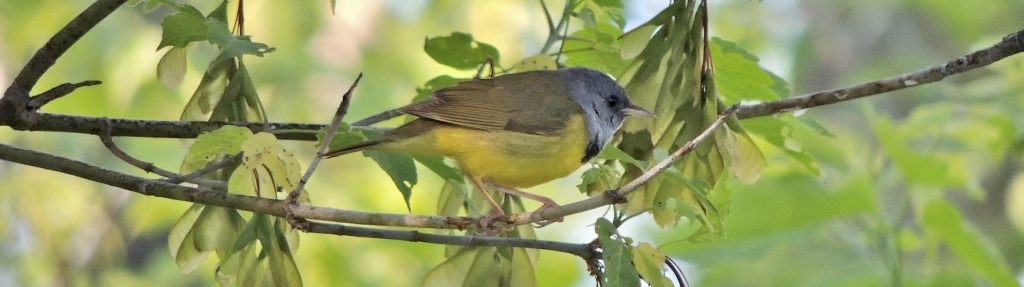
Mourning Warbler (M)

It took a few minutes, and we finally managed to coax the bird to come our way, and then it showed itself in textbook fashion. It was a male in fine breeding plumage. I doubt the bird cared much what we looked like, but we were almost speechless with admiration of it. Photos here are from a decade or so ago, perhaps the last time I was privileged with lingering looks at a Mourning Warbler.

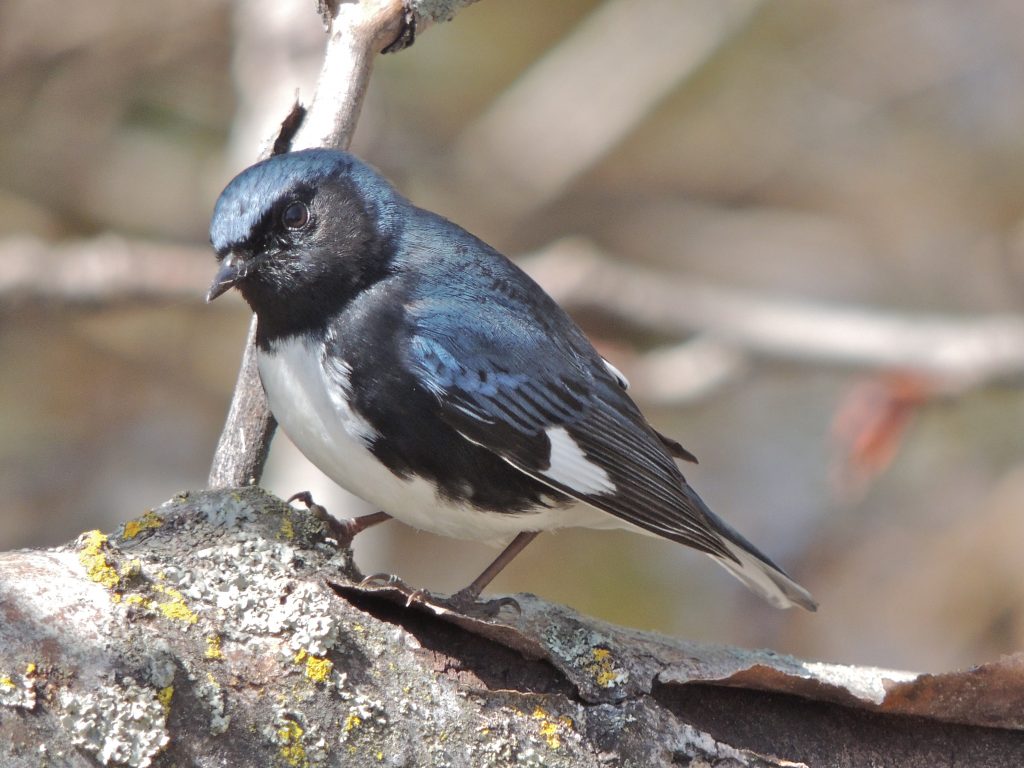
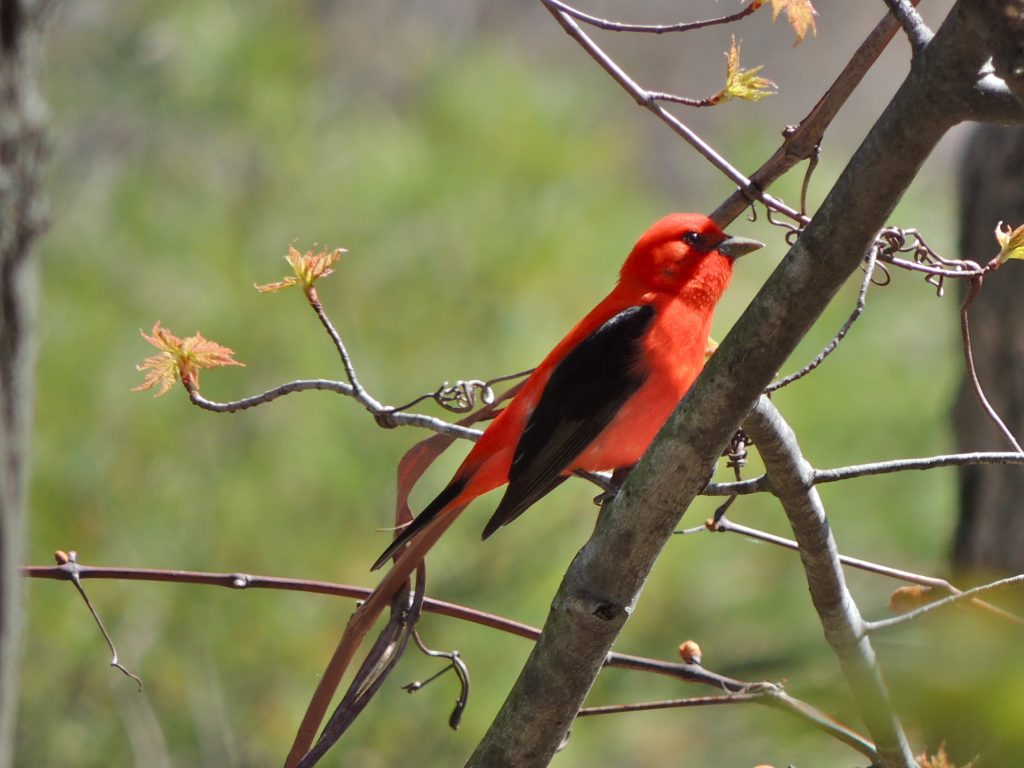
This Mourning Warbler episode really topped off what was nevertheless a very rewarding three hours.  It’s mid-late May and while many birds have settled into brood rearing, just as many are still making their way north, following the back end of winter.   We’d had lots of high points: A large flock of Chimney Swifts, perhaps 30 or 40, circling and weaving to feed on aerial insects; Countless Warbling and Redeyed Vireos, Rosebreasted Grosbeaks, Baltimore Orioles and at least two Scarlet Tanagers competing in song to claim the upper layers of forest;  A handful of Blackthroated Blue Warblers, Northern Parulas and Tennessee Warblers were heard but not seen.

Black-throated Blue Warbler (M)

It was quite simply just a great morning immersed in the best of spring birding with a hard-to-beat, Bird of the Day Mourning Warbler.

Scarlet Tanager