House Finches

12 December 1981, 1982 & 1983. My house cleaning has turned up another forgotten treasure so here’s a little more from my archives.

I used to keep a page-a-day format diary and as I saw or found something of interest in nature I’d write a brief note about it on the appropriate page. At the end of the year I’d start again adding more to each date. The idea was that it could eventually be a log of several years’ comparative observations, provided I could keep my notes brief and my writing compact. In time I found that the self-imposed conflict of wanting to record exciting stuff but at the same time keeping it succinct was a bit limiting and gradually, to my regret, I let the practice slide.  Regret because there are some intriguing entries to be found in those pages.

Yesterday, reading the May 10th page, I found a 1981 entry which tells how we all went to Morgan’s Point on Lake Erie and there found: Blackburnian Warbler, Mourning Warbler, Ruddy Turnstones and a Glaucous Gull. And then, especially notable: “ pair of House Finches nesting at the tip..G.M thinks this is only the 3rd authenticated Ontario breeding record.”  An exciting find and undoubtedly Bird of the Day.

Until the late 70s House Finches were a rarity in Ontario but in the early 80s they started to move in from New York State to the south-east, approaching from along the Niagara River border.  So picture us for a moment, excited by a pair of House Finches and believing we’d discovered birding history being made – well 3rd place anyway.

At the time I kept the diary, we lived in Grimsby, Ontario a smallish town along the south shore of Lake Ontario.  Our home was beautifully located at the toe of a wooded escarpment ridge; lots of interesting birds visited our feeder.

On today’s date, December 12th, in 1981 (just 7 months since finding the nesting pair 40 miles away) I noted 6 House Finches: 3 males and 3 females, at our bird feeder, and wrote: 1st. time seen here by us, species is spreading have not heard of others in Grimsby to date.” Then in 1982 (also today’s date) “House Finches now increasingly common.  Have had 9-10 at feeder at one time. we wonder if they will displace, at least in part, the House Sparrow.”  Finally, the next year,1983, I noted “House Finches now 15 17 at feeder at a  time.  This winter feeding millet and sunflower only.”

Today the House Finch is well established across Ontario.  It does not seem to have displaced the House Sparrow which nevertheless does appear to be in decline for some reason. House Finch population numbers fluctuate and the explosive growth that we saw in the 1980s was checked in the 1990s by the spread of a respiratory and ocular disease that frequently causes death and affects only House Finches.
Eastern Towhee (more archives stuff)

26 May 1980.  In my last entry about the Snowy Egret I noted that my old Peterson Guide ‘fell open’ at the white herons page.  This occurred in the midst of moving bookcases, sorting and even discarding books (a very few) and repainting walls; an undertaking to be delayed as long as possible but one which inevitably turns up lost treasures and many ‘Why are we keeping this?’ questions. One of the revelations (which shouldn’t have surprised me at all) was that the Peterson referred to was actually my second Field Guide to the Birds East of the Rockies by Roger Tory Peterson, it replaced an earlier edition in which the colour plates were bundled together in the middle of the book; an arrangement that had some advantages but not enough to survive advances in technology (!) that eventually made it easier to place the illustrations opposite the text accounts.

I started thumbing through this older Peterson Guide and found some interesting penciled notes from 1977 to 1980, a time when I’d only lived in Canada for a handful of years and was clearly a keen beginner. Consider these: dark cap, ¾ collar, b&w mottled back, white wing stripe, black bill & legs, smallish about starling size. Or this one: Yellow H, dark eye stripe, tan under, slate above, dark breast streaks, white wing bar.  There are no dates, habitat, or locations with these notes, perhaps they served their purpose at the time, perhaps I went home happy; but today I have no idea what they describe.

However I do remember the place and circumstances behind the following notes: Pelee 26/5/80 Size of large sp. Brn back, light under, Black head. At top of tall dead tree. Call reg. Pink oooo trill. This was in Point Pelee National Park a celebrated migration hotspot and focal point for serious birders. It was evening and I had parked ignoring the traffic rules to study this bird which was singing loudly at the forest edge.  Some minutes later a park ranger pulled alongside, pointed to the No Stopping sign and asked me politely to keep moving, so I did without having solved the mystery bird’s identification, although I apparently I found time to scribble some field notes.  In time I came to understand that what I had seen was a Towhee or Chewink as it is labeled in that early Peterson Guide, and now formally called an Eastern Towhee.

Eastern Towhee. Male. May 23 2011

There are no other notes from that May date, but I am sure it had been a full and challenging day.  Was the Towhee my Bird of the Day?  I suspect not, there would have been many more satisfying sightings on what was almost certainly a very bird-rich day.  But in hindsight maybe it was, it has survived as a clear memory, one that often comes to mind when I spot a Towhee now forty years later.

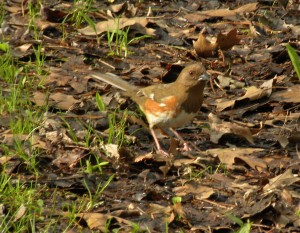
Eastern Towhee. Female. May 23 2011

[slickr-flickr tag=”towhee”]

Snowy Egret (from my archives)

May 22 1982. Woodstock ON.  My 30+ year-old, battered and faded Field Guide to the Birds East of the Rockies by Roger Tory Peterson rarely sees the light of day any more. It used to accompany me everywhere and was irreplaceable in developing my confidence in the field. Eventually the Peterson guide  surrendered its position of supremacy among bird guides to the National Geographic Field Guide and more recently the Sibley Guides; but I was slow to give it up.  I still suggest to novice birders that Peterson will solve 90% of your bird i.d problems.

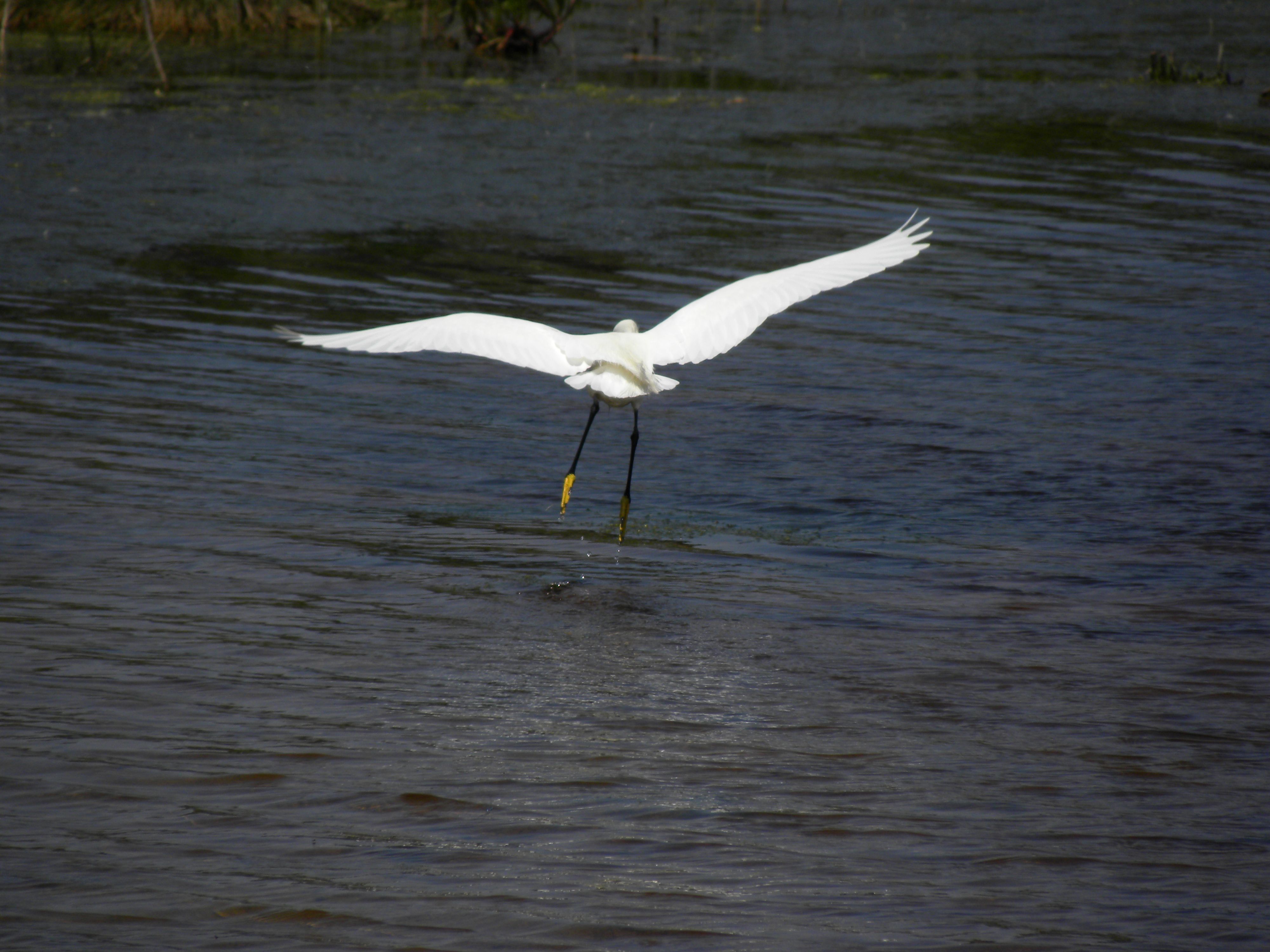
It fell open today to the page of illustrations of white herons: Great Egret, Snowy Egret, Cattle Egret, Little Blue Heron and Reddish Egret.  I was reminded of a May morning thirty years ago when I explored around a reservoir and surrounding countryside near my wife’s parents’ home.  Being mid-May I’m sure there was much to see and plenty of confusion in my mind, I don’t recall.  But I can still vividly remember cautiously approaching a small watery inlet and finding, to my surprise and delight, a small white heron.  Save and except as notable rarities, white herons played almost no part in the avifauna of Ontario 30 years ago.  I had no confident idea of what I was looking at but knew the list of possibilities was short and that I needed to note as many field marks as I could in whatever amount of time the bird would allow me.  An all white plumage doesn’t take long to commit to memory, but I remember noting long plumes cascading down its back.  It didn’t tolerate my presence for many moments before taking flight and as it did so I made note of its bright yellow feet.  Once it had flown out of sight I turned to my trusty Peterson  and immediately found his note accompanying the Snowy Egret entry: “Note the golden slippers.”

Snowy Egret and one of its golden slippers. Cape May, N.J. May 2012

I remember being breathless with excitement at what had presented itself so perfectly, I remember trying to explain to others the significance of it and reporting my sighting to local birders and how little they seemed to care.  Perhaps they were envious, perhaps they thought I was surely mistaken.  It doesn’t matter, that Snowy Egret was my Bird of the Day; maybe even bird of the year. And I never fail to remember that day whenever I see a Snowy Egret now three decades later. They are quite common a little south and east of us, particularly along the Atlantic shore, but they seem to give the Great Lakes a miss.[slickr-flickr tag=”snowyegret”]

There may be more to life than birds.

Bird of the Day blog entries rarely stray far from well, birds.  But there’s more than just birds to be enjoyed outdoors.  I’ve started writing and blogging about the other stuff, I call it the Understory Report and have headlined it: ” My notes, observations and reports on that layer of life between your feet and the tree tops.  It may be dark and shadowy at times but there’s a lot of life in the understory.  Read on….” at  www.theunderstory.ca

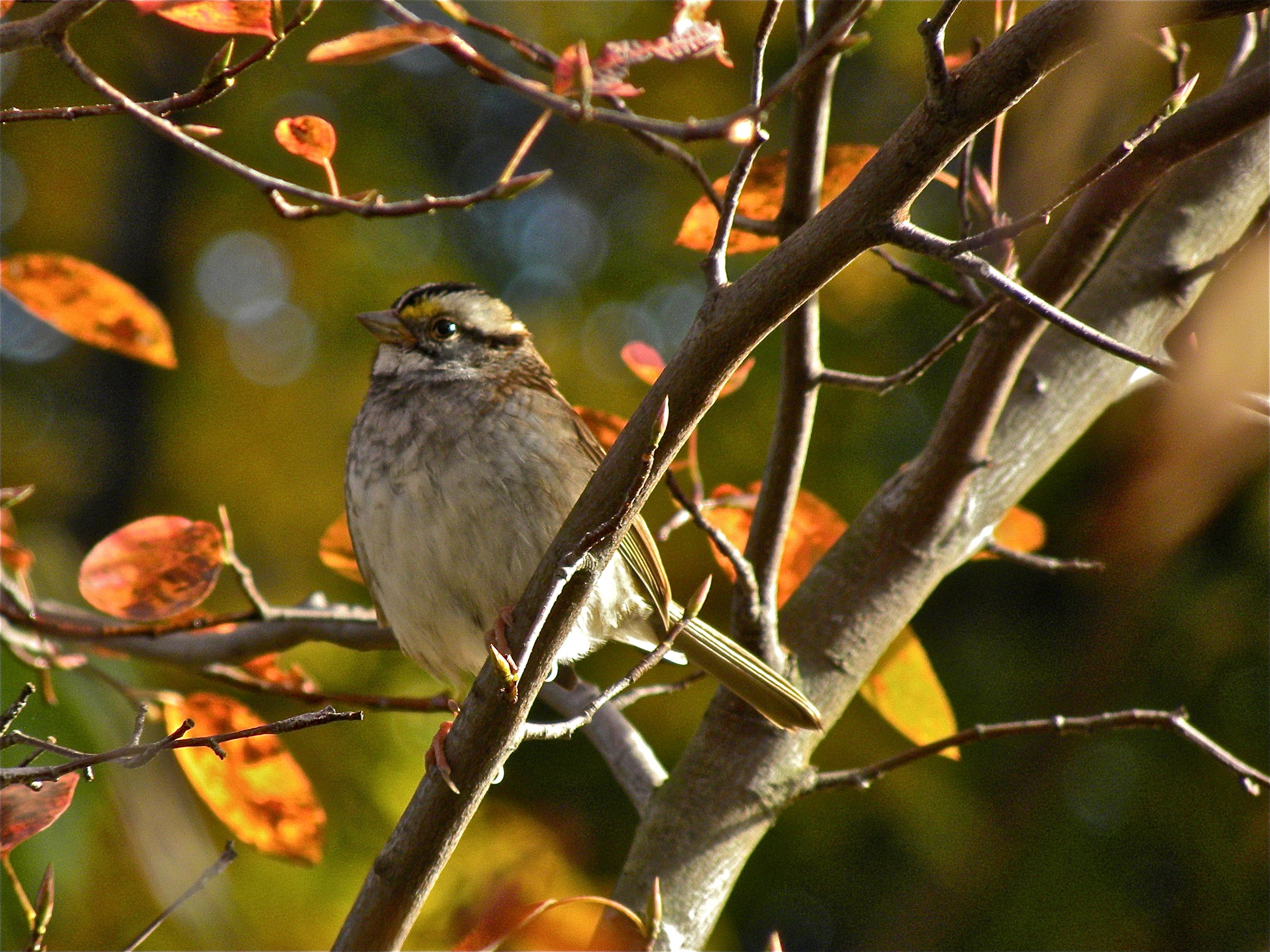
White-throated Sparrow in the understory.

Belted Kingfisher

December 6 2012. Burlington ON. A small group of regular walkers convinced me to join them for a quick lunchtime march through woodland trails and along a small river valley.  It was quite cold but with the sun shining it was not unpleasant.  We were quite surprised by the bird activity including several White-breasted Nuthatches, Northern Cardinals, Downy Woodpeckers and even a boldly marked Whitethroated Sparrow that was hopefully examining the top branches of a bare Manitoba Maple.  Two Redtailed Hawks flew heavily through the trees to emerge into the open over the river flats provoking discussion among us as to their respective ages; I figured they were both immature birds. The hawks’ presence offended some of the smaller birds but none quite as much as a Belted Kingfisher that darted up river in the bouncing flight and rattling call that makes the kingfisher unmistakable.  Its presence made it Bird of the Day, it seems late for kingfishers to still be around. I’m sure most have long gone farther south, but I guess as long as there’s open water and fish to be caught, there’s a living to be had.