Black Vulture

December 29 2012.  This time last year the birding  fraternity hereabouts was all atwitter about a couple of Black Vultures hanging out along the banks of the Niagara River in Lewiston, NY.  What made it extra tantalizing was that the Niagara River marks the international border between the U.S.A and Canada.  So for those who compile winter, country, province and goodness-knows-what lists, waiting in the cold, willing the birds to take flight and wander into Ontario must have been some kind of exquisite, self-imposed masochism. And yet….in 1987 on this very date a Black Vulture had taken up residence not so far from my house, albeit in a slightly more up-market neighbourhood.

This entry in my diary qualifies it as retrospective bird of the day, though not necessarily in the celebratory sense.  “1987.  Sheltering in hemlocks at LaSalle Park a Black Vulture.  Found on Boxing Day by others. D.S looking for it failed at first but found a Varied Thrush instead. Burlington now temporary home to Black Vulture, Varied Thrush, adult Bald Eagle and 2 Brant Geese.

A few words more about each: I saw the Black Vulture that day but was only mildly impressed, lumpen and black, sitting disconsolately high in a hemlock tree it was no prize for me. Soaring in high wheeling circles on a hot day – now that’s worth looking up at, that’s when it could be Bird of the Day.  The Varied Thrush eluded me, I have only ever seen one and that was in British Columbia where they belong; a very pretty bird, in stature like our American Robin but coloured in black, orange and blue-grey, like the mountain slopes in October. Bald Eagles were a rarity around here until about 10 years ago since when they have become regular winter visitors and have established breeding territories.  Brant drift through from time to time, they must be strays gone off-course in migration, they are a bit like a familiar but erratic cousin who shows up from time to time then leaves without even saying goodbye; here today gone tomorrow.[slickr-flickr tag=”boxingday”]
Eastern Screech Owl

December 27 2012.  We had snow last night, quite a bit for us; last winter was so mild that it was something of a novelty.  I’d almost forgotten how a night of snow lays a blanket of silence over a neighbourhood.

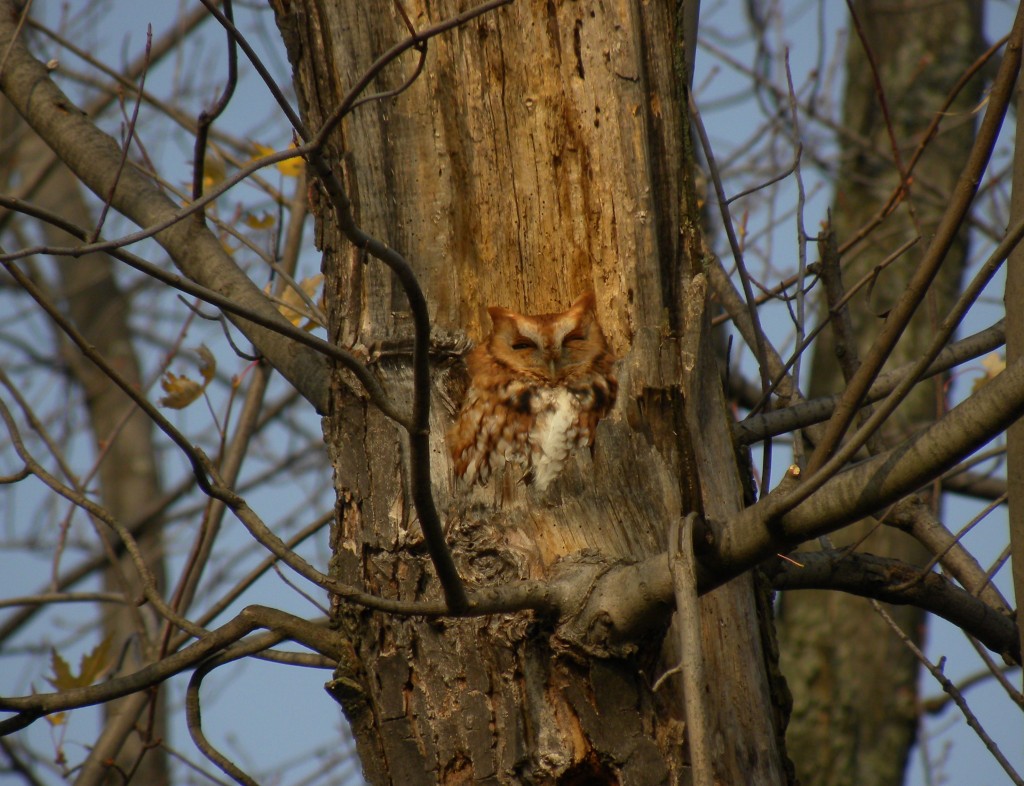
With a breakfast meeting to go to, it was dark and still when I left the house. I dug a winding pathway to my way to my car and was contemplating how best to sweep it clear of snow without making the drifts in my small parking area any worse when I heard a Screech Owl’s tremolo call. Did I imagine it? No, because I heard it again moments later, I stopped what I was doing and listened, the third time it called I could pinpoint it to a large ash tree in a neighbour’s back yard.

Screech Owls’ calls are odd, not at all what you’d expect from an owl.  Click here for recordings of them courtesy of the Macaulay Library.  Among Canadian owls it’s only the larger species like Great Horned Owl, Barred Owl and Great Gray Owl that hoot in the classic sense, the smaller birds make a funny assortment of screeches, squeaks and whistles.

The Screech Owl has two main songs or calls, and I defer to Pete Dunne, who in his Essential Field Guide Companion describes bird songs and calls particularly well, and for the Screech Owl he says: “ The contact call sounds like a low mellow, gargled or trembling whistle, lasting two to four seconds, all on the same pitch; it may be loud or softly uttered, giving the impression that a bird no more than 10 20 feet away is much father away. Also makes a descending nasal whinny that is often (but not exclusively) used to assert territoriality.

Eastern Screech Owls are really quite common in urban areas; it’s just that you don’t see them very often.  I read somewhere that if you have enough trees in your neighbourhood to support gray squirrels; you have Screech Owls too.  They’re also fairly easily lured by imitations of their call; if you can figure out how to effect the burbling tremolo that is, but they’re not particularly amused by trickery; they sometimes literally hit back.

The pleasure of a today’s soft Screech Owl call in the fresh snow early dawn made it my Bird of the Day even before the day had really begun.

Eastern Screech Owl basking in late November sunshine

Black Tern

May, June & October.  Heading north on Interstate 17 from Phoenix is a fascinating if occasionally propulsive drive.  As you leave the great sprawl of Phoenix the desert landscape is punctuated by Saguaro cacti, hundreds of them, most of them stately and senatorial.  You get so used to them as you head into the mountains that almost without you noticing, they become fewer and fewer; and then they’re gone.  It’s on the return journey that you start to notice them again because now they’re special.

And that’s the way it’s worked for many bird species. Birds that are commonplace gradually dwindle, hardly anyone notices until they’re gone.  Then years later one reappears and we celebrate.  Take the Black Tern.

In my old diary of notable sightings, for four consecutive years,1981 to 1984, I noted the return of Black Terns, all around the 7th to 10th of May .  It was remarkable because their pond was a stranded remnant of an old marsh that had the misfortune to be obliterated by a major highway.  River valleys and frequently by extension, marshes make popular routes for highways, much of the hard work of cutting through hills and leveling the land has been done by the river.

Birds of Hamilton and Surrounding Areas by Robert Curry, my best reference book for local bird records, states that 1989 was the last nesting at the site where I was seeing them.  Curry writes: “There were only one-third as many Black Terns in North America in the early 1990s as in the late 1960s.  The loss of wetlands, both for breeding and as migration stopovers, has been the major cause of the decline.  Other factors may include the effect of pesticides on insect foods and declining numbers of small pelagic fish, the birds’ preferred food on the tropical ocean wintering grounds off the South America coast.” They’ve gone from many once reliable breeding sites in this part of the world, and it’s a sad loss.

I watched a Black Tern in October of 2011 in Smithers British Columbia.  It was a long way away, swooping and hunting over a large lake, flitting erratically then diving in large dipping arcs to touch down and pick a morsel from the lake. It made my blog entry but was upstaged as my Bird of the Day by a Western Grebe.

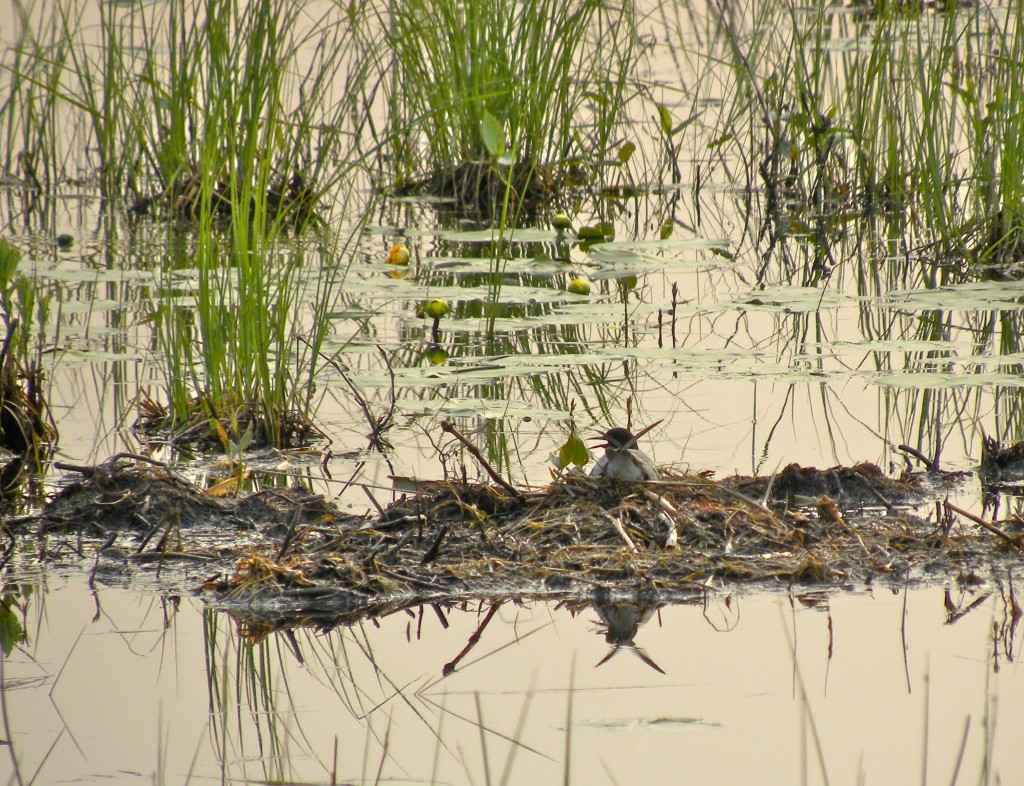
In June that same year, at a large marsh on Lake Erie where Black Terns are still found, I was shown one on its nest. Although I wasn’t keeping these records then, I remember the thrill, it was best bird of the day. They’ve gone from being a reliable migrant nesting species to a rarity in a generation; and regrettably I’m discovering my diary has many more just like it.

Black Tern incubating eggs. Note how wet this nest must be

Common Goldeneye

December 18 2012. Bronte ON. This morning before it was light, I ferried a cousin to Toronto’s international airport, he’s headed back to St. Maarten and his slow-pace life aboard a catamaran! I don’t need to describe the heavy traffic, the torture of navigating to the right drop-off point or the return journey in rush hour; you’ve experienced it too I know. So you’ll appreciate my motive on my return journey in making a brief diversion to a lakeside marina to see what birds might be around. This was the same marina which last winter hosted a Snowy Owl and which, later in the year, is regularly home to nesting Red-necked Grebes.

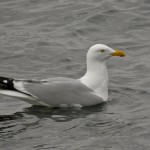
I didn’t spend long walking around its shoreline, only long enough to enjoy a few winter ducks. One of the first encounters (auditory only) was a Herring Gull calling from a distant beach. The call: “Kyee kya-kya-kya-kya-kya-kya-kya.” is evocative of the Atlantic coastline and always brings back memories of my childhood on the south coast of England where they, along with Black-headed Gulls, were the sound of summer.

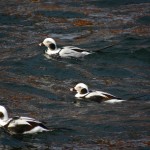
The channels and inlets of the marina held a smattering of Buffleheads and the odd Red-breasted Merganser. A raft of about 30 Greater Scaup was bobbing just offshore on the still waters of the lake and much farther out was a group of male Long-tailed Ducks behaving like a bunch of late night bar patrons trying to out-shout each other. Every now and then one of them took off for a brief ‘look at me guys’ flight only to crash-land back beside the gang and continue the noisy conversation. You expect this sort of behaviour in March when testosterone levels are high and the girls are paying attention, but in mid December?

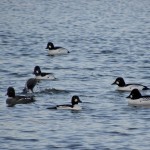
Closer and far more sedate, were two Common Goldeneyes, just hanging around waiting for winter to come and go. I always check Goldeneyes carefully just in case there’s a stray Barrow’s Goldeneye from the West coast mixed in; but not this time. They are a handsome bird and for their composure and poise the Common Goldeneyes were my Bird of the Day.


Swans, Three species.

December 13 2012. Hamilton Harbour, ON.  I have often reported birds found in what I have anonymously and variously described as ‘the bay’ or ‘the harbour’.  To demystify things a bit, I’m referring to a large, triangular, enclosed body of water known by some as Hamilton Harbour and by others as Burlington Bay; which you use depends on where you live.  It is a deep-water harbour surrounded on one side by very heavy industry, on another by pricey homes and on its third by a beach bar that separates it from Lake Ontario and which is now a transportation corridor laced with highways and power transmission lines. It can be seen by clicking here on Google Maps.

The Bay was heavily polluted by industry and urbanization particularly in the first half of the twentieth century (although we’re scarcely blameless today) but serious and extensive, expensive remediation efforts are making significant improvements.  It is a sheltered place with areas of clean and shallow water and abundant aquatic plants; a powerful magnet for wintering waterfowl.

Yesterday I stopped at a quiet marina along its shore to see what waterfowl was around, just when you assume nothing much could have changed, a rarity will show up.  On the windward side of the marina’s landmass a few hundred heads-tucked-in Lesser Scaup and Rudy Ducks were bobbing in the waves while much closer to shore, Mallards and American Coots seemed offended by me disturbing their midday rest.

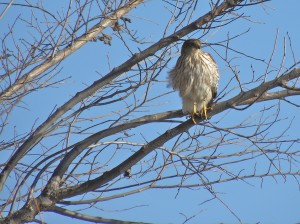
Elsewhere the shoreline was crowded with American Black Ducks, Mallards and Mute and Trumpeter Swans. In the distance I could make out Common and Red-breasted Mergansers, Greater and Lesser Scaup and the shine of rich chestnut off the top of some sunlit Redheads.  Loafing around a man-made island were a few Tundra Swans calling softly among themselves. As I wandered along the beach a Sharp-shinned Hawk flicked overhead to land in a nearby willow from which it watched me suspiciously.

Sharp-shinned-Hawk, watching me warily

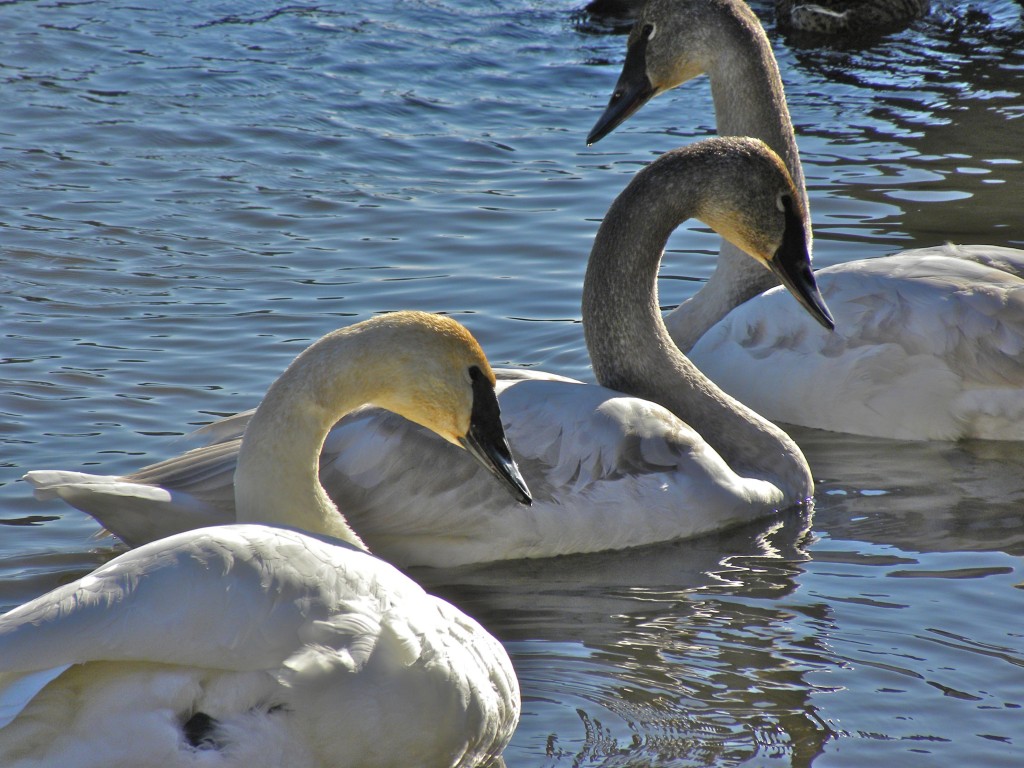
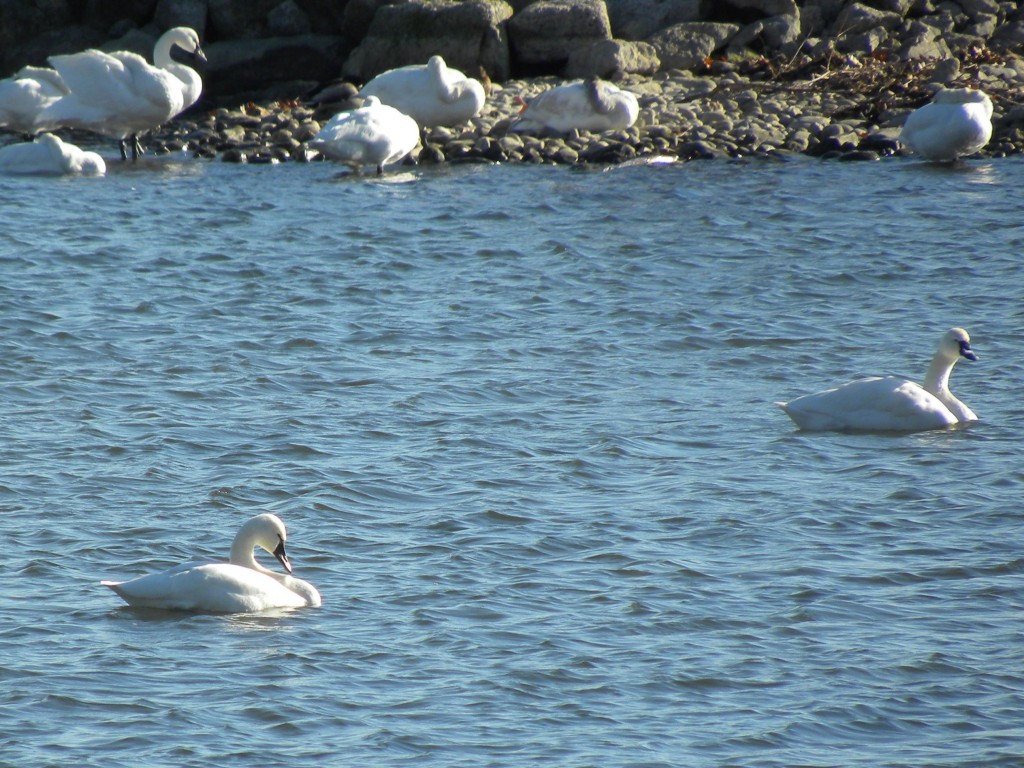
I took some time to review my skills in distinguishing between Tundra and Trumpeter Swans.  Other than size (the Trumpeter is about 15% larger) and call, the two are almost identical.  But I had read the following tip in Pete Dunne’s Essential Field Guide Companion: ..hint for separating Tundra and Trumpeter Swans. On Trumpeter, the black base of the bill seems to envelope the eye; on Tundra, the eye is tangent but distinct.  If you can see the eye separate from the bill, its Tundra.”  And you know – he’s right!

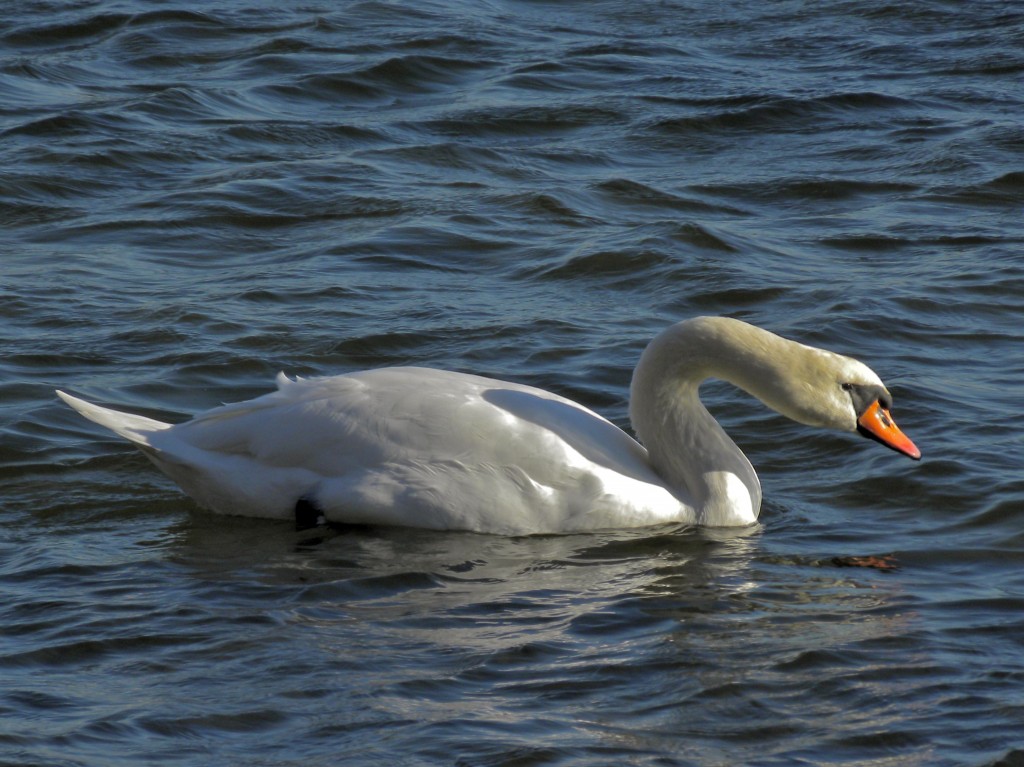
Take a look at the photos accompanying this posting. The pleasure found in comparing these two ‘Cygnus’ swan species made them my Birds of the Day, and then I realized that we have Mute Swans here as well, what an opportunity to compare the three species.  Mutes are an introduced species and are only superficially similar to the Tundra and Trumpeter; one major distinction is the bright orange bill of an adult Mute Swan.

A bit of later research revealed that here, at the west end of Lake Ontario, is one of only three places in the U.S. and Canada where you can see all three swan species together at the same time.

Trumpeter Swans. Adult and first year cygnets
Tundra Swans. A little distant, but note the separation between the dark bill and the eye.
Mute Swan. Dec 13 2012. Note the orange bill-  unlike either of the Trumpeter or Tundra San
Mute Swan. Dec 13 2012. Note the orange bill- unlike either of the Trumpeter or Tundra Swan


[slickr-flickr tag=”swans”]