Hooded Oriole

This was the last day of our guided excursions and we spent it at cultural sites in and around the busy and texturally rich city of Oaxaca. It is the land of the Zapotec people who, like so many meso-American cultures, including the neighbouring Mayans and Aztecs, had developed a society of humbling cultural sophistication and wealth; that is until Hernandez Cortez and his armies spread catastrophe across the land, some at the end of a sword and some unwittingly through disease. We spent the morning exploring Monte Alban, the site of an ancient Zapotec ceremonial centre, then later the workshop of a traditional potter. The afternoon took us to San Augustine, a village with such an abundant supply of spring water as to make it unusually lush and green and which at one time supported a (now bankrupt) cotton weaving industry.
Water also attracts bird life and it was in San Augustine that I was suddenly distracted from the guide’s itinerary by a tree full of warblers: Yellow-rumped, Tennessee, Nashville, Townsend’s and Orange-crowned among them. Then the Hooded Oriole came along for an obliging and breathtaking photo-op, behind it was an unidentified hummingbird and a little later a White-throated Thrush and a probable Slate-coloured Solitaire foraged in the dense foliage of an Indian Linden tree.
As we returned to Oaxaca at the end of the day (with me vowing to go back) our guide asked what we’d liked best and notwithstanding some astonishing historical artifacts and exquisite ceramics, my immediate and almost-without-thinking response was “Hooded Oriole”; my undoubted Bird of the Day.
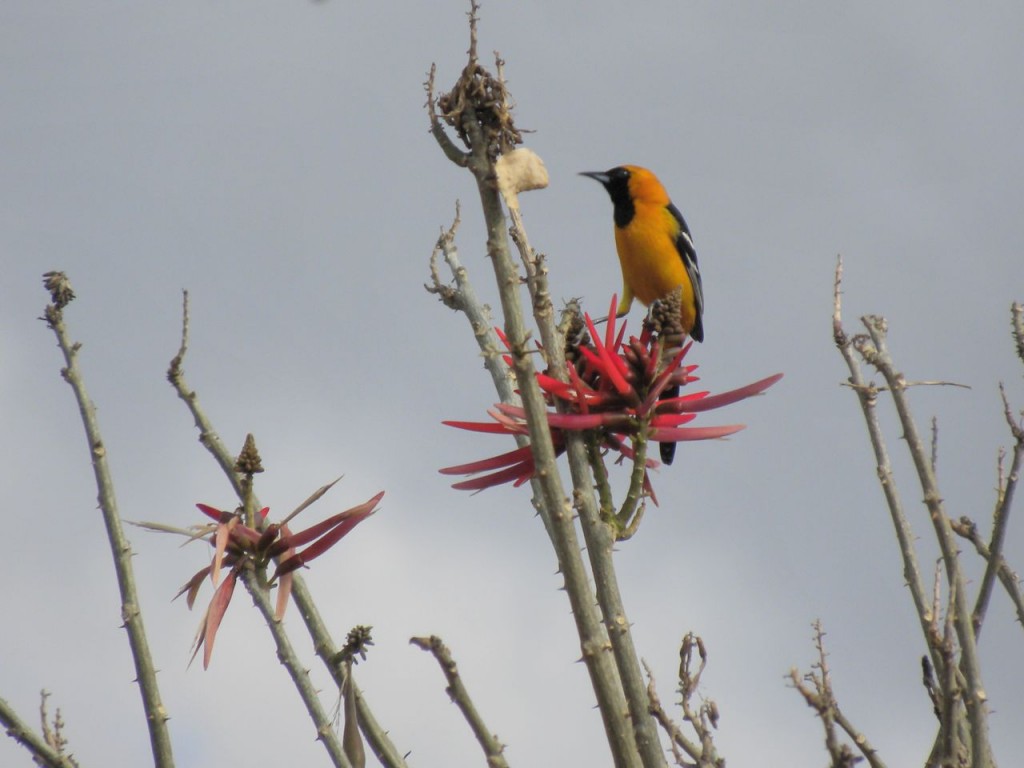
Hooded Oriole
Hooded Oriole

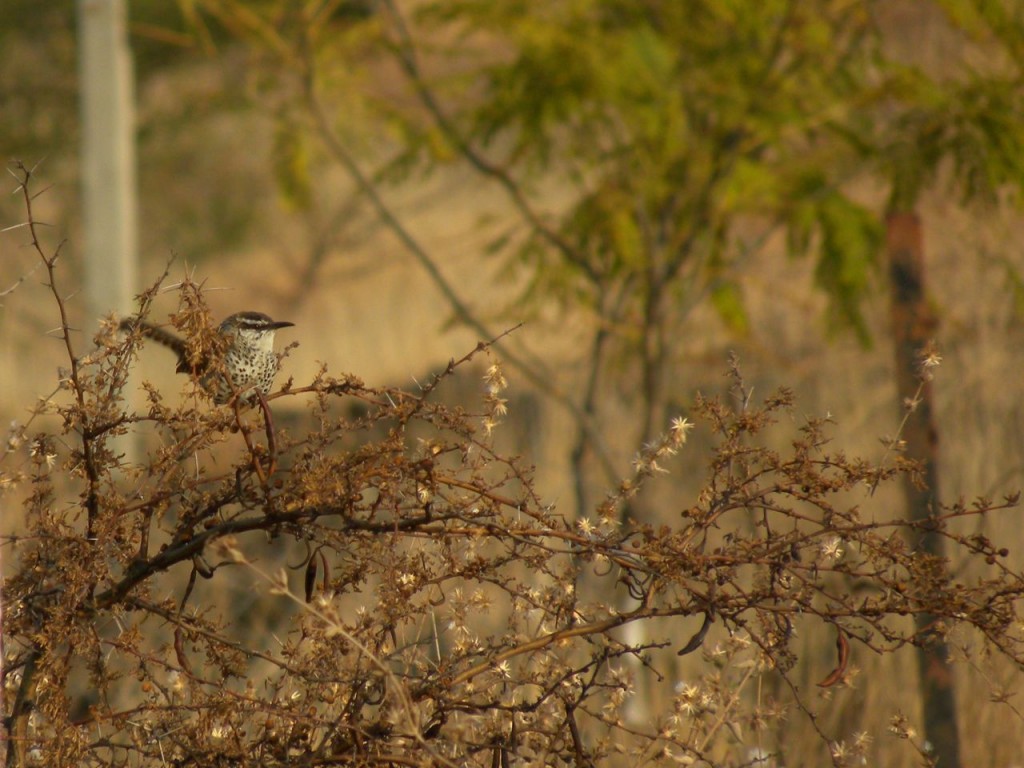
Boucard’s Wren

January 22 2013. This is the dry season in the State of Oxaca, and maybe all of Mexico for all I know. The fields and byways are a dusty ochre and there are few trees in full leaf anywhere; a good thing for those of us on the look-out for birds.

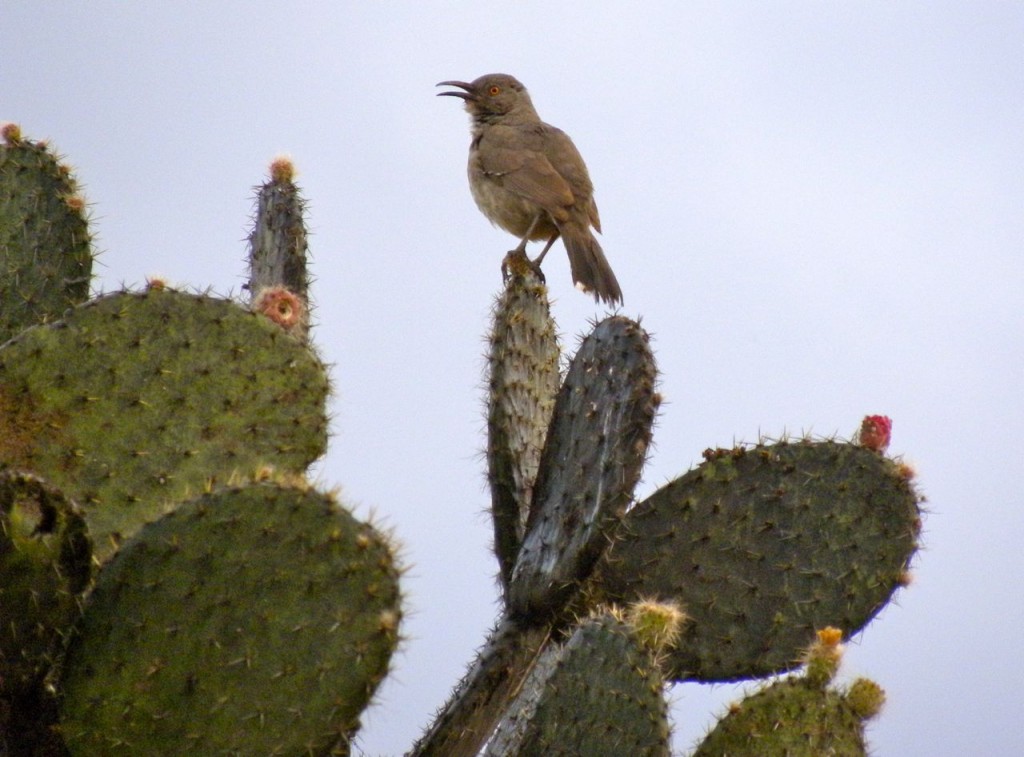
Curve-billed Thrasher singing in thanks for an overnight rain

But we had some rain last night and it was still overcast when we set out on a pre-breakfast walk through the farm and scrub lands behind our hotel.  Perhaps it was that refresher, a glimpse of spring to come, that set several birds singing. Curve-billed Thrashers have a rich and complex song every bit as strident as the Brown Thrasher’s though not as regular in its phrasing. An unseen but clearly heard Eastern Meadowlark had me puzzled for quite a while with a high and liquid song similar to, but not quite the same as, the “spring-of-the-year” calls that is its hallmark in Ontario; it was only when I finally spotted it that I made the connection.
The scrubby cactus and mesquite-lined tracks held many White-throated Towhees, Lark Sparrows and the rather rare Boucard’s Wrens. The Towhees were working the grassy margins looking for seed and the Lark Sparrows always flew a hundred yards or so away at our approach. Boucard’s Wrens are only found over a very limited range right here in central Mexico, indeed they are a much sought-after species for those who maintain lists.  Paradoxically, for me they were the common wren of my walks these past couple of days. I think they may even have been nesting because they were often found in pairs and sometimes more, and I spotted one, carrying a beak-full of food, fly to a pile of cactus, mesquite and construction rubble. They seemed to pop up to inspect us as we walked by and they announced our progress with sharp electric buzzes, they were the Bird of the Day despite many other interesting sightings.

Spot-breasted Wren
Boucard’s Wren

Central America may be the centre of the wren universe, my field guide lists 46 species: there’s 9 quite large wrens, including Boucard’s, in the genus Campylorynchus; 16 in the genus Thyrothorus which includes the Carolina Wren and the perhaps eponymously named, Happy Wren; and 7 in the genus Trogolodytes, which is where we find our familiar House and Winter Wrens.

Vermillion Flycatchers

We’re staying at the home of a rug weaver and natural dyer in Teotitlan de Valle, Oaxaca, Mexico. As we settled in to our accomodation I was more than a little surprised to see that our host had a copy of the Guide to the Birds of Mexico and Northern Central America. No field guide this one, it’s 850 pages of all you need to know about the 1070 species you just might run in to. He has a great story to tell how he came to be the proud owner of this marvellous book, the upshot of which is that he was given it as a gesture of thanks for services rendered to a group of itinerant birders. Discovering this resource got us off to a good start. He readily understood where my interests lay and volunteered to take me to a nearby watercourse and reservoir at cockcrow this morning; I quickly accepted.

So this morning he dropped off a small group of us at a pond edge, explained the lay of the land and then left us to explore on our own and walk the kilometer or so back in time for breakfast. It was a perfect arrangement, his only caution to us was to watch out for rattlesnakes.

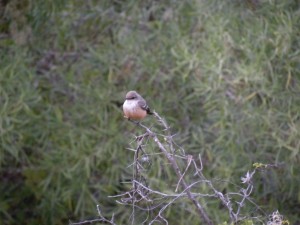
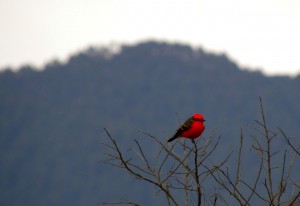
I ended up going there twice today, morning and late-afternoon, it was so good. The Bird of the Day was easily the Vermillion Flycatcher; there were dozens of them. If they weren’t so splendid, both males and females, I could almost have become quite dismissive and shrugged them off, but they are really cool birds. The male is an eye-popping scarlet and black number while the female is, if anything, even more beautiful in a subtly delicious way. The photos will explain better than I possibly can.

Vermillion Flycatcher - an exquisite female
Vermillion Flycatcher – an exquisite female
Vermillion Flycatcher. A magnificent male

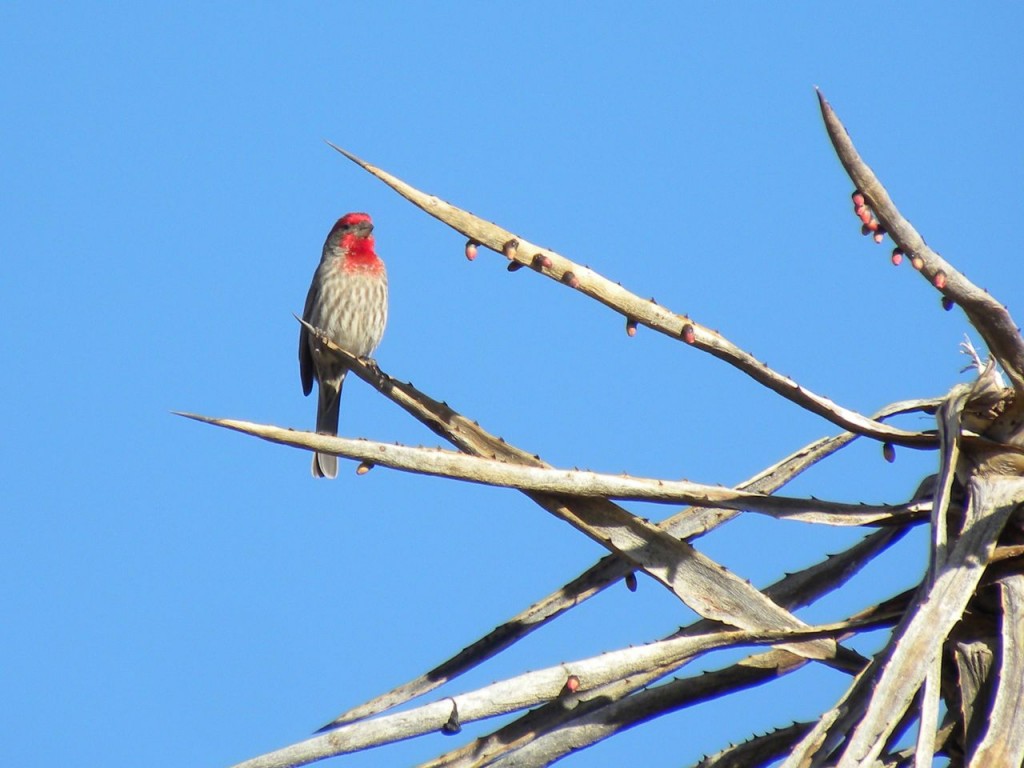
There were many more memorable sightings. In the morning the small bushes along the creek held many Wilson’s Warblers, Aztec Doves and a Black Phoebe. A Northern Mockingbird caught my attention atop a cactus and moments later a strikingly handsome House Finch perched nearby.

A group of White-throated Towhees was scratching for seeds along the dusty farm track on my evening walk. Later a couple of Loggerhead Shrikes, a small group of Greater Kiskadees and a hovering Laughing Falcon made for a great spontaneous birding trip. I even managed to find a quiet place to sit and watch to see what might pop up but the light started to fail, so I headed back. And, by the way, no rattlesnakes.

House Finch.  A native to Mexico and S.W U.S but introduced to the northeastern states, and spreading
House Finch. A native to Mexico and S.W U.S but introduced to the northeastern states, and expanding its range.

Magnificent Frigatebird.

January 17 2013. Magnificent Frigatebirds must have impressed early sea-goers of all ranks, they’re so masterful soaring in circles along the boundary between land and ocean. Watching them through binoculars I wondered how many lessons in aeronautical design are held in those long-winged proportions, some of mankind’s most frail-looking competitive gliders either did or should owe a lot to the frigatebird.
On our travels today we stopped for lunch at a Pacific beach, Playa Cangrejo. It is perhaps five kilometres long, an arcing bay punctuated at either end by towering rock outcrops. The wind blows so furiously along the shoreline that uncounted years of drifting sand has piled over these terminal-rocks creating massive sandscapes, The sea was furious with white-horses tearing off the wave-tops. In the vernacular of my childhood, white-horses were more rampant dynamic and dangerous than mere whitecaps.
At the shoreline a small group of fishermen was working the close-inshore waters netting fish, usually no more than fingerlings but enough good sized fish to eke out a living. Brown Pelicans and Magnificent Frigatebirds knew a living when they saw it too. They gathered around the fishermen as they hauled the nets in and waited anxiously for whatever was thrown their way. The pelicans stood beside the men while the frigatebirds soared and swooped overhead.
I never tired of trying to capture the classic frigatebird photograph but this one is among the best, showing the mutually workable, if sometimes strained, coexistence of fisherman and birds.

Magnificent Frigatebirds. Hoping to share the fisherman's catch.
Magnificent Frigatebirds. Hoping to share the fisherman’s catch.

Rosita’s Bunting and Lesser Ground Cuckoo; a dead heat.

January 18 2013. Today I engaged Eric Antonio Martinez to guide me, to show me the birds of ‘the Isthmus’ this culturally, ecologically and climatically distinct part of Mexico.
It was a blockbuster day with more firsts than I can possibly recount and two Birds of the Day; Rosita’s Bunting and Lesser Ground Cuckoo.
First the setting. It’s mid January and there is a wickedly cold slab of air sitting over the northern part of Mexico, for reasons that I don’t fully understand it is giving rise to an unforgiving and unrelenting gale force blast of wind here in the south. We had to seek canyons and crevices tucked out of the wind to hope to see any birds at all. Where you might normally have expected to see birds of all sizes and shapes picking away in open fields or perched on fence posts, there were none. So we worked the lower edges of a short range of mountains that lie just north of the town of La Ventosa.
The highlights without getting too tedious were: an early Feruginous Pygmy Owl that responded to Eric’s calling, several Doubleday’s Hummingbirds a dark green mite with a long red bill, Ash-throated Flycatchers much like ‘our’ more familiar Great-crested Flycatcher, a Laughing Falcon a stocky accipter-like falcon that specializes in meals of snakes, and several Scissor-tailed Flycatchers. The day’s list actually ran to a bit over 50, some of which were quite familiar like Nashville Warbler, Warbling Vireo and Blue-winged Teal. And then there were the Birds of the Day.
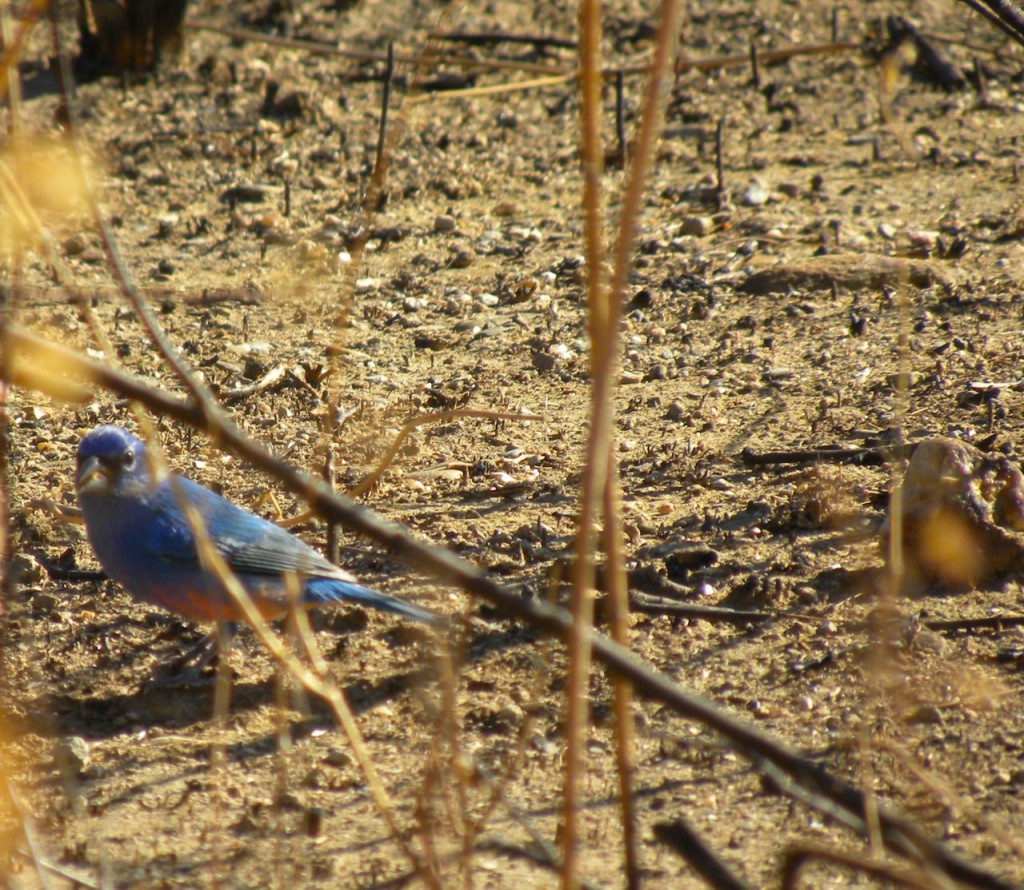
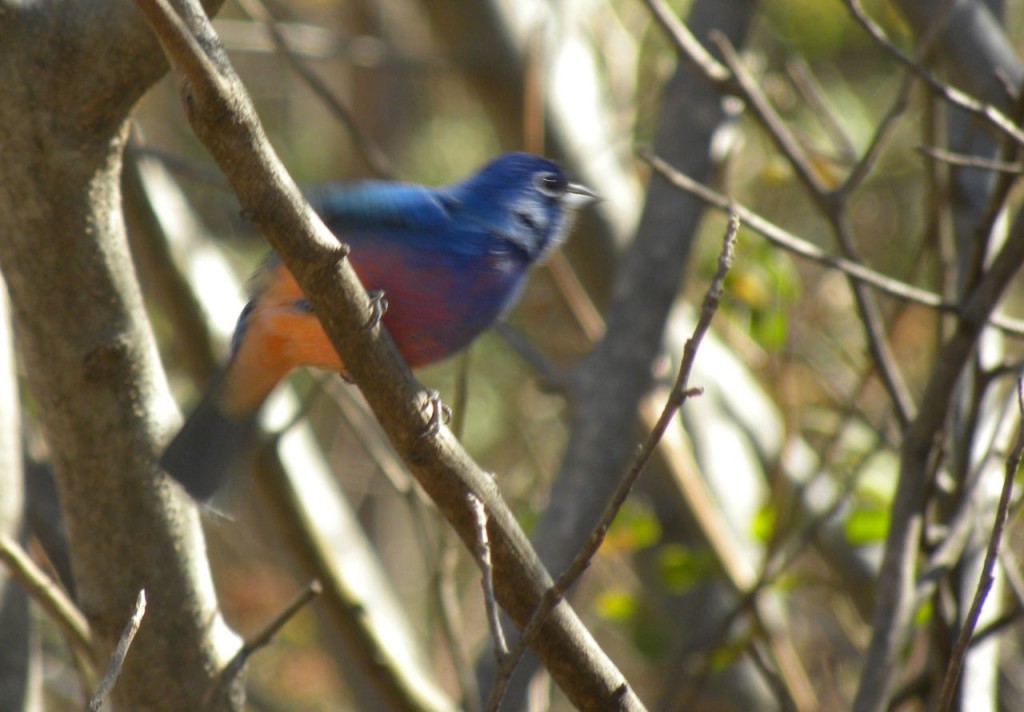
Bird of the Day number one. In a dry scrubby woodland edge we happened upon several Rosita’s Buntings, aka Rose-breasted Bunting. This species is only found here on the slopes of this little mountain range. I have never encountered a bird quite as eye-popping as this, the male’s head, back and wings are a vivid electric blue, bluer than an Eastern Bluebird but maybe matched by the best a Blue Jay has to offer. Its breast and belly though are in evolving shades of tangerine through crimson, the full range of a spectacular sunset. Here’s a couple of pictures, one is pretty blurry but it hardly matters because its the colours that make the bird.

Rosita's Bunting.
Rosita’s Bunting.
Rosita's Bunting.  Also known as Rose-breasted Bunting, but originally named after an early ornithologist's wife.
Rosita’s Bunting. Also known as Rose-breasted Bunting, but originally named after an early ornithologist’s wife.

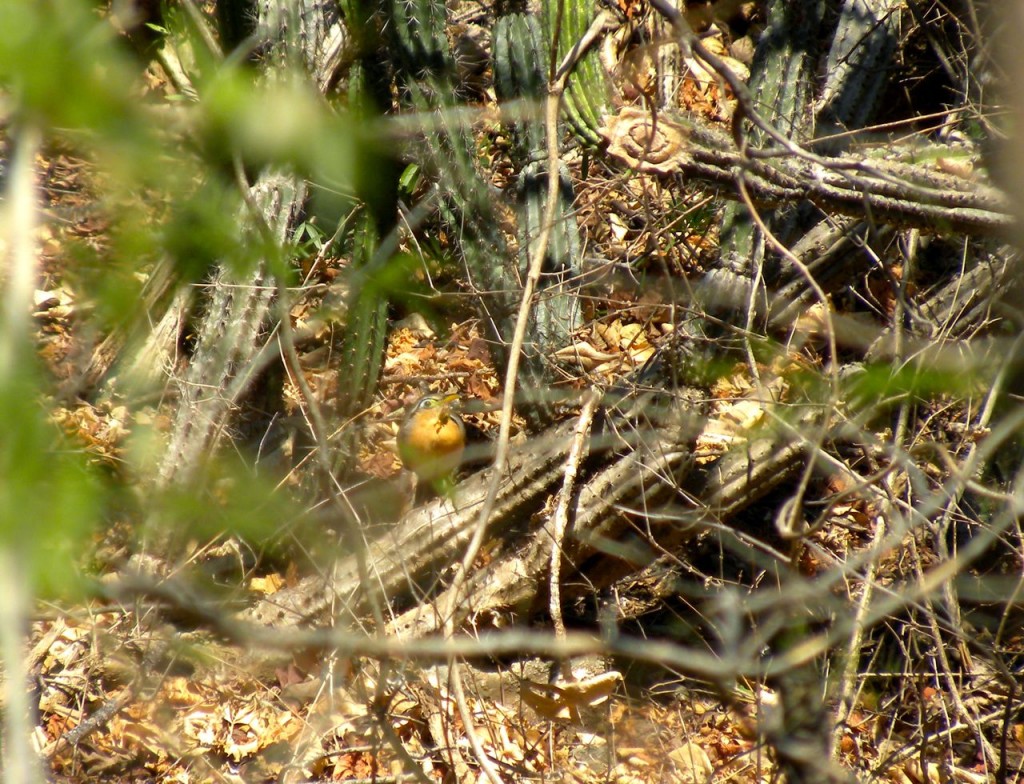
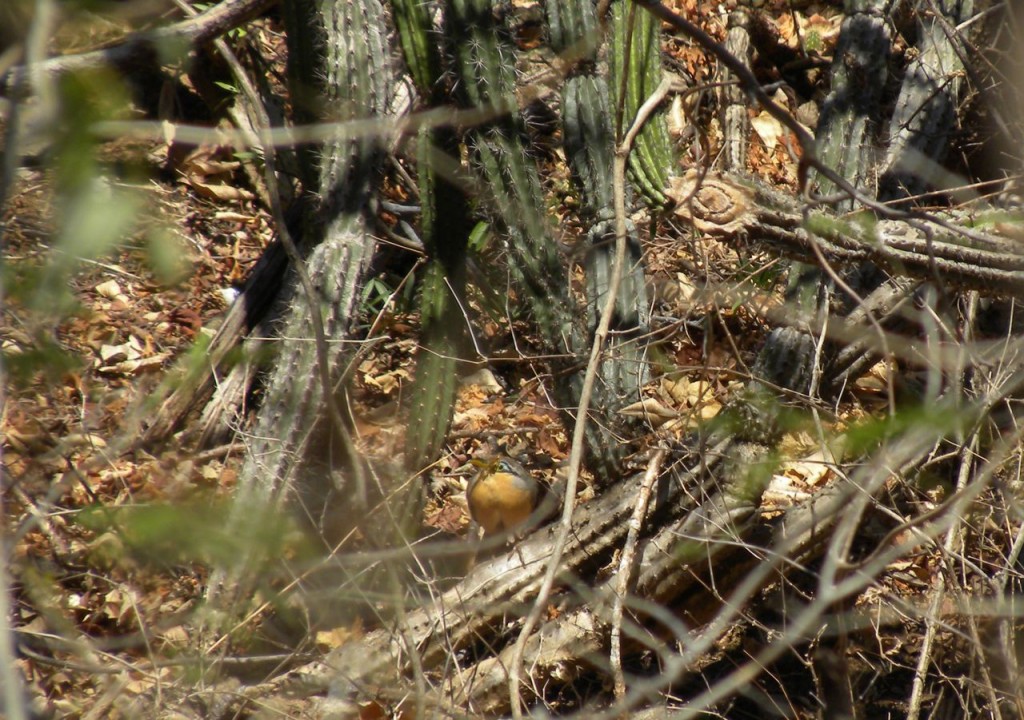
Bird of the Day number two. We set out to find a Lesser Ground Cuckoo, a relative of the Roadrunner; which makes it a potentially curious bird to begin with. They are elusive, secretive, ground hugging birds of dry scrubby woods.  To make up for their evasiveness they have a call like an infuriated screaming and whistle-blowing referee, They’re happy to be heard but just don’t want to be seen. We tried calling for them for a long time and eventually one responded; it was impossible to find it though. Then as we finally turned to walk away I looked across the shallow canyon beside the path and put my binoculars on something a little different; what at first I took to be an American Robin turned out to be bird we sought, the Lesser Ground Cuckoo. It was facing me and had an expression of anxiety emphasized to theatric effect by the most remarkable Cleopatra eyes, the dark round eye itself surrounded by a large teardrop field of blue skin. In the pictures below the bird is partly obscured by foreground clutter, click on them to enlarge the photo and look closely and you’ll get the idea.

Lesser Ground Cuckoo with Cleopatra's eyes
Lesser Ground Cuckoo with Cleopatra’s eyes
Lesser Ground Cuckoo skulking among the roots.