Spot-breasted Oriole

April 30 2013. I’m in El Salvador to assemble and distribute wheelchairs. Today we distributed100 to children who are patients of a rehabilitation hospital. My team member colleagues aren’t birders, but they understand that some people are, so they go along with it. However our Salvadorian hosts are generally unfamiliar with and somewhat bemused by the idea, and I think the birds too believe I’m up to something sinister. My allotted birding time is early in the day from sun-up until around 8.30 when we head off to work
The area around the hotel is well treed, in fact any corner of land left unused for a while soon becomes well treed, unless someone decides to call it home or set it on fire. So I prowl around the parking lot under the watchful eye of a security guard with a shotgun, looking for movement or listening for bird sounds. None of the birds on my short list of sightings is particularly remarkable, unless you’re a visitor from the cold north, when they’re all a treat.
In San Salvador (the capital city) the sound of Great-tailed Grackles is pervasive as they sail between tree-tops. They must be a nest predator because I often see Clay-coloured Thrushes, Great Kiskadees and Yellow-winged Tanagers chasing them away. Small flocks of parakeets fly shrieking across the sky, I’m not sure whether they’re Pacific Parakeets or Green Parakeets, the species are almost indistinguishable, but they’ll often descend to a treetop and spend half an hour eating flowers and chattering noisily before departing in loud squawking unison, off to the next tree.
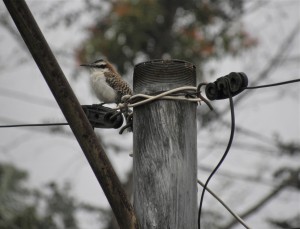
Rufous-naped Wren
Rufous-naped Wren
Rufous-naped Wren
Rufous-naped Wren

I spotted a pair of Rufous-naped Wrens working quietly and inconspicuously over a group of shrubs. It took a while to figure out what I was seeing because as wrens go, they’re large and strongly marked, not much like the wrens we’re familiar with in Ontario. I managed to get these shots of one later at a different location.

When it’s all so new it’s difficult to say any one bird is Bird of the Day but I think a pair of Spot-breasted Orioles would be it for today. It took me a while to be convinced they’re Spot-breasted, they could have been Altimira or even Streak-backed Orioles. I need better photos, my best picture-taking vantage point is a window at the end of the hotel corridor and well, it could do with a cleaning.
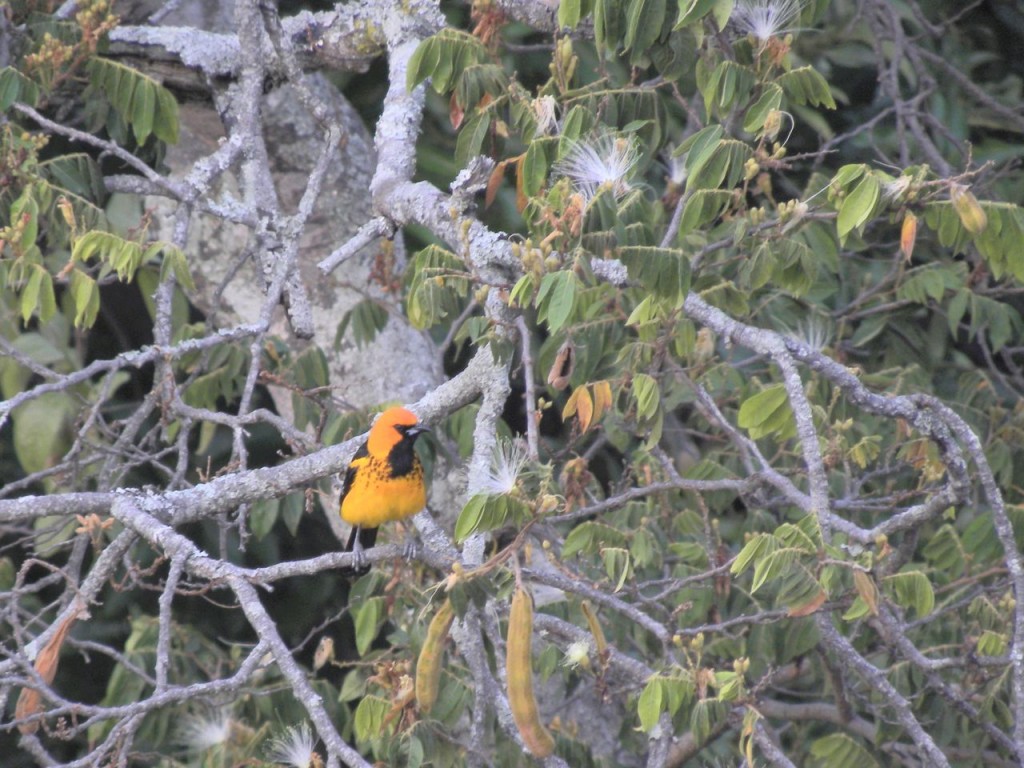
Spot-breasted Oriole

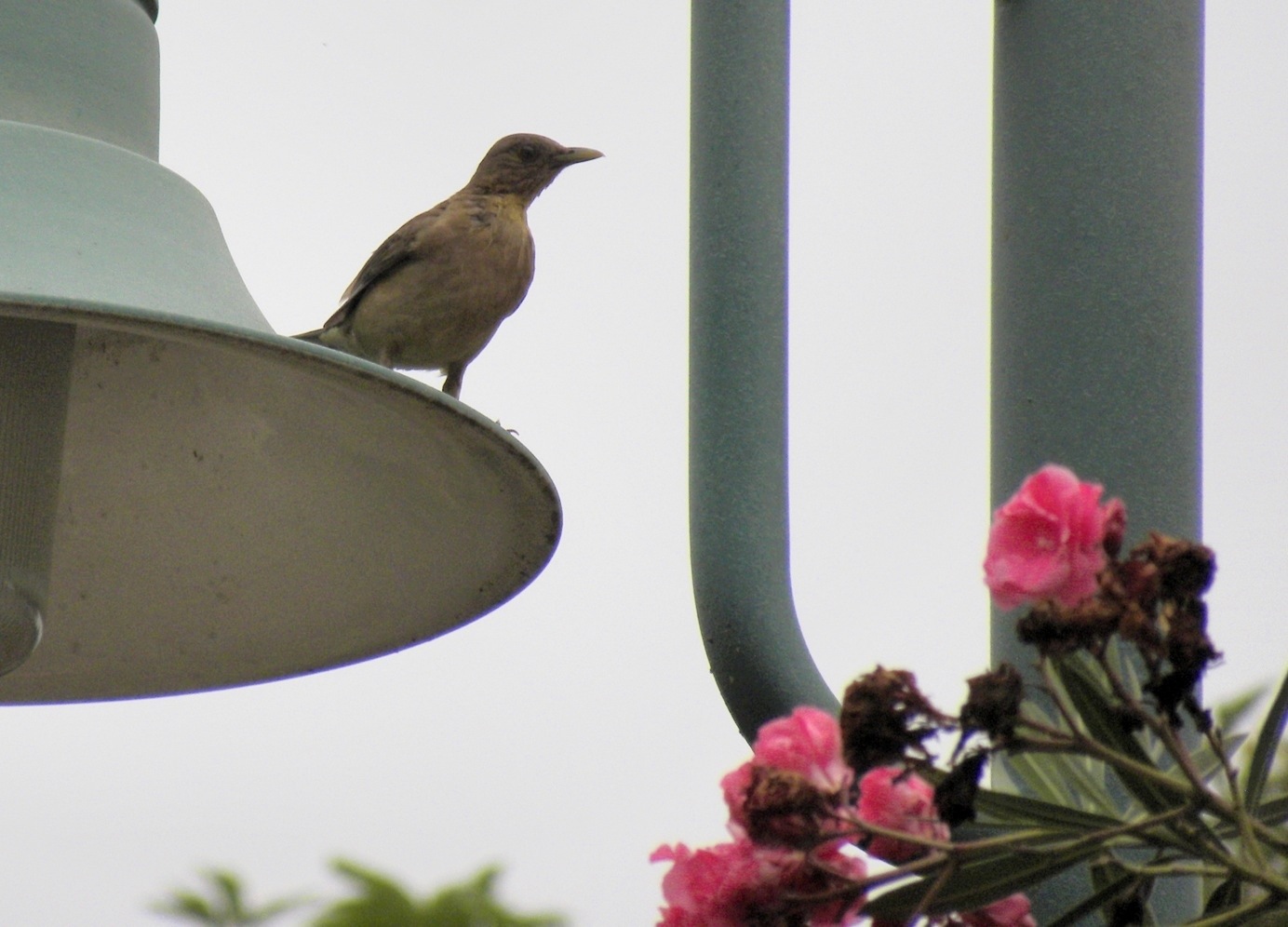
Clay-coloured Thrush

The Clay-coloured Thrush
is the national bird of Costa Rica. At first blush it seems somewhat myopic, unimaginative or even perverse that a country renowned for the vivid brilliance and diversity of its bird life should select one of the dullest birds in the Americas as its avian figurehead. But in my short time here in El Salvador, I’ve come to see it Costa Rica’s way.
The Clay-coloured Thrush is a very close relative of our familiar American Robin, it’s the same size, in the same genus, and it flies, hops and stands sentry just like robin; and for all the same reasons, it is equally closely related to the European Blackbird. There are several more near relatives in the same (unfortunately named) genus ‘turdus’, but I mention the European Blackbird because the Clay-coloured Thrush has a song uncannily like the fluting, liquid melody of the blackbirds’.
On the day of our arrival in El Salvador, I heard birdsong coming from within dense bushes near the hotel, it was almost a blackbird’s song and would have been except for some languid run-on phrasing. I started to think that there might be an escaped population of European birds in this small Central American country.
Then on my first (and shallow) night of Salvadorean sleep, I could hear this same ‘blackbird’s’ song at all hours of the night. Next morning with the song of a blackbird in mind, I couldn’t quite associate what I was hearing with other unrelated songster families; mockingbirds, tanagers or members of the Catharus genus like Nightingale, Swainson’s or Wood Thrushes. It was a puzzle.
Later that morning I happened to see several Clay-coloured Thrushes around the leafy suburbia of the hotel; they’re quite common. Then in researching them I learned that Costa Rica had chosen the Clay-Coloured Thrush as its national bird, not for its visual appeal, but for its rich, liquid song which often continues into the night and in some Central American countries has been credited with bringing on the rainy months of May through September. I’m drawn to the conclusion that my blackbird sound-alike is none other than the Clay-coloured Thrush; its song makes up for its drabness, exactly the point Costa Rica made.
All of that is a rather long-winded way of saying that Costa Rica’s bird of the nation was for me, on my second day in El Salvador, Bird of the Day.

20130429-213353.jpg

Baltimore Oriole

April 25 201. RBG Arboretum Hamilton ON. Really I saw very few birds today, I was busy doing other stuff, I surprised myself though by picking out the song of a Baltimore Oriole from the racket surrounding me.  It was nice to know that there’s a bit of me on high alert for things like unexpected bird song.

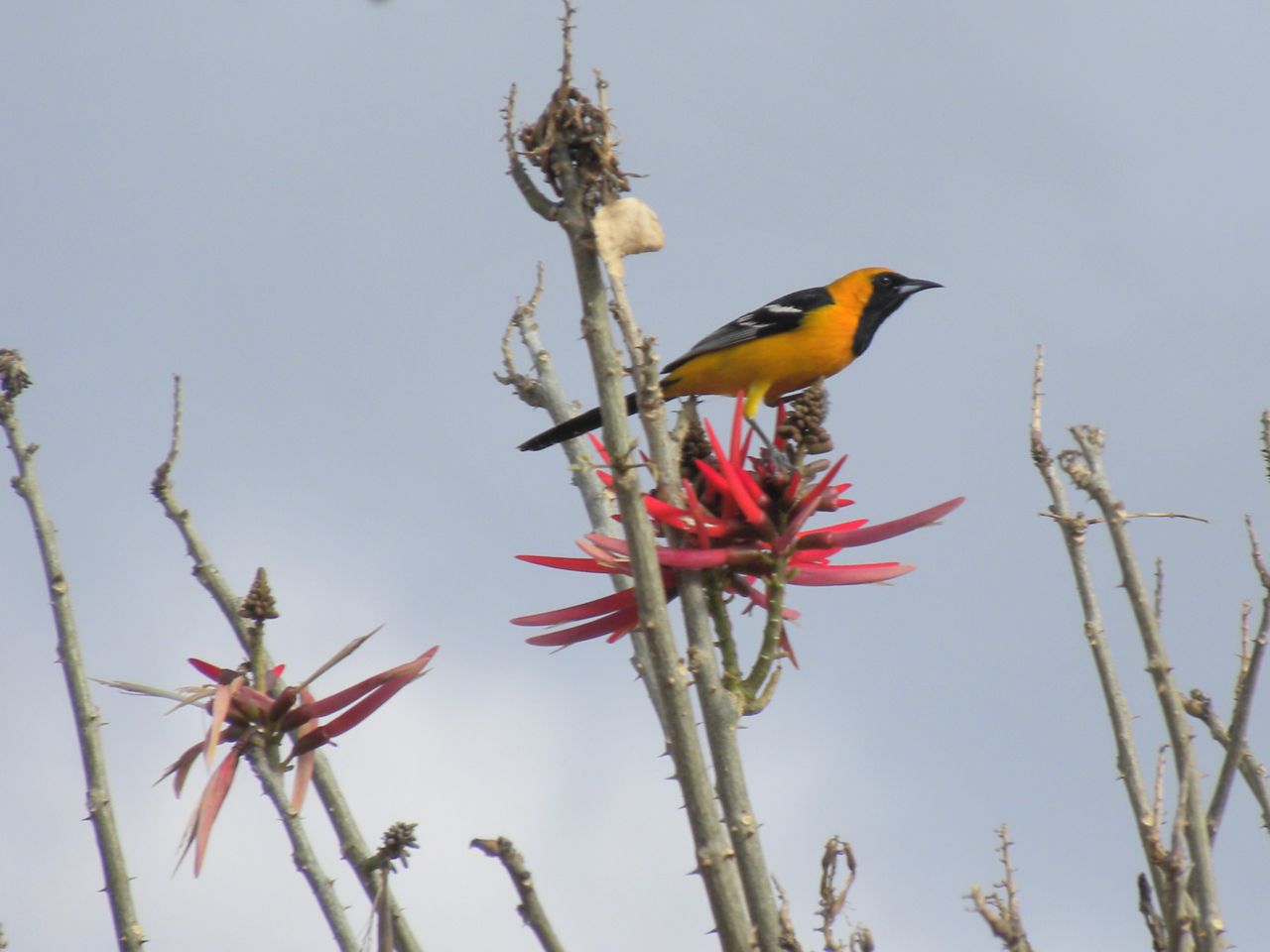
Quite apart from the Baltimore Oriole’s splendour, the shocking orange and black which according to Ernest Choate in his Dictionary of American Bird Names were the colours of the Baltimores, the colonial proprietors of Maryland back in the 1700s, this is a very early date for this species.  A couple of years ago I heard and saw one on April 27th, I was quite astounded then; they are a bird I associate with full leaf-out and bright floriferous gardens.  And in a couple of weeks that’s the way it’ll be, they’ll be everywhere and I know I’ll tire of their insistent and piercing whistles.  But on this date with scarcely a splash of colour anywhere, they are Bird of the Day; and although I don’t have a picture of a Baltimore Oriole, perhaps its close cousin, this Hooded Oriole, will provide enough of a hint of what’s soon to come.

Hooded Oriole, San Augustine, Mexico

Neo tropical Migrants

April 23 2013. A bit of a diversion from my usual post, but this is about billions of Birds of the Day.  Our woodlands will soon be teeming with bird life.  It’s getting busy already but the bulk of what we call neo-tropical birds, the colourful warblers, shocking tanagers, cuckoos, vireos and the like, has yet to arrive.   Many, maybe most of them are streaming  northwards from Central and South America up through Mexico towards Texas and Louisiana, and from there they’ll disperse throughout the north and eastern parts of the continent.  Some species island-hop up the Antilles island chain to Florida and move north from there.  The mass of animal life may seem trivial, after all it’s just a bunch of birds each no bigger than a chicken egg; but there’s millions of them, maybe billions.

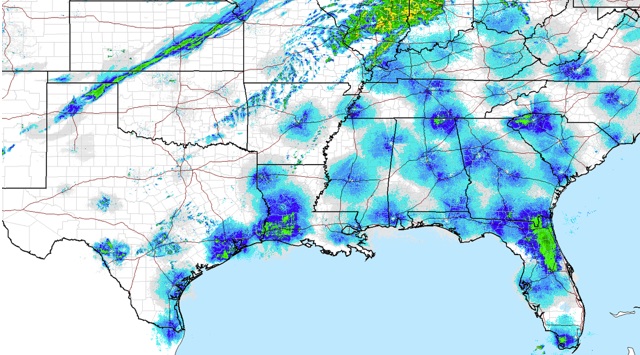
In the early days of the development of radar, observers were puzzled by ghostly images that appeared when there were no planes flying.  To cut a long story short, it was migrating birds they were seeing; and now you can too.  All you need is access to good live night time (because that’s when the birds fly) radar images. The good news is that it’s available on line at the U.S National Weather Service’s radar loop. What you’ll see on many, or even most, nights between late April and late May is vast agglomerations of birds on the move. Look again at 7.00 in the morning and the eastern half of the continent will likely have gone quiet while the west, which is still in darkness, has birds in the air. You’ll can either take my word for it that it’s birds, but if you need more information, read this article

I’ve added a screen shot taken at 10.30 pm April 23 2013.  Most of those big blue blobs are birds.  The more linear yellow, green and blue cudgel shaped bit at the top is a weather system.  Along the coastline of Texas you can make out streamers of birds just offshore, heading for land.

Weather radar at 10.30 p.m April 23 2013 showing masses of migrant birds.


Spotted Sandpiper

22nd April 2013.  Ruthven Park, Cayuga ON.  Today the sun came out to validate the efforts of countless birds that have arrived expecting a new season of plenty. I spent the morning at the bird observatory and took almost three hours to complete the daily census, a task I can usually do in an hour and a half.  I wanted to find as many species as possible, and besides, there was a group of Grade 4 kids swarming the banding lab; I find that I’m not much into other peoples’ juvenile offspring anymore.

Talking of offspring, the census was full of sightings which, to an atlasser, would qualify as breeding evidence:  A Red-tailed Hawk at its twiggy, platform nest, two Eastern Phoebes evaluating a deep, overhanging porch as a possible nest site, a pair of Belted Kingfishers excavating a hole in the riverbank, the amorously entangled courtship of two Downy Woodpeckers and a mother Raccoon foraging near her den and from which came anxious purring sounds.

This mother Raccoon had a den full of kits nearby.
An early Spotted Sandpiper from 2 years ago

New this year included my Bird of the Day, a Spotted Sandpiper.  Standing by the river, scanning the far bank, watching the Belted Kingfishers and trying to keep a mental note of species calling and singing, I heard a tiny distant weet–weet-weet, the unmistakable sound of a Spotted Sandpiper.  I looked for it along the downstream waters-edge expecting to see it picking for food, but instead it was flying towards me.  It passed not ten yards away and kept on heading upstream.  Who knows how much further it has to go before finding its summer home, Spotted Sandpipers breed throughout Ontario as far as the shores of Hudson Bay.  They are the signature shorebird of wherever there’s water.

I heard my first-of-the-year House Wren, watched about 70 Bonaparte’s Gulls wheeling around a flooded field across the river, enjoyed Ruby-crowned and Golden-crowned Kinglets and caught sight of a handful of Yellow-rumped Warblers high in the tops of some White Oaks.

Many times I stood quietly watching and listening, and reveled in the sun’s warmth.  There’s more of that to come, otherwise why would all these birds be showing up.