Western Palm Warbler

16 May 2013. Dyers Bay ON. A rip-roaring day at the bird observatory today. We had anticipated a large influx of birds  overnight, and while it didn’t quite happen that way, within an hour or two of sunrise we were kept busy. Several warbler species showed up including: Yellow-rumped Warbler, American Redstart and Black-throated Blue Warbler.  The treetops around the observatory were jumping with lively little birds and lower down, mostly in the bottom couple of meters, the most abundant bird was probably the Western Palm Warbler, a fairly large and pipit-like warbler.  They are distinctive at a glance because they pump their tails up and down a lot as they move and forage around – and moving is something they do a lot of, it’s almost impossible to get them to hold still for the camera.
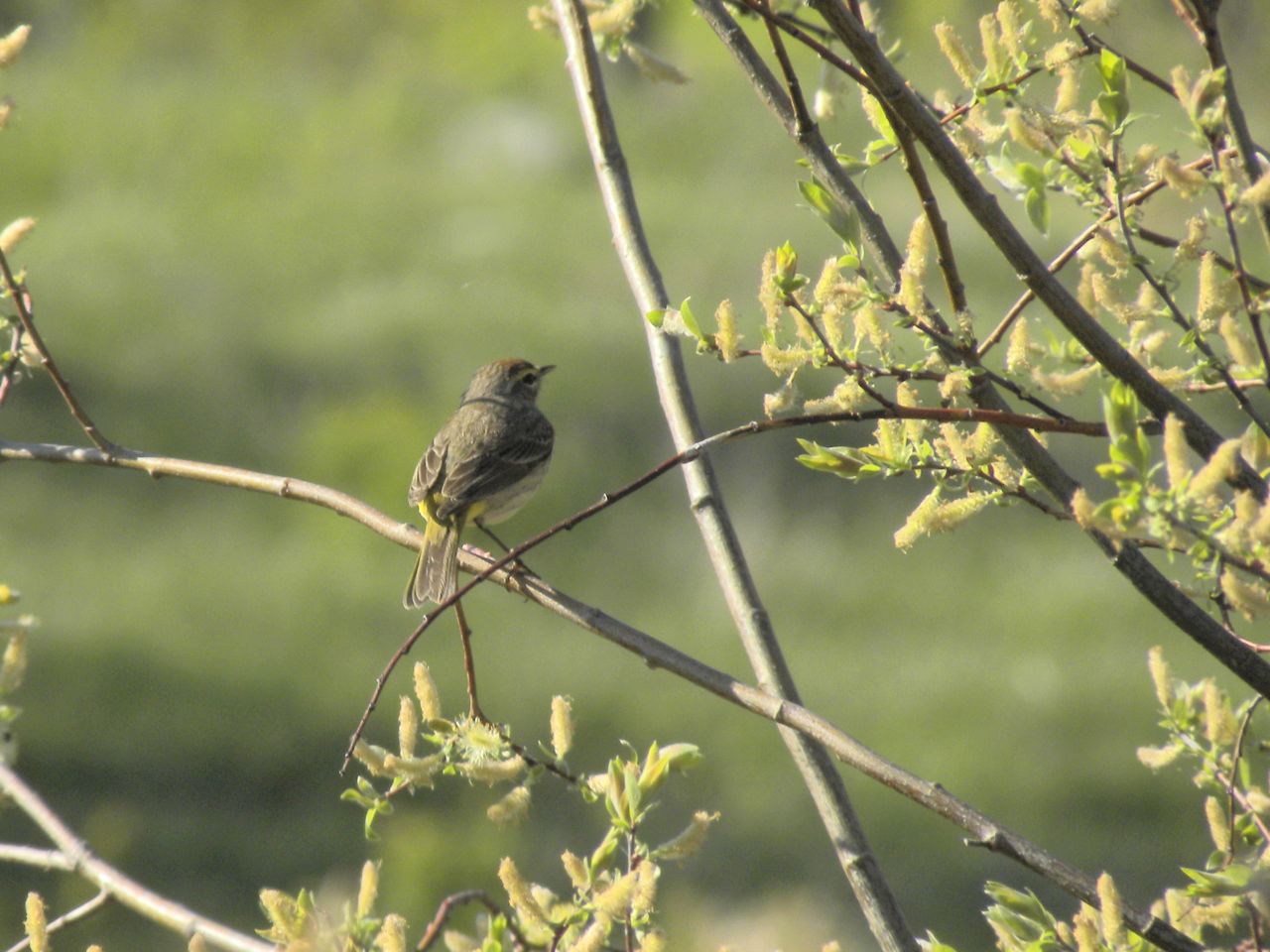
Western Palm Warbler holding still for half a second

Although exhausted by the morning I skipped a planned power nap and headed for the nearest settlement to catch up on e-mail and to see what birds might be found along the way.  Missions accomplished, on my return journey I ended up exploring the shore of a large and shallow lake and was rewarded with  the sight of a family of River Otters plunging and playing like Marineland porpoises.
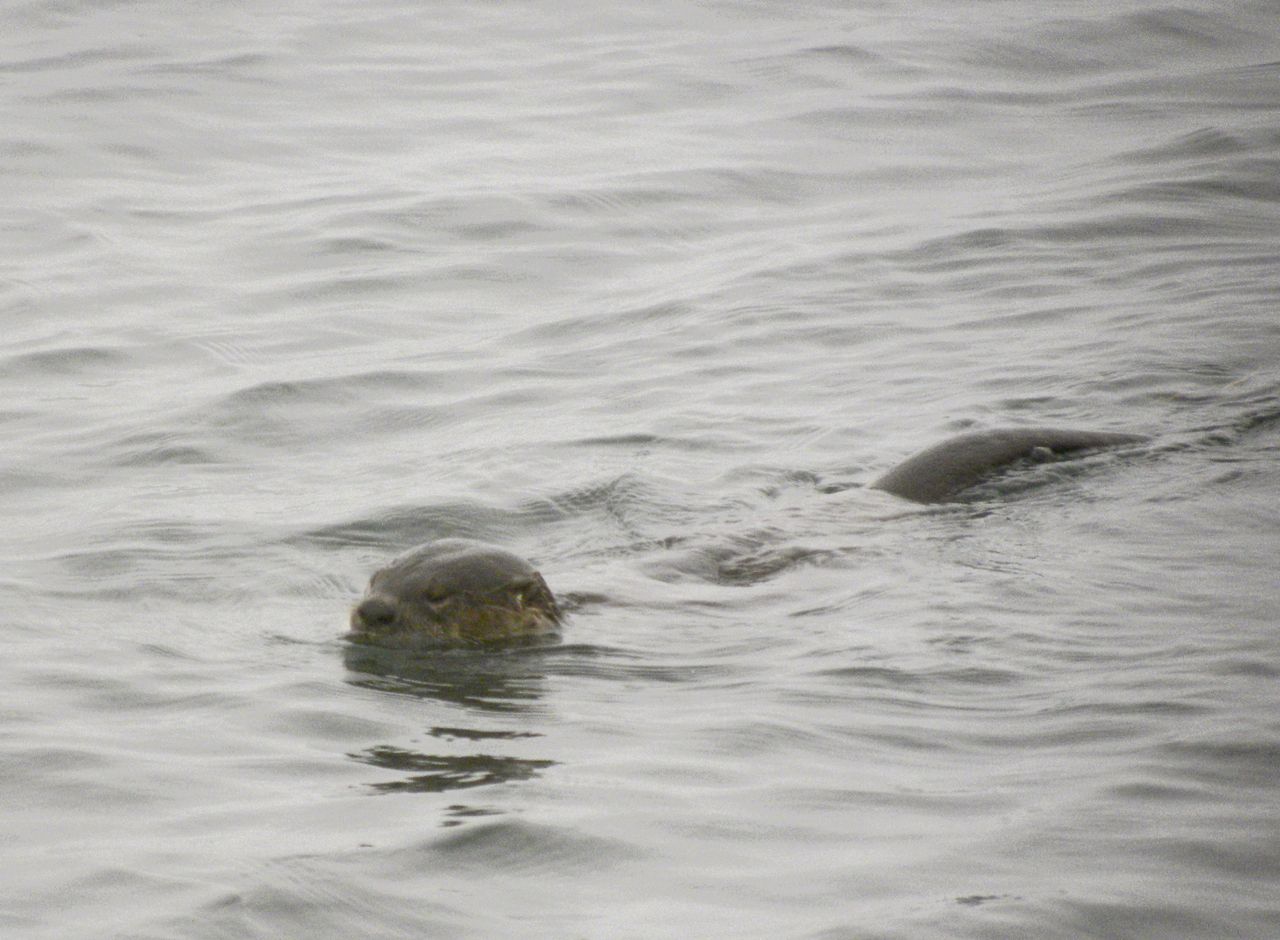
River Otter
River Otter
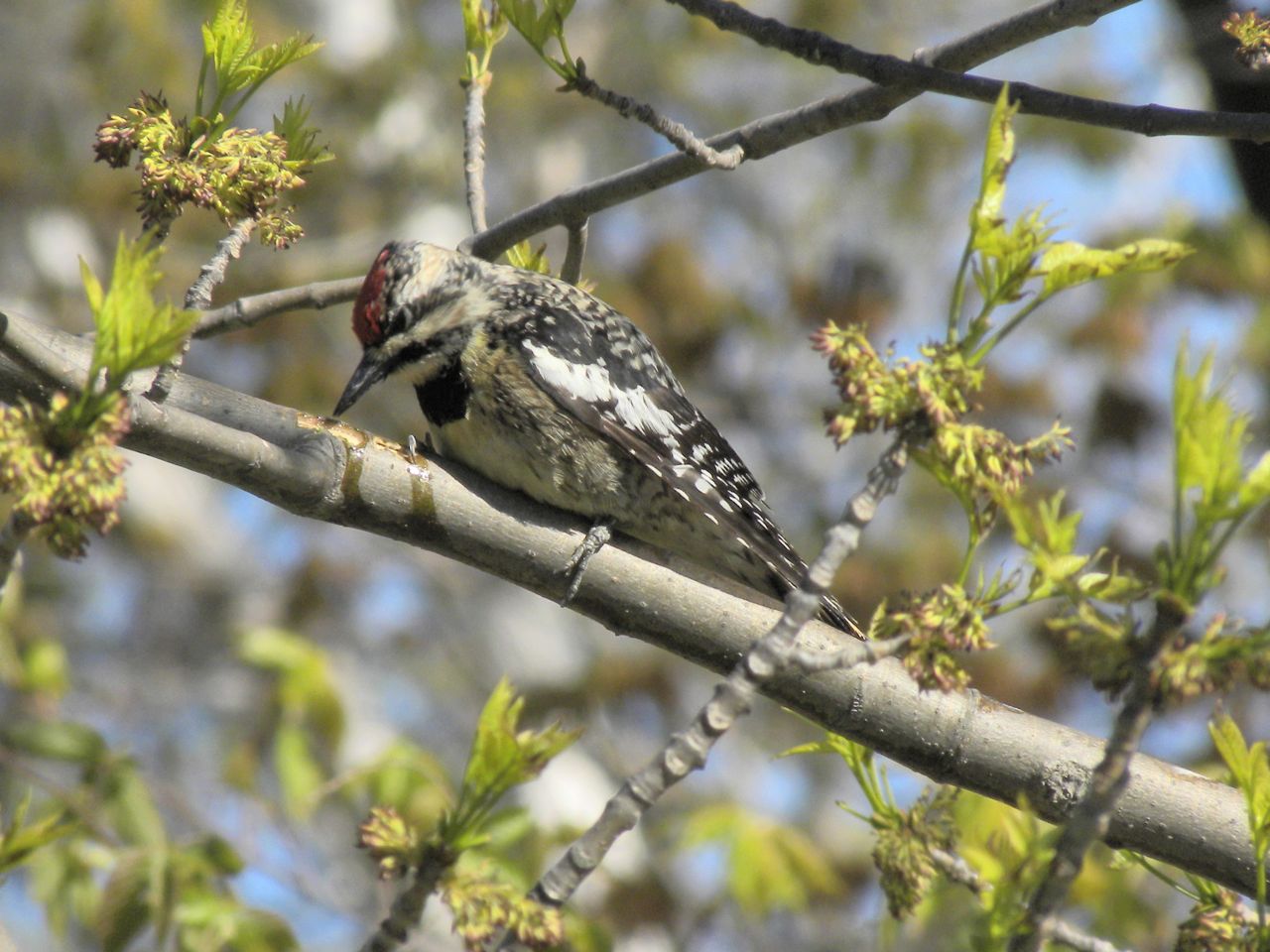
Yellow-bellied Sapsucker tapping a maple for sap.

Turning back to bird activity, I watched a female Yellow-bellied Sapsucker punching holes in the bark of a small maple.  This is what sapsuckers do and how they got their name, apparently the oozing sweet sap draws insects which are eaten later as needed.  There were a couple of expected warbler species: Yellow Warbler, Common Yellow-throat, and…this is where it got interesting… hundreds (yes really) of Western Palm Warblers all around me.  It was a virtual river of tail-wagging, ground-hugging warblers, and every now and then an intruder like a Yellow-rumped or Magnolia Warbler found itself swept along in the tide.  On such a busy day it was hard to single out any one bird as the best, but in celebration of the novelty of a river of birds it would be a little churlish not to view the Western Palm Warbler as my Bird of the Day.
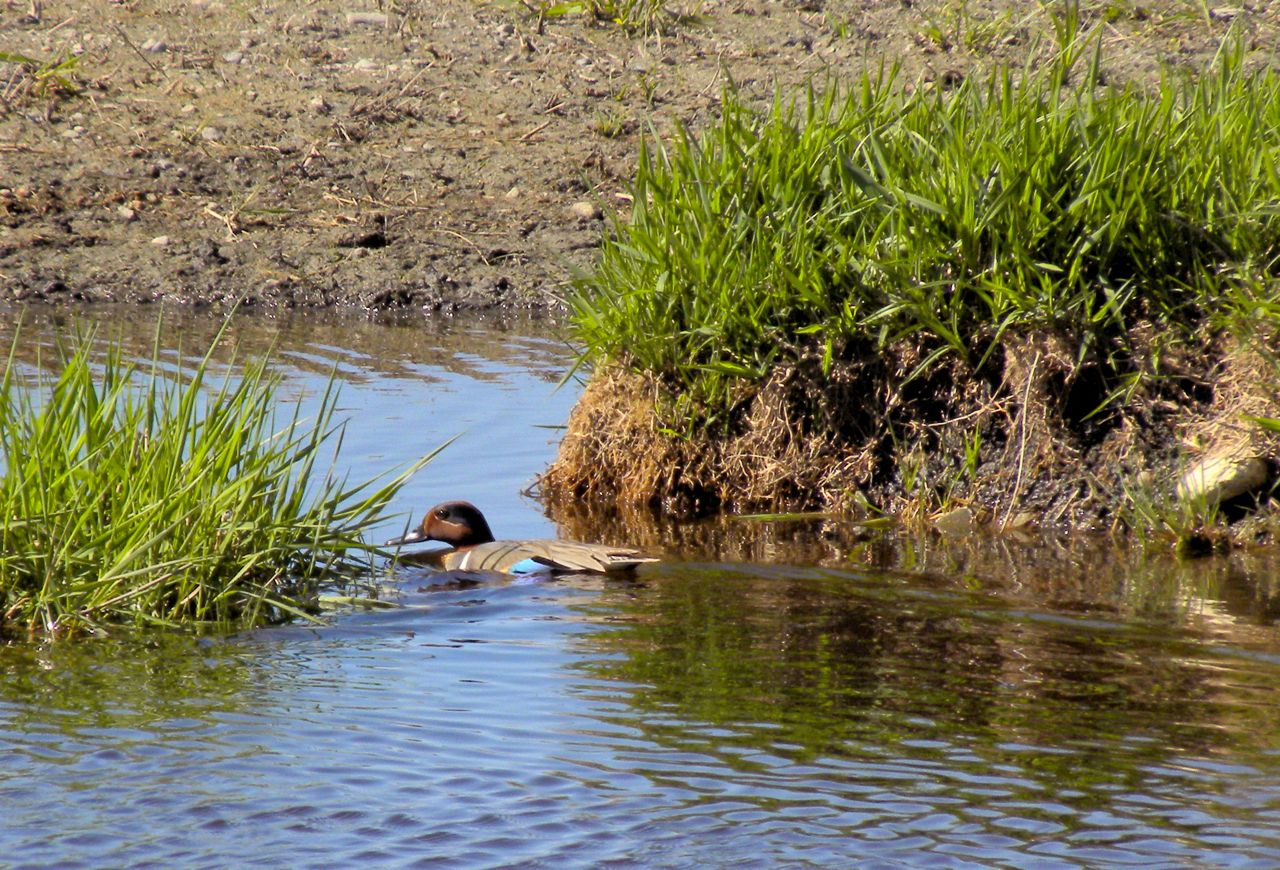
Green-winged Teal

Green-winged Teal
Green-winged Teal making dash for cover

May 13 2013. Cabot Head ON. It feels kind of needlessly self evident to say that birding in new territory is rewarding and exciting; but it’s inescapably true. My days here at the Bruce Peninsula Bird Observatory are full of fresh challenges, some of them related to bird species and choice, some to weather and some to the interpersonal dynamics of a group of people who share but one thing in common, an interest in birds.
The mornings we spend looking at and for birds. We capture a very few of them in mist-nets, we band them, record vital statistics and let them go. Most birds though pass through unseen or maybe if we’re lucky glimpsed fleetingly.  The afternoons here are free-time and that’s when I grab a map and explore the rugged countryside nearby. It’s an area of poor or abandoned farms, wetlands, rocky scrub and woodlands; it used to be beef cattle country but now it’s of little value in today’s agricultural economy although wildlife thinks it’s just fine. The area is home to remnant populations of Eastern Canada’s only venomous snake, the Masassauga Ratttlesnake, I haven’t encountered one yet but if it should happen that it’ll be on mutually good terms.
Yesterday was cold – really cold, with snow flurries! Today in the wake of the worst of the weather system, an eye-wateringly cold north-westerly wind has kept most people indoors. The flow of spring migrants has stalled as the tender neo-tropical birds hold back waiting for better conditions. But even so the variety of birds that have arrived and are now either moving through or setting up home is a delight.
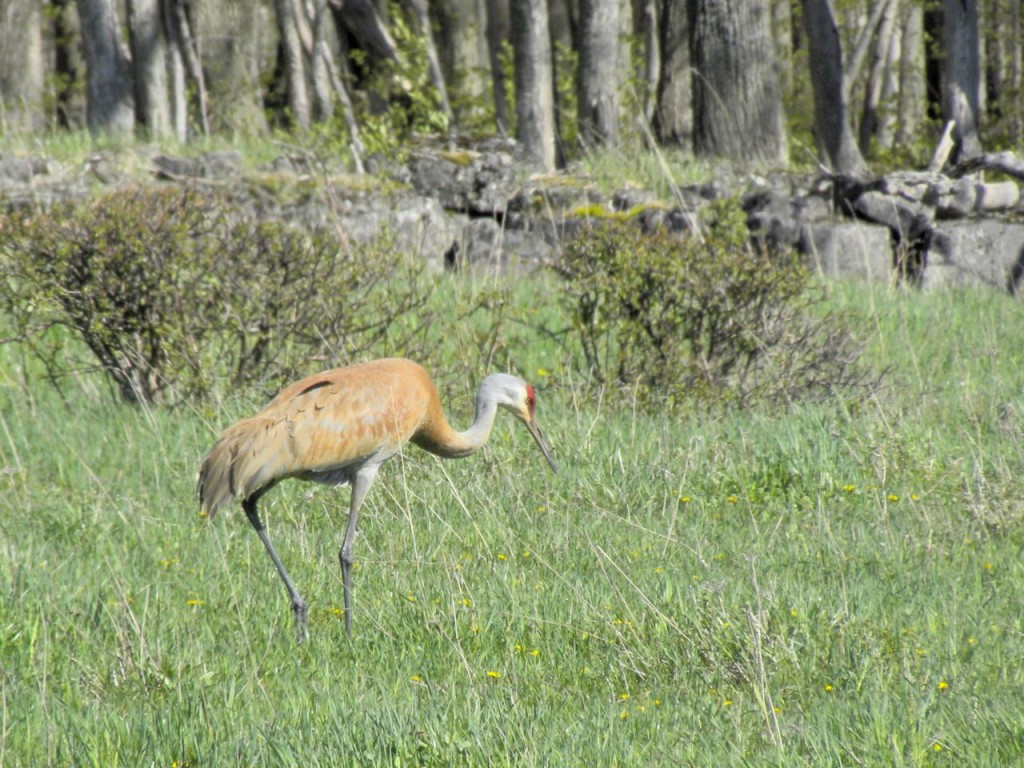
In some wet fields beside a country road I found a flock of 12 Lesser Yellowlegs, a pair of Blue-winged Teal and a very handsome Green-winged Teal. Across the road a Sandhill Crane was stalking through a dry upland area picking a meal from among the grass and scrubby thorns. A couple of Eastern Meadowlarks flew away in the direction of a male Northern Harrier who was quartering a distant area of long grasses and dried weeds.
I tallied about 20 species over the afternoon, not a large number but a good and rewarding selection. Bird of the Day was the Green-winged Teal, fashion show smart with his bottle-green and chestnut head and neck over a muted fawn and grey body. I’m told that both Green-winged and Blue-winged Teal bred here last year so it seems safe to assume that it’ll happen again this year. The Lesser Yellowlegs though have a long way to go to reach their Arctic shoreline nesting grounds, as soon as weather conditions improve they’ll be on their way.

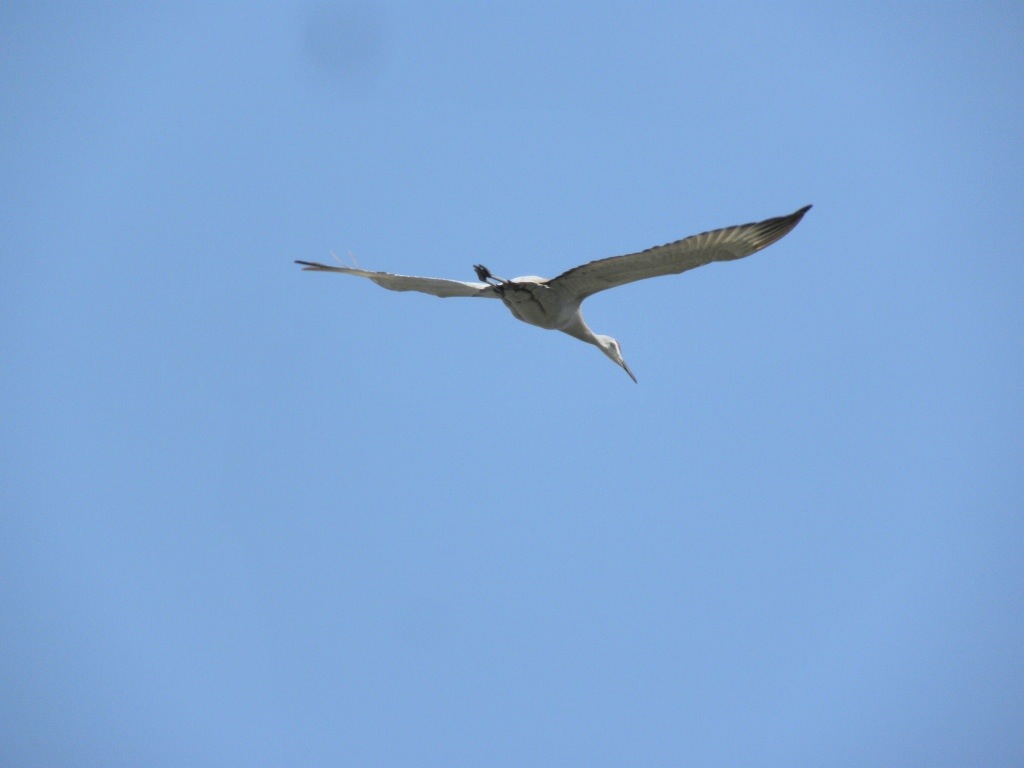
Sandhill Crane

12 May 2013. Dyers Bay ON.There are something like 15 cranes species in the world, two in North America: Whooping Crane which is excruciatingly rare and the Sandhill Crane which is common in many parts of the U.S and Canada though not seen much around here. The Ontario population seems to be growing though and they may become commonplace in a couple of decades, but for now, and for me, they are a treat worth going out of my way for.
After a morning at the bird observatory I spent the afternoon investigating the wetlands and meadows around the promisingly named Crane Lake. I wondered whether it had earned its name as a reference to a historically large population of Great Blue Herons, often mistakenly referred to as cranes or whether indeed there have been Sandhill Cranes here for generations. Whatever the reason the lake is well and correctly named; I saw about a dozen Sandhill Cranes in a short space of time.
Crane Lake is largely inaccessible, the lands around are now in a national park where happily the management strategy seems to be to leave well enough alone. I parked at the side of a rough untravelled road, more of a track really, and walked down through a rough fractured-limestone grassland towards an expanse of sedge meadow. There were Eastern Bluebirds singing and possessively guarding nest boxes against the ambitions of Tree Swallows. Here and there scrubby trees growing in rocky outcrops held Western Palm Warblers and Eastern Meadowlarks scattered ahead of my progress attracting the attention of a Merlin sweeping overhead. Down in the sedge meadow I heard Sora and Swamp Sparrows

The gurgling bugle calls of Sandhill Cranes pointed to a party of seven or eight settled into a hollow not far away. Later, on my return I intersected the group and had fun watching them stalk away then lift up and circle me, objecting to my intrusion.

Sandhill Crane circling
Sandhill Crane. Bruce Co.

Northern Jacana

May 4 2013  Ilopango El Salvador. As guests of Rotary Clubs in San Salvador our group  is very well cared for.  The wheelchair distribution work is done and it’s nearly time to leave; but first to reward us with some down time our hosts took us to what they modestly call the club by the lake. Without dwelling on it needlessly I’ll just say it’s where the wealthy elite relax and find an escape from the grit and gridlock of San Salvador.  It’s noteworthy that to drive to the club you have no choice but to pass through a small community typical of any Salvadorian village, except that it’s controlled and managed by a very violent and antisocial gang; the police, the government and law & order have no presence or right to be there!

The club is a hedonist’s paradise, manicured lawns and shady forest groves were alive with birds, mostly Clay-coloured Thrushes and Great-tailed Grackles.  Breaking away from my hammock-lounging, lemonade-sipping team-mates I went looking for birds. The list was fairly short: a Rufous-naped Wren, an army of American Coots, some Spot-breasted Orioles, Golden-fronted Woodpecker, a Berylline Hummingbird and, Bird of the Day, a young Northern Jacana strolling across the grass by the beach.

Young Northern Jacana

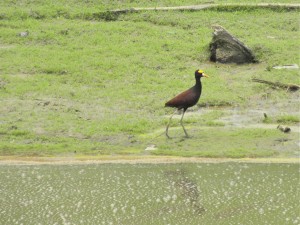
Jacana’s are a fairly common wading bird of hot climes wherever there’s aquatic vegetation and open wet weedy areas.  Northern Jacana adults have a rich dark cinnamon brown back turning to almost black up the neck and head and terminating in a bright yellow headlight.  Also known as Lily Walkers, jacanas seem to pick their way fastidiously on stilt-like legs, sampling the way ahead with exaggeratedly long matchstick toes.

Northern Jacana adult

I first encountered jacanas in my earlier trip to Suchitoto but they were all adults, today’s bird, enjoying the club’s facilities and hospitality, was a juvenile.  Still the same high-stepping stick legs and concert pianist’s fingers but in light plumage more like an avocet.

Masked Tityra

May 3 2013. Suchitoto, El Salvador. I was just enjoying a day’s birding in the mountains of El Salvador guided by a quartet of local birders, when I encountered a bird I had no idea existed; a Masked Tityra. I spotted one high in a dense tree on the opposite bank of a wide gravelly river. I called to my companions, two more or less retired American gentlemen and a pair of energetic twenty-something Salvadorian men with excellent bird finding skills. By the time they joined me it had flown out of sight. All that I could tell them was that it was an ash-grey bird with a contrasting black tail band and maybe something red on the head, about the size of a parakeet. They scratched their heads, grunted noncommittally, so we moved on; it often goes that way in birding. Then moments later one of the young guys heard a call, put two and two together and suggested that I’d seen a Masked Tityra.

Masked Tityra
Masked Tityra

One look in a field guide and I agreed; that was my bird. All of that would have been satisfying in itself but then a while later, a pair of them landed quite close on a dried up old tree stump and I managed to get a few shots. I think the curiousness and novelty of this bird made it my Bird of the Day. I need to know more about this bird, but it can wait.

We were in Suchitoto in the mountains of El Salvador, a place of drama not only for the exotic bird life but also for its social history and physical geography. El Salvador endured a decade of civil war that left it a broken dysfunctional country. It is recovering but there is still much poverty and gross underdevelopment. Suchitoto was quite a hotbed of the rebel leftist guerrilla movement and there is much evidence of that in the town. To say that the war is over and all is forgotten would be an oversimplification, but the country is at peace, it’s calm except for the seismic activity and our morning’s birding included dancing across a small creek that bubbled with muddy hot spring oozings.

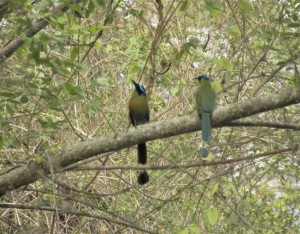
Blue-crowned Motmot
Blue-crowned Motmot

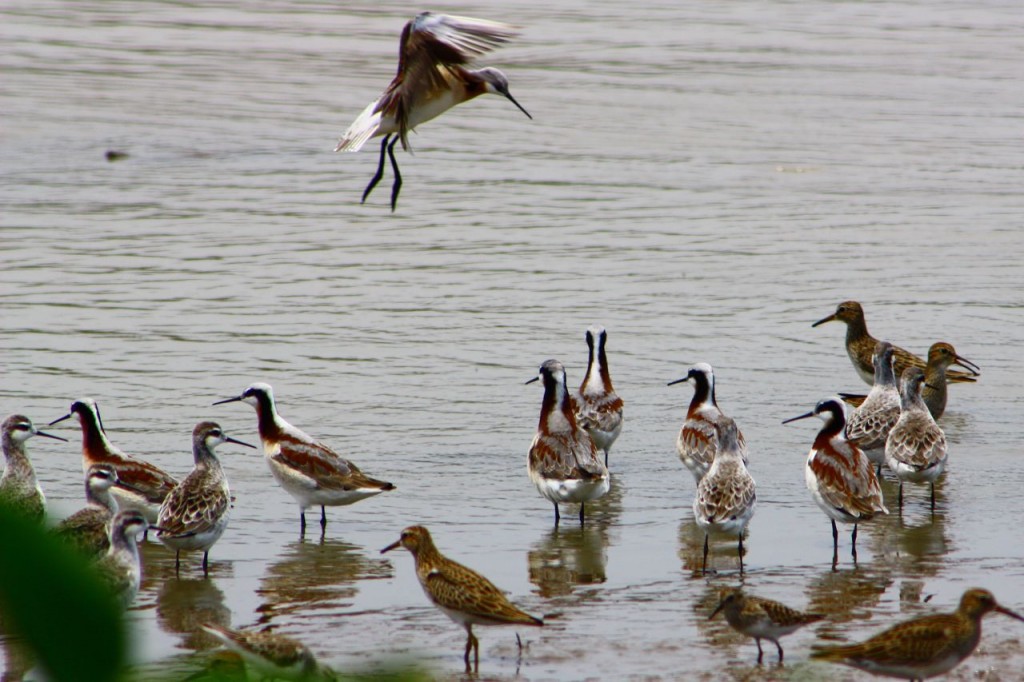
My half day in the heat produced many birds that were either new, newish or long-time-no-see to me, but at least I’d heard of them before: Elegant Trogon, Blue-crowned Motmot, Plain Wren, Roseate Spoonbill, and Collared Plover among them. We found a small group of Buff-breasted Sandpipers and debated for a long time over a pair of birds that I thought were Upland Sandpipers but turned out to be American Golden Plovers. I did not see them, but Marvin, our expert young guide, found and photographed a spectacular group of Wilson’s Phalaropes with some Pectoral Sandpipers mixed in.  Courtesy of Marvin Qunitilla here’s his shot.Wilsons phalaropes & Pectoral Sandpipers copyright Marvin Quintanilla