Yellow-throated Vireo

8 September 2013. Ruthven Park, Cayuga ON.  In praise of vireos; I could go on about them for a long time, and if you look back you’ll see that I have.  Warbling, Red-eyed, Blue-headed and even Plumbeous Vireo back in January.  If you click this link and look back to just a year ago the family as a whole figured prominently, but It’s been a while since Yellow-throated Vireos really stepped out of the shadows but today they made everything right.

At the bird observatory this morning we heard a Yellow-throated Vireo singing just outside the banding lab.  Like the other vireos they have a two, three or four syllable song. The Yellow-throated’s song is similar to the Red-eyed although it’s husky, hoarse and less melodic, it’s still got the “hear I am— way up — –tree-top” rhythm, although a good throat clearing would help.

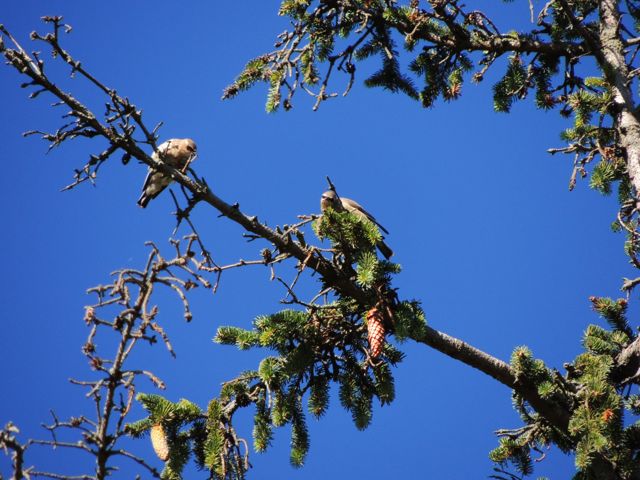
Setting out on the census I heard it again and tracked the song to the top of a large Black Walnut tree where there were actually two of them. I managed to get some long-shot photos among the yellow walnut fruit, photos which are okay as for-the-record shots, but hardly the sort of thing you’d pass around except among friends, which you are so here’s one.
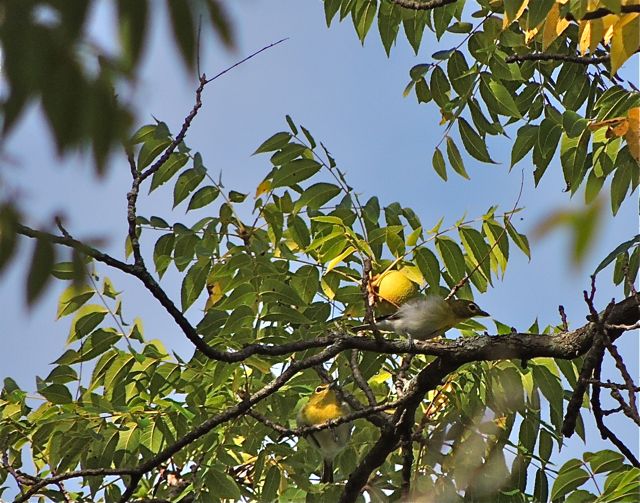
Two Yellow-throated Vireos in Black Walnut

But later in the day we banded one of the Yellow-throated Vireos and then we really admired it.  A bit like a Blue-headed with it’s pronounced spectacles, but a sensational almost chrome-yellow breast makes this bird by far the brightest of the vireos. And like all vireos they are pugnacious, that hooked bill, used so effectively on insects and caterpillars, is effective in registering its disapproval of human intrusion.
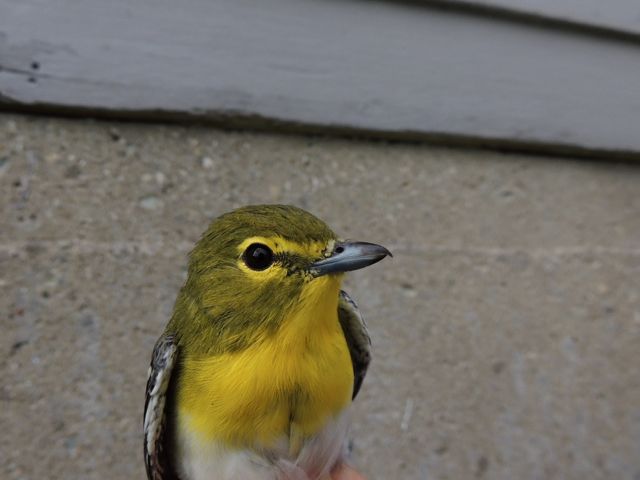
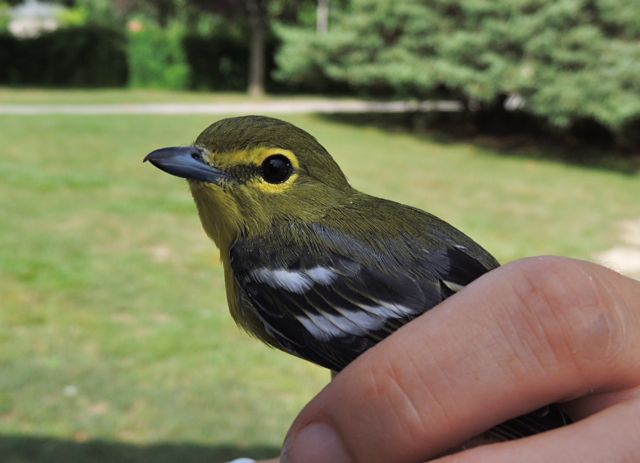
Yellow-throated Vireo portrait
Yellow-throated Vireo

Warblers passing through today included Black-throated Green, Black-throated Blue, Magnolia, and Blackpoll. Everyone seems to love the warblers and they do have a lot going for them, but up against the Yellow-throated Vireos well, it’s a tough choice and today the vireos win.
Black Tern

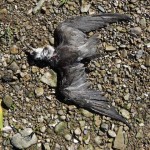
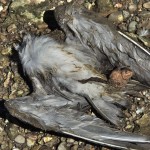
8 September 2013. Ruthven Park, Cayuga ON.  It would have been nice to have picked Bird of the Day from any of: a young Bald Eagle that soared low along the riverbank during my census walk, a Greater Yellowlegs that flew low upstream and settled to feed in sparkling shallows just in front of us, or the bright lime-green-backed male Chestnut-sided Warbler caught up in a flock of Cedar Waxwings, or even the soaring and hunting Osprey, all of them made my eyes widen in near disbelief.  But Bird of the Day was a Black Tern, dead unfortunately, a rare bird and freshly deceased.

The tern was lying ignominiously in a sludgy backwater and for a long moment we had no idea what it was.  I picked it up gingerly and was struck by the long pointy wings, narrow beak and something glistening pinky-yellow at the base of its belly; maybe partially disemboweled we thought.  Then one of our small party seized with diagnostic inspiration exclaimed, Black Tern! and then it all came together: the swallow-like wings and tail, the gull-like bill and the overall gray black topside plumage; Yes.  Holding it at arms length, we admired it for what it had once been but were vaguely repulsed by what it had become, a muddy bird with nothing left to do but decay.

Perhaps the most disquieting aspect though was its left foot.  The glistening pink-yellow thing at the base of its belly turned out to be a foot, distended, swollen and deformed beyond recognition except that claws were discernable emerging from a pair of cherry-sized malformations.  It seems to make sense that the foot with its perhaps cancerous growth had so exhausted the bird that further weakened and drained by the effort of migration it expired at the side of the river .

Here are a two pictures of it.  Viewer discretion is advised.

All pictures only visible if you are logged on, not if you’re reading this as an email

Blackpoll Warbler

6 September 2013. Ruthven Park, Cayuga ON.  A couple of days ago a cold front swept down from the north-west and turned the days from very warm to warm-ish by day and distinctly cool at night. As if to emphasis the change, at the bird observatory this morning there was frost on the ground! It was just a light touch at dawn and once the sun came up it vanished.

The last two days have seen an increase in numbers of migrant warblers, still not big surges, but some species that we know breed at the very limits of the tree line are starting to show up.  Today we saw Tennessee and Wilson’s Warblers, birds of the boreal forest as well as a couple of Gray Cheek Thrushes and a Blackpoll Warbler both of whom have come from very far north.  All of these birds still have a long way to go.  The Blackpoll Warbler outdoes them all on the migratory epics, for, having bred in a broad band of far northern places like Alaska, northern British Columbia, Alberta and Saskatchewan, they’re on their way south and east to the Atlantic coastline from where they’ll fly out over the Atlantic for a four-day, non-stop flight continuing south and east until the north-east trade-winds propel them on to Brazil.  It’s for this stupendous effort and the journey ahead that my heart goes out to the few Blackpoll Warblers seen today, and also for what it’s worth the  honour of being my Bird of the Day.

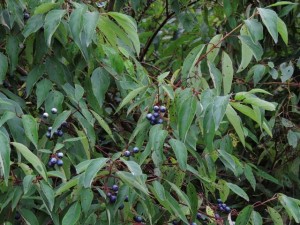
Red-osier Dogwood fruit

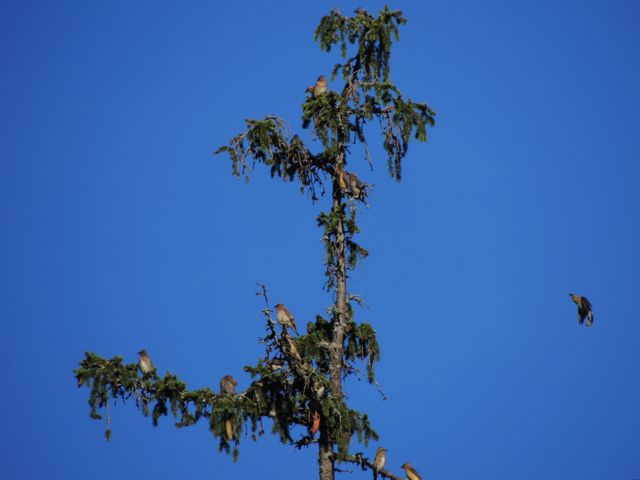
It’s been a good summer for fruit production, the Riverbank Grape vines are loaded with large bunches of ripe, purple-black fruit and both Red-osier and Gray Dogwoods have lots of berries too.  Lots of fruit means lots of fuel for birds like American Robins, Gray Catbirds and Cedar Waxwings all seen today.  The Cedar Waxwings swarmed in large flocks finding tree-tops from which to sally out on fly-catching sorties, the abundant fruit can wait for now.  A crowd of thirty or so, including many young of the year, descended on the upper branches of an aging Norway Spruce and allowed me a few moments to get these pictures.

Cedar waxwings filling a Norway Spruce
Cedar waxwing tree
Cedar waxwing tree

Great Blue Heron

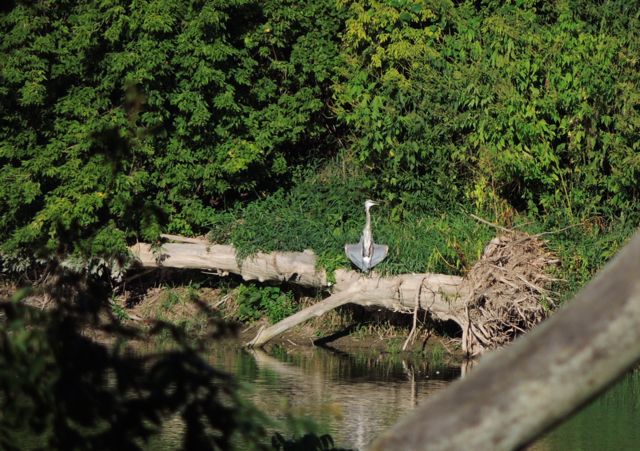
3 September 2013. Ruthven Park, Cayuga ON.  Trudging around the census route this bright summer morning, I paused to check a far riverbank where I’ve come to expect Osprey, Belted Kingfisher, Canada Goose and Great Blue Heron, and right on cue they were all there.  A pair of Ospreys nested not far away so it’s not at all unusual to see one or two of them along the river.  Sometimes they’re easy to spot framed against the sky on a dead branch, today’s bird was less obvious on the edge of a dense Hackberry, but still it had a commanding view of the river. Great Blue Heron flashingI was more entertained though by a Great Blue Heron who was standing on a log with its wings spread wide, catching the morning sun, this picture was taken from quite a distance but you get the idea.

Eastern Wood Peewee RP 4 Sept 2013
Eastern Wood Peewee

The census produced 35 species, Notable were the continued presence of many Eastern Wood Peewees still hanging around the forested areas and calling plaintively, a Sharp-shinned Hawk that shot across the river flats looking for an easy breakfast and a Blackpoll Warbler checking for insects in a tangle of wild grape.

The Bird of the Day was the flashing Great Blue Heron. Herons don’t make headlines as often as they should, what with their Cretaceous Era looks, amphibian-croaks and lugubrious flight, they really are sensational creatures.

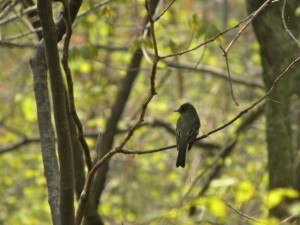
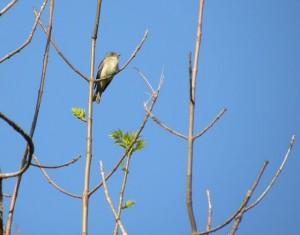
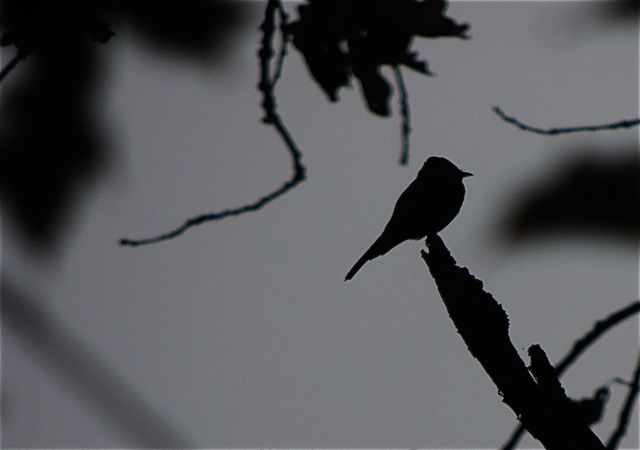
Eastern Wood Peewee

3 September 2013. Ruthven Park, Cayuga ON.  Eastern Wood Peewee, the unsung hero of the woodland. Well, maybe not unsung, but overlooked certainly; they’re late to arrive, reliable, melodic and now leaving in large numbers; my Bird of the Day today.

I was at the Ruthven Park Bird Observatory today, fall migration monitoring has restarted and it’s nice to be involved. The day’s work starts just before dawn (although rarely do I get there then, I have to drive for 45 minutes first) when the mist-nets are opened, and doesn’t stop until around lunchtime, or when six hours of monitoring has elapsed.  I will usually undertake the daily census, a walk around a prescribed route recording everything (avian) seen and heard; it’s an interesting challenge to see how many species we encounter as the seasons change, today it was 27, yesterday (a gloomy and thunderous day) just 21, and the day before that, it was 37.

There were few surprises on today’s census walk-around.  I know that many many birds go unseen and unheard on the census because on my return to the banding lab they’ll often ask me if I saw the Nashville Warbler, the Yellow-billed Cuckoo or the Curve-billed Thrasher, because they did; but only because the poor thing flew into a mist-net trying to sneak past in the understory. Today’s tally included a nice Least Flycatcher who came to see what all the noise was about, two Ospreys sitting sentinel in riverside trees hundreds of yards from each other, and a Ruby-throated Hummingbird on a wire.

E wood Peewee. June 8 2011 Eastern Wood peewee. Rondeau May 22 2011 Eastern Wood Peewee. Rondeau P.P.But as I started out by saying, the birds of the day were Eastern Wood Peewees.  In one well-treed area I counted about 15 of them, although in truth I really couldn’t count them with much certainty, they were everywhere calling to each other: Pee-ee? – Pee-ur.  If it wasn’t for their song you’d hardly know they were there, they’re so modestly attired.  Perhaps they wanted to be seen today, a kind of farewell serenade.

A little bit like the Red-eyed Vireo, their repetitive song is one of the hallmarks of a broadleaf forest summer day.  Peewees prefer high look-out perches at woodland edges or near clearings and will sit waiting for a small meal to fly by when they’ll sally out, snatch it in mid-air and return to (usually) the same commanding perch.  Peewees can be hard to separate visually from Least, Willow or Alder Flycatchers and Eastern Phoebes, but these others don’t go for that sort of woodland habitat and the Peewee’s two and three syllable signature “Pee-ur-wee?  Pee –ur.” song is unmistakable.

As these photos from earlier days suggest, the peewee is most happy when its back is turned to the camera.  It will never achieve stardom that way.  Never mind here’s a cameo shot, it’s all I could manage today.Eastern Wood Peewee