American White Pelican

24 September 2013. Hamilton ON. There’s a now little used saying along the lines of, “Guests, like fish, begin to stink after three days.”  Much as we all understand its context, such aphorisms are fading fast in our digitally abbreviated and celebrity-drenched world which adopts and almost just as quickly dumps, new pithy and useful phrases, discarded just like candy wrappers.

All of this has little to do with today’s birding excursion except that when I saw an American White Pelican where pelicans don’t belong, my reaction was just as much, Wow! as it was, Oh are you still here?
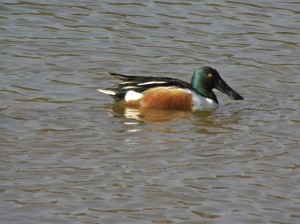
Northern Shoveler
Northern Shoveler

I had walked out to one of my favourite birding lookouts, actually the same place that prompted my previous posting on the Orange-crowned Warbler and Peregrine Falcon.  And for sake of continuity from that story, some shorebirds, a dozen or so Lesser Yellowlegs, had shown up today, otherwise it was much the same mix: Great Egrets, Green-winged Teal, a bunch of Northern Shovelers and some Great Blue Herons.  But in sweeping the vista to count the Great Egrets (seven) I found myself looking through my binoculars at a White Pelican swimming along quite happily.

A White Pelican was first spotted here about a month ago, it excited a lot of comment and the list compilers were quick to respond.  But as time wore on and it lingered, so its celebrity status dwindled. Having heard nothing about it for weeks I’d assumed it had moved on, completing its migration from Northern Ontario or Manitoba to the Atlantic coast.

We see one or two American White Pelicans here every year and I can never quite get over how odd it is to see pelicans here at all, and not in tropical or semi-tropical waters in the company of fanciful literary beasts.  That’s probably a hang-over from my childhood when Pelican was the children’s book trademark equivalent of Penguin; either that, or maybe also because they belonged in the whimsical works of authors like Edward Lear.

Despite all of my hesitancy and even ingrained prejudices I do accept that seeing an American White Pelican today was really quite special; standing head and shoulders above everything else and deservedly Bird of the Day.
Orange-crowned Warbler and Peregrine Falcon

24 September 2013.  Talk about a study in contrasts!  Book-ending the day were the warbler that no-one ever knowingly sees and the falcon that is the avian standard bearer for everything swift and powerful.

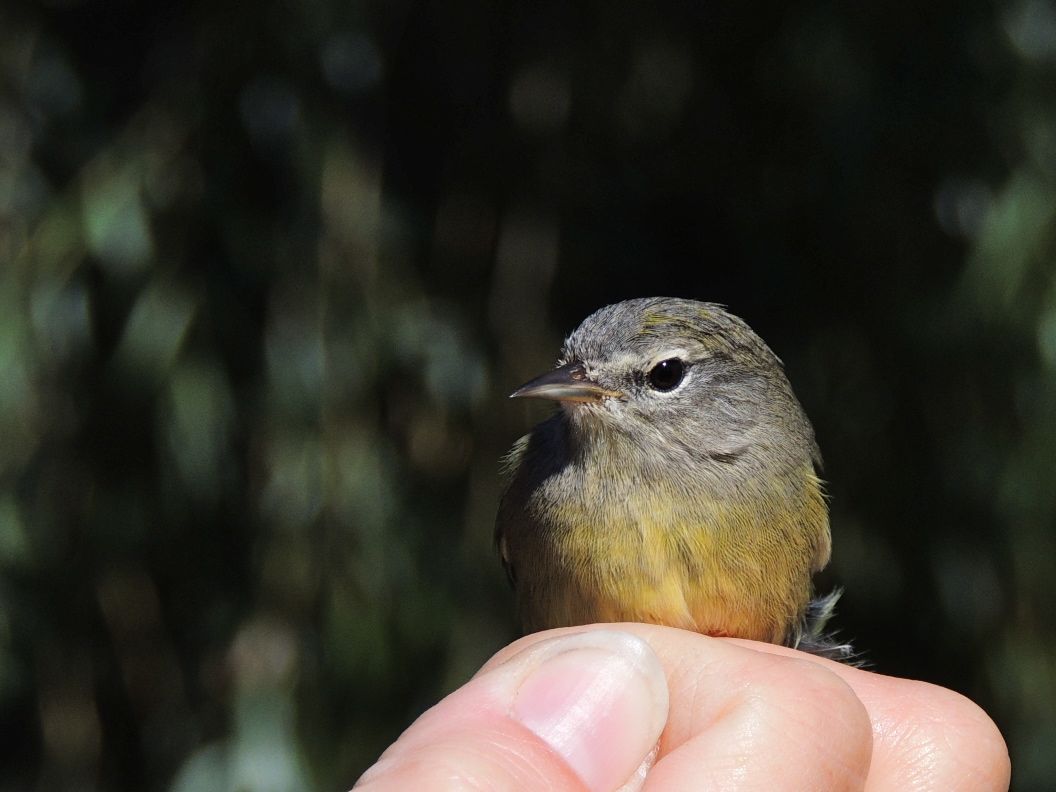
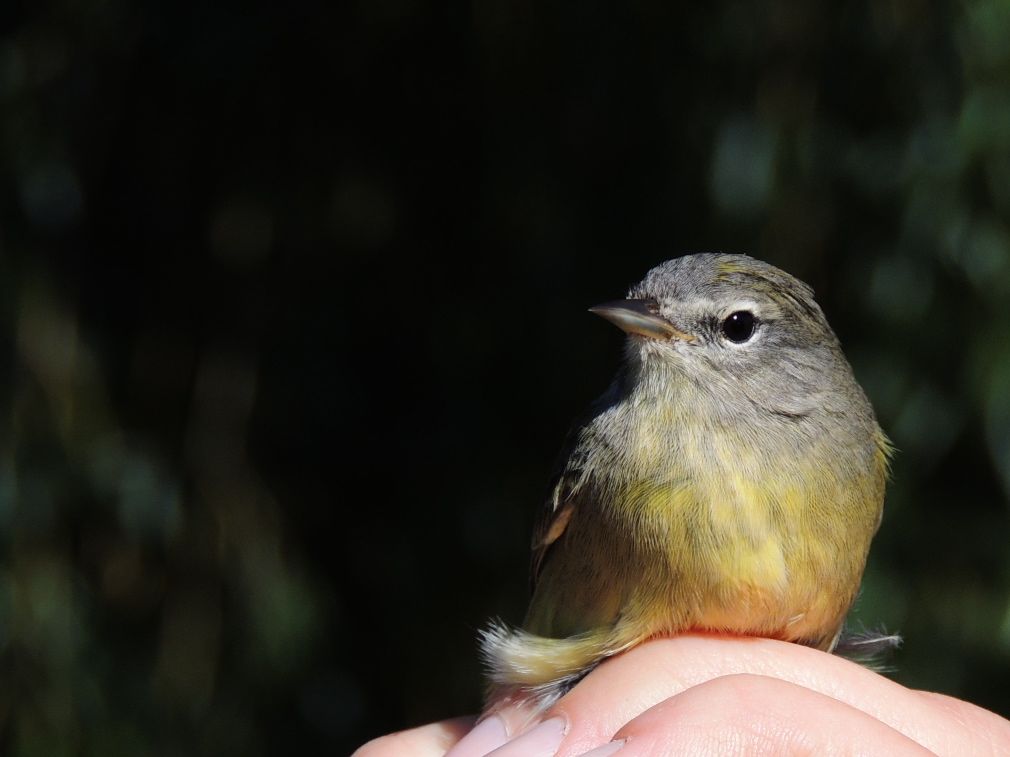
Orange-crowned Warbler: It was with only a little tongue-in-cheek that I called it the warbler that no-one ever knowingly sees.  The thing is, this bird is the quintessential “I’ve no idea what that is” warbler.  I think when the Creator fashioned the prototype warbler, it was the Orange-crowned.  Seeing it, the Creator thought, “Well, we’ll have to do better than that if we’re to avoid repeating the Old World Warbler debacle.  We need to add marks and decorations, some flamboyance, some details that separate and distinguish the dozens of species on the drawing board, one from the other.”  So with a splash of blue/grey here, a wash of yellow there, some bold black eye-liner and liberal use of white wing-bars, such splendors as the Canada, Magnolia and Black-throated Blue Warblers and a host of others came about.  Unfortunately the Orange-crowned Warbler was already out of the bag so to speak and although they rightly own a part of warblerdom; they are a reminder of the Old World Warbler mistakes.

We encountered an Orange-crowned Warbler at the bird observatory today.  I took first look at it and pursed my lips in that sideways manner that suggests the interrogative Hmmm.  I passed it to my colleague who did much the same thing but at least offered up some ideas: Tennessee Warbler? – No, Nashville Warbler?- No, female Black-throated Blue? – No, too small.  Could it be an Orange Crowned?  We checked the books, inspected the undertail coverts, agreed on eye-ring details and thought maybe that’s what it was.  Still we referred it to the man in charge who initially and tentatively proclaimed Tennessee Warbler. We begged to differ, and in the bright light of day we were at last able to find some, just a couple, of little orange feathers on its crown.  So Orange-crowned Warbler it was, and to do it justice, it is a cute little bird.  Here’s a couple of pictures of it.

Orange-crowned Warbler

Then much later in the day, I decided to see if there were any shorebirds to be found on the shores of a lake where the water level is falling and exposing mudflats.  There weren’t any, but I and another idler enjoyed telescope views of Great Egrets pacing delicately and deliberately along the reedy margins looking closely for something cold, wet and slippery to spear.  Without warning there was an abrupt explosion of anxiety and we turned to see a young Peregrine Falcon take a close pass at a Green-winged Teal that moments earlier had been sitting quietly minding its own puddle-duck business.  The falcon failed to make contact but soared up in a wide arc in front of us, turning to show its brown streaked body and the classic long and wide pointed wings that could only say Peregrine.  In a roller coaster move it stooped for the second time taking a swipe at another small group of ducks, again without making contact. It swerved away behind a small island and I thought it had left us but moments later it streaked past for the second and last time before vanishing behind a bend in the river.

You’d have to be pretty jaded not to be stopped in your tracks by a Peregrine Falcon, they are, to use a hopelessly overdone word, an icon.  If icons are touchstones, symbols, points of reference and reverence and all of that, then Peregrines qualify.  Hard not, then, to make it Bird of the Day. But on the sublime to the ridiculous scale, so too must the Orange-crowned warbler qualify.  They were both really cool birds.

Red-breasted Mergansers

18 September 2013. Cabot Head ON.  My diary notes for today start, “Another golden day just like yesterday.  Sunny, light winds, mares’ tails clouds and not hot – and not cool.”  As birds go, it too was neither hot nor cool. Screaming troops of Blue Jays sallied back and forth making keeping a count quite tricky; it’s funny to watch them when sometimes they fall out of the sky in tumbling unison to the tree-tops then flit around screeching at each other.

The slow laugh of a Pileated Woodpecker made us search the trees until finally it flapped away mechanically to somewhere across the waters looking for better things .

Late in the day as we were returning from an interesting hike that included finding a nervous looking Masassauga Rattlesnake, and driving along the shore road I noticed a group of about ten Red-breasted Mergansers engaged in a most curious feeding behaviour.  They were close to the shore in crystal clear water no more than two or three feet deep. They could obviously see something tasty and digestible for without any apparent warning they took off scampering across the water surface and then shallow-diving to skim just below the surface creating a small bow-wave and chasing whatever it was, sometimes up to the very edge of the beach, it was almost as if they were surfing upside-down.  It must have been worthwhile for them because a couple of Ring-billed Gulls stayed close enough to harass them for an occaisional snatched free meal.

I watched the mergansers from my car for a few minutes, and then realizing how important it would be to record this scene I readied my camera for a video of this unusual activity.  I was sure it would be a ground-breaking recording of hitherto unreported bird behaviour.  And with that they promptly stopped the chase as if they were embarrassed to have been caught in the act of something unseemly.  So all we’re left with is this, my brief account, my memory and for what it’s worth the knowledge that they were my Birds of the Day.

Philadelphia Vireo

14 September 2013. Cabot Head ON.  There are migration seers, people who look at the weather charts, hold up a licked finger to gauge the wind or analyze decades of records as if they were football stats and from which tomorrow’s game can be foretold, but its starting to look as if bird migration is a crap shoot. For sure our summer birds will go south for the winter and generally speaking it’s about now that they should be on the move; many are.  But whether they pass overhead, two or 25 miles west of us, or just trickle through depends entirely on them.  We’ve had cold clear nights with frost a degree or two away, we’ve had roaring northerly winds kicking up marching ranks of surf, and we’ve had warm nights with gentle southerly winds.  All of them causing much metaphorical beard stroking and muttering about tomorrow’s birds and yet each day seems much the same, a dribble of birds:  American Redstarts, Blackpoll Warblers, Black-throated Green Warblers and thrushes, Swainson’s and Gray-cheeked, all nice birds but we do lots of time-filling.

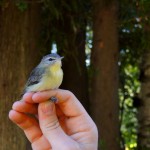
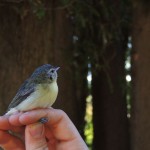
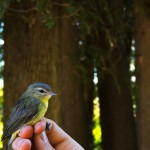
Today though one of my favourite birds arrived, a Philadelphia Vireo.  I’ve written plenty about vireos in the past but here they are again causing me sighs of admiration.  The Philadelphia with its under-parts washed in yellow is a pretty bird, yet thanks to its stern eyebrow and hooked beak, an slightly malicious looking little beast.  Here’s a trio of photos taken just before we sent it on its way.

Viewable only on the My Bird of the Day site, not on an email.

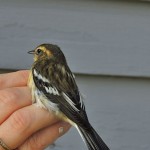
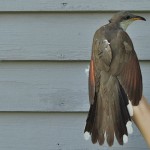
Yellow-billed Cuckoo and… I’m going away again.

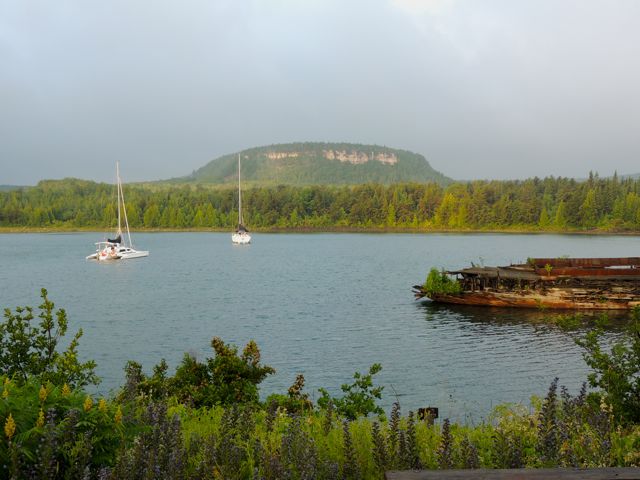
10 September 2013. Ruthven Park, Cayuga ON.  Now that the fall migration is really picking up steam, witness some really cool birds at the bird observatory today, I am about to depart for two weeks at the Bruce Peninsula Bird Observatory (BPBO).  BPBO is located on the east side of the Bruce Peninsula, a long finger of land that separates the enormous expanse of Georgian Bay from the vastness of Lake Huron.  It’s something of a flyway for migrating birds heading to and from northern Ontario.  I’m expecting exciting bird times, and to top it off the setting is pretty, it sits on the shore of a sheltered bay with the rugged, broken limestone shore of the lake on one side and expanses of forest backed by towering cliffs the other.

The view from Bruce Peninsula Bird Observatory
The landward view from Bruce Peninsula Bird Observatory

The point of all this is to say that since it’s a 45 minute drive to a coffee shop for internet access, postings will be sporadic for the next couple of weeks.

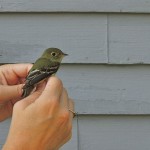
Back to today. It’s one of those odd September days when contrasting weather systems vie for dominance; currently a blanket of warm and moist air has taken charge producing record high temperatures.  This is expected to last for two days when the pendulum will swing back.  This warmth made funny things happen at the bird observatory, my census walk was deadly quiet.  I spotted just 17 species; I have no idea why so few, 25 to 30 would be more typical. The mist nets though were catching lots of birds, and some good ones too: Blackpoll Warblers, Blackburnian warbler, Philadelphia and Red-eyed Vireos, Magnolia Warbler, Traill’s Flycatcher and a beautiful Yellow-bellied Flycatcher.

Bird of the Day though was a Yellow-billed Cuckoo that I found in a mist net on the last check of the day.  When I saw it from afar my first reaction to its size was Cuckoo, but that’s such a long shot that I promptly dismissed the idea and thought instead maybe a Blue Jay or, with such a long tail, perhaps a Sharp-shinned Hawk.  Well of course my first inkling was correct.  It squawked loudly as I gathered it up and we banded and let it go as quickly as we were able.  Here are a few shots of it and some of the other highlights.

To see the photos above you’ll need to be on the website, they’re not viewable if you’re reading this as an email.  (Or are they?  Post a comment and let me know what you’re able to see.)