Carolina Wrens

18 February 2014. RBG Hamilton, Ontario. For this tale of Birds That Have Amazed Me, I must first set the scene. I spend a goodly number of winter mornings in a greenhouse as part of a happy team preparing plants for a fund-raising plant sale in early May.  We’re all volunteers and at the end of the day we make a decent pile of money, even if our net profit probably works out to about three dollars an hour.  We’re not a particularly sophisticated operation; it’s mostly about the love of plants.   But of course while we toil inside in the relative warmth, our hands in the soil and plants in various stages of tentative growth, it is still winter outside; never more so than this morning when an overnight snowfall was still flinging its last squalls about.

Our coffee break is a relaxed affair held in a neighbouring greenhouse, so for a while we abandon our benches and leave our work gloves and pruning shears to rest awhile.  This morning, for no particular reason, I happened to be the first to return from coffee and when I entered the greenhouse something small and brown flitted from me, moving fast and zipping away just above ground level.

My immediate thought was mouse, but that idea lasted less that a millisecond, mice don’t fly.  It had to be a bird.  But in here? Well why not: it’s warm, it’s sheltered and there’s plenty of food. What better reasons can there be?  If a bird, then what kind of bird?  A sparrow? Hmmm, maybe a Song Sparrow – they flit around at ground level.  All of the above reasoning took seconds only, and then I started to suspect a wren.  A Winter Wren maybe, but unlikely; a Carolina Wren was more likely.  I crouched down below the tables of plants and soon caught sight of not one, but two Carolina Wrens.

This is so typical; wrens have attitude.  They really couldn’t care less about convention.  So what if this is a greenhouse: people territory with locked doors, stuff in orderly rows, and labels on things?  So what if people are wandering around?  You can always stay out of the way and besides, half of them can’t see beyond the end of their iPhone anyway (my greenhouse friends excluded from this generalization).

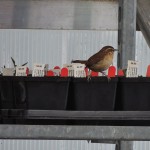
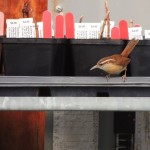
Later when the morning’s work was done and most people had left, I crept around with my camera trying for a winner of a Carolina Wren shot.  They disdainfully kept their distance, they have attitude remember; but still I was able to get a few, mostly for the record, shots.  Here they are.
This post contains photos in galleries visible only on the website, not if you’re reading this as an email.
Screech Owls

17 February 2014. Burlington Ontario. This winter is so complete that even the birds have gone.  Not all of them of course, it just seems like it.  I’m aware that there are ducks out on Lake Ontario, on fast-flowing rivers, around sewer outlets or anywhere there’s open water, and chickadees, nuthatches and other winter-hardy birds are still around; although not so many.  Whether their friends and relatives have moved on or perished I just don’t know; I suppose when winter does finally hand over to spring we’ll get some idea of the damage done.

Today I ventured out to see if last year’s pair of Bald Eagles had reinstated their nest as Bald Eagles do from year to year.  They were very successful in 2013 and we were pretty sure their two eggs must have been laid sometime around St. Valentine’s Day, that is to say  right about now.  So if they’re going to nest here again, well they’ll likely get started pretty soon.  On this bright, not too cold, sunshine-filled day, hiking out to the site seemed like a good idea, but skiing there seemed like an even better idea.  It’s a decade or more since I last cross-country skied and a four years ago, in a fit of ambition, I even bought new skis and boots to replace my early 1970s equipment, but my ambition exceeded my implementation and the new stuff has stayed unused until today.  This is not a skiing blog, but I’ll just say that I was quite pleased to have only one minor mishap (on a slope) and that I managed to re-find the rhythmic stride that makes cross-country skiing so enjoyable, and besides it was a glorious sky-blue and snow-white day.

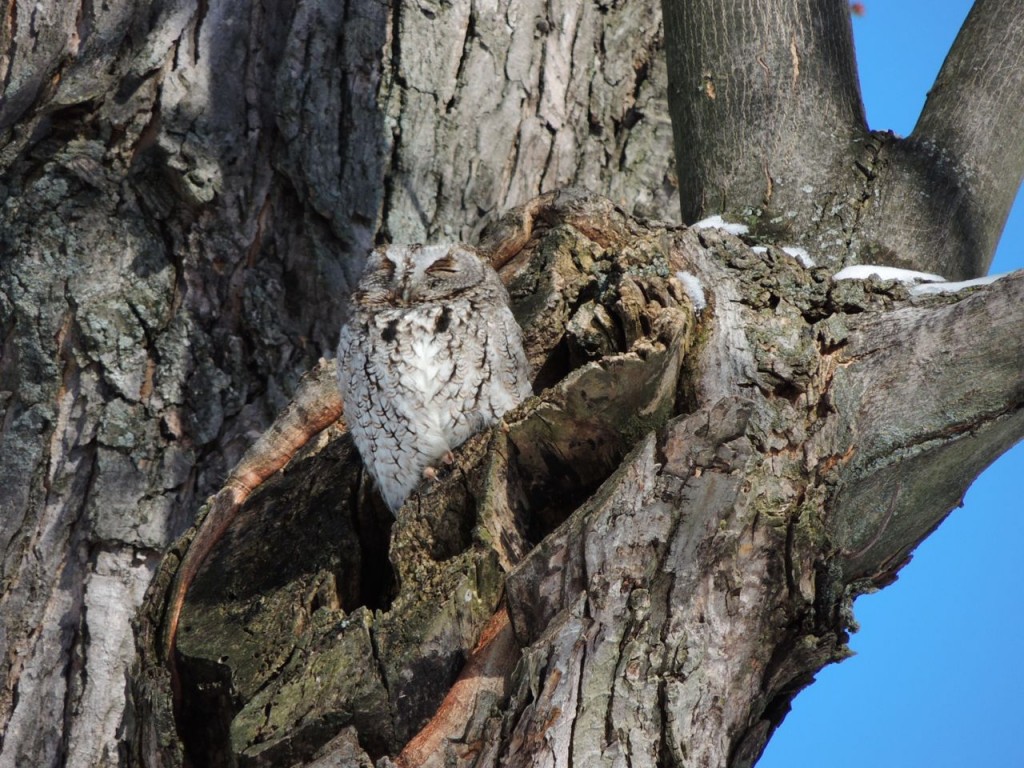
Well there was absolutely no sign of activity in or near the eagles’ nest.  I could hear a woodpecker pounding away somewhere nearby but otherwise nothing.  On my return home I swung by my two favourite Screech Owl trees and grabbed a couple of nice pictures.  Then went down the harbour’s edge just in case there was a patch of open water with waterfowl; but where last year I saw Redheads, Trumpeter Swans and American Coots, today six young hockey players skated furiously, slapping the puck with sharp cracks.  I swept my binoculars across the wide all-white expanse of the harbour hoping for a sentinel Bald Eagle but the only sign of life was a distant Coyote wandering around looking, like me, for ducks, or geese, or its case, anything to fill its belly.

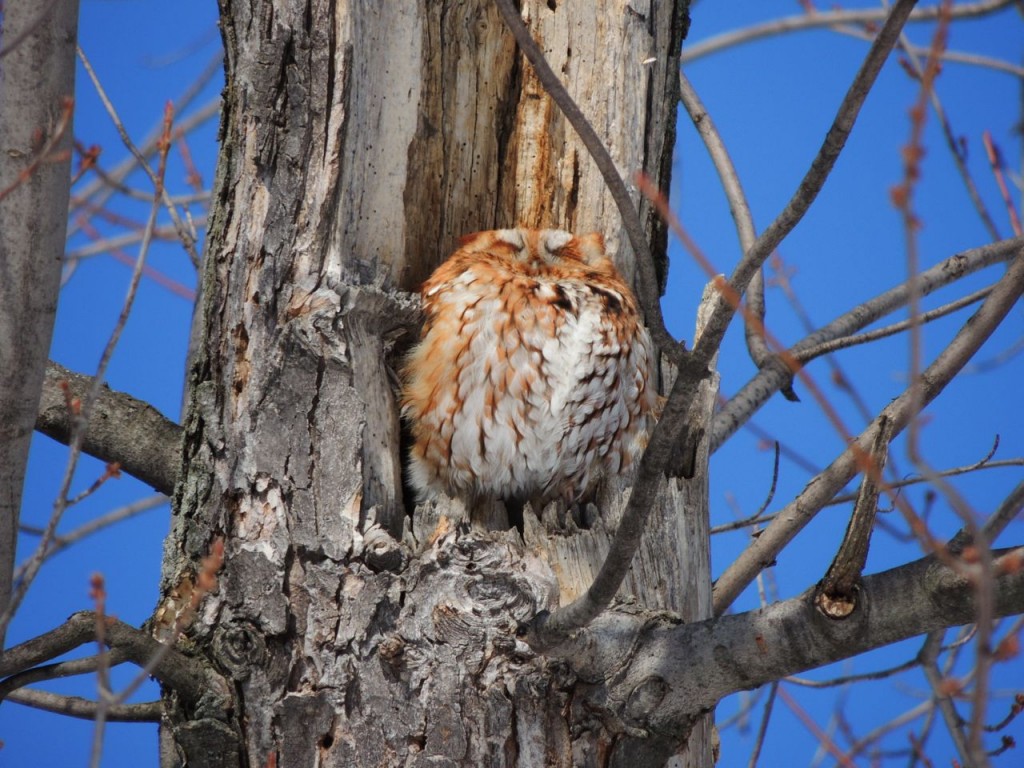
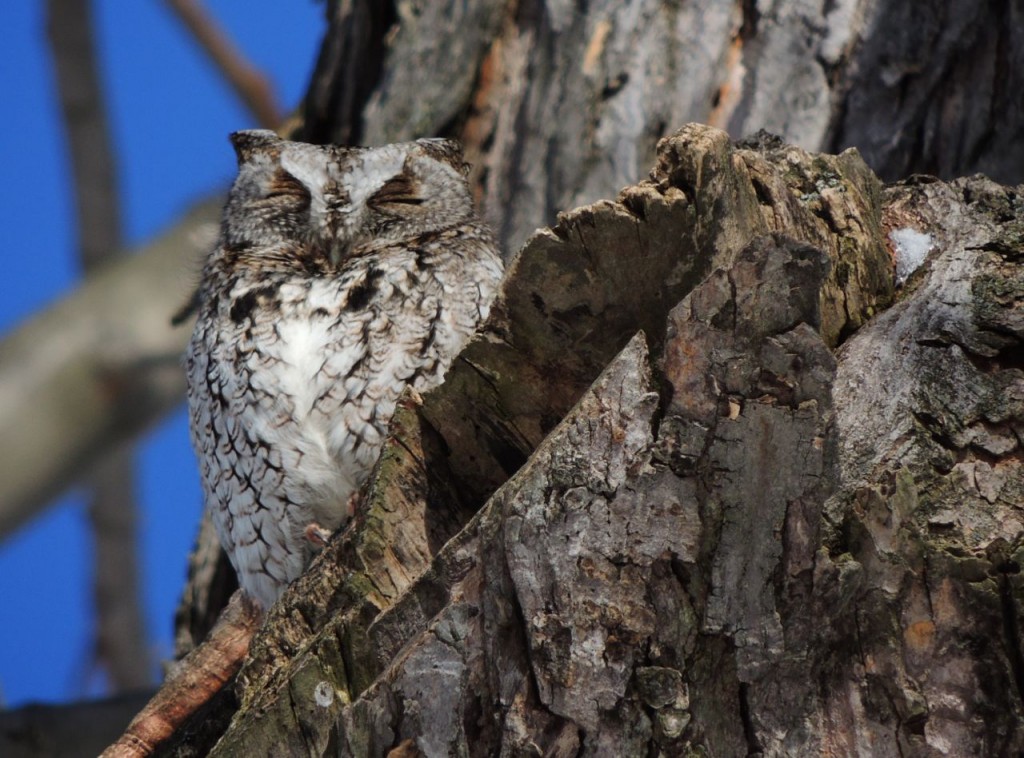
So Screech Owls it is as Birds of the Day, not that I’m complaining, just a commentary on the complete winter.  Here they are.Red morph Screech Owl Screech Owl - grey morph. Feb 2014-2 Screech Owl - grey morph. Feb 2014

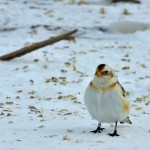
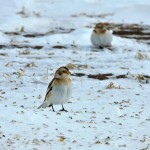
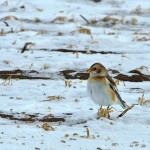
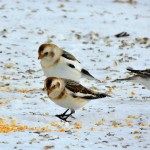
Horned Larks and Snow Buntings

8 February 2014.  Haldimand ON. An overwhelming gender imbalance in my house and conversations that seemed to revolve largely around topics like knitting, toilet training and fashion editorials reminded me that I really wanted to get some good Snow Bunting pictures.  I bundled up, gathered my camera and binoculars and left saying I’d be back in about three hours; I’m still not sure if anyone heard me.

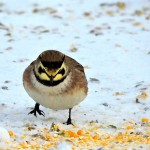
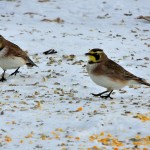
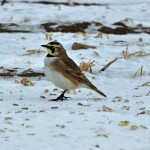
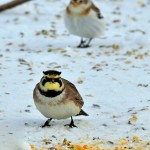
At the site where we’d been banding a week or so ago there were clouds of Snow Buntings, many of them on the road surface picking grit which is essential for digestion of their seed diet.  I pulled over to the roadside and saw that among the many buntings that were tucking in to the refreshed piles of corn, were several Horned Larks.

The object of the trip was to get some photographs and after the best part of half an hour trying to get decent shots from within the car I decided on a colder but better technique.

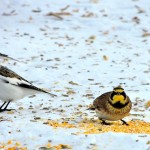
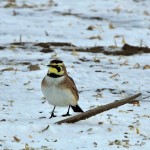
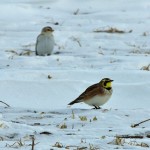
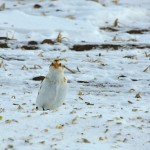
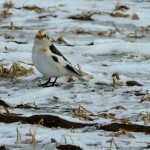
I rarely compromise my personal comfort for bird pictures. My camera is versatile and perfect for my kind of bird photography which is to say opportunistic rather than Audubon Magazine quality. But this morning demanded compromise.  With coat zipped and buttoned up tight, ear-muffs, wool hat and warm boots on, I slogged through the snow, placed a pad on the ground and sat with my back to the wind, about ten feet from the scattering of corn.  I’d tried this approach before and knew that Snow Buntings and Horned Larks are generally unconcerned by what other species would consider an imminent and mortal threat.  Within a few minutes they flew in, apprehensive certainly, but the food meant a lot to them and I enjoyed several minutes taking photos at close range.  Here are a couple of galleries of photos. You can click on any photo to enlarge it.

First the Horned Larks.  On some of them you can make out the little tufts of feathers that suggest horns (hence the name).  There are 21 subspecies of Horned Lark in North America, ours have the bright yellow throat that distinguishes them as being of the sub-species ‘alpestris’. (Probably the handsomest of the 21).

Snow Buntings are invariably described as cute.  I can’t argue, they could be the model for every dickie-bird that Walt Disney ever drew.  Most birds in the flock were females, but where you notice the wing is markedly blacker and whiter, starkly so in some cases, it’s a male.

This post contains lots of photos in galleries visible only on the website, not if you’re reading this as an email.
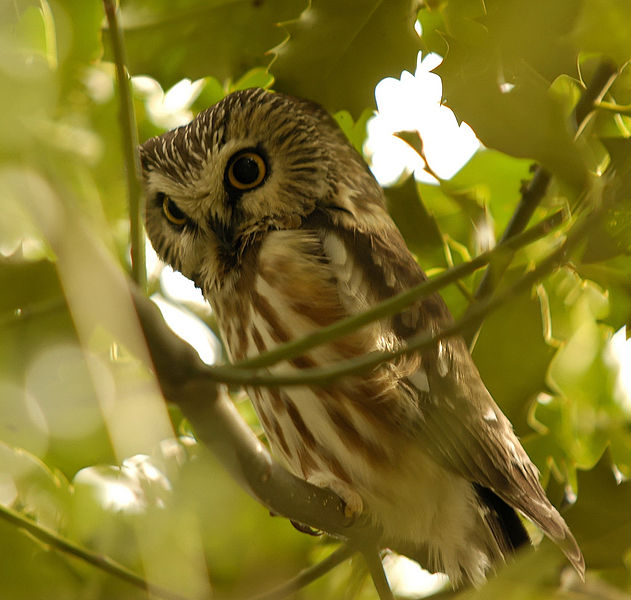
Northern Saw-whet Owl

6 February 2014.  Ontario. Not the normal sort of posting this one.  But today I had the privilege of a very brief glimpse (but no photograph) of a Northern Saw-whet Owl.

I am on the list of volunteer drivers for The Owl Foundation, an owl rehabilitation centre that relies for support on the goodness of peoples’ hearts. When they have a patient-owl that needs to be transported, either as an incoming injured bird or as an about to be released bird, they call upon a string of drivers to do the job.  Today I ferried the Saw-whet on the last leg of its journey, delivering it to the rehab experts.

As the young specialist lifted it gently from its box she quickly assessed its condition and confirmed a fractured humerus; not a good condition.  But, she added with relief that the bone had not penetrated the skin; if it had, the exposed end would have dried and been incapable of repair and healing.  As it was they planned to send it on to a veterinary surgeon for an attempt at resetting (my words, not theirs).

That quick in-the-hand assessment was my glimpse of this pretty little bird.  The accompanying notes said that the finder’s husky had picked it up.  It must have been in a poor way for a dog to pick it up; perhaps it had been in an earlier collision with a car.

Anyway, the prognosis is rarely good for birds with such injuries.  Vets’ fees are high and volunteer organizations depend on the generosity of donated professional time; if the chances of repair and rehabilitation are good then it’s easier to call upon such donations.

Saw-whets are endearing little owls.  Their name comes from one of their calls which is supposed to sound like a saw being sharpened, or whetted.   You can read more on this species and play a recoding of the call by following this link to The Owl Foundation website.

I obtained the engaging photo below from Wikimedia Commons and is the work of Brendan Ially.

Northern saw-whet Owl

Screech Owls

3 February 2014. Burlington Ontario. Although really nothing more than tabulating the rhythm of the Earth, flipping over the January page of the calendar seemed to have made all the difference.  Bright sun, a blanket of snow and barely noticeable cold was all that the birds and I needed to enjoy each other’s company today.

I walked around a favourite valley not far from home, a place of sheltered trails, a meandering river and a winter bird population that knows and loves people and the food they usually bring with them.  I pocketed a small bag of mixed birdseed and went to see what photography opportunities would pop up.

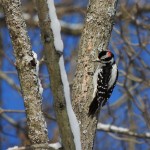
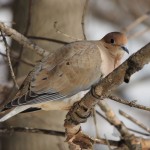
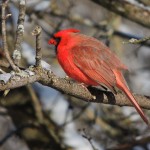
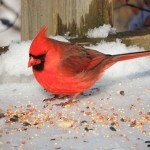
It was, as I expected, all about the usual avian suspects and they provided lots of opportunity.  There was little sense in looking for rarities, just enjoy a beautiful winter morning. The birds obliged nicely and the gallery below is a reflection of my morning’s walk.

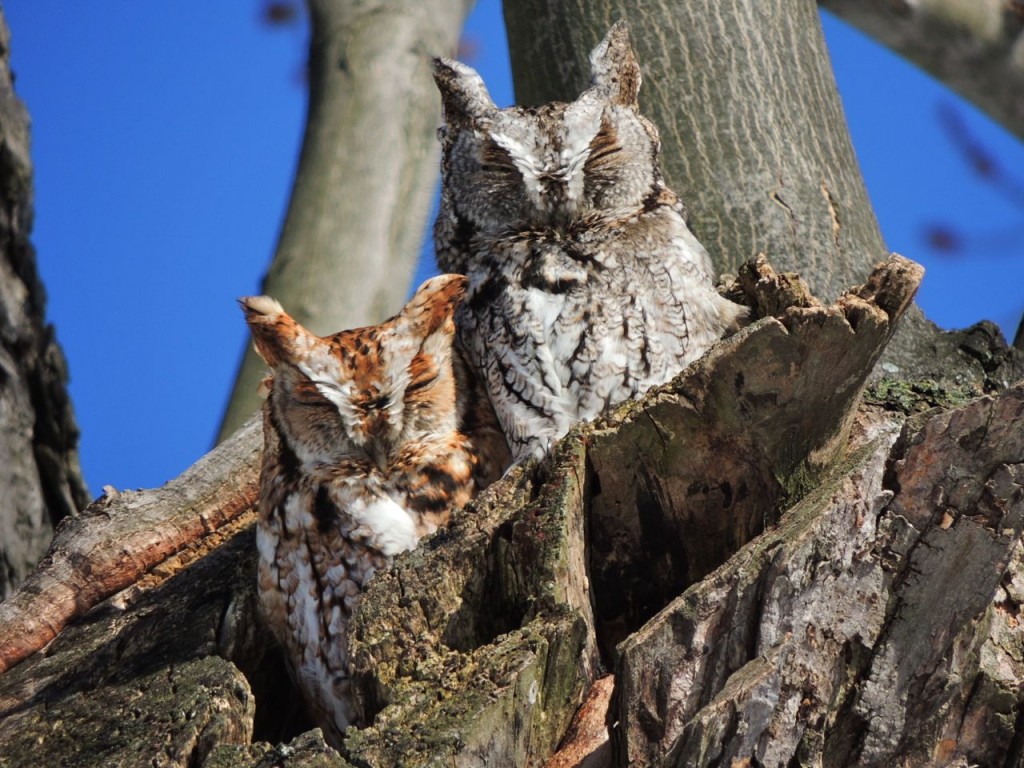
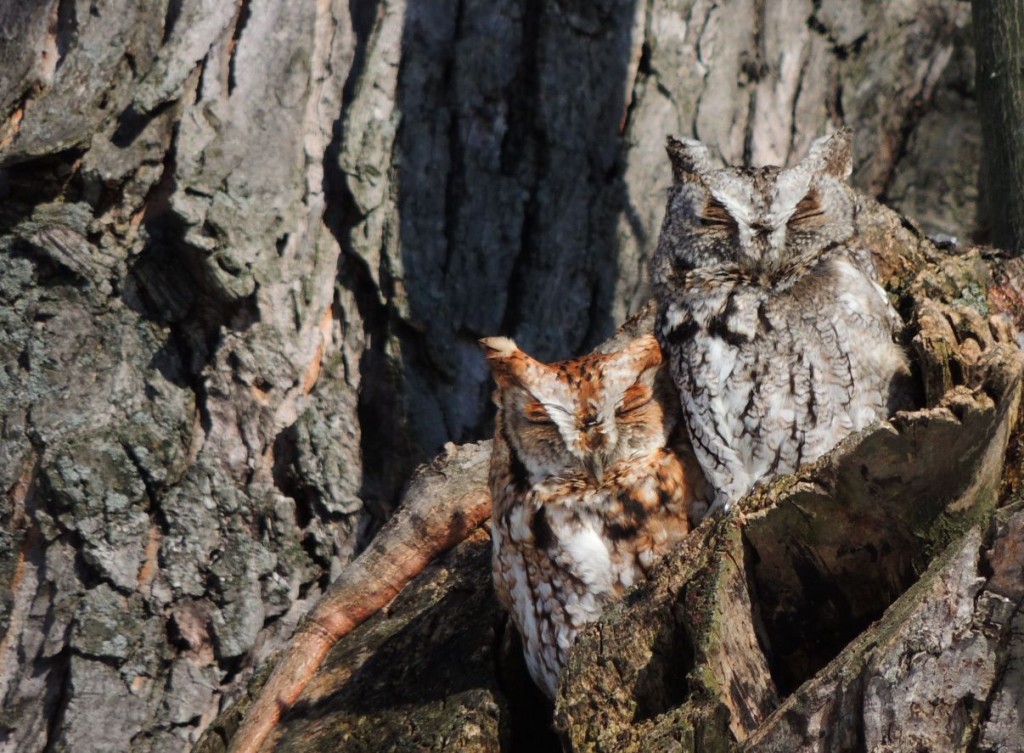
My Wow! moment came almost as an afterthought.  Completely satisfied with my morning of photo-op birds, I decided to drive around a nearby cemetery where a Screech Owl can sometimes be seen, particularly if the sun shines. He was there right on cue and since the sun shone so brightly I was spurred on to check another owl spot, where to my astonishment these two Screech Owls were sitting sunning themselves.

Screech Owl pair 3 Feb 2014

To help you interpret the picture of these two birds, I need to quote a local authority, Bob Curry, from his excellent book Birds of Hamilton and Surrounding Areas (Pub’ Hamilton Naturalists’ Club 2006): “The Eastern Screech Owls occurs in three colour morphs: grey, brown and red.  Grey Screech Owls are by far the commonest in southern Ontario, these include the similar brown morphs that are seldom distinguished in the field or in museum collections. ….Red morph birds are less well adapted to cold and are commoner in the United States.  Based on specimens in the Royal Ontario Museum….red morphs comprise about 19% of the Ontario population.

Quite apart from the sheer pleasure of seeing them, what made these birds so special was to find the brown and grey morphs together and apparently a bonded pair, a sign of spring if ever there was.

Screech Owl camouflage. Here, you stand with your back to the grey bark and I'll stand by this reddish bit.  It coordinates better.
Screech Owl camouflage. ” Now dear, you stand with your back to the grey bark and I’ll stand by this reddish bit. That way we’ll look better for the photographer.”

This post contains photos in galleries visible only on the website, not if you’re reading this as an email.