Red-headed Woodpeckers

Jamestown Island Va. 16 October 2014. Every now and then you’ll run into what seems to be a moving convention of birds of a feather. Birders often talk about waves of warblers, a fairly common occurrence in spring and fall migration when birds are moving en masse and they seem to be all around, I’ve experienced it several times.

Today I found myself in a gathering of representatives of the Picidae family; the woodpeckers, I think it was just coincidence, not a migratory wave; but whatever the reason, it was memorable.
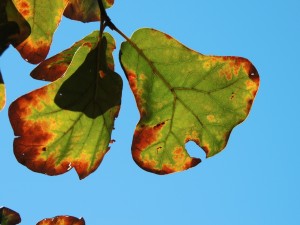
Blackjack Oak
Blackjack Oak leaves

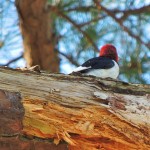
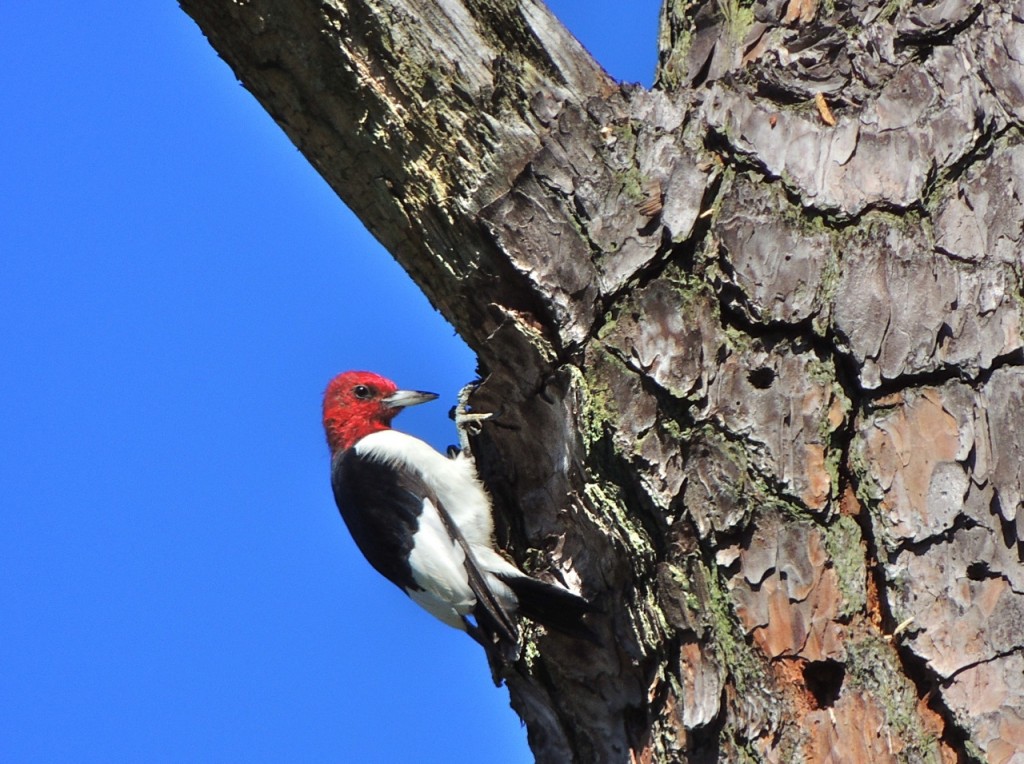
This was our last day in Virginia and I had the day to myself again. For the purposes of this posting, it’s sufficient to say that the State of Virginia, in and around tidal waters, is a great place for finding birds. I spent a few hours on the botanically and historically rich Jamestown Island, stopping now and then to examine trees like Blackjack and Post Oaks, Persimmons and Black Tupelos, and exploring in general, trying to imagine how this looked as the capital of the Virginia Colony in the mid 1600s. Making my way out to the once strategic end of the island known as Black Point, meant passing through an open glade of Loblolly Pines where I could hear the churring calls of two or three Red-headed Woodpeckers. That certainly stopped me in my tracks and moments later I was rewarded with one landing on a decaying tree trunk nearby.Red-headed Woodpecker-3
But there was more to this place than Red-headed Woodpeckers, I also noticed a Downy Woodpecker bashing noisily at something overhead and, if the Downy was bashing noisily, a Pileated Woodpecker was positively pounding, if not axeing, a pine tree just across the way. Words don’t do its efforts justice, if a picture’s worth a thousand words, then a comic-book illustration with blurred action, sprays of wood chips and Bam! star-bursts would be more like it!  It was soon evident that there were, in fact, two Pileated Woodpeckers when they started calling out to each other with their rather slow mezzo-soprano laugh . They hung around for quite a while but were last seen flying away, one chasing the other like two overweight crows. The soft ‘chfff’ call of a nearby Red-bellied Woodpecker and a yellow flash overhead, the under-wing of a Northern Flicker completed the woodpecker clan gathering.

I lingered to watch the Red-headed Woodpeckers for a long time. In Ontario they are a rare treat and a rapidly vanishing species. A pity since, in a world where looks count, they are really quite spectacular.
Black Vulture

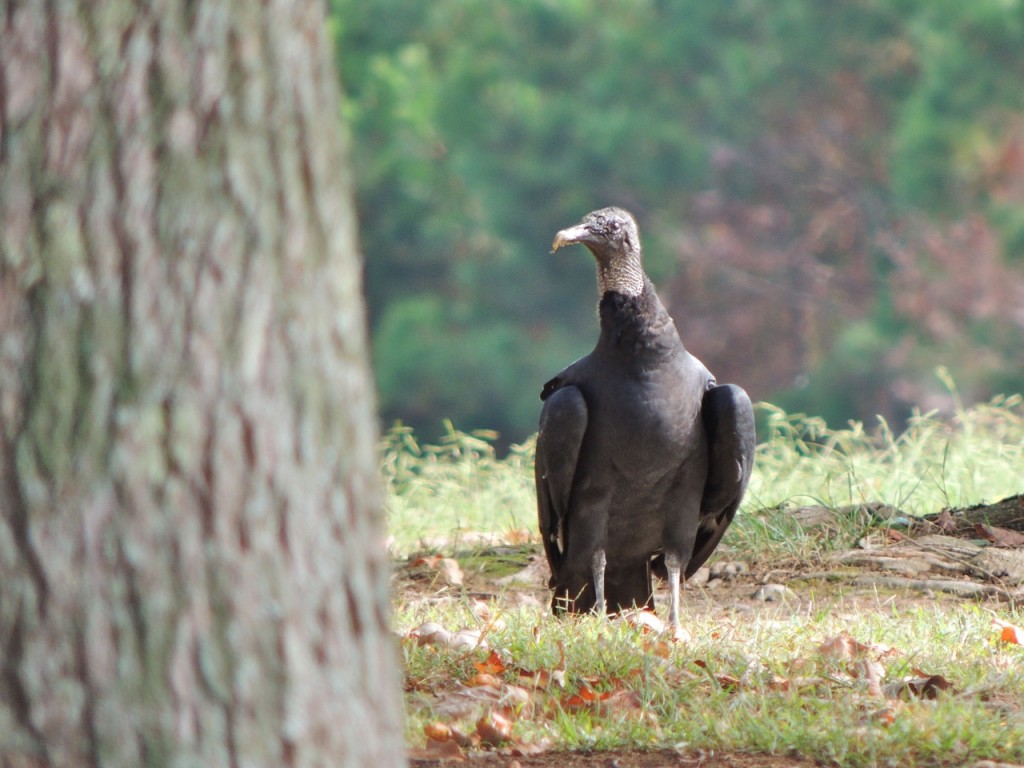
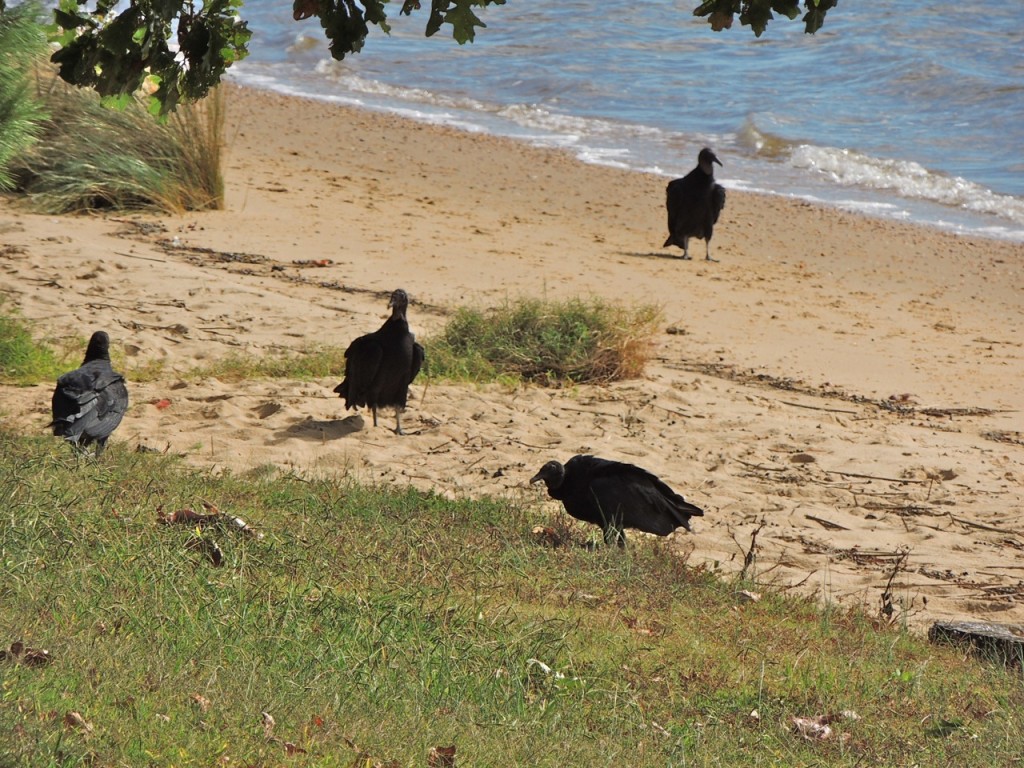
Williamsburg Va. 16 October 2014. With a full day to do as I pleased I opted to take my time investigating the rich habitats along Williamsburg’s Colonial Parkway. Encountering a group of quite entertaining Black Vultures was an unexpected surprise and it added a rather amusing novelty to an already bird-rich day.
The parkway is a winding, two-lane road that amply deserves its name. It threads through dense forests which include many of my favourite trees: Black Gums, Tulip Trees, various oak species and Paw Paws included. It leads to the shore of the wide, tidal James River and follows it along, crossing a number of reedy tributaries that empty into the James.
I pulled into a picnic area under a canopy of towering Loblolly Pines intending to explore a stretch of waterfront beach and an adjacent river-mouth. Locking my car and glancing down at the beach I saw that I was being watched carefully by a group of Black Vultures, two on the strip of sandy beach, the other somewhat closer to me and up hill a bit. I appeared to be spoiling their fun, the lower two seemed to have been enjoying a seaside stroll while the upper one was pulling on the juicy remains of a large fish. They watched me cautiously while trying to continue with their fun, the lower two started to trot away for a bit, they actually seemed to be capable of quite a canter, but after a moment had second thoughts and strolled back. The fish-dinner individual sauntered further up hill until it stood at the top looking down at the others below. By this time a fourth individual had joined them and it became quite a party. Eventually they’d had enough and spread their wide wings into the wind and lifted off, wheeling away to rise quickly above the treetops.

Black Vulture
Black Vulture

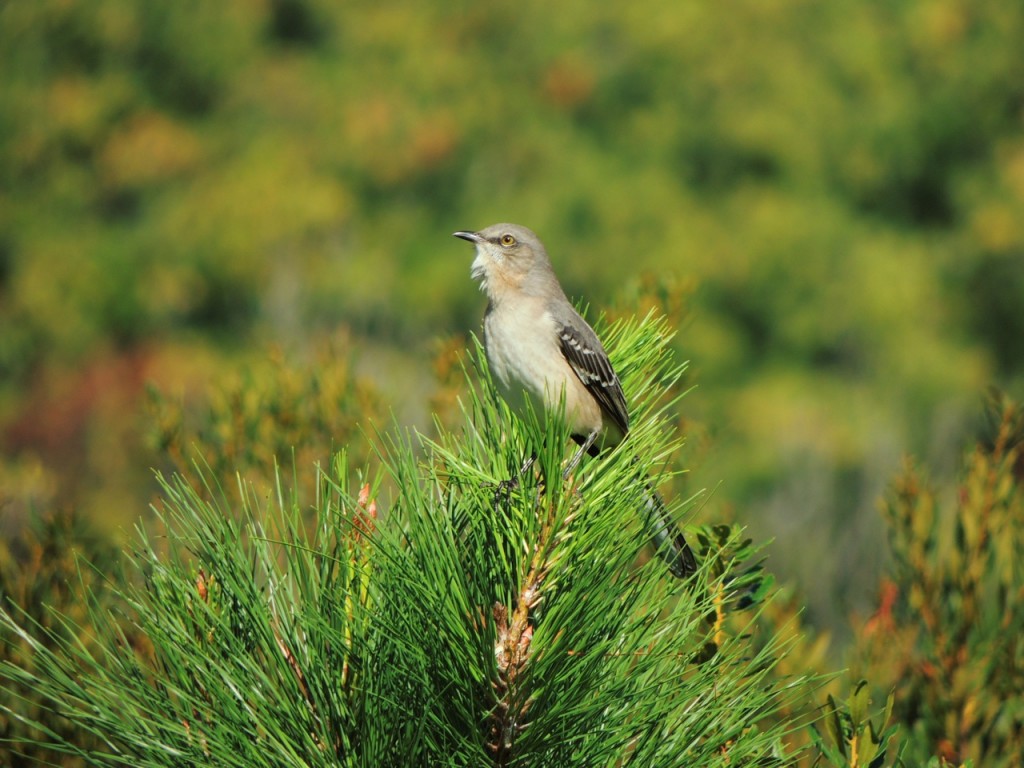
They were quite a contrast to the many smaller and prettier birds that I’d spend a couple of hours watching beforehand. The cover and abundant supply of food along the shore supports a large population of Northern Mockingbirds, Eastern Bluebirds, Yellow-rumped Warblers, Carolina Chickadees and even a Saltmarsh Sparrow – a new bird to me!

Northern Mockingbird in full song

I watched three Bald Eagles, an adult leading two juveniles, in a purposeful chase after an Osprey which had just caught a fish. The eagles soon caught up to the twisting and turning Osprey which then, perhaps as a result of hard lessons learned, chose to let go of its fish. I expected the eagles to make a mid-air catch, but instead the fish fell several hundred feet to the river below and as far as I could see, that was the end of it. Perhaps, if the fish survived its initial capture and then the fall, there was a happy ending; but there seemed to be nothing in it for either Osprey or eagles.

DSCN9140

Peregrine Falcon

October 13 2014. Chesapeake Bay Bridge-Tunnel, Virginia.  The Eastern Seaboard of the USA can be characterised in any number of ways, for millions it’s somewhere to live and work, for birders it’s the Atlantic Flyway; a migration pathway followed by millions of birds. I spent a little time today on one of the hotspots along the Atlantic Flyway, on the southern tip of the Delmarva Peninsula, a long stalactite of abundantly fertile land that separates the teeming waters of Chesapeake Bay from the vast spread of the Atlantic Ocean.

The thing about this long finger of land (and Cape May, its little brother to the north), is that it’s a great birding destination. Most of the Delmarva Peninsula is in Maryland but the southern tip lies in Virginia, not that it makes much difference to the flyway. Away from the Atlantic or Chesapeake Bay shorelines, the land is intensively farmed on wide, flat fields of cotton, beans and sweet potatoes. Dense stands of oak, Sweet-gum and Tulip Trees, impenetrably tangled with vines and briars, encircle the fields, making them suffocatingly hot for many long summer weeks.

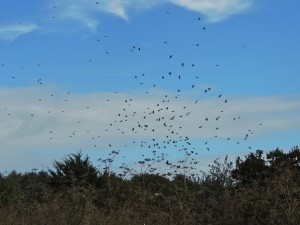
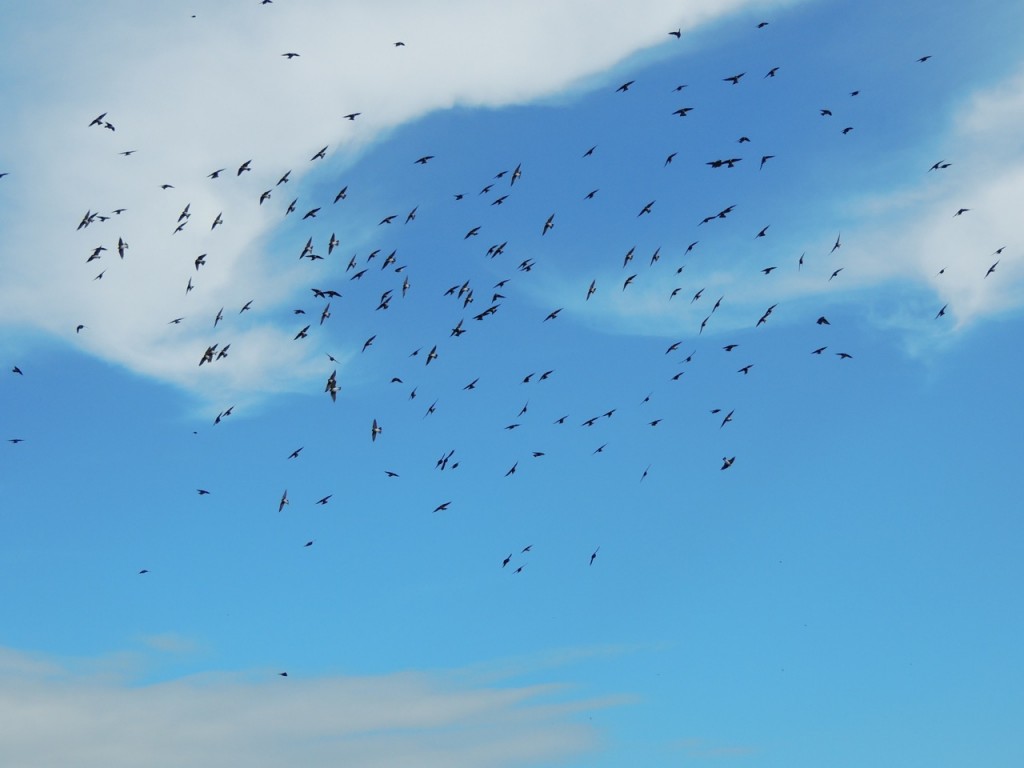
Tree SwallowsThis southern tip is alive now with migrating birds. I watched large passing flocks of Tree Swallows, hundreds strong and tailed by hopeful Merlins, Cooper’s and Sharp-shinned Hawks. At lower levels I could hear small birds chipping and calling in the bushes and trees and just above the horizon were groups of drifting Turkey Vultures and Black Vultures.

Tree Swallows
Tree Swallows

But I set out to tell of the Peregrine Falcons seen today. The first one passed low over our car and was noteworthy simply because, like all Peregrines, it flew as if it owned the skies; the second one, much later, was quite a different experience.

The tip of the Delmarva Peninsula is connected to mainland Virginia by a twenty-and-a-bit miles long bridge and tunnel combination; mostly bridge. The bridge-tunnel links the north and south shores of the mouth of Chesapeake Bay where it opens to the Atlantic Ocean.  Needless to say it is a very commercially important and strategically vital waterway. On a fine day it’s an easy drive, a touch tedious at times, but if you like ocean views and the thought of the engineering task that made it all possible, it’s a rather thrilling experience; but I imagine an approaching hurricane makes it a quite different story. As we drove across, a steady east wind was blowing and Great Black-backed Gulls were riding on the ridge of wind deflected upwards by the bridge structure. To drive north and be passed by a southbound gull surfing a wave of rising air just a few feet away and at eye-level was to make me wish I could stop for a dramatic photo. But while such a picture could be magnificent if done well, stopping to get it would be dangerous and thoroughly illegal.
But the greatest picture, held only in my mind’s eye, was of a Peregrine Falcon, my Bird of the Day, seen streaking south along that same pathway of rising air and, I like to imagine, looking each car driver in the eye as they passed.

Blue-headed Vireo

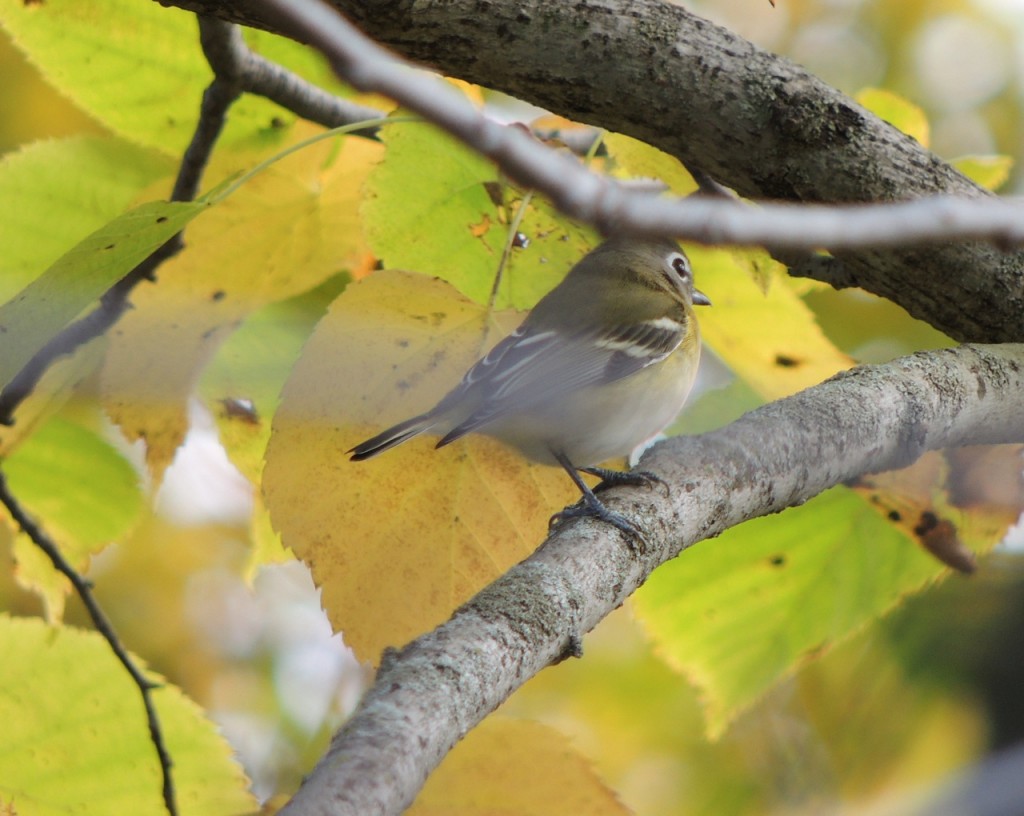
10 October 2014. Cayuga ON.  I make no apologies for celebrating a Blue-headed Vireo as my Bird of the Day even though I did so just a couple of weeks ago. Quite simply, today’s vireo met the standard that it, among all of the day’s birds, made me think Wow!

This time of year is a birding roller coaster, the weather is changeable, birds are migrating in enormous numbers and trees are shedding their leaves. I was at the bird observatory all morning, there was a touch of frost first thing, but by midday it was almost T-shirt weather. Our expansive meadows are knee-deep in what were once bright flowers but are now billions of seeds for American Goldfinches, House Finches and Song Sparrows, and there are trusses of wild grapes drawing in squalling flights of American Robins and young Cedar Waxwings; it’s time to fatten up .

My census round seemed quiet at first but here and there I could hear (and sometimes see) White-throated Sparrows or their close cousins White-crowned Sparrows. I watched two Northern Flickers high in a Shagbark Hickory feasting on Poison Ivy berries. (A couple of side notes: Our local sub-species of Poison Ivy is a high-climbing woody vine, unlike the more northerly ground-hugging version which rarely grows more than a metre high. I doubt any rational person would venture to eat the berries but clearly many other creatures are unaffected. After all, berries are the way they are in order to be eaten by something.) I noted a few Yellow-rumped Warblers foraging and it wasn’t until near the end of the census route that I found the Blue-headed Vireo. It seemed quite unmoved by the mini-crisis that was being whipped up by a small group of Black-capped Chickadees and a handful of anxious Chipping Sparrows. The vireo just went on about its business of gleaning insects from the inner branches of an American Basswood. I stood to watch and enjoy it for a while although it was never still for very long but I was able to get this satisfying action photo.

Blue-headed Vireo
Blue-headed Vireo

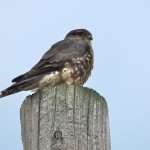
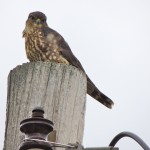
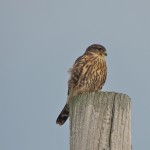
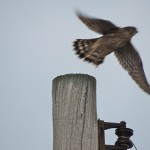
Merlin

8 October 2014. Burlington ON. I didn’t go looking for birds today; there are other things in life. But the day nevertheless ended with a lucky and spectacular sighting, a Merlin; I’m sure it saw me long before I saw it.

I have been helping a friend who is seeking election to the local city council. We spent much of the afternoon knocking on doors and as afternoon was turning into rush hour, I stopped to install one of her ‘Vote For Me’ signs on a strategic corner. I had finished the job and was just putting my tools away when I glanced up and noticed a good-sized bird sitting atop a utility pole. I knew immediately that it was a falcon and a quick binocular check told me that it was a Merlin.

Two things about Merlins: they terrify smaller birds and they make flying look easy. It’s a little difficult to be sure, but I think the back is bluish enough to make this a young male, but male or female, young or adult, a Merlin would be Bird of the Day any day of the year .

I admired it for a while and then decided that it was worth the gamble of driving home to get my camera; normally I wouldn’t bother, few birds stay in one place for very long. But Merlins are hunters that pounce on the unsuspecting and are inclined to sit and wait for an opportunity. Home was a two-minute drive away (maybe five in rush hour), the question was whether it would wait long enough.

Well, it did. I returned and was able to take many photos that capture both the hunter and the vulnerable inner individual, just another creature struggling to survive. As I returned to my car, I turned for one last shot and caught the moment of its take off.

The photos in the gallery above is visible only on the website, not if you’re reading this as an email.