Fox Sparrows

11 November 2014. Burlington ON. This just might have been the last warm day of the year. Taking advantage of this beautiful grab-it-while-you-can day, we took our exercise along a bird-rich valley and were well rewarded.

My companion soon spotted a very unexpected Cooper’s Hawk sitting on the railing of a large pedestrians-only bridge. Knowing that Cooper’s Hawks rarely tolerate human closeness for long, and hoping for a perfect photograph, I moved closer as unobtrusively as possible. Well, the results weren’t great but here’s what we saw.

Coopers Hawk
Coopers Hawk

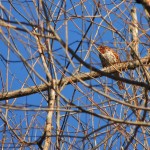
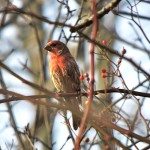
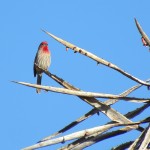
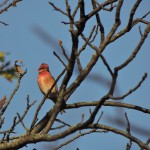
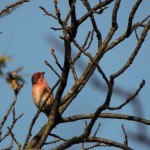
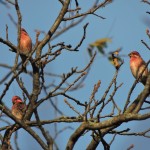
Recently I dwelt on the mild embarrassment of being phalaroped; that is to say, leading myself down the garden path to an incorrect identification. I came close again today. We approached a group of three smallish birds high overhead in a bare, perhaps dead, tree. Through binoculars and craning my neck, I struggled to make an identification. Eventually I concluded that I was looking at three juvenile Rose-breasted Grosbeaks. I thought I was seeing the streaky underside of three young males with a vague patch of crimson at the throat. Their size was right, the timing was okay, but not perfect, Rose-breasted Grosbeaks should be well on their way to Guatemala by now, and frustratingly, I couldn’t think what else they might be. Fox Sparrows was a possibility, although I don’t associate them with tree-tops, they are birds of the forest floor that like to scratch around in leaf litter. My camera is the perfect tool in marginal viewing situations like this, so propping it against a stable surface, I took several pictures for closer scrutiny later. I’m glad I did for that’s when the Rose-breasted Grosbeak idea came unstuck.
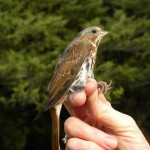
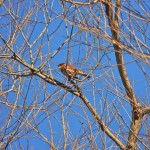
Above (in a gallery visible only on the website, not if you’re reading this as an email.)  are a couple of reasonable photos of today’s birds as well as another individual in the hand for comparison. I make today’s birds Fox Sparrows. Here’s why: The imagined crimson at the throat turns out more of an agglomeration of brownish-red spots the same colour as its wings and under-tail, and consistent with a common field mark of Fox Sparrows. The reddish chevrons on the breast and belly are right for a Fox Sparrow, and wrong for a grosbeak. I’m left, however, puzzling over these three being way up high and exposed on top of a tree when I always though of them as birds of the low leafy understory. Most reference books make that point, only Pete Dunne acknowledges that Fox Sparrows, when flushed, often fly straight to take a high perch in a tree. Conclusion: there’s always something to be learned and the birds don’t necessarily read the texts.

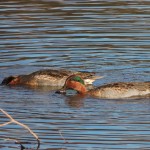
There were other nice birds this morning. Notably, several shiny Green-winged Teal dabbling and swimming alongside some, giant by comparison, Mallards. Later a Sharp-shinned Hawk wheeled low overhead showing off the bands of its fanned tail and its under-wing patterns.

Green-winged Teal (F & M)

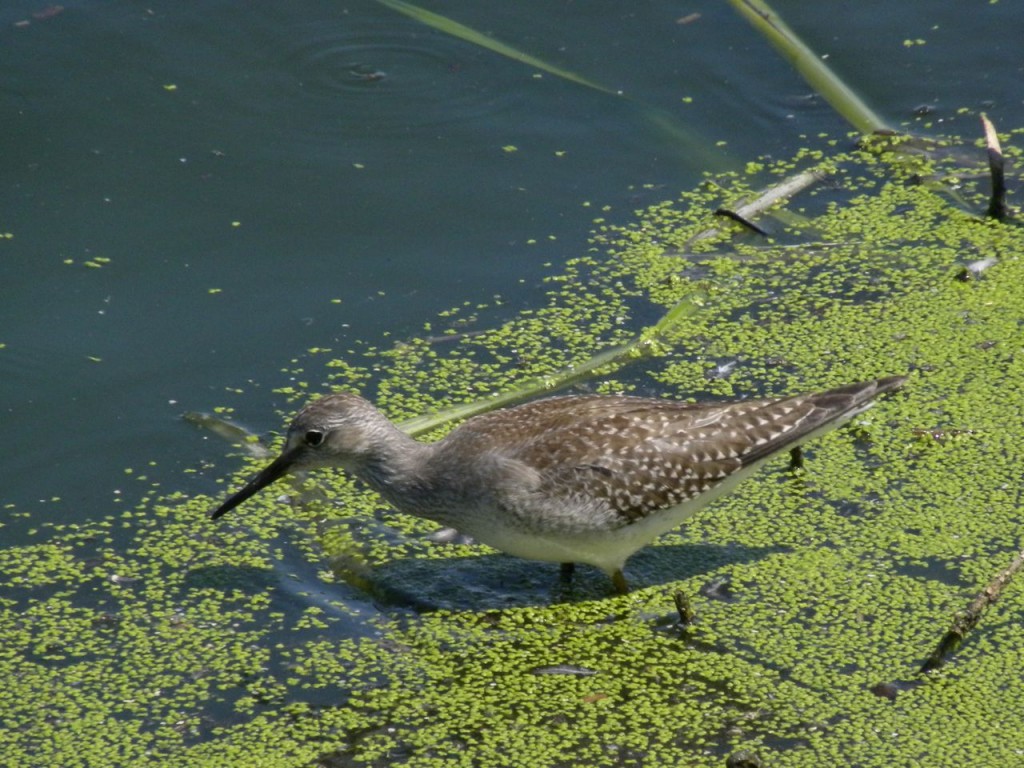
Lesser Yellowlegs

2 November 2014. Cayuga ON.  This Bird of the Day story started this same first weekend of November three years ago when I was taking part in our local naturalists’ clubs annual Fall Bird Count. A companion and I were criss-crossing an expanse of quiet countryside, mostly farmland and deciduous woodlots. A wide, yet generally shallow, river marked the west boundary of our chosen area, and it was on the shore of this river that we came across a sensational sighting, a phalarope; at least that’s what I made it out to be. On the opposite, gravelly, margin of the river I saw a small grayish shorebird wading chest-deep, or possibly swimming, darting and twirling in a frantic chase for food. It was really at the limit of reasonable binocular viewing, but I was almost certain that it was a phalarope of some kind. But… I hadn’t seen many phalaropes in my life, wasn’t really sure which of two or three of the world’s species it might possibly be, and wondered if it wasn’t getting a bit late for in the fall for them anyway.

Well, after my excitement had died down, and in the exercise of an abundance of caution, my companion and I drove to share the triumph with, or maybe solicit the help of, an expert birder who was rather easily convinced to come and look. By the time he arrived, there was no phalarope to be seen, however we could see a Lesser Yellowlegs picking and prodding for food along the same stretch of shoreline. I think it would be a 99.999% certainty that this was the very same bird that we’d seen, chest deep in water, barely an hour earlier. We thereupon coined the term ‘phalaroped’ as the term for willfully allowing yourself to be misled as to a bird’s identity. Being phalaroped is one of the realities of birding; it happens too often.

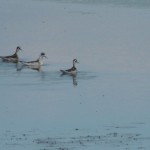
These photos, the two above of a bunch of distant Red-necked Phalaropes  (click photo to enlarge) and one below of a Lesser Yellowlegs, may help illustrate how, under marginal viewing conditions, they could be confused.Lesser yellowlegs

Today I undertook to cover that same territory for this year’s Fall Bird Count. It was sunny and cold and we encountered some notables including a flock of 45 House Finches, a young Bald Eagle being harassed by three Red-tailed Hawks and a Northern Harrier, always an elegant bird. But best Birds of the Day came at that same river’s edge where, to my astonishment, on the opposite, gravelly, margin were two Lesser Yellowlegs ! Same time and place; could it possibly be that one of them was the same bird as my phalarope of three years ago?

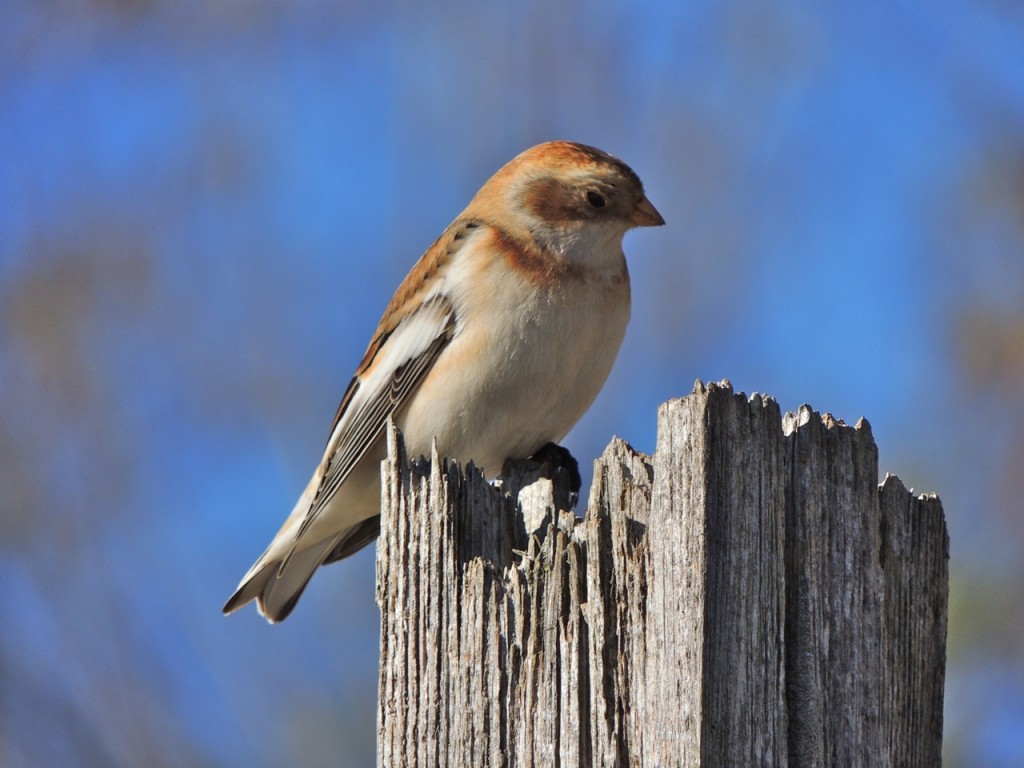
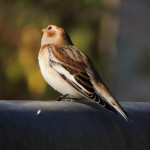
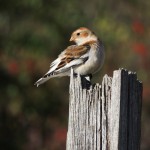
Snow Bunting

30 October 2014. Burlington ON. The study of birds, like many a generally worthwhile pursuit, is a constant learning experience. This morning included a teachable moment that reminded me just how much I don’t know.Snow Bunting. Valley Inn-2

Towards the end of a satisfying birding morning we came upon a solitary Snow Bunting that left me almost speechless. I was sure, certain, that we’d found a bird so far out of season as to be at least a mild sensation. After all, Snow Buntings are birds of mid-winter, January and February, they’re birds of hard cold days when the landscape is stark, hostile and windswept, not mild and still leafy as it was today.

I could hardly wait to get home to post a “Guess what I saw!” sighting on our local bird-reports line. But first (at least I’ve learned to look before you leap too far)….a precautionary check of the bible of local birding, Robert Curry’s Birds of Hamilton and Surrounding Areas. Here’s what I read; “We know them as winter visitors along the shores of Lake Ontario and Hamilton Harbour when they first arrive in October, and later in open fields as snow cover develops… In late October, flocks of arriving Snow Buntings sweep along the Lake.” Curry reports mean fall arrival dates in the last week of October. Well, yes, but… Oh never mind, it was a delightful sighting, it made my day (Bird of the Day) and it taught me something I didn’t know; Snow Buntings arrive here in October; look for them. Here’s a few more shots of it in a gallery.

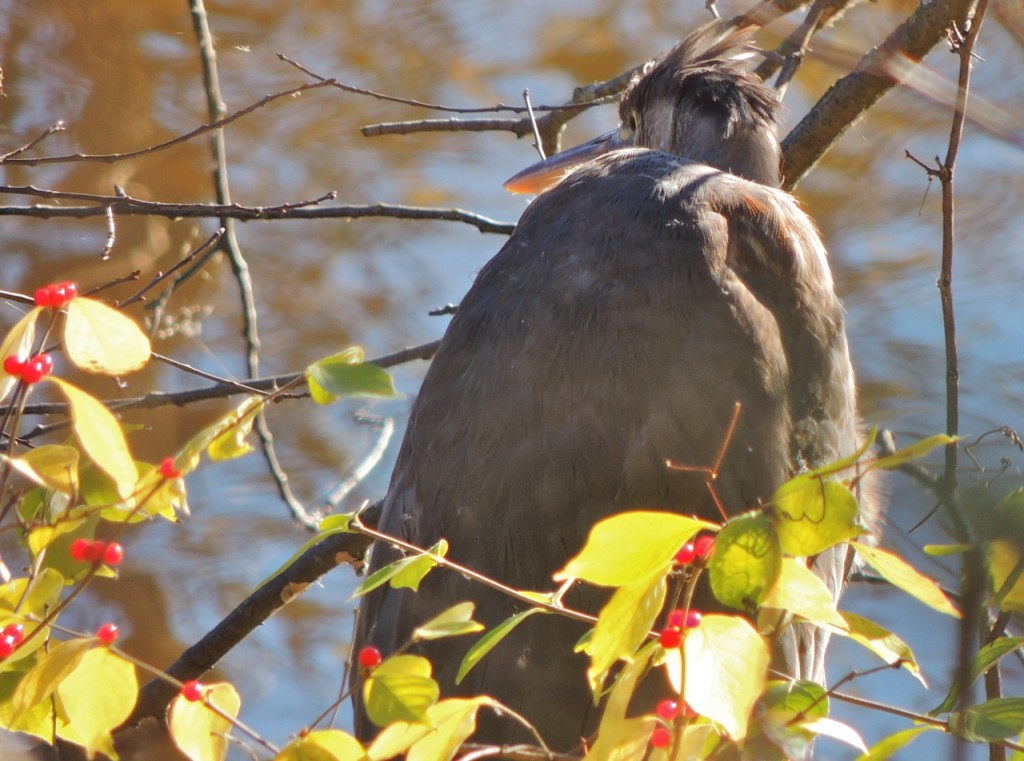
It was not the only highlight of a pleasant two-hour walk through some of the richest, most varied habitat in our region. It started out a little flat with Slate-colored Juncos, White-throated Sparrows and Black-capped Chickadees, nothing wrong with any of those, but nothing all that newsworthy about them either. I had the company of a couple who are fairly new to birding and Marion was pleased when I found a small flock of Eastern Bluebirds, a first for her. A little later we watched a group of Cedar Waxwings feasting on the berries of Tartarian Honeysuckle and were surprised to see a Great Blue Heron perched on a riverside branch, uncharacteristically ambivalent about our closeness. For a while I wondered if it had managed to get itself into a place without an easy exit and therefore making it difficult to fly off, Great Blues are usually quick to distance themselves from any possible human threat.

Great Blue Heron
Great Blue Heron

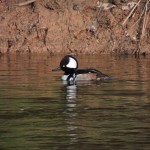
Reaching an area of shallow water and mudflats, we were treated to a couple of small flotillas of Hooded Mergansers diving for whatever is usually found in shallow silty waters. The males were very spectacular in their striking winter/breeding plumage, especially with their hoods raised. There were Mallards, Northern Shovelers and Green-winged Teals too. The males of these latter three were in different stages of their fall moults which will take them into full breeding plumage. Mallards are now back in full look-at-me plumage, Northern Shovelers part-way there and the Green-winged Teals quite a long way from their Sunday best.

All of the above-mentioned ducks are in this gallery, but you’ll have to be on the website to see them, you’ll not see them if you’re reading this as an email.


Purple Finches and Tundra Swans

28 October 2014. Cayuga ON.  For a long time this morning, doing the census round at the bird observatory was like walking into a theatre which, save for a few stragglers, held nothing but empty seats. Where, metaphorical moments ago, there was life, today our rich woodlands and river valley seemed deserted; not entirely of course, but what a contrast to those busy fall migration days of just a few short days and weeks ago.

I was counting American Crows, Red-winged Blackbirds and Blue Jays in ones and twos. I could hear a Carolina Wren on the other side of the river, and an Eastern Bluebird somewhere not too far away but I couldn’t see either of them.

Things looked up when a group of six Purple Finches flew up into the lower branches of a Black Walnut and obligingly sat around to be photographed. Purple Finches are neither common nor uncommon, but they always seem to be noteworthy because the males are so striking. Field guides often describe them as looking as though they’ve been dipped in raspberry juice, a little over-folksy I think, but not inaccurate. It’s quite easy to confuse them with House Finches, but the males of the latter species, while quite surprisingly crimson at times, are not as expansively tinted from head to tail. To illustrate, I have included a couple of House Finches along with some of today’s birds in the gallery below. (Visible only on the website, not if you’re reading this as an email.)

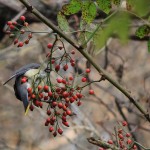
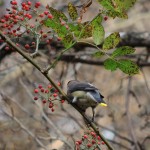
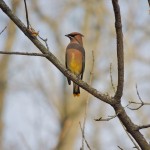
Later, I found a small group of Cedar Waxwings feeding on the bright orange fruits of Multiflora Rose briers. My presence made them flighty, so I sat down and remained quite still.  After a while they seemed to accept that I presented no mortal threat  and I was able to get the photos below (Also visible only on the website, not if you’re reading this as an email.); and in those same quiet moments caught sight of a Golden-crowned Kinglet.

I was quite pleased to find the Purple Finches and had notionally flagged them as Birds of the Day, but then much later I heard a quiet, distant, bugle-like call which, at first, I thought might be a Sandhill Crane . But moments later a V of twenty-seven Tundra Swans swept low overhead, calling softly, “wu wu”, amongst themselves as they went. They’ve come from their breeding grounds on the arctic shores of James and Hudson Bays and are on their way to Chesapeake Bay.

I have chosen Tundra Swans as my Birds of the Day many times, but usually in early spring. Today they are a sure signal that cold weather is on its way, but that same high-in-the-sky conversation when heard again four months from now, will be welcomed as a sure sign of the end of winter as they return from their Atlantic coast wintering grounds and head north once again.

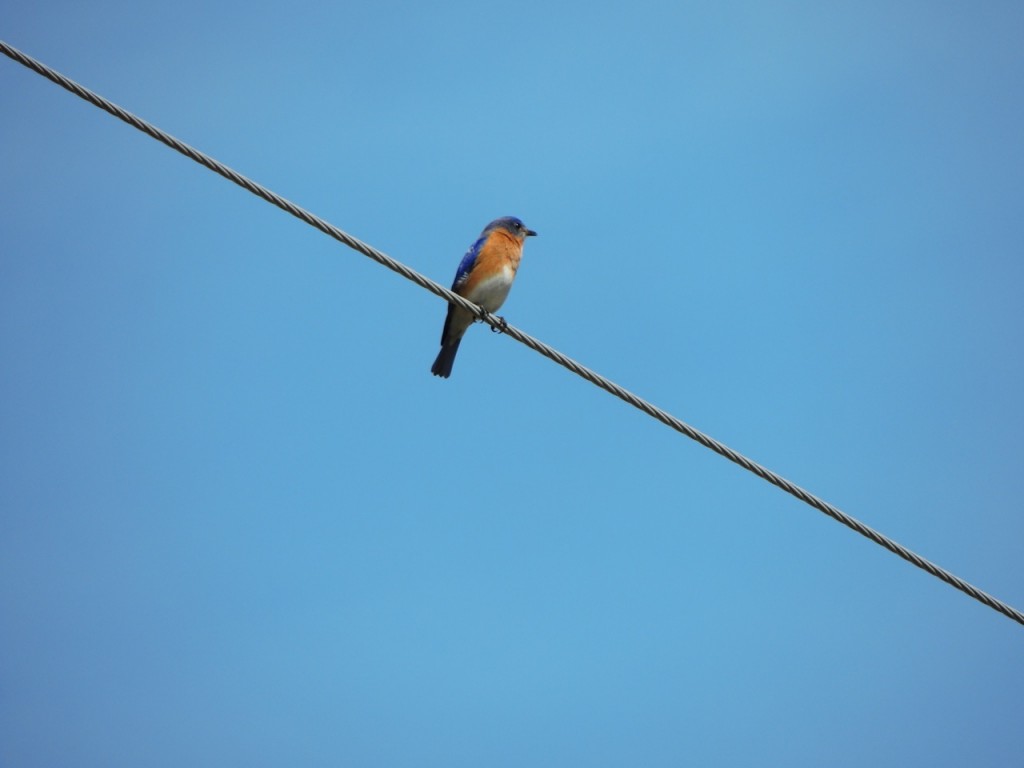
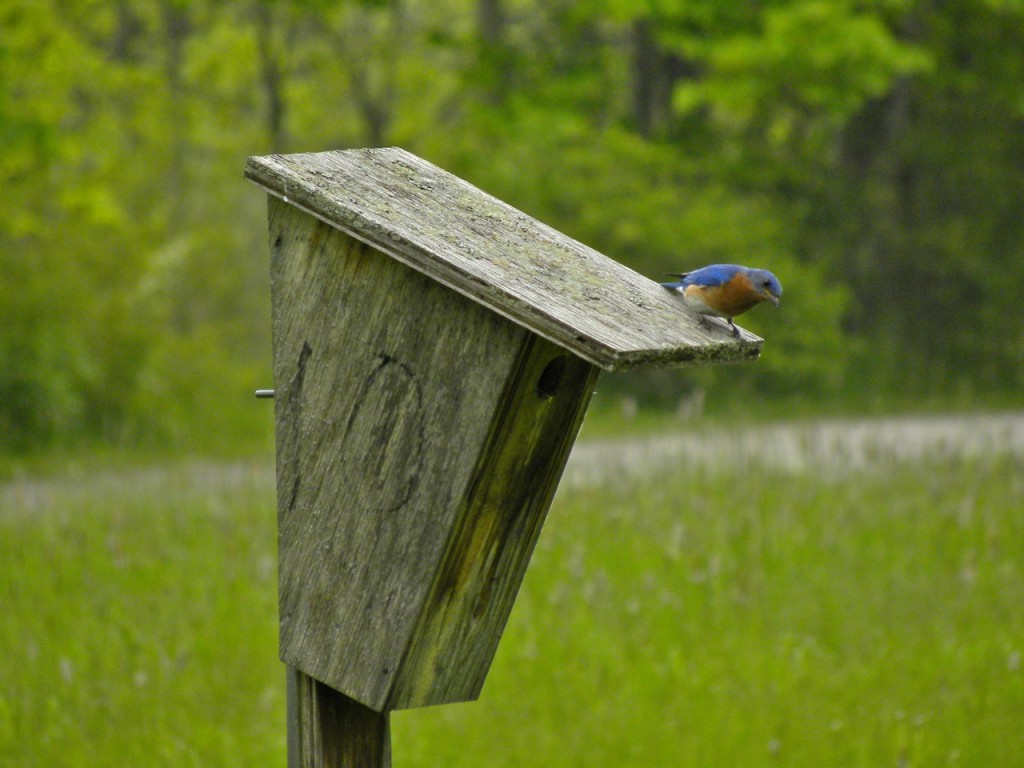
Eastern Bluebirds

Ancaster, ON. 25 October 2014.  Baby-sitting three pre-school boys for a weekend doesn’t leave much room for birding; none really. But I managed to find a couple of hours, having previously agreed to join a group examining a tract of land which has recently become a restoration project.

Well, when we arrived, a southwest wind was blowing a gale and rain was threatening. With every gust, another branch was stripped clean and the air filled with tumbling leaves. A sky full of leaves is a betrayal, things airborne being the stock in trade of most birders.

We traipsed around the field, which the owner, a university, had forgotten it owned until just a few years ago. In the half-century or so that have elapsed since the land was acquired (and forgotten), this one-time farm fell victim to the march of European Buckthorn, an invasive species. Using undergraduate labour, the university is trying to restore the land to its original post-glacial, pre-contact state; chainsaws and bonfires are blunt but effective starts to the process.

We saw precious little in the way of bird life; everything with wings seemed to be staying out of the wind. But our day brightened considerably when we came upon a mixed-age flock of Eastern Bluebirds gathered in a sheltered valley; they were deservedly my Birds of the Day.Eastern Bluebird (male) RP

Eastern Bluebirds are widespread across the eastern half of the continent and are year round residents everywhere south of the Mason-Dixon Line. But we are well north of that line and our bluebirds are migratory, most of them anyway; a few sometimes overwinter. We often see these mixed flocks at this time of year and usually they’re loose, rambling groups. Just when you think there’s a dozen birds, more appear and then more again.

The sight and sound (they have a charming fluting call) of the bluebirds certainly brightened up a rather dreary outing, which was otherwise only punctuated by a wind-tossed Turkey Vulture, a solitary Red-bellied Woodpecker and a few robins and goldfinches.Eastern bluebird May 29 2011