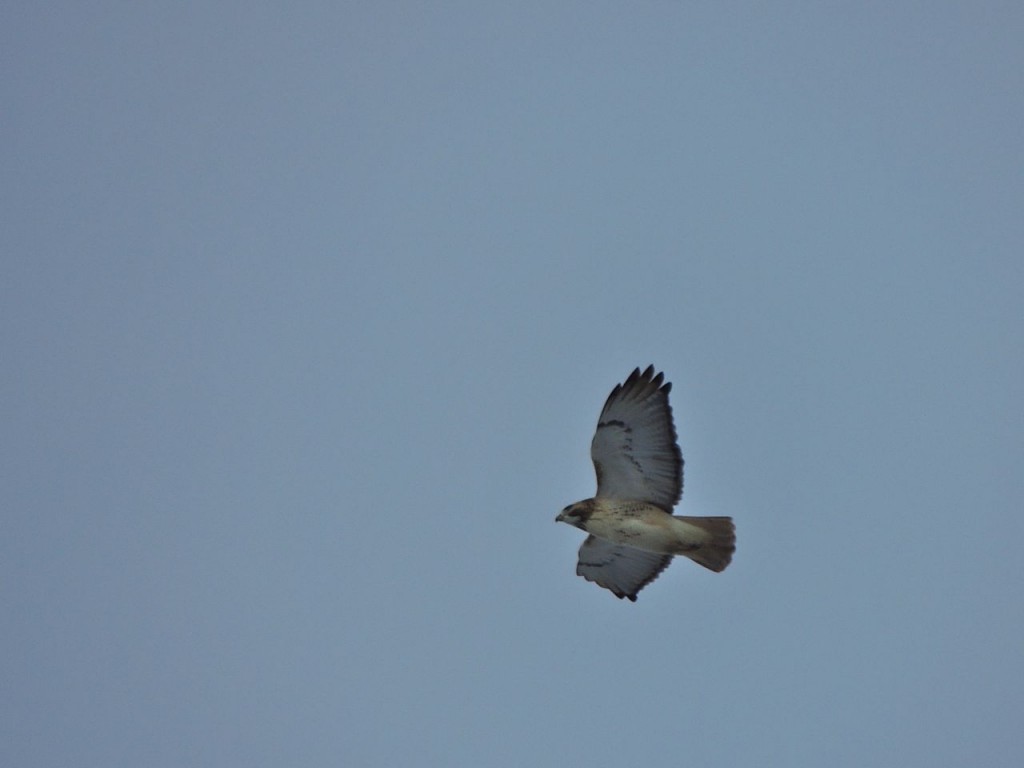
Rough-legged hawk.

30 November 2014. On a mild, yet monochromatic, day I walked various sometimes-birdy stretches of the perimeter of the large industrial harbour that dominates our local geography. It was warm enough but, the bright orange berries of Bittersweet notwithstanding, I was quite conscious of how much natural colour had drained away. It was, as I noted above, a monochromatic day.

Interestingly, the few bird species I made note of were low on colour too. To wit: Several Horned Grebes in their winter greys and whites instead of summer gold and chestnut; A Northern Mockingbird, always pearly grey; A handful of Hooded Mergansers, the young ones in dusky brownish grey and the handsome adult males in black and white; And a young Common Loon, so people-shy that it seemed reluctant to admit to any buoyancy, showing only its mottled grey brown back.

A howling west wind, whipping up whitecaps, kept a windsurfer happy and I watched him for a while. I wondered about the efficacy of his dry-suit, the cold on his exposed hands and face and the advisability of spending any time whatsoever doused in the waters of this famously polluted industrial harbour. As I turned to leave, I noticed a Rough-legged Hawk high overhead making its way efficiently against the wind. At first I thought I was a Northern Harrier because it was so strikingly long-winged. But through binoculars I could see the diagnostic black belly and under-wing patches that mark a Rough-legged Hawk. I suspect the effort and dynamics of flying into the wind accentuated the relative long-winged-ness of this species, a characteristic that gives them a rather languid, floppy appearance when hunting low over winter fields.

I was glad of this Rough-legged Hawk for adding some metaphorical colour to the day even though splotches of black had been the keys to my identification of it.
Pied-billed Grebe and Ruddy Ducks.

28 November 2014.  As October wears on and the birding just keeps on going, I invariably make a mental note that this winter I’ll be hardier, I’ll dress for the weather (whatever it may be) and I’ll be out there keeping active and birding. The thought that there will be many fewer birds doesn’t matter, it’ll be fine. Then the first bite of winter arrives and my resolve fades.

Today, after a morning of domestic errands, I faced a choice: Take a long walk sheltered from the icy wind and hope for some interesting lingering migrants, or head home for a hot lunch? I opted for lunch, but a bit of internal nagging directed me to make a few diversions along the lakeshore, just in case. It was hardly vigorous exercise but it turned out to be worthwhile.

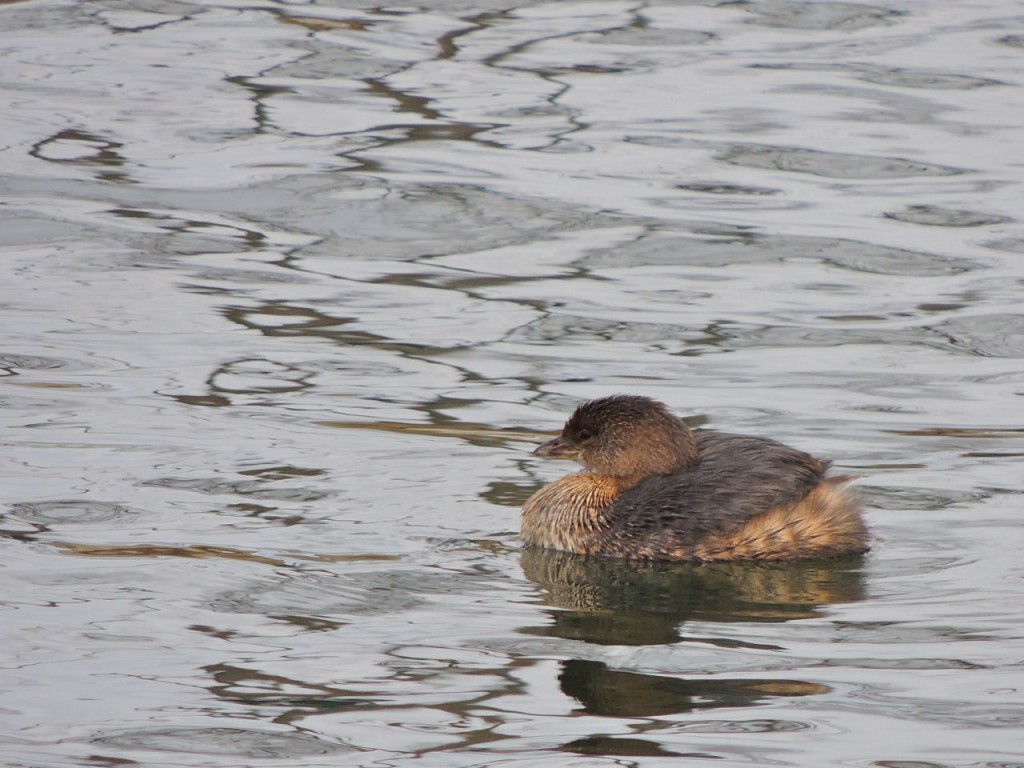
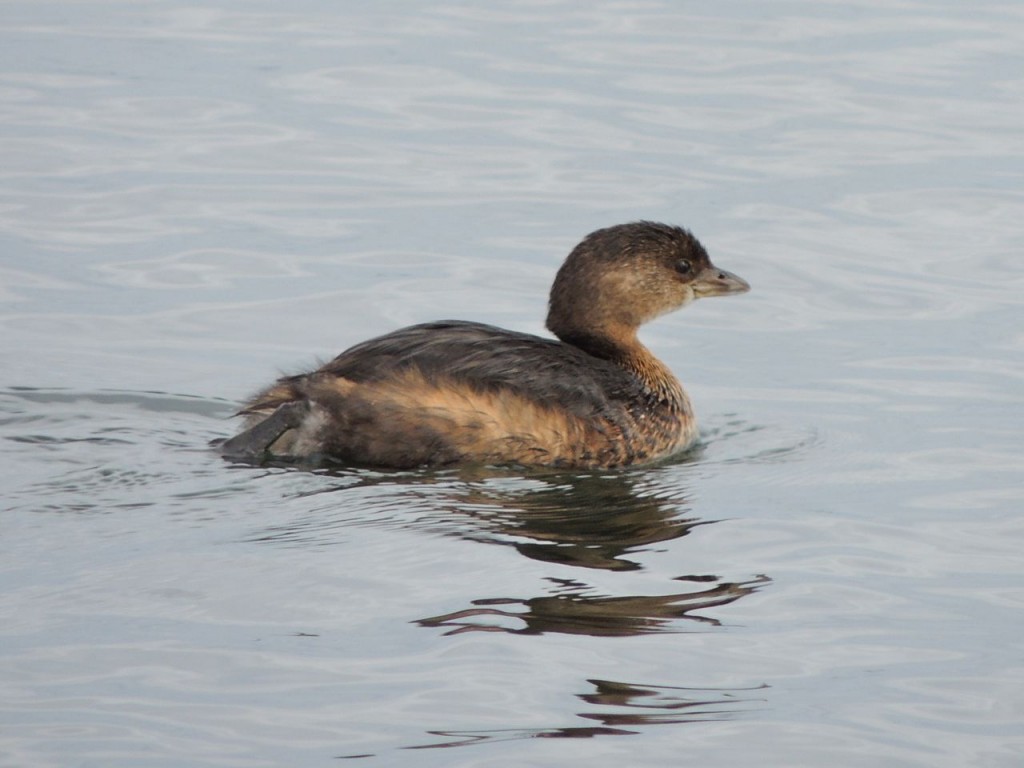
My first stop was a marina that attracts lots of waterfowl. The inlets seemed to be choked with Mallards and a scattering of American Coots and Lesser Scaup. Then the anxious retreat of something smaller and rounder caught my eye, so I made my way to a better vantage point; and there I was able to watch and eventually photograph this Pied-billed Grebe.

Pied-billed Grebe
Pied-billed Grebe

I was kind of enchanted because Pied-billed Grebes are rather enigmatic birds: they’re grebes, which should mean they have a certain subtle presence about them; but they don’t, they’re more chicken-like. When it comes to breeding season, when that stubby little bill turns whitish with a black band around it, (hence the name) Pied-billed Grebes hold their own; dowdy looking though they may be, they can howl like a banshee from within the obscure corners of cattail marshes. If you didn’t know what you were hearing, the territorial wails of a Pied-billed Grebe would stop you in your tracks. Cool birds.

Pied-billed Grebe
Pied-billed Grebe

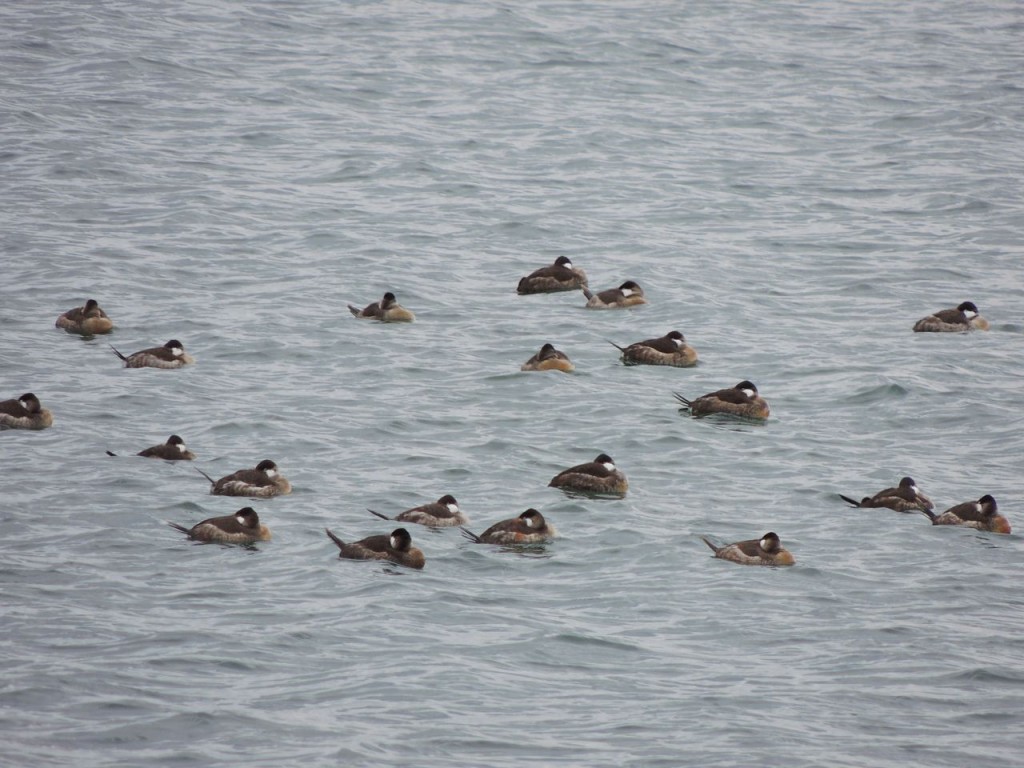
Nearly home, I parked for a moment to get a better look at rafts of small ducks bobbing just offshore; they turned out to be Ruddy Ducks. I wouldn’t go so far as to say they’re unduck-like, but that little stick-up tail does set them apart, in much the same way Pied-billed Grebes don’t quite fit the mould. Ruddy Ducks are part of a group called Stifftails, a collective name for any of several small, round ducks with short wings and long spiky tail feathers. The Ruddy Duck is the only North American member of the group (ignoring questionable sub-species); there are others (but not many) in South America, Europe and Africa.

Ruddy Ducks
Ruddy Ducks

At one time, our Ruddy Duck was seen as a valuable and ornamental addition to various wildlife parks in Europe. Once settled in, it began breeding furiously with its European cousin, the White-headed Duck, and in no time hybrids started to dominate the landscape and the pure White-headed Duck was in danger of genetic extinction. Culling the Ruddy Ducks, and presumably any obvious hybrids, and leaving Europe for White-headed Ducks has solved the problem. I recall from my trip to Spain in September that the sight of a White-headed Duck quite excited my tour group leader; they had indeed become nearly extinct. So we get to keep and admire our Ruddy Ducks and there they were today all bobbing around, heads tucked in apparently asleep.

Black-capped Chickadee

20 November 2014.  This was an unusually wintery day (and week) for mid November; but not without precedent I’m sure.  It was very much more like January, with permanent-looking snow on the ground and a wickedly cold wind that blew a couple of  Red-tailed Hawks around like old newspaper pages.

Wind blown Red-tailed Hawk

This wallop of cold came, as a river of frigidity, straight from the Arctic. It got started a couple of days ago and really picked up steam yesterday. Bitter winds swept the length of Lake Erie absorbing buckets of relatively warm moisture and then dropped it as snow on the hapless City of Buffalo; two metres of snow is a lot – even for winter-savvy Buffalo.

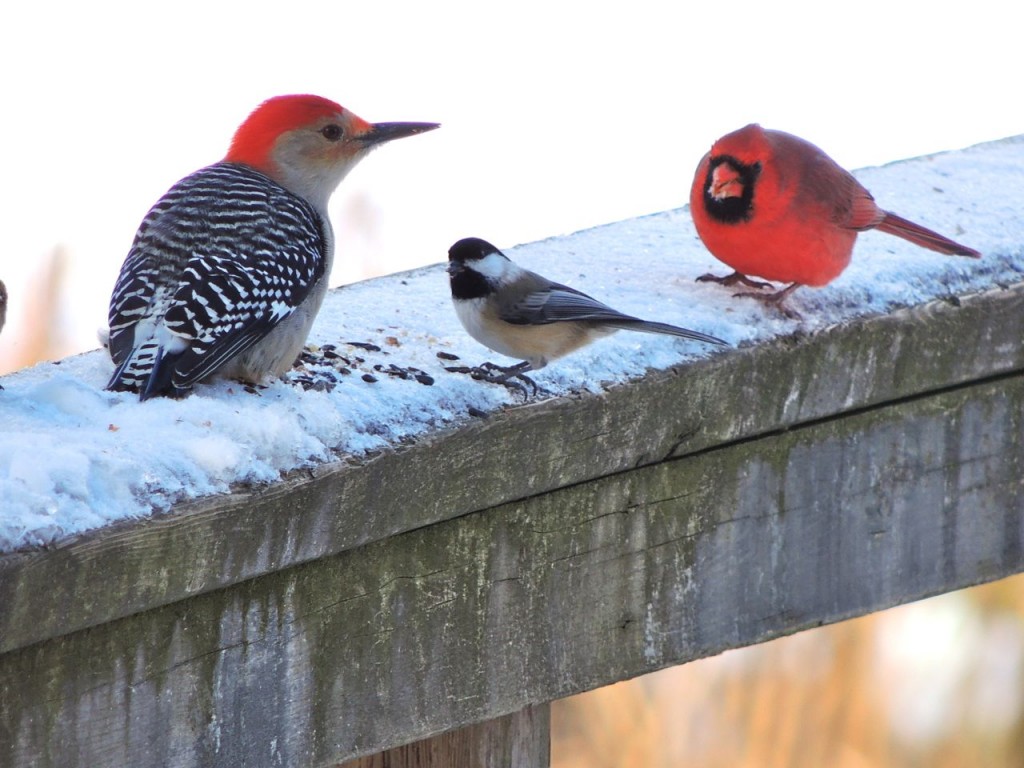
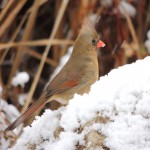
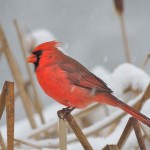
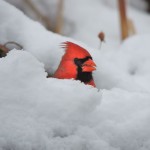
Bundled up in clothes that haven’t been out for nine months, I walked up through one of my favourite sheltered valleys. I had hoped for some unusual birds trying to make it through this hostility. Well, there were no strangers but our resident birds were happy to scavenge for handouts. This valley is part of semi-public lands (technically private, but open to the public as long as they stay on trails). It attracts many walkers and bird-feeders, particularly families on weekends.  The resident Black-capped Chickadees and White-breasted Nuthatches have become quite tame and will feed from an outstretched hand. Red-bellied Woodpeckers, Blue Jays and Northern Cardinals are almost as bold; you can imagine how appealing this is to families with young children.

Red-bellied Woodpecker, chickadee & cardinal in early snow

All of these birds were there, all of them hungry and engaging. But by far the most abundant were Black-capped Chickadees. Whenever I stopped to look around, they’d fly in and sometimes land on my hands for no apparent reason (other than the reasonable hope that I was offering food). I don’t have any idea how many Black-capped Chickadees live in this valley; it’s a lot, probably too many. Nor do I know how many of them are year-round residents or how many just come for the lean months.

Knowing, as we do, that birds migrate seasonally in pursuit of accessible food or breeding territory, it’s not hard to imagine that Black-capped Chickadees from miles around have always sought wintering spots like this valley for shelter and food. And this particular retreat with its superabundance of food well, it’s cute, but I think a touch unhealthy; too many birds of one species in one place.

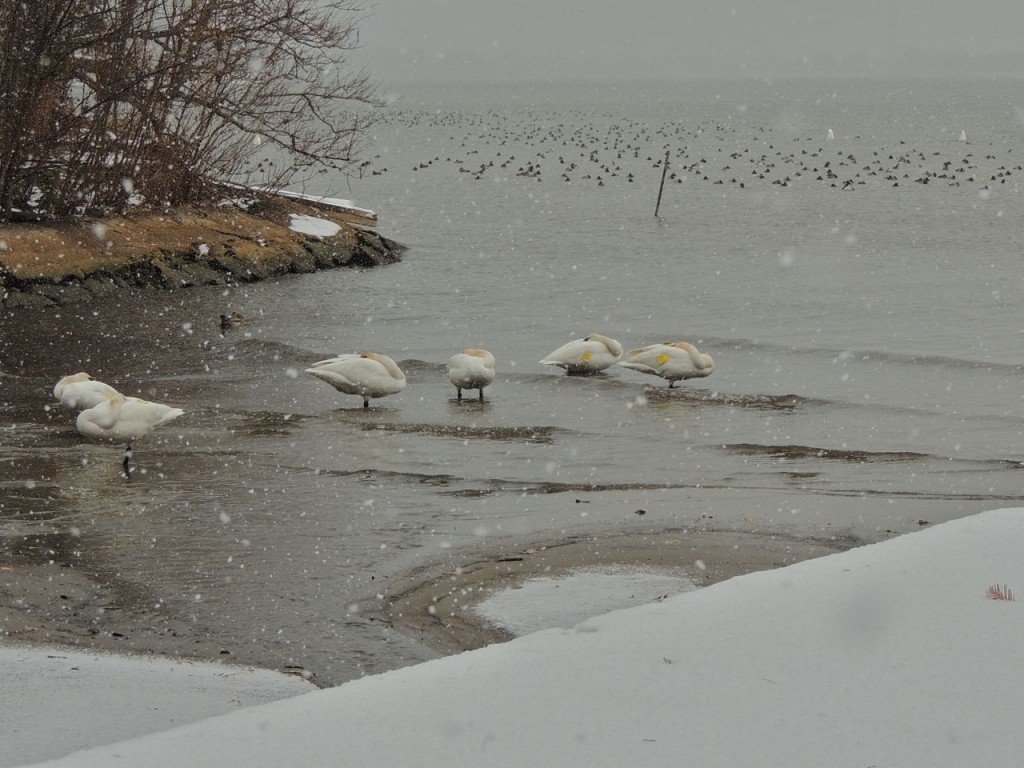
Trumpeter Swans in snow squall

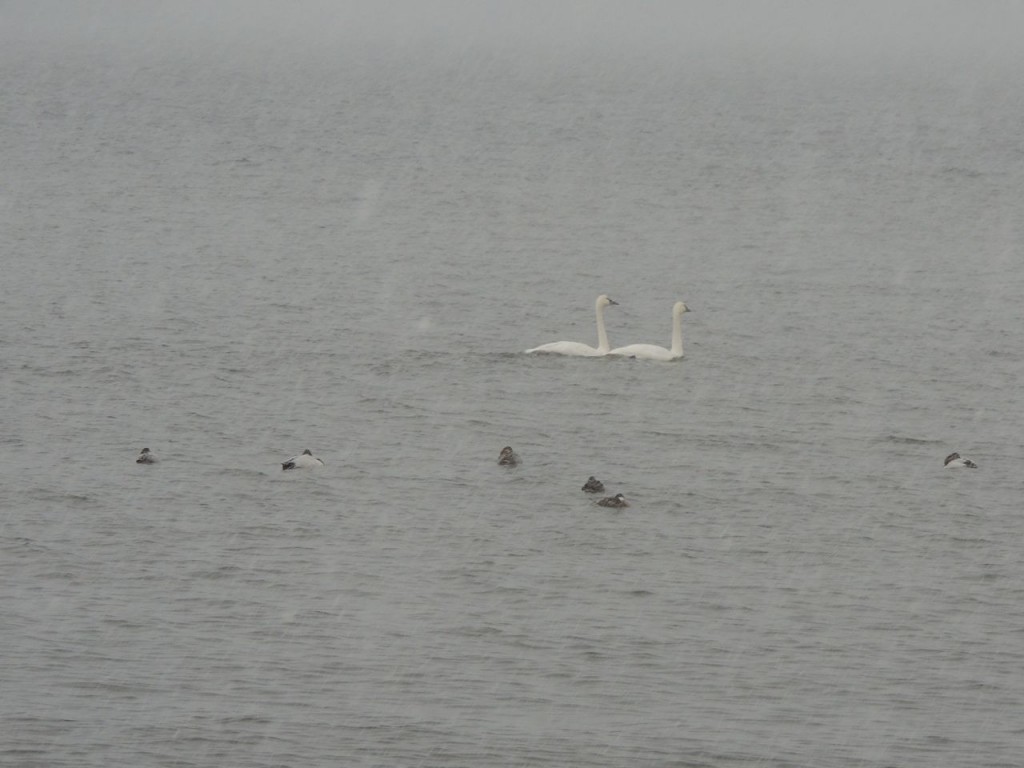
Heading home, I stopped to scan the harbour waters, just in case. As I admired a group of snoozing Trumpeter Swans and a distant pair of Tundra Swans, a vigorous snow squall blew in drawing a grey curtain across the waters, coating my binoculars and sending me back to the warmth of my car and shortly thereafter, home. Nice for me, but no easier for wildlife.

Tundra Swans in snow squall

American Pipits

17 November 2014. Burlington ON.  If the first snow of winter should occur overnight it can be a useful aid in getting a determinedly sleeping, school-aged boy awake and out of bed. “Hey, Graham! There’s snow outside!” And Bingo, he’s up! It usually worked once a year, sometimes twice.

Our children are long past that stage now but we still get first of the winter snowfalls; it came last night and continued all morning. I had early errands to do but stopped at a favourite spot to see how snow was affecting the birds.

Well, firstly, this was a day to be a photographer, the quiet wet snow had outlined everything to Christmas Card perfection. Secondly, a coating of snow makes life tough for birds; it’s easy to forget that, and at this time with many late migrants still around, their distress was obvious. The snow had driven them to search for food in places which previously they probably would have avoided. I was quite surprised by the number of sparrows, in particular, seen hanging around bare roadsides looking for food. Snow and hungry birds made for some great, if slightly clichéd, shots but the still-falling snow was wet and I had to be careful not to soak my camera. That same caution seemed to have kept the often-encountered opportunist photographers at home; I had the place to myself. Here in a gallery visible only on the website, not if you’re reading this as an email, are a few of today’s shots of adorable, if hungry, birds.

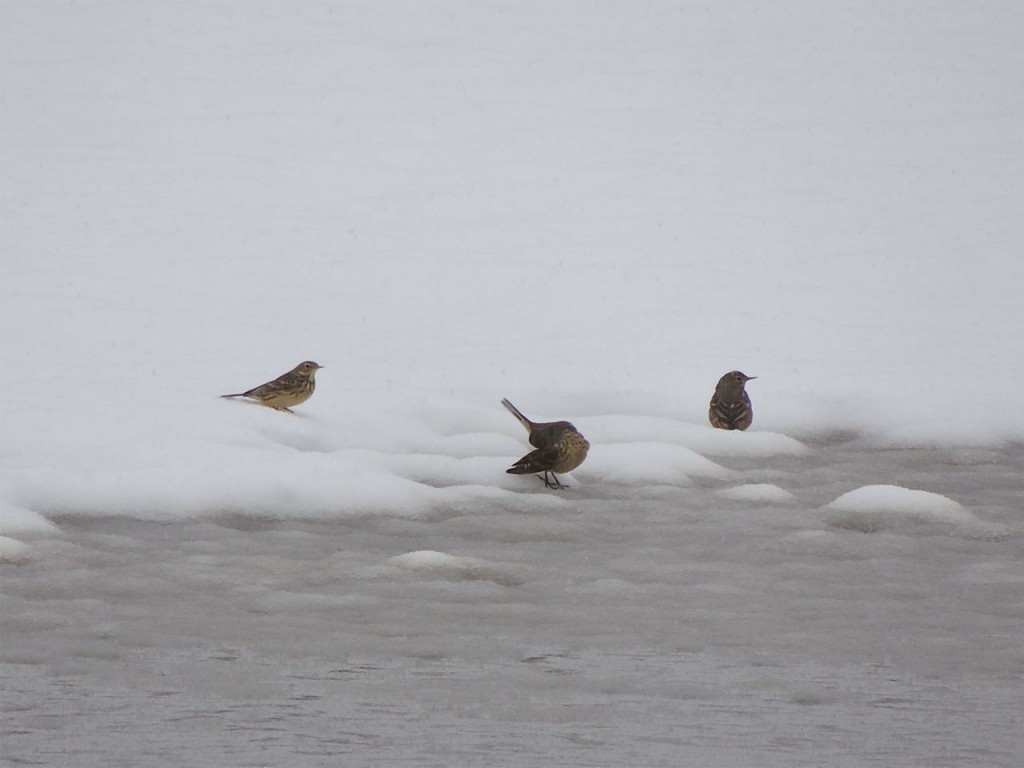
It was while dodging and stepping carefully around puddles of slush, that I noticed the arrival of a group of what I took to be sparrows, land some distance away. I’d left my binoculars in the car (water on lens avoidance again) so wasn’t sure what I was seeing. So I took a couple of long shots for later scrutiny and promptly forgot about them, they soon flew away.

Later as I was reeling through the morning’s cutesy images, I came across those two quick-shots and almost exclaimed out loud. What are these? Oddly my first thought was Redwings, not Red-winged Blackbirds, but Redwings, a pretty little winter thrush of north eastern Europe. Well, clearly it wasn’t that, and it wasn’t until I got home that I was able to take a better look to confirm my second thought, American Pipits. Here they are.

American Pipits
American Pipits

American Pipits aren’t particularly rare, but being birds of open fields and shorelines, they just seem to slip by under the radar. They are closely related to the Old World wagtails and share much of their rather effervescent charm.  American Pipits winter well south of the Mason Dixon Line in the U.S.A, and breed in our far north far beyond the tree line; so for us they’re transients passing through and this is the right time of year to see them. While  not especially noteworthy to those who collect rarities, I was pleased to see them, my Birds of the Day.

Canvasback and Wilson’s Phalarope

14 November 2014. Hamilton and Burlington ON There has been a lot of fuss recently about a Wilson’s Phalarope lingering on some nearby mudflats and making itself generally available to those who would photograph or otherwise record its presence. In the course of some errands I found myself (An odd expression since I wasn’t lost!) close to its reported location, so made a short diversion to take a look. Well, there it was, exactly where everyone said, fluffed up, neck drawn down and hunched. It stood quietly with its back to a cold wind that owed more to January than November. I’ve got to admit that I was underwhelmed, feeling rather flat about this lovely little bird; maybe because there was no element of surprise in finding it, no wow! moment.

It did get up and run around for a while mixing in with squads of shuffling Green-winged Teal. Its slender, finely drawn features put it in the fine-china category of shorebirds, but dressed as it was in its winter greys and looking a little abandoned, it was well, nice but a little uninspiring. I think I quite unreasonably expected more of it.

Phalaropes are dainty little shorebirds; worldwide there are only three species, all of which breed in the northern reaches of North America, two of the three in Ontario. Wilson’s Phalaropes head to western South America for our winter, they gather in tens of thousands at highly saline lakes in the highlands of central Andes in Peru, Chile and Bolivia. The time to see them at their best is on their return spring journey when the females in particular are extremely showy. One of the pictures in the gallery below (visible only on the website, not if you’re reading this as an email) includes many spring plumage Wilson’s Phalaropes, it was taken by a companion in El Salvador in May of 2013.

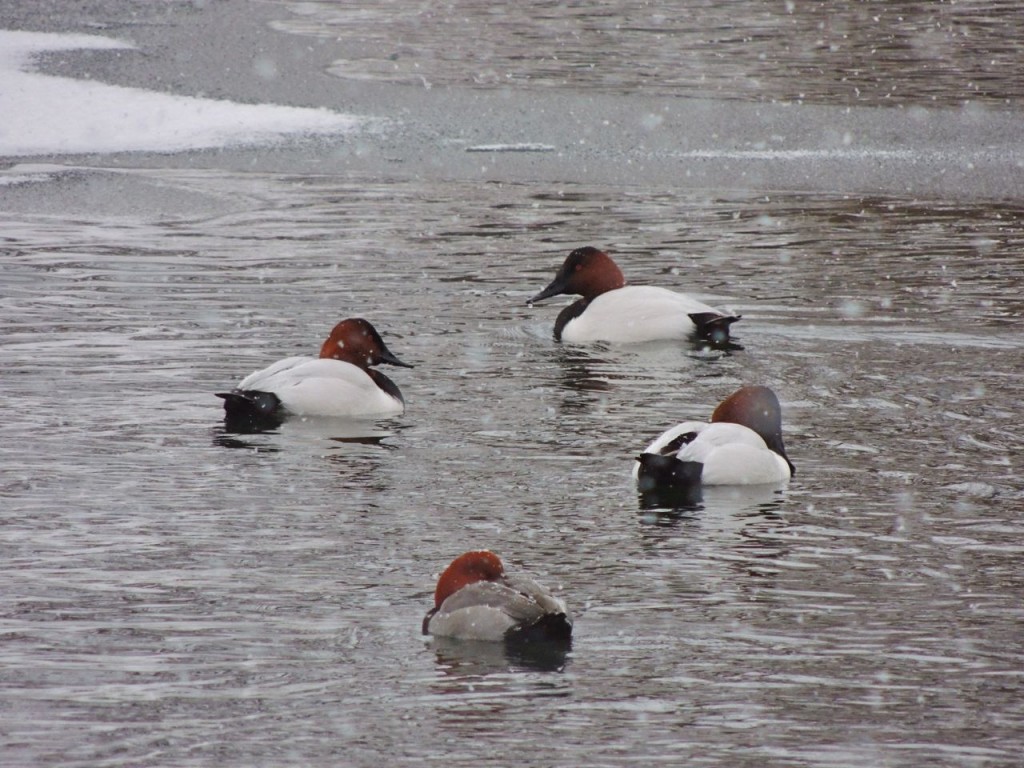
Later in the day I stopped briefly to see what waterfowl had shown up in the harbour; it will soon be a mass of wintering ducks, species like Common Goldeneye, Bufflehead and Greater Scaup. In my brief scan I quickly picked up Trumpeter Swans, Red-breasted Merganser, Redheads and Canvasbacks, all nice birds. It’s not that I’m comparing Canvasbacks to Wilson’s Phalaropes, but the delight of seeing a Canvasback, a rather highborn looking duck, had that little wow! moment that made it, in some ways, a real Bird of the Day rather than the oh-yeah-there-it-is-ness of the earlier phalarope.

Canvasbacks in Christmas snowstorm