Cherrie’s Tanager and Magnificent Frigate Bird

24 January 2015. Boquete, Chiquiri, Panama.  Today was my first daylight experience of this mountain town, Boquete. My purpose in being here is to learn another language, pursuing my interest in nature comes a close second
I have two days before classes start and I know Boquete and area will turn up some new and breathtaking birds, but first I have to find my way around. Boquete sits near the top of the range of volcanic peaks that comprise Panama in general and form part of the spine of the Americas. A towering, supposedly inactive, volcano (Volcan Baru) overlooks the town and all around us are thickly forested peaks, ridges and cliffs, all bisected and trisected by tumbling mountain streams rushing towards the Pacific some fifty kilometres away. At this elevation, not far from the continental divide, daytime temperatures are moderated and consequently the town has become a desirable retirement destination for Europeans, Americans and Canadians.  It makes for a cultural mix that is perhaps a bit like a trifle, the parts: ex-pats, Amerindians and mixed-race Panamanians are discernibly distinct but seem to work well together in a colourful and happy way.
Today, I took a long walk this afternoon deep into the recesses of a lush valley. I can only imagine what a wondrously wet and tangled place it was a century or two ago, perhaps even as recently as the 1990s. This valley has been tamed as a pretty ritzy, no-riff-raff-please, retirement community wrapped around a golf course.
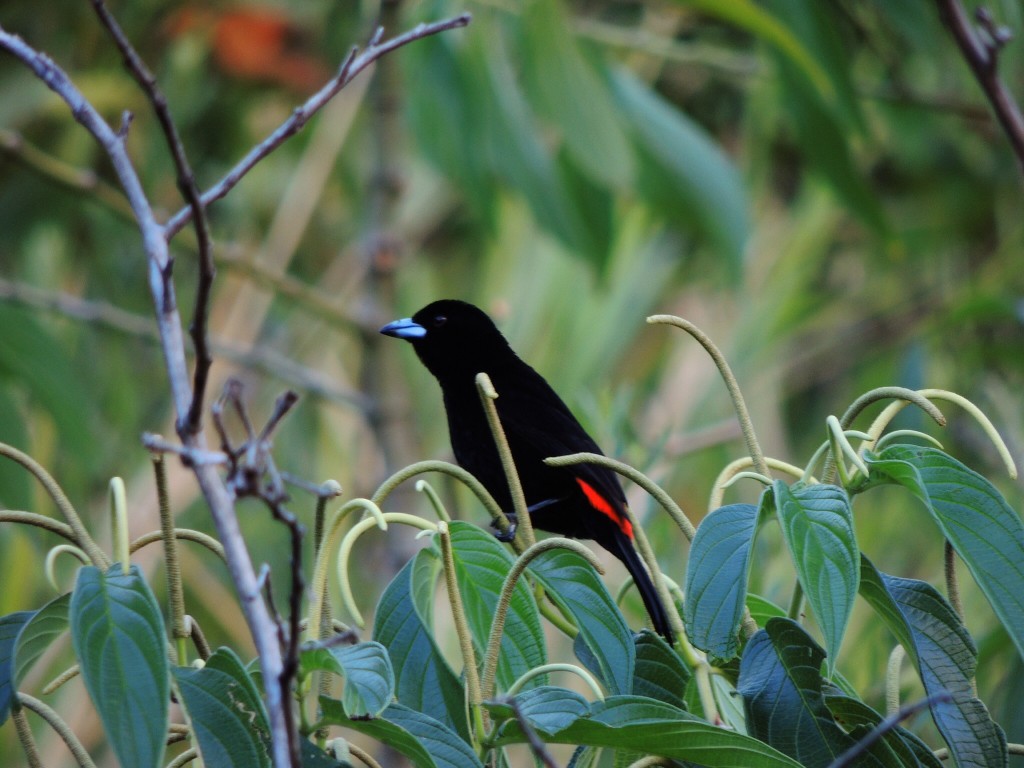
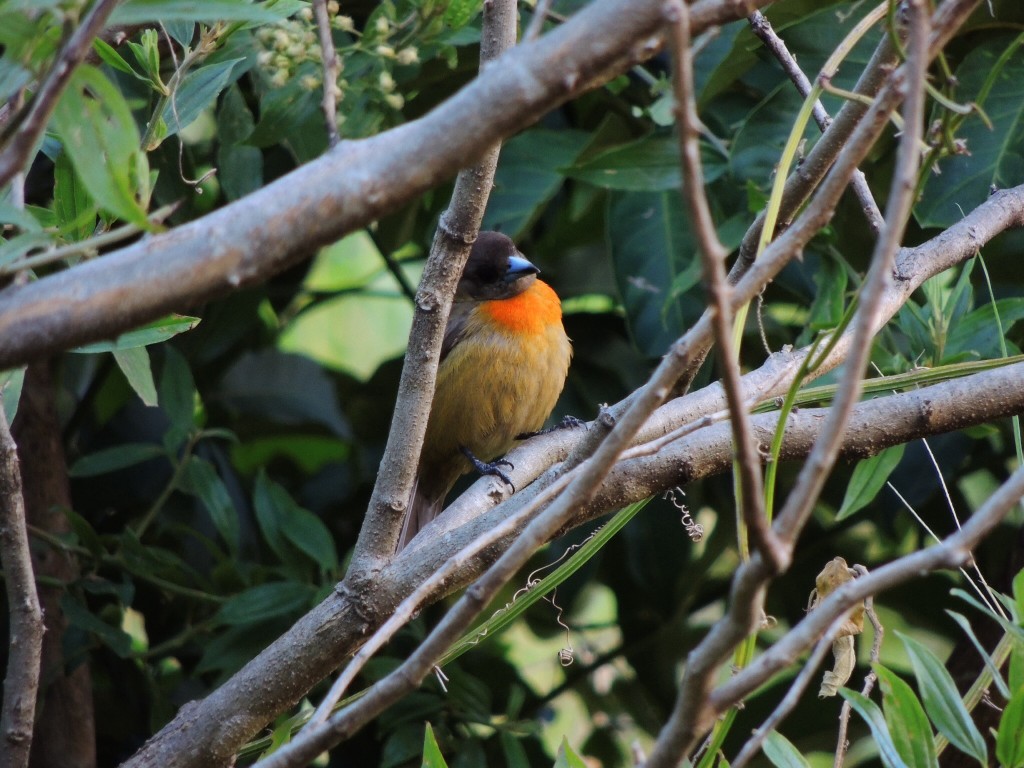
Cherrie's Tanager (m)
Cherrie’s Tanager (m)
Cherrie's Tanager (f)
Cherrie’s Tanager (f)
image
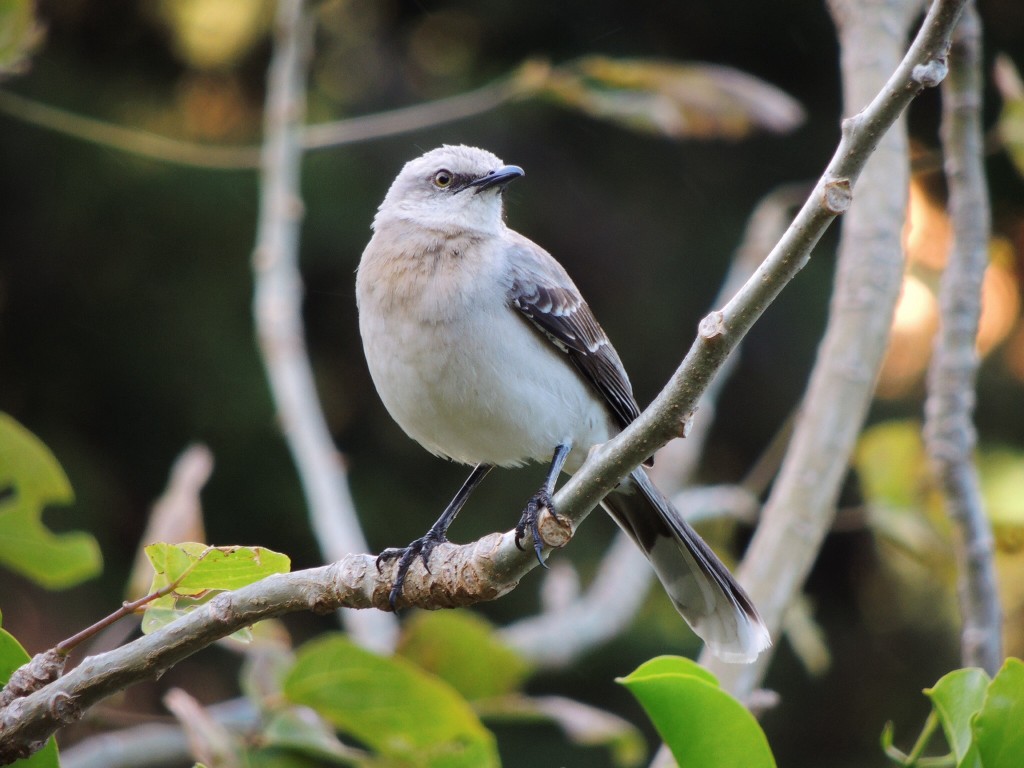
Tropical Mockingbird


I talked my way past the guards on the gate, easily convincing them that a pale Canadian on foot carrying only binoculars and a camera was no threat to residents. I don’t play golf, it holds little appeal, but I have to say that the golf-cart pathways winding from tee to bunker to green allowed me to wander at will and get quite close to some interesting little corners.

Notable birds along the way were a pair of Cherrie’s Tanagers, the male jet black with a hot-scarlet rump and tail, and the female, a beautiful creature of golds, browns and cinnamons. They were my Dramatic Birds of the Day. Spectacles like this are what make Central America: Costa Rica, Panama and Nicaragua, prime birding destinations.

I came across a pair of Tropical Mockingbirds, very much like our Northern Mockingbird, stately in pearly greys and white but lacking the bold white wing-bars of its northern cousin. My Surprise Bird of the Day was a soaring Magnificent Frigate Bird spotted cruising high over the mountains, much higher than the many Black Vultures that permanently dot the sky around here. Magnificent Frigate Birds are like huge, wildly exaggerated swallows with deeply forked tails and long slender and angular wings.  They are exclusively oceanic, indeed when I turned to my field guide, it showed their range as covering both flanking oceans only, but grudgingly acknowledged that they may sometimes be seen soaring inland. It has nothing to gain from hanging around here, I can only suppose this one had decided to cross the narrow Isthmus of Panama and give the Caribbean a try.

Interestingly, I met a few old familiars too: an Osprey scouting one of the golf course’s water hazards, several House Wrens, a Great Blue Heron and a Great Egret.  A good start on Panama with lots more to come.
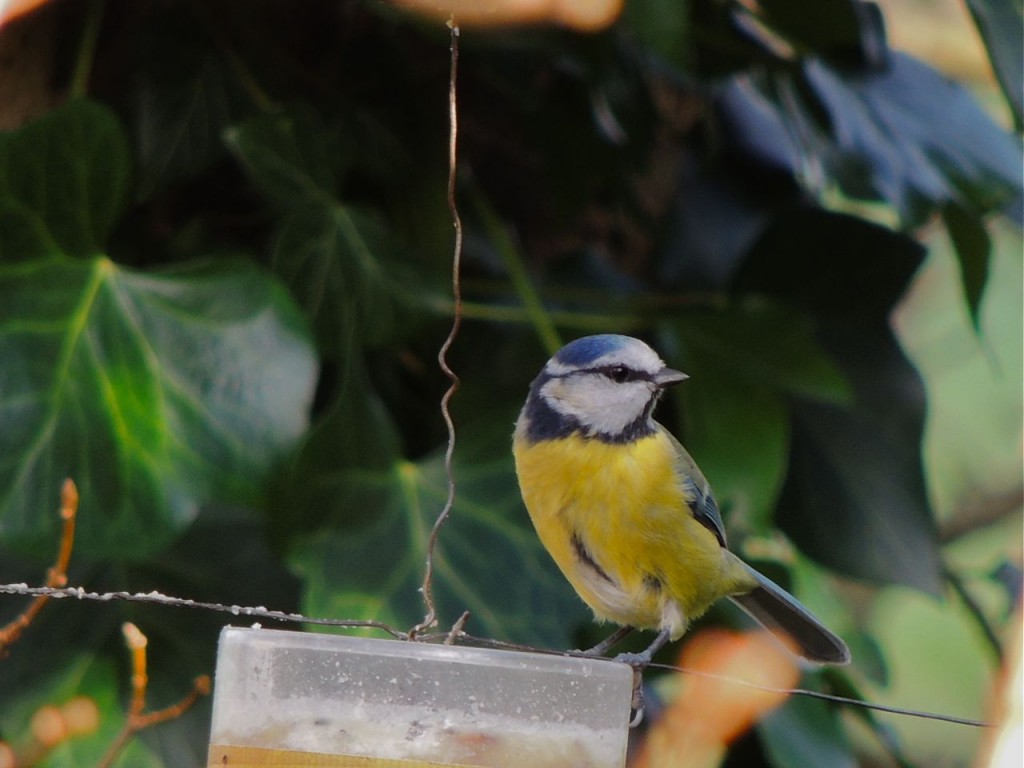
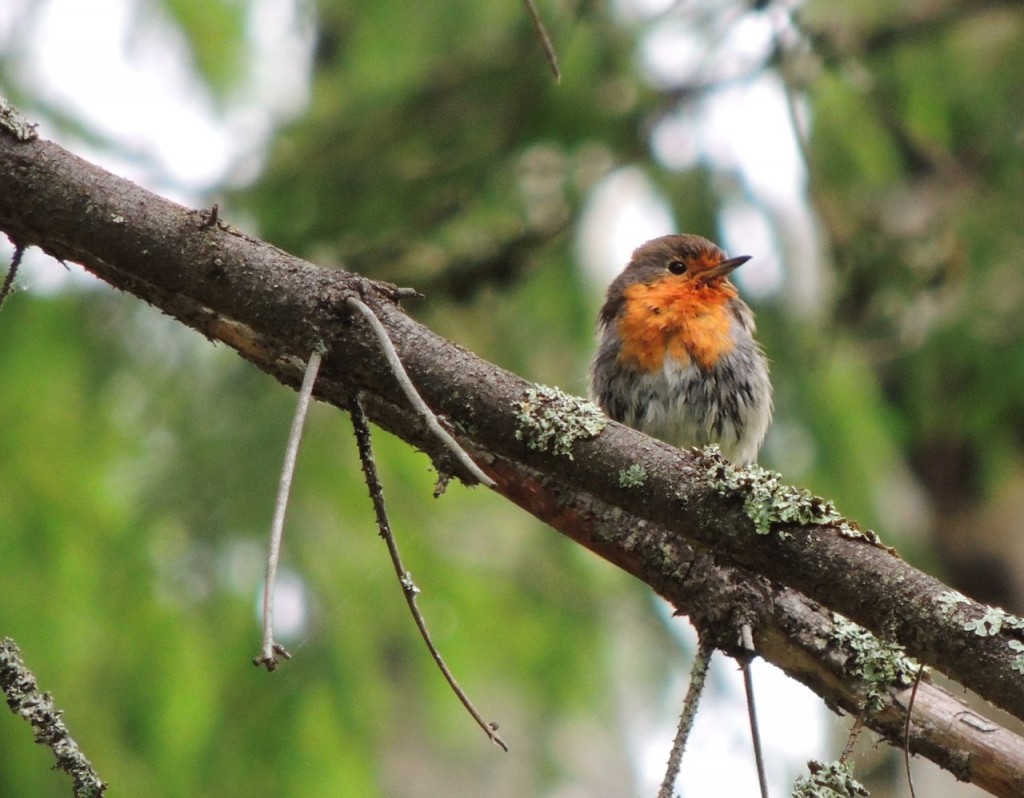
European Robin

16 January 2015. Southampton, England. I’ve just returned from a long-weekend trip to the south of England to attend the funeral of a dear aunt; a long life well lived. England’s south is noticeably milder than most of the country and I half expected to see birds from colder parts of Europe holed up for the winter. I’m sure the flocks of Fieldfares were from Scandinavia and I suppose it’s quite probable that the many Blue Tits, Great Tits and Robins I saw had indeed moved from colder places; hard to know.

Robins, (technically European Robins to separate them from unrelated American Robins) hold an almost unassailable place in the hearts of Brits. I think the classic portrayal of the Robin is as a bold hanger-on, waiting to pounce on earthworms and spiders uncovered by a toiling gardener. I remember reading somewhere that this opportunistic tactic of seizing unlucky invertebrates originated with Robins following foraging pigs; Robins, apparently, see us as vertical swine.

Blue Tit
Blue Tit

Where I was, there were dozens of Robins and Blue Tits. But only the Blue Tits, among small birds, would linger long enough to allow a photograph and the flightiness of birds in general reinforced my opinion that European birds are more secretive and nervous than American birds. There were, I sensed, many more Robins than the area would support as a breeding population; or that they themselves could tolerate. They were not terribly easy to see, instead they generally only made themselves apparent by their oft-repeated song, a peevish scramble of high notes, delivered from a hidden perch. But as an icon (a word I use with extreme caution) of Englishness and as a sparkle of colour and song in the appropriately funereal light of January, Robins made the day.

European Robin photographed in Sweden June 2014

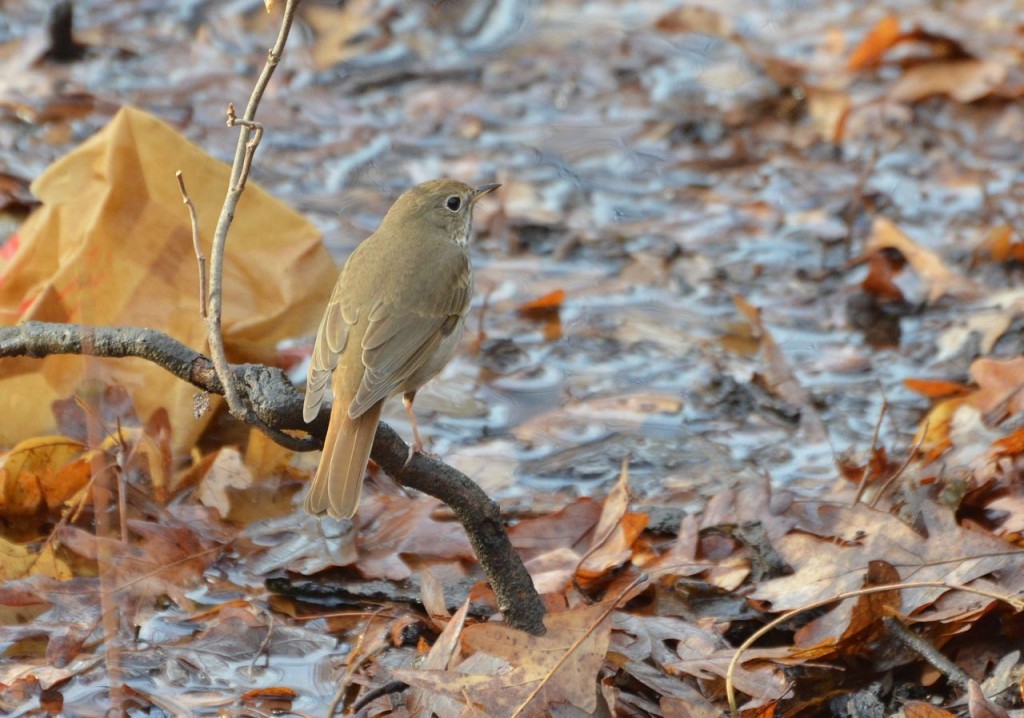
Hermit Thrush

13 January 2015. Burlington ON. The central premise of this site is that whenever I go birding, there’s always one bird that stands out as special, at least one that makes me say Wow!. Sometimes, usually because the bird is dramatically unexpected, the Wow! comes with punctuation and is capitalized. Frankly most wows are uttered under my breath; they’re still writeable birds though, as you’ll have noticed.

Today’s bird walk produced a Hermit Thrush, a Wow!-with-punctuation find. I had just completed a circuit tallying winter birds. These were truly winter birds, it was minus fifteen degrees Celsius with a light wind from the north. There was an inch or so of snow and the river was frozen over save for a couple of spots where the water churned too fast. In my notes, I twice recorded hearing the empty calls of American Crows, there were dozens of Black-capped Chickadees hoping for handouts of sunflower seeds and a few Downy and Red-bellied Woodpeckers.

Moments from returning to my car, I saw what I took, at first, to be a female Northern Cardinal fly up to the top of a scramble of Multiflora Rose briers. It didn’t look quite right for a cardinal so I binoculared (I promise not to try THAT again) it, and then came the Wow!

Hermit Thrushes are regular overwintering birds around here, but in small numbers and generally elusive. Why they stay I can’t imagine, they live on a diet of soft invertebrates, berries and fruits. In a deep freeze you’d wonder where they find any, I assume the meagre scattering of desiccated rosehips was the attraction to this bird. Hermit Thrushes, like their more fully migratory, cousins: Veerys, Gray-cheeked, Swainson’s, and Wood Thrushes are somewhat shy and retiring, bashful, they always seem to be looking back over their shoulder at you. And the expression seems a little doleful as if they wished that neither of us were there to see the other. None of the thrushes is particularly flamboyant, they’re more dignified in grays and browns as if they belong in the servants’ part of the house; not upstairs.

But why the Wow!? I suppose because at this hard part of the year they are few and far between, rarely seen, gentle souls and subtly attractive.

Hermit Thrush
Hermit Thrush

This photo from Wiki Commons is by Andy Reago & Chrissy McClarren.

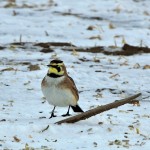
Horned Larks

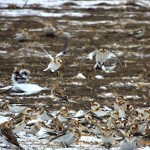
11 January 2015. Fallsview, Dundas ON. I took part in a Snow Bunting survey today; we didn’t see any but did manage to spot a small flock of Horned Larks that flew to the top of a nearby ridge in a field of corn stalks. They were excruciatingly difficult to make out strutting and scurrying between dried leaves and stalks at about the limit of our binocular-aided vision. We felt pretty pleased with ourselves for having spotted them at all especially in the knuckle-pinching wind, I was pleased enough to consider them my Bird of the Day.

Other than the time spent squinting at the Horned Larks, we spent an enjoyable hour crawling slowly along snow-dusted country roads, scanning fields for Snow Buntings and generally irritating other car-drivers who had more sense of urgency.

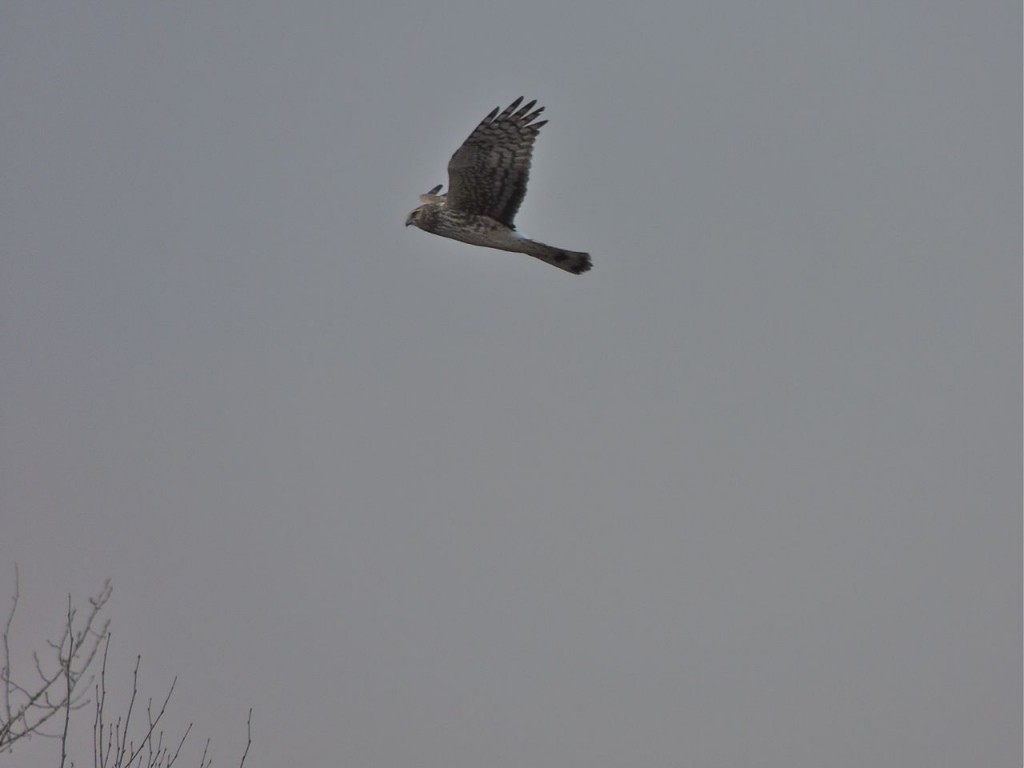
Northern harrier at Badenoch
Northern Harrier, hungry and hunting

There were plenty of hungry raptors around. Not far off the road, we spotted a hunting Northern Harrier, flying low, barely a metre above ground level and subsisting I’m sure on the occasional rat, mouse or vole. I twice spotted a Rough-legged Hawk, really too far away to enjoy, at first it was sitting at the top of a bare oak and later, patrolling low and fast over some low-lying fields.

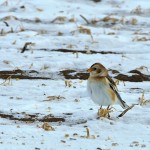
The Snow Buntings survey is interesting. A young friend in pursuit of a master’s degree is studying the correlation, if any, between the amount of snow cover and the apparent abundance of buntings. For this she needs an army of volunteer observers to conduct regular surveys during January and February. ( If you’d like to help, or at least learn more, follow this link.) The ideal three-kilometre long survey route crosses open, windswept landscapes; the last place you might want to be on an icy January day, but just the sort of habitat that Snow Buntings find desirable at this time of year.

Taking part in studies like this is exactly the sort of birding I enjoy most, so it is with some regret (just a little) that I will be away for much of the study period. I’m not going to be much use, but today I helped another birder establish a suitable route and conduct her first survey. Our route cut across open farmland punctuated by old barns and new country dream homes. The flanking fields are either tidily plowed or still hold the remnants of summer’s alfalfa, corn (maize) or soybeans.

It’s very hard to just spot Snow Buntings wandering around in these winter fields; they are small and exactly the colour of tired, snow-streaked fields. The best opportunities, the ones that make you stop the car and get out, are when flocks of hundreds take flight and roll across the landscape like a snow squall. These flocks sometimes include a handful of Lapland Longspurs and Horned Larks and together they’ll eventually settle again to forage for summer’s dropped seeds, and become invisible once again.

More Snowy Owls

4 January 2015. Hamilton ON. I suppose it depends on your definition of drama, but many of my encounters with birds, particularly those that find their way into these postings, involve some element of a mini-drama. I would include today’s encounters with a Snowy Owl as being a minor mini-drama; many wouldn’t, but as I said, it depends on your definition of a drama.

I left the house this morning intending to go to our local library, but being Sunday it wasn’t open until after lunch. What now? I wondered. There were a couple of easy options and I took the ‘go-birding’ one. There’s a spell of bad weather on its way; strong winds to begin with and then it’s supposed to turn much, much colder by nightfall. Knowing that birds somehow anticipate threatening changes in the weather, I headed to the downwind end of our large harbour; there’s always something going on there, especially at this time of year. Winter birding is more about the naked elements, hardship and eat-or-be-eaten dramatics than summer birding. Those same factors are assuredly present in summer, they just suit our ideas of charm and prettiness better.

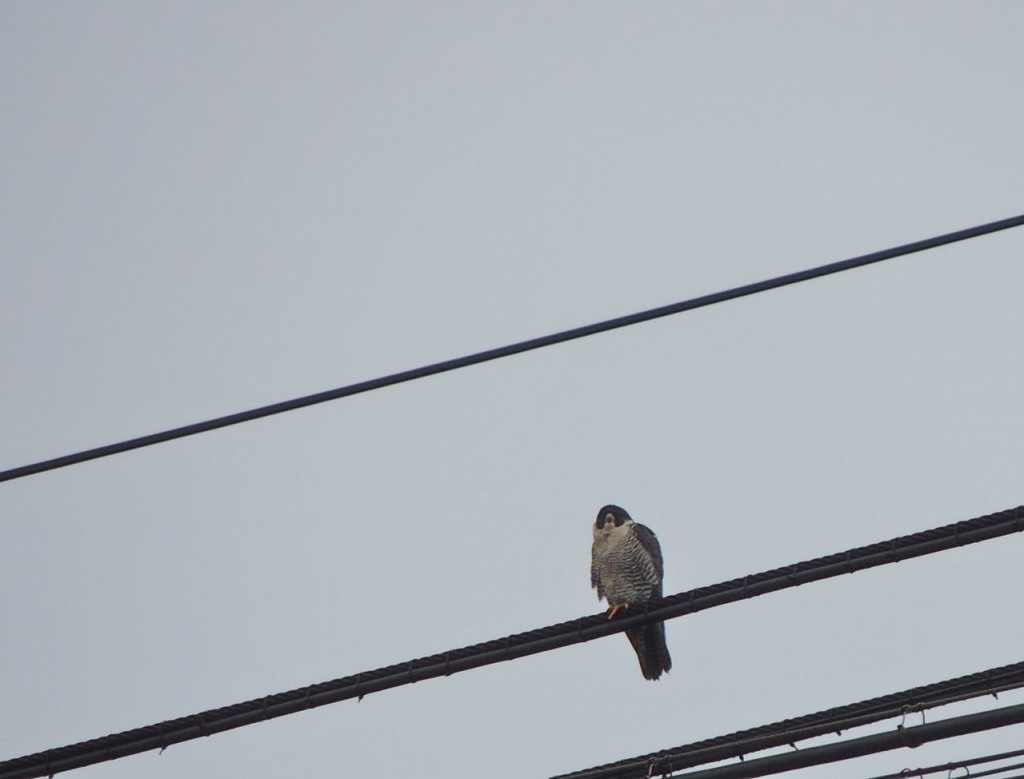
Peregrine Falcon
Peregrine Falcon


My first drama queen was a female Peregrine Falcon spotted on some cables high overhead. While my back was turned for a few minutes she left, probably in search of a meal, an event that would be no fun at all for the meal but explosive theatrics to an interested observer.

I scanned the shores and harbour edges and noted several loafing Great Black Backed Gulls (highly capable slayers of unwary ducks) and, riding the swells, hundreds of Long-tailed Ducks and Lesser Scaup who don’t frighten anyone except maybe mollusks like Zebra Mussels, which I sincerely doubt experience the emotion of fear.

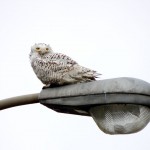
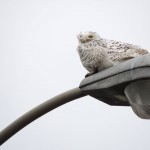
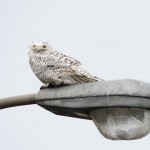
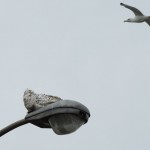
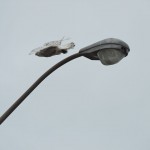
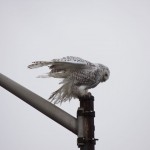
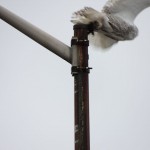
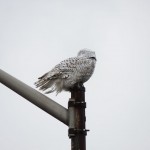
As the waves started capping white, I moved further around the edge of the harbour, spotting first a distant Snowy Owl and then another right above the road. Being a fair-weather birder, I pulled well over, flipped the emergency flashers on, and angled so that I could watch and photograph from within the dry warmth of my cocoon. The bird was atop a streetlight that seemed to offer it little to grip, I could see that the blustery wind was making life difficult, so anticipating that it might very soon fly off, I took several shots and readied the camera just in case there would be an in-flight moment. It worked and I pressed the shutter not an instant too soon. (All of the Snowy Owl pictures are in galleries visible only on the website, not if you’re reading this as an email.)

The snowy moved a hundred metres or so to another roadside streetlight and I was able to get a few more shots before it had had enough of me and a couple of photographers who’d stopped to see what the fuss was all about. I regretted, just a little, having drawn this extra attention to it; it seems voyeuristic somehow that this minding-its-own-business-and-trying-to-survive bird of open tundra should attract the pointed attention of camera lenses; or am I being too sensitive?