Three-wattled Bellbird

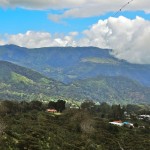
10 February 2015. Finca Lerida, Chiriqui, Panama.  In the last week of my three-week stay in Boquete, my Spanish lessons were shorter but more intense. As a result by 10 a.m. each day, school was finished. On this particular day, a look at the surrounding mountaintops suggested that Finca Lerida would be enjoying very fine weather so I decided to go and explore its many trails again.
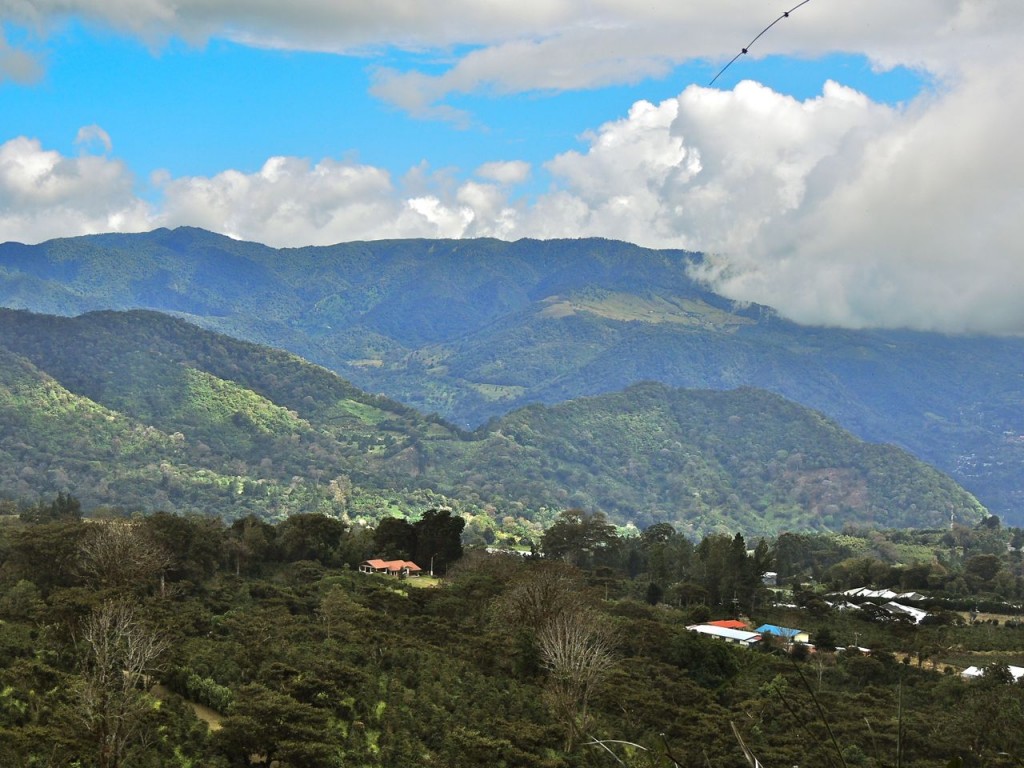
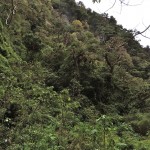
Finca Lerida - the setting
Finca Lerida – the setting

Just as on my recent return trip to the quetzal trail (see Tufted Flycatcher post) , I determined to take my time and enjoy everything the forests around Finca Lerida had to offer. I often cover a lot of ground when I’m birding but I’m not really sure whether slow ambling ranks as effective cardiac exercise; I rather doubt it. But I can say that around Boquete, and at Finca Lerida in particular, the elevation makes all walking a workout. Boquete is at 3,900 feet above sea level, and I’d guess Finca Lerida is another four or five hundred feet higher still.

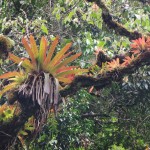
After a heart and lung-stretching hike up, endlessly up, through ranks of coffee bushes I made it to the fringes of the forest backdrop where the interesting bird are to be found. But there’s lots more than just the birds to enjoy here.  On any branch that offers a reasonably horizontal surface, many of the large canopy trees support dense growths of bromeliads, orchids, and grasses . Bromeliads are designed to capture rainwater in the overlapping leaf bases and, with enough rain, the added weight often causes bits of branches to break and fall; the ground in this rain forest is littered with such debris. I found a piece of branch about eighteen inches long encrusted with a fascinating blanket of two or three types of bromeliad (one in flower), small orchids, bamboo, mosses and goodness knows what else. Holding and inspecting this microcosm of the treetop world, I wanted to take it home with me, but it didn’t take many moments’ thought to see far too many obstacles; Agriculture & Food Canada not the least of them. Here’s a photo of that little piece of jungle treetop.
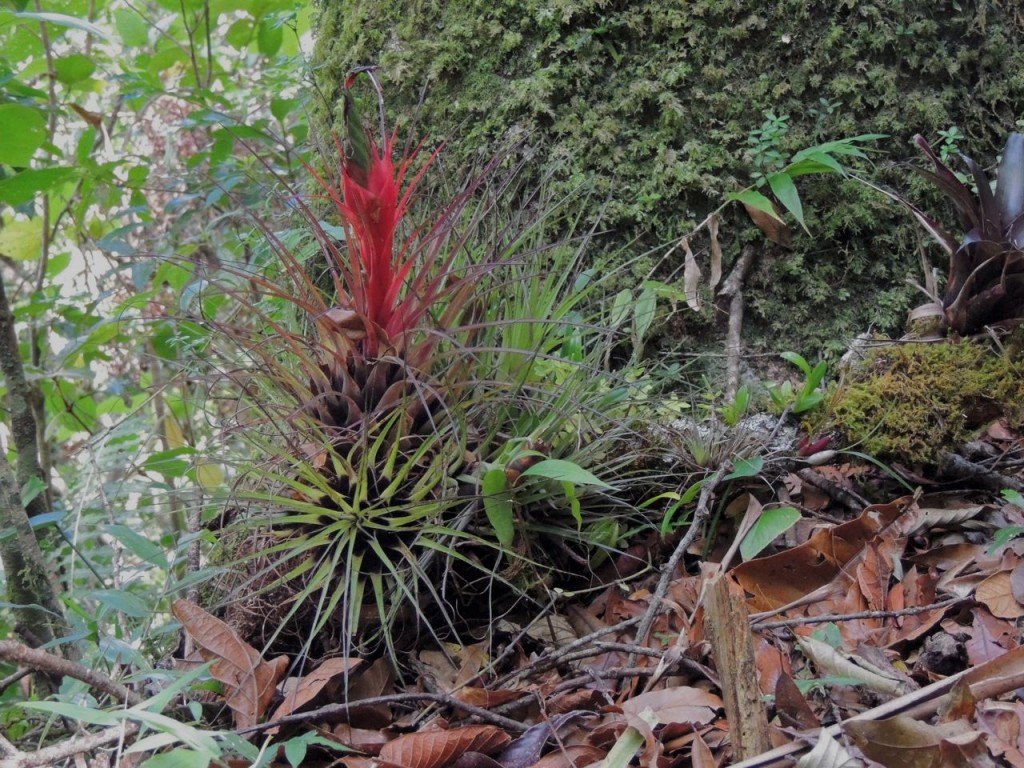
Bromeliad branch

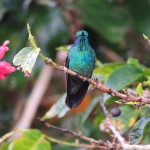
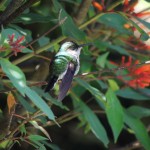
Continuing along the path I caught movement deep within the understory – a flash of violet. I waited and hoped for whatever it was to move again. It did and flitted a little closer until, through a gap in the greenery, I could make out a small, iridescent violet hummingbird with a long decurved bill. This is how forest birding goes; the tropical rainforest vegetation is extremely thick, birds appear and disappear in milli-seconds; you would never want to be lost in it. For once my camera agreed to focus on the bird rather than the branches in front or the landscape behind and I was able to get this picture, good enough to identify it as a Violet Sabrewing. A day or two later, I commented on my sighting it to a local expert who nonchalantly responded that Violet Sabrewings are quite common around here. “They might be to you.” I replied. He just smiled.
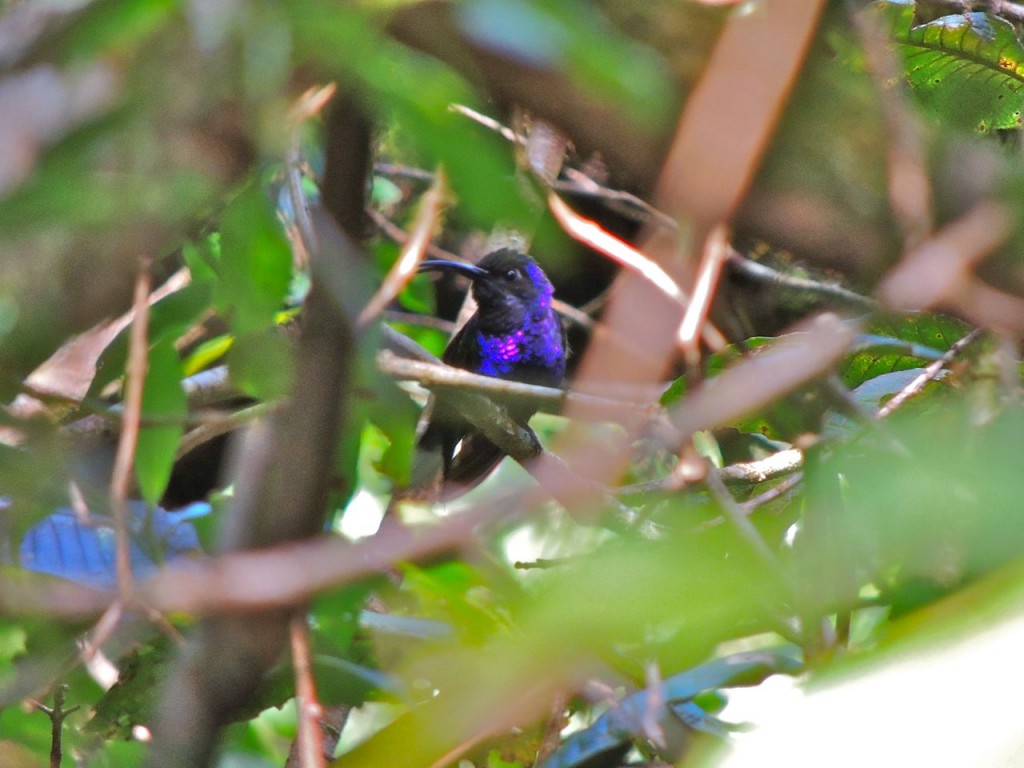
Violet Sabrewing
Violet Sabrewing

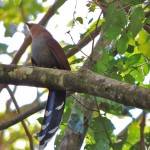
Continuing slowly along the trail, with a deep valley on one side and thick rainforest on the other, I became aware of a strange, regular and repetitive call carrying through the forest with a resonance something like a cross between a squeaky gate, a metallic clang and an electric crackle; although none of those really do it justice. It was acutely difficult trying to locate whatever it was and I don’t think I have ever spent as much time and patience in search of one elusive creature; I didn’t know whether I was hearing a bird, a monkey or perhaps even someone pounding steel fenceposts. Whatever it was, it didn’t seem to be moving around so I persevered in my search knowing that I was probably looking for a needle in a haystack. It ended in triumph though, for high above me I found a calling male Three-wattled Bellbird, a curious creature if ever there was. Follow this link and listen and see for yourself. My own photos don’t do it justice. I’d heard of bellbirds but had absolutely no expectation of seeing or hearing one in my short time in Panama; it was such a surprise and thrill that it was unquestionably Bird of the Day, even displacing the flashy Violet Sabrewing of a little earlier.
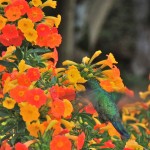
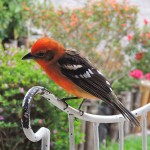
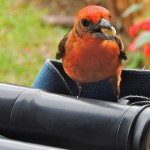
When eventually the bellbird flew off, I realized how hungry and weary I’d become. It was enough for one day, so I headed back downhill to the coffee shop for a very late lunch. I wouldn’t normally make mention of meal-time moments, but as I got comfortable outside the coffee shop, a Flame–colored Tanager joined me, clearly expecting that I would share my empanada lunch with him. I think we’ve all seen this sort of conditioned, easy-pickings behaviour by birds at some time, usually it’s urban House Sparrows, and I also recall being impressed by brazen Baltic Gulls cleaning up leftover Pizza at a Stockholm café. But if ever there was an appropriate metaphor for the searing tropical colour of Finca Lerida, it would be this spectacular tanager (and not forgetting the Green Violet-ear hummingbirds.)
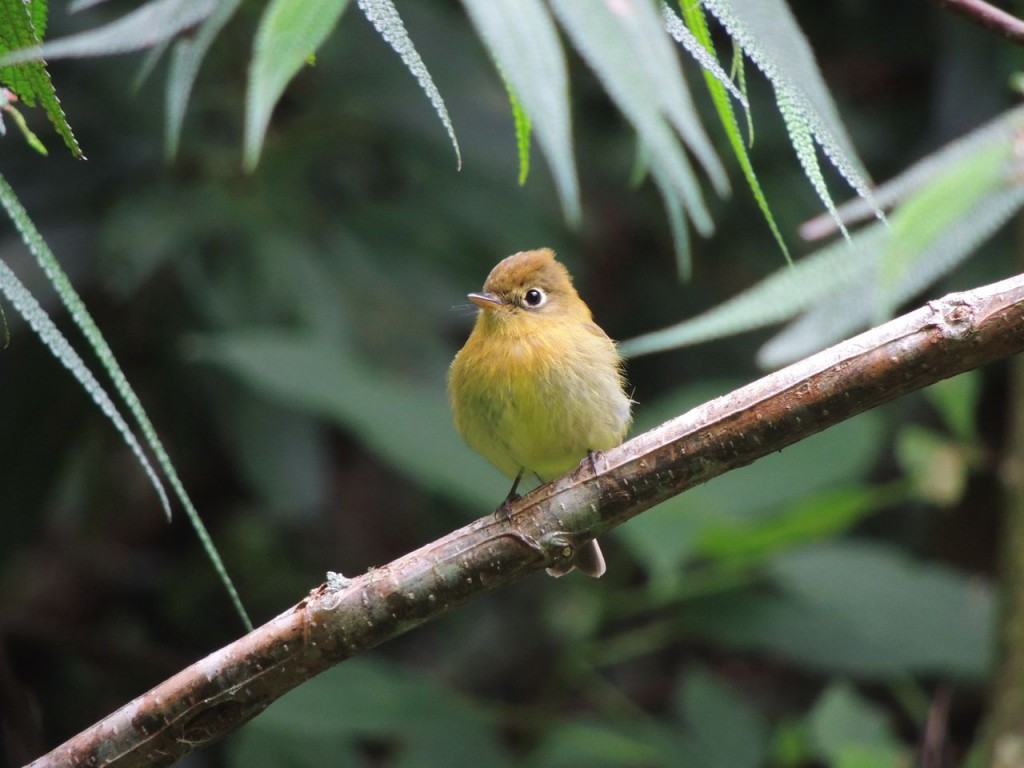
Tufted Flycatcher

8 February 2015. Quetzal Trail near Boquete, Chiriqui, Panama.The hike of a week ago, the one on which I caught glimpses of the Resplendent Quetzals, left me determined to return and take more time to explore that particular valley trail; to take all day if necessary. This was my chance.

Many hike this trail search of quetzals, it’s a very rugged path and climbs steadily towards the quetzal habitat, which is in deep forest about two kilometres from the start. As I observed a couple of entries earlier, I really doubt that anyone without an experienced guide would see a quetzal, but all sorts of hopeful and unaccompanied folks make the attempt anyway.

The trail starts where the valley opens out among fields which are cultivated after a fashion, it is flanked by towering forested mountainsides and follows the course of a fast running mountain torrent which defines the quetzal valley; the trail never wanders far from it or one of its tumbling tributaries. The apparently clean and perhaps drinkable waters sparkle as they gush and careen unstoppable through rocky clefts and interlocked tangles of straggling greenery.


I took my time trekking slowly uphill, sometimes explaining to passing groups of quetzal-questers what I was looking at, not that I was seeing all that much; and certainly not a quetzal. None of them was in the slightest bit interested in a Long-tailed Silky Flycatcher that I spent time staring at.  It was on the top of a bare and scrawny tree, but against the bright sky it was almost impossible to make out any of its colour, a pity because I know from illustrations that they are plumaged in a rather beautiful combination of greys and yellows. It was only by its silhouette, especially that of its crest and graduated tail, that I was able to indentify it.

The warm and lush forests naturally teem with insects; protein to many, and where there is protein there is always something ready to eat it. Apart from the Silky-flycatcher, my notes from Boquete include several other members of the large and variously adapted Tyrannidae or Tyrant Flycatcher family: Tropical Kingbird, Greater Kiskadee, Yellowish Flycatcher, Dark Peewee, Black Phoebe, Torrent Tyrannulet and Tufted Flycatcher included. There were a few others that I was sure were part of the family but was unable to identify for one reason or another. And of course there were many more eaters-of-flies such as swallows and martins, which are not part of the Flycatcher family and probably don’t care whether they are or not.

I continued on past the quetzal zone, climbing ever onwards and marvelling at how unthreatening this impenetrable jungle seemed; admittedly I was on a well used path but still…. This is the sort of country that should, I would have thought, have placed me in imminent danger at every turn. Where were the venomous snakes: Eyelash Vipers and Bushmasters? Why no clouds of malarial mosquitoes? And what about armies of looping leeches or flesh-stripping ants? There was none of it. It was as pleasant as a June stroll along one of our tranquil lakeshore trails; albeit a good bit bumpier.

I eventually reached the end of the path at the plunge pool where the river arrived from several hundred giddy feet above. I scrambled to a well-placed rock and enjoyed my picnic lunch, it was the sort of cool, green place that could have used a Victorian poet to do it justice.

Well, along the way this day I found a few birds of interest; quite enough to satisfy me. If you were an avid lister it might not cut it, for while the tropics, Central America in particular, may be rich in bird life it takes luck, effort and an absence of leaves to find them; a skilled local bird guide is the best answer.

I caught fleeting looks at a Ruddy-capped Nightingale Thrush, a nervously evasive member of the Catharus family of thrushes, some members of which spend spring and summer in Ontario. They are all rather slender and gentle-looking birds, subtly clad in buff and soft browns (see my earlier posting about a Hermit Thrush). The Ruddy-capped Nightingale Thrush has a glowing warm cinnamon-brown cap and back. Interestingly (to me anyway) I may have heard several of these birds singing on this and other days. I was, and remain, a little puzzled by the songs of what I thought were Wood Thrushes coming from within the thick forests. But the song wasn’t exactly right and surely, I reasoned, Wood Thrushes wouldn’t be singing unless they’re on their northern breeding grounds. Song, after all, is about establishing, defining and maintaining breeding territory. But still, I was hearing something very much like a Wood Thrush and some research on Xeno-canto (perhaps the ultimate repository of bird vocalizations) leads me to think that I was indeed hearing the songs of Ruddy-capped Nightingale Thrushes; although I’ll probably never know for sure.

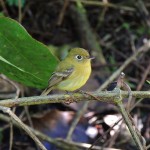
Yellowish Flycatcher

But back to flycatchers for the day’s best birds. I spent a long time watching a pair of Yellowish Flycatchers who seemed quite oblivious to my presence and later I watched a pretty, little, buffy-orange Tufted Flycatcher catching flies; well what else? The interesting thing about this bird was its habit of almost always returning to the very same spot after sallying out to grab a bite to eat; as if it were somehow tethered. Like the Yellowish Flycatchers, it was unconcerned by my approach, so obtaining a good photo was not difficult, I just steadied the camera, framed the shot, focused and waited for the bird to come back. Here it is, my bird of the day from a day that many might not celebrate for bird life, but which I reveled in for the whole experience of a tropical rain forest.

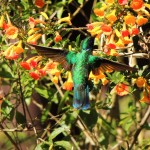
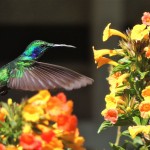
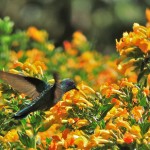
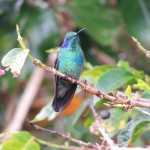
Hummingbirds: Scintillant & Rufous-tailed, White-throated Mountain Gem and Green Violet-ear

1 February 2015. Finca Lerida, Chiriqui, Panama.  At the end of yesterday’s expedition with Jason he suggested that I might like to make a trip to Finca Lerida some day. He said it’s the closest and most reliable place to see hummingbirds and, if I chose to visit, I might expect to see Green Violet Ears, White-throated Mountain Gems as well as Scintillant and Rufous-tailed Hummingbirds. A day of hummingbirds sounded like a good way to spend this second half of the weekend and since it would be just a $5 taxi ride, I followed his suggestion.

Finca translates roughly as estate, farm or ranch. Some years ago the owner of Finca Lerida, this sprawling hillside coffee plantation, saw an opportunity to share the beauty of the estate, set in its frame of towering jungle-clad mountains, by creating a relatively small but glittering bed and breakfast, restaurant and coffee-shop. He succeeded, it is very pretty and there are many extraordinarily scenic stops throughout the property.I wasn’t there to criticize, but I suspect that few visitors give a moment’s thought to how many thousands of acres of virgin forest were cleared in its creation or ponder the pros and cons of coffee monoculture.

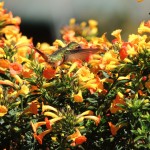
I used the term glittering to describe the public face to emphasize the exuberant use of colour. The broad splashes and sweeps of gold, scarlet and magenta are almost shocking. There are huge Angels Trumpet (or Brugmansia) trees carrying hundreds of pendulous pink, orange or cream flowers. Extravagant banks of Bougainvillea provide waves of colour-shock, while familiar flowering plants like Impatiens and Fuschia line and define paths. And it is perhaps the thousands of brilliant orange flowering bushes (I wish I knew what they were) that hold the most appeal for hummingbirds.

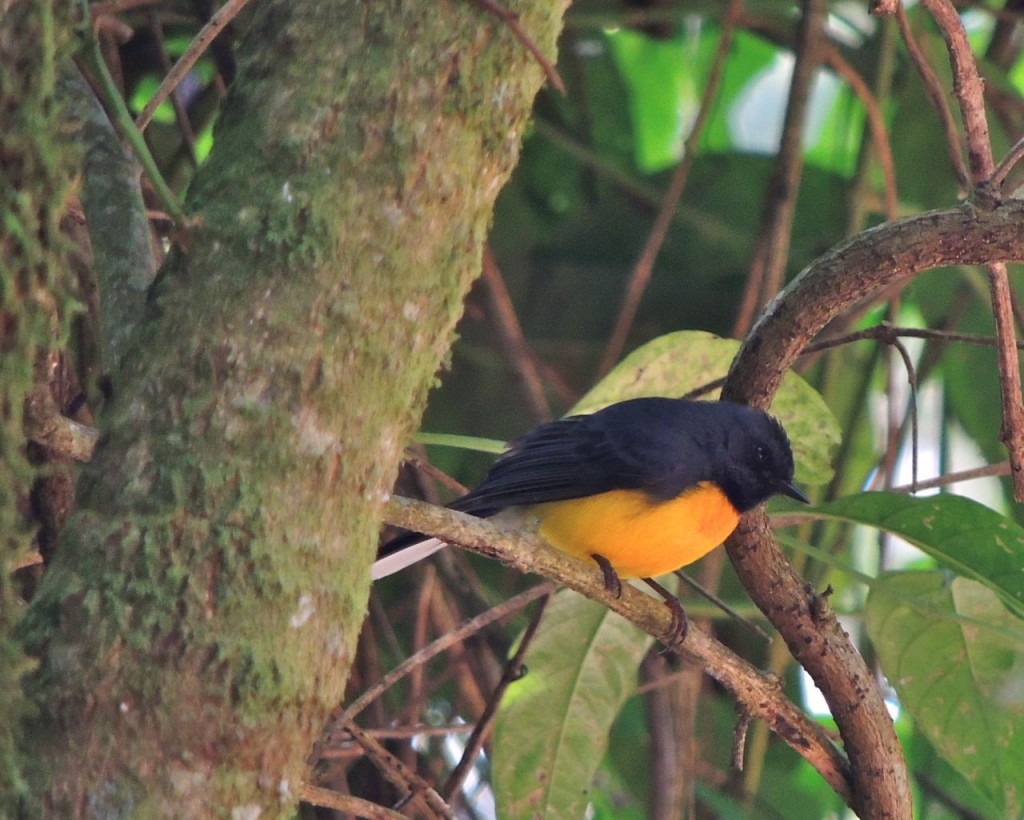
Finca Lerida welcomes birders and provides a guide to a number of trails that skirt the background forest; I walked them all. My notes of the day record: ” ..I set off to walk the trails of Finca Lerida. It was several hours of walking of the kind I like best. There was always something fascinating: ferns of all sizes from the minute to 10M tree-size, leaf shapes and patterns, flowers, towering trees, bamboo and all a-tangle. I couldn’t help thinking of the early Spanish soldiers and merchants and the impenetrability of how it must have been. I hiked out to a putative waterfall, which, while vertiginous, was truly puny, perhaps a garden hose volume dropping over greened cliff. Back at Finca Lerida I enjoyed an hour or so of ambush photography of hummingbirds. I know I have Green Violet-ear, Scintillant and Rufous tailed – but what else?…and a photo of what I took to be a euphonia of some sort but can’t make a match.” (It turned out to be a Slate-throated Redstart.)

Slate-throated Redstart

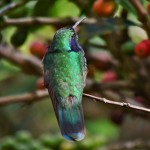
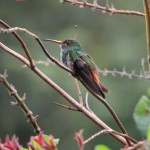
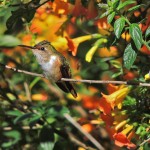
That hour of ‘ambush photography’ produced many duds as expected, but it’s a numbers game and inevitably some turned out okay. I had little idea what species I was photographing, but no matter, if I get a decent shot I can always i.d it later. It turns out that most were Green-Violet Ears, a self-explanatory name if ever there was. But I’m pretty sure there are a couple of Scintillant and Rufous-tailed Hummingbird shots and the odd mystery bird. Identification really didn’t matter a lot, they are all extreme exotics and, as always, it’s more about the day, the place and the experience.

Footnote. One of the things about hummingbirds that often catches my attention is their many fanciful names. (At least among English-speakers.) I suppose it’s something of a reflection of the somewhat cutesy and frivolous view we hold of them. A quick review in the index of The Birds of Panama came up with: Greenish Puffleg, White-vented Plumeleteer, Humboldt’s Sapphire, Green-breasted Mango and Violet Sabrewing; and that’s just in Panama. It’s as if they’re viewed more like Christmas tree decoration than a marvellously adapted and sophisticated family of birds.
There are several galleries of photos in this post.  They’re visible only on the website, not if you’re reading this as an email.

Resplendent Quetzal

31 January 2015. Boquete, Chiriqui, Panama. I have never regretted paying a local guide to show me around the best birding spots. I may have gulped a bit at the price, but in the end have never regretted it. Like engaging a skilled tradesman, (a plumber comes painfully to mind) they can do the job better, more efficiently and in one tenth of the time it would take me to barely complete the task.
So today, my first day without Spanish lessons, I hired Jason, a friendly, well informed and English speaking birder, to take me out for half a day of Chiriqui’s best birding. He introduced himself by saying that we were going to visit three good places. I thought, “I’m in your hands Jason. Vamos – lets go!” (Jason Joel Lara can be contacted at jthunder12@hotmail 507 6718 6279)

Birders, occasional birders and informed tourists alike rate the Resplendent Quetzal as the Holy Grail of birds in this part of Panama. Frankly, I wasn’t concerned whether I saw one or not. For me it’s almost always more about the experience, the place and whichever birds make it special one way or another. But still Jason ‘knew’, or believed he knew, that I longed to see quetzals, so off we went.

We made our first stop at “ the Rock-climbing Place” a roadside wall of geometric basalt in a warmly fragrant valley which, when we arrived, was still in early morning shadow. As the sun rose to warm up our side, we found Elegant and Thick-billed Euphonias, diminutive but brightly coloured fruit and seed eaters and members of the finch family. They like to find their food in the dense clusters of mistletoe that plague certain trees and it’s their preference for mistletoe which, with its sticky seeds, helps spread the parasitic plant.

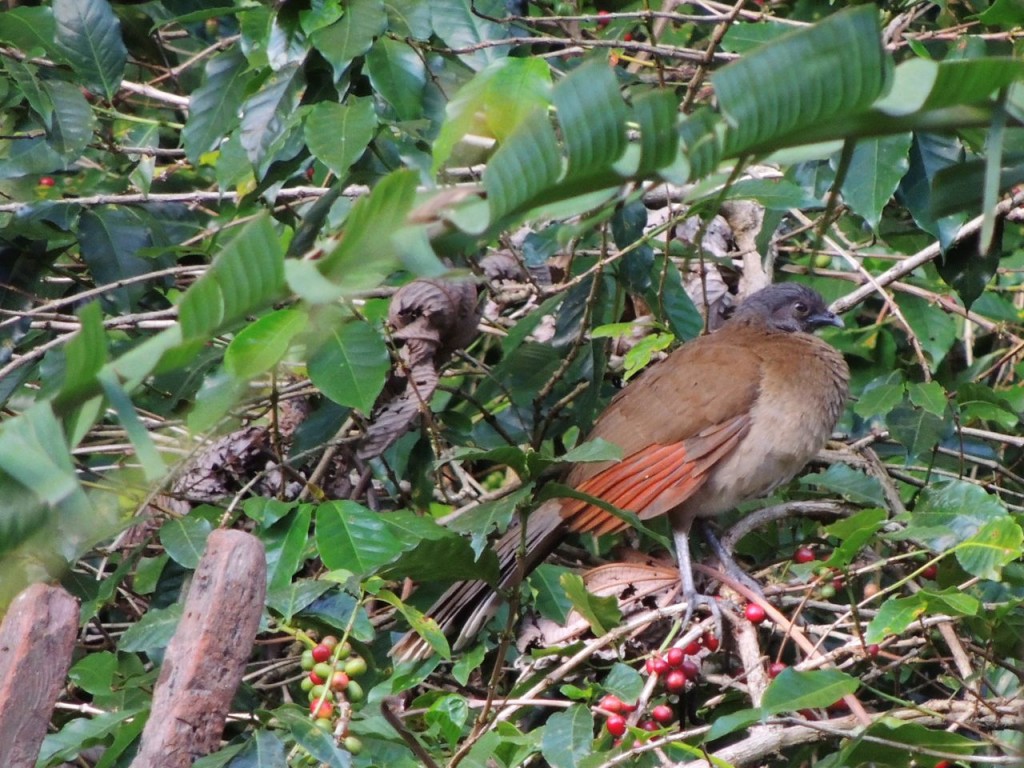
A small group of Gray-headed Chachalacas flew from the still-shady opposite side of the valley and landed not far from us. They moved quietly deep within the tropical tangle and gulped down bright red coffee beans; someone’s homegrown crop. Chachalacas are pheasant-sized birds, one of those species I’d seen pictures of but, being somewhat exotic and tropical, had assumed I’d probably never see. Times change and now I’ve not only seen them but I’ve managed a couple of reasonable pictures, here’s one.

Gray-headed Chachalaca

After a brief but unproductive stop at Cascada San Ramon, a noisy, gushing waterfall falling from a notch in the green mountainside, we moved on to the Quetzal Trail. Jason managed to infect me with a sense of Quetzal priority but it took a one or two kilometer hike up a rough and ascending trail to reach their habitat.

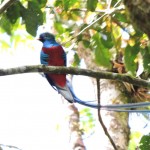
I seriously doubt that any casual observer would spot a quetzal unaided. At this time of year they spend the early mornings feeding on the cherry-sized fruit of a species of avocado and then, once full, sit quietly in the deeply shaded mid-canopy of the forest. I had expected them to be another pheasant-sized bird (and therefore somewhat conspicuous) but they turned out to be more magpie size, and very hard to spot. Jason on the other hand, with his years of guiding and experience knew exactly what to look for and where, and soon pointed out a group of males and females sitting quietly digesting breakfast.

Resplendent Quetzals are often described as the most beautiful bird in the world; well, beauty is in the eye of the beholder. There is no question that Resplendent Quetzals deserve the adjective; indeed a dictionary definition of the word resplendent is itself laden with superlatives! The male with his exaggerated iridescent green-blue wing coverts and streaming tail outshines the female, who would be head-turning enough on her own. On the negative side though, our quetzals were very difficult to photograph. Details of the struggles with my camera and the tricks I had to play on it don’t matter; my best efforts are above.

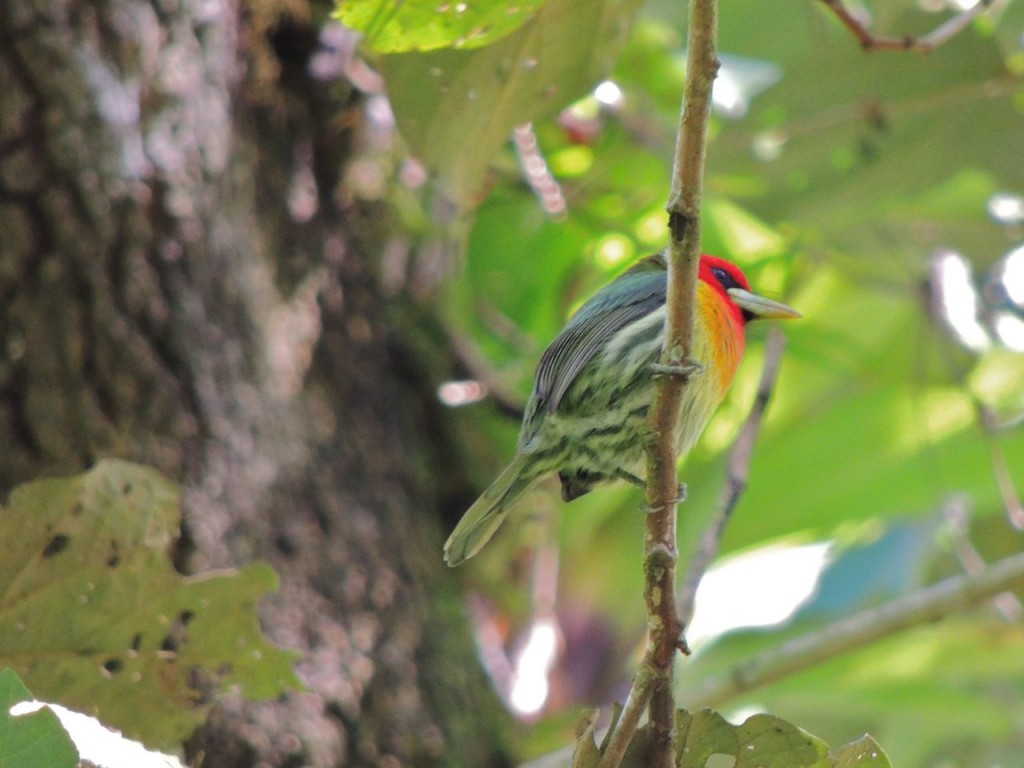
Breath-taking though the quetzals may be, we saw many other wonders. A Two-toed Sloth looking, for all the world, like a ragged nest in the top of a scrawny tree was a surprise and of course stayed obligingly still for a long time; the entire day for all I know. I might have opted for a couple of Squirrel Cuckoos as my Birds of the Day because I like the quirkiness of the cuckoo family as a whole and a Red-headed Barbet was Jason’s bird of the day; they are an uncommon relative of toucans, so I was suitably impressed. I was happy too with a Yellowish Flycatcher that posed quietly for us, I liked it for its cuteness, its contented nature and that it is so closely related to the Least, Willow and Alder Flycatchers that we commonly see here during Ontario’s summer. But it’d be hard to top the quetzals and once found I was convinced; Resplendent Quetzals my Birds of the Day.

Red-headed Barbet
Red-headed Barbet

Blue-gray Tanager

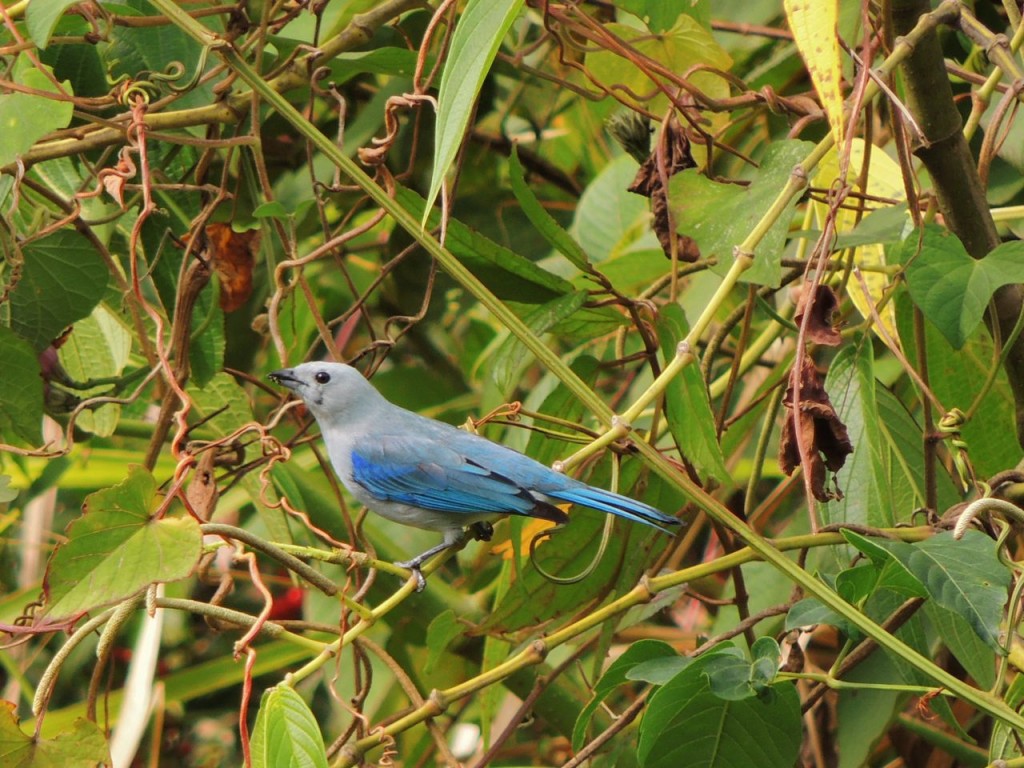
January 28 2015, Boquete, Panama.  My field guide, The Birds of Panama by George Angehr & Robert Dean describes the Blue-gray Tanager as one of the most familiar and ubiquitous birds in Panama; I have certainly seen many of them in these early days. I suppose you could get tired of them in time; but then it would seem to be hard not to always be smitten by the subtle treatment of the blue palette on this bird.

There are thirty-seven tanagers listed in the guide’s index. At risk of tediousness, it’s worth noting that while the majority of listed tanagers are “true” tanagers (in the Thraupidae family) a handful, well actually ten, are tanagers in name only, they’re members of the Cardinulidae family, which plunks them in with grosbeaks, buntings and, as you might have gathered from the tongue-twister name, cardinals; I was relieved to note that the Blue-gray is one of the Thraupid tanagers, a true blue.

I sleep rather fitfully so it has become easy to head out at first light to explore some of the hidden corners of this rather picturesque mountain town. Following a quiet road this morning, I ended up at the gates of the cemetery; intact I might add. Cemeteries can be very productive birding spots, they are by definition deadly quiet, and as often as not bordered by woodland or at least some kind of uncultivated area. Many bird species prefer edge habitat over interior forest or even open spaces, edges offer quick cover, access to nearby food and strategic viewpoints, ideal for territorial songbirds. Anyway, I walked around this sometimes-manicured sometimes-not collection of headstones, vaults and tumbledown crosses, but for all of my forgoing introduction it was really not very productive. I did spot a little Red-legged Honeycreeper high up in the nearby forest canopy; it was a male in spectacular breeding plumage: generally all over dark blue but with an iridescent sky-blue cap. It was much too far away to attempt a photograph but I recommend checking Google Images to see what I mean about spectacular.

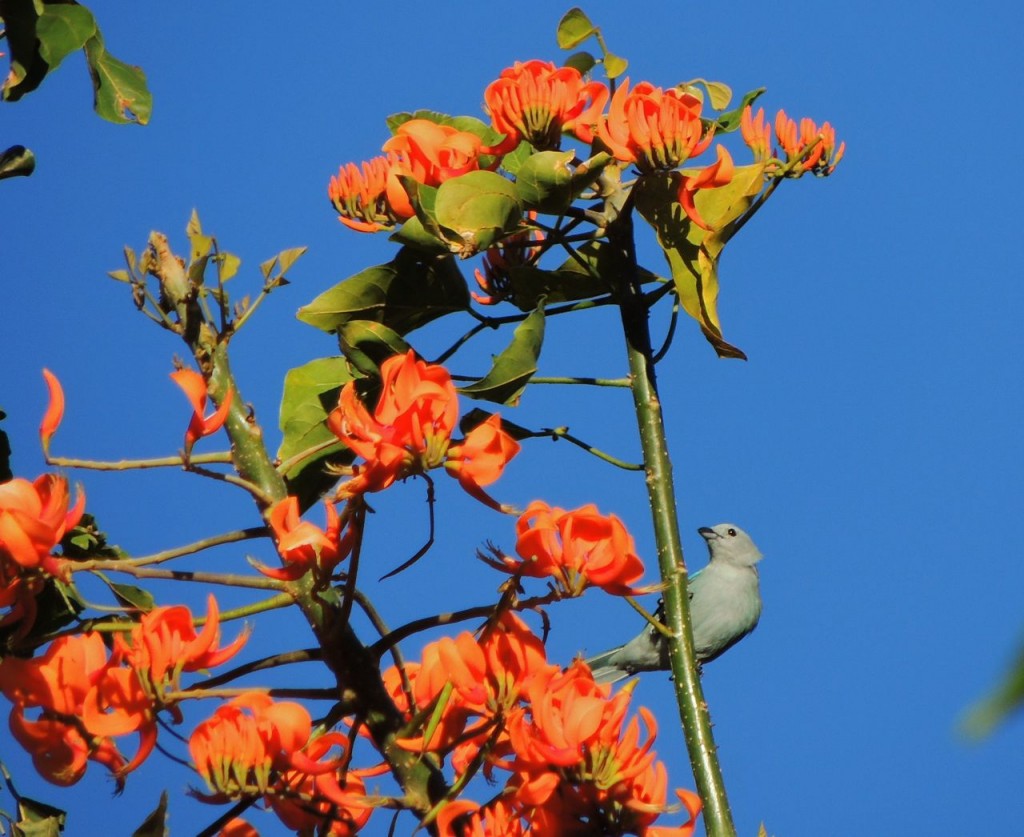
Leaving the cemetery, I gazed for a long time at the glorious orange flowers on a number of Malinche trees (I think that’s their name). There I found birds aplenty, mostly Tennessee Warblers and Blue-gray Tanagers, feeding I assume on the nectar. Orange and blue are a complimentary colours so it’s no surprise that the tanagers look good among the blooms.
Lest they should someday become ho-hum birds, I’ll take this chance to spotlight today’s Blue-gray Tanagers as my Bird of the Day. Here’s a couple of photos.

Blue-gray Tanager
Blue-gray Tanager
Blue-gray Tanager
Blue-gray Tanager