Turkey Vultures

23 March 2015 Cayuga, ON. With an absolutely clear calendar I foresaw a day in which I could seek some spring-arrival Tundra Swans and other waterfowl usually associated with the first open water. But the temperatures dropped precipitously last night and, although bright and sunny, it was cold today and a brisk north wind only made things worse. I had little appetite for standing around peering at distant ducks under such conditions; there are times when I’ll willingly do so – but not today.

I visited our local hawk-watch where three shivering and cheerless souls, stood scanning an empty sky. I like hawk-watching under certain conditions: an abundance of birds and moderate temperatures being foremost; I left and headed for the bird observatory where I spend so much time in spring and fall.

Not far from the bird observatory I disturbed a pair of Turkey Vultures who had found the corpse of a raccoon; a satisfying meal I imagine. They flew heavily to a nearby shed and sat disconsolately waiting for me to leave. Anticipating a good photo opportunity, instead I parked in a convenient spot and waited for them to revisit their breakfast before it got cold. Evidently it wasn’t that important to them for after a few minutes they left for a little exercise, a flap around the neighbourhood. I took just a couple of shots, this one ruffling its feathers just before take off.
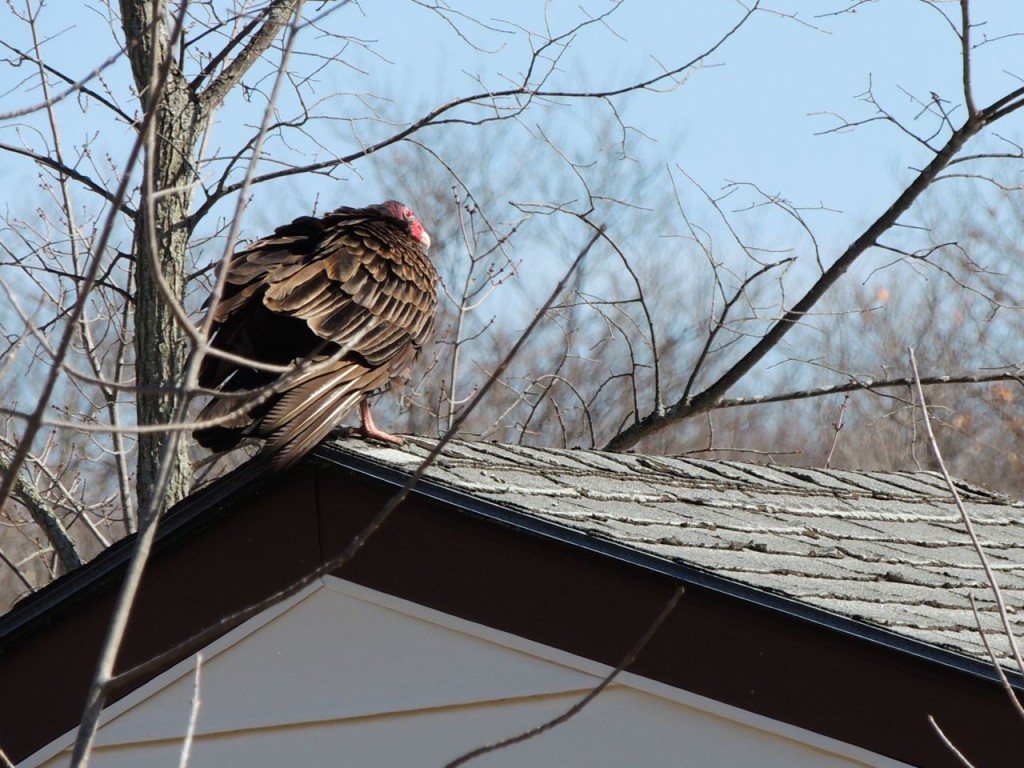
Turkey Vulture
Turkey Vulture

At the bird observatory, I bundled up and walked around my spring and fall census route compiling an interesting list of birds, including three petulant Killdeer and a Red-tailed Hawk driving a one-year-old Bald Eagle away from the hawk’s chosen nest site. Two male Wood Ducks flew past me following the river upstream with a flock of six male Mallards close behind. The Wood Ducks were squealing, as they do, like frightened piglets, a rather disappointing sound from a bird, which, in every other way, is thoroughly endearing.

Chilled and eyes streaming, I left knowing that warmer weather is really not very far away and quite happy with my day’s sightings. Especially with the Turkey Vultures, my slightly macabre Birds of the Day.
Gadwall

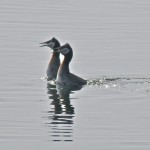
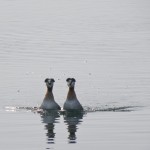
21 March 2015. Bronte, Oakville, ON. For some thirty five years I have maintained a rather hi-and-miss rolling diary in which I write of notable things happening in the natural world. On this date in 2012 I wrote, “Red-necked Grebes in courtship at Bronte Harbour.”   I remember it well; a pair were conducting an impressive side-by-side courtship dance. They ploughed the waters in a series of brief rituals, braying and cooing to each other as they went. Here are a few pictures from that day.

Reading that diary note, I decided to see if they’d returned, hoping of course for another chance to witness that elaborate water-dance. This particular harbour is one of the very few places in eastern North America where Red-necked Grebes breed, and they are so indifferent to the presence of people and their play boats, that their nests are easily observed, sometimes no more than ten metres from shore. Today a few Red-necked Grebes were present, having probably returned from a winter spent along the Atlantic coast. But conditions are quite different this year, as yet there is little open water and the sheltered yacht-basin breeding site is still largely iced over. Among the three or four grebes I found, I could see no sign of pair formation let alone courtship. Once the ice melts it won’t take long though for things to change.

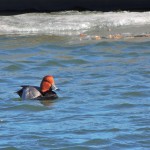
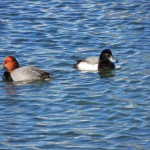
Scanning the yacht basin with its geometric assembly of docks arranged like the halves of a zipper, I found plenty of Redheads – always gorgeous, Lesser Scaup (ditto) and Long-tailed Ducks (ditto). And then, in the distance, a small flock of Gadwall puttering around on an expanse of ice. They were today’s wow! bird. Not because they are particularly colourful, they don’t have any of the splendour of some of their kin: Mallards, Green-winged Teal or Northern Pintails for example. But they have a sort of understated coolness, a disregard for fashion born of self-assurance. Author and ornithologist, Pete Dunne puts it this way; “ Fairly common and conservative, in both attire and social commitment. Males make a fashion statement with tasteful gray….” In the field, one of the most distinctive features of the male is its overall grey appearance, a splash of white in the wing and  a coal-black rear end. The female on the other hand is overall greyish brown, not unlike a female Mallard although slightly more streamlined.

I sense that my words are unlikely to make much of a case for a Gadwall Appreciation Society; it’s not that important anyway. I like them a lot and don’t see enough of them, but when I do they make me smile and celebrate inwardly. Enough to be my Bird of the Day. Here are a couple of photos of that group, maybe you’ll find some of what I see in them.

This post contains photos in galleries visible only on the website, not if you’re reading this as an email.

American Robin

19 March 2015 Burlington, ON. The end of winter and approach of spring has birders watching closely. Today the sun rose at 07.26 and set at 19.30; twelve hours and four minutes on the right side of the ledger. The signs of spring in bird life have been evident for a couple of weeks, nothing outlandish just a trickle: small migrating flocks of Red-winged Blackbirds and Common Grackles, and Red-tailed Hawks and Turkey Vultures counted at a nearby hawk-watch, and even a few reports of American Woodcocks, Song Sparrows and Killdeers.

On Lake Ontario there are increasing numbers of what we refer to as bay ducks, species that winter on the Great Lakes or along the Atlantic coast and breed above the Arctic Circle. It’s my view (unsubstantiated, and worthy of more research on my part) that at this stage of winter’s decline, these birds are driven to pursue the retreating edges of the ice between their Atlantic refuges and the Arctic.

So I think that right now, as the ice on and around Lakes Ontario and Erie starts to break up, this is the front line of the bay-duck spring migration. It will take a few weeks yet for open water to appear all the way between here and the Hudson Bay lowlands, but they’ll be watching and testing the limits. They must reach their breeding grounds as soon as possible; the early bird gets the best breeding site and the summertime available to raise their young to independence is short enough.

I’ve been watching and feeling this incremental approach of spring. Silently cheering at the sound of singing Northern Cardinals, contentedly noting the flocks of Red-winged Blackbirds and Common Grackles overhead and pleased to see the odd funereal Turkey Vulture cruising by.

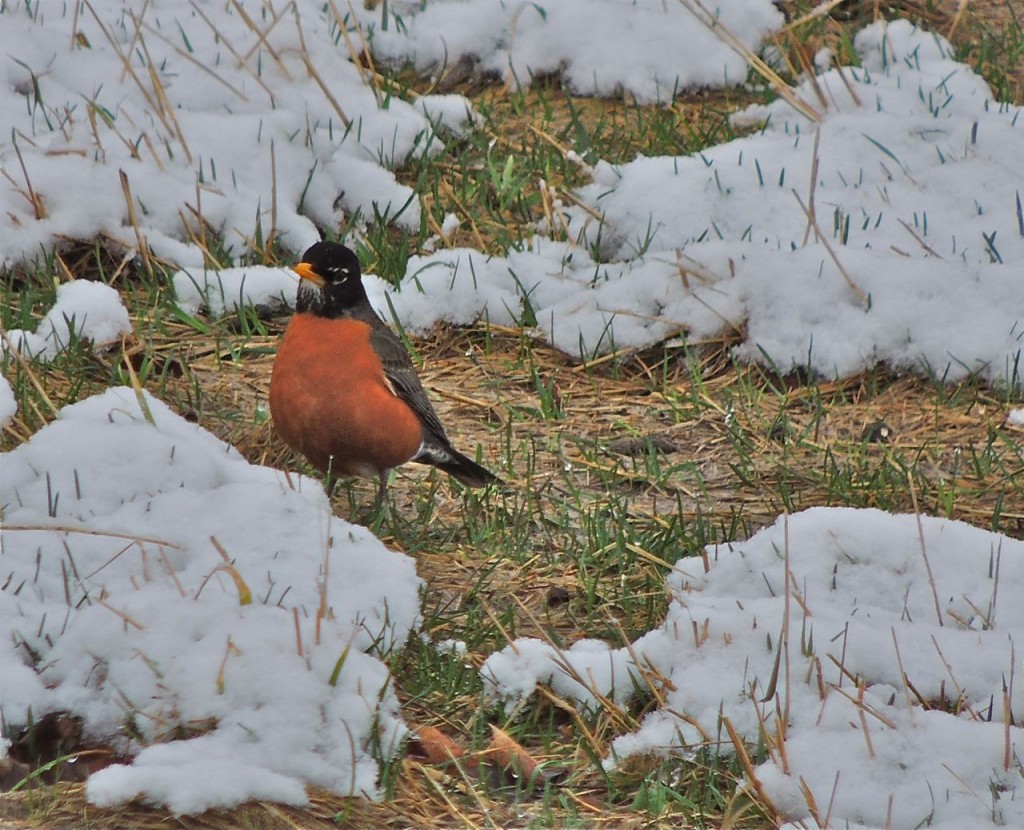
American Robin (male) in late snow

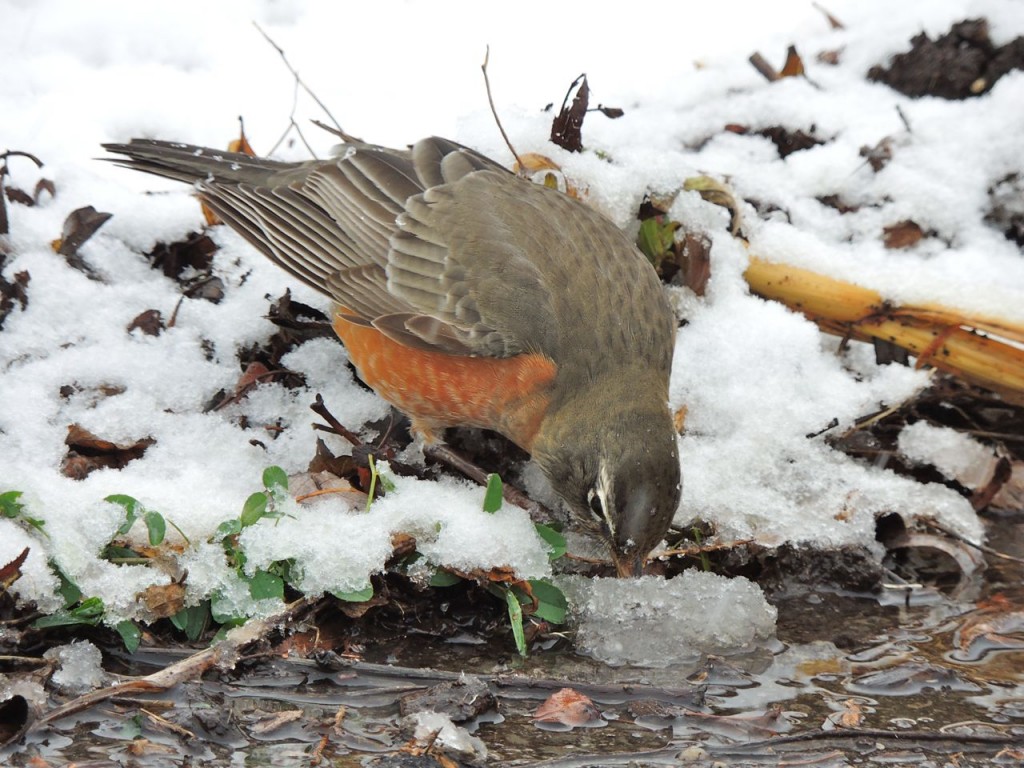
I started my day at a breakfast meeting in the half-light; but the sun was up when the meeting ended at 8.45. As I walked back to my car I heard, for the first time this year, a singing American Robin. Robins have been out of the public eye for a few months. I haven’t mentioned robins until now partly because although the spring sighting of a robin is the sort of thing that can make a cute seven o’clock news filler, really our robins were never far away, they usually winter in some of the denser woods and ravines around here, unseen by most of us. But a robin in song is another matter altogether, it’s like the sunrise; the first light of daybreak is helpful but the sun‘s first peek over the horizon is the confirmation you need; you don’t get robin song without spring being right on top of us. Today’s American Robin in song was not only Bird of the Day, but perhaps also my Bird of the Spring Equinox.

American Robin
American Robin

Peregrine Falcons

9 March 2015 Burlington, ON. The morning started well for me with a Carolina Wren singing boldly just outside our front door. Like a nearby Northern Cardinal, also in full song, it was commenting, as only they know how, on the change in weather. This day dawned bright with temperatures well above freezing. It must have been our change to daylight saving time that made it warm enough for rivulets of melt-water to appear everywhere.

Looking back at my notes, and photos from a year ago, I could see that we’re at about the same point in the reemergence of light and life.   I headed off to a couple of favourite lakeside sites. Naturally it was pretty much as expected, a little less ice-free than last year but a day or two of warmth will make a lot of difference. At a nearby marina were many Lesser and Greater Scaup, Long-tailed Ducks and White-winged Scoters all diving for food.

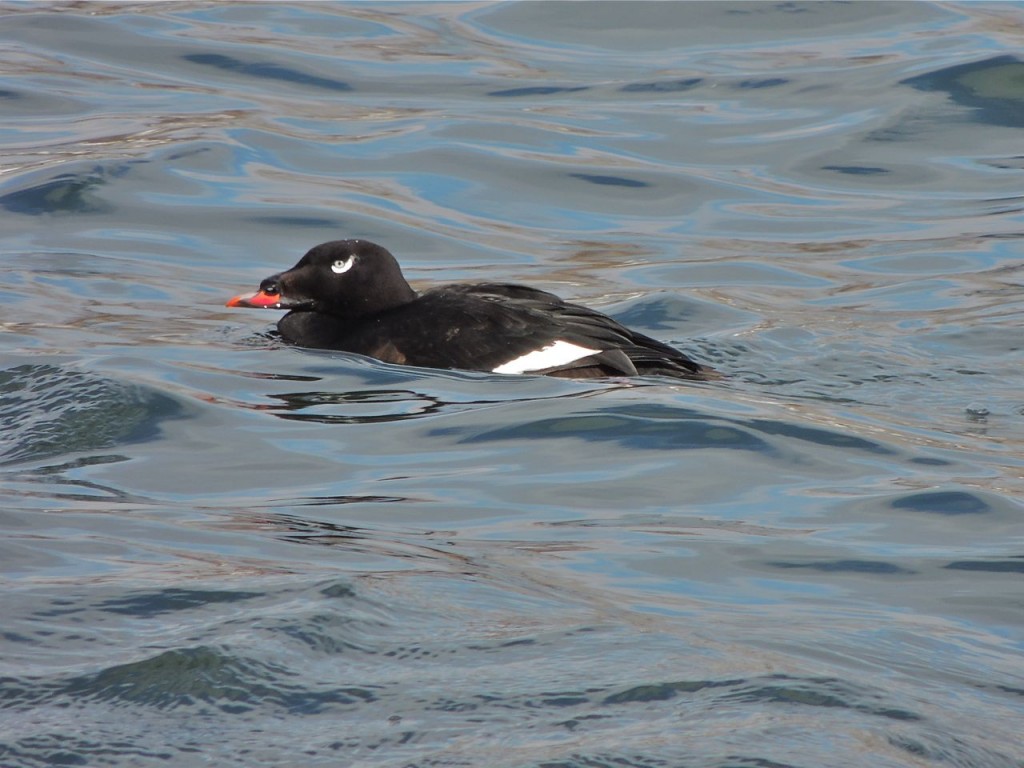
I spent quite a long time trying to capture photos of White-winged Scoters in the act of diving. It was surprisingly difficult because it all happens so quickly. After many missed shots I began to anticipate the process. Over the span of a second, or maybe two, a White-winged Scoters goes from a rather placid, barge-like posture to: sit-up-and-pay-attention, brief neck stretch, minor wing-spread – and then dive; gone. I realized that the sit-up-and-pay-attention moment was my cue to press the button. There was always a momentary camera pause to allow for, but it worked and I brought home an entertaining and vaguely instructive collection of shots on how to make diving look easy.

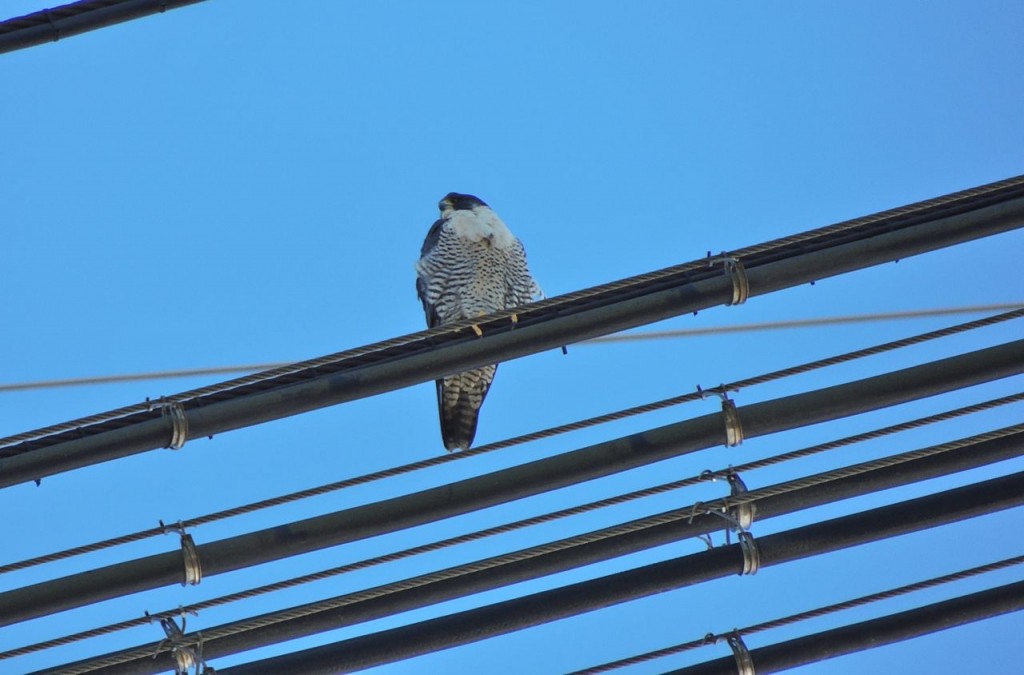
Later I stopped to check on our local pair of Peregrine Falcons. One of them, I couldn’t tell which, was on a ledge near the top of the bridge superstructure where they have their nest site. I watched it through binoculars for a long time; it seemed to be unusually attentive as if anticipating something. I wondered if it was on guard duty and scanning the skies for unwelcome visitors; territorial peregrines will aggressively chase off any other hawks or falcons that come anywhere in sight.

Peregrine Falcon
..as if nothing happened

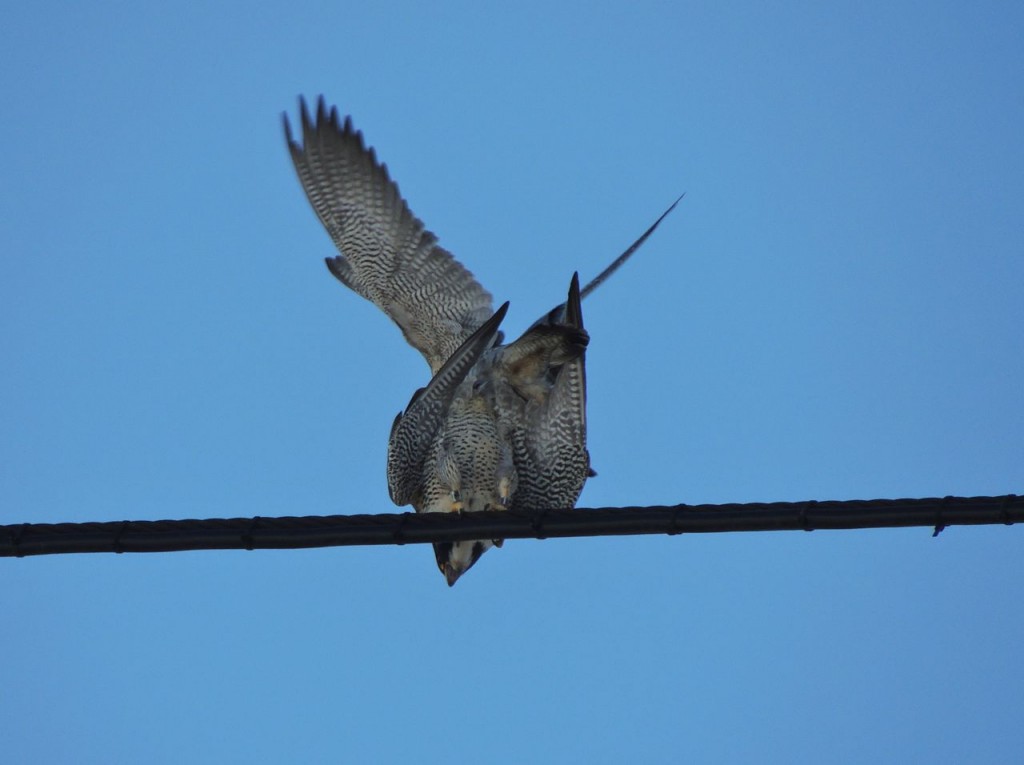
Eventually it launched itself off the ledge and flew to land on a large cable directly overhead. So directly overhead that I had to move quickly to avoid an unwelcome shower of Peregrine poop; not everything about peregrines is awe-inspiring. As I regained my composure, a second peregrine swept in, calling as it flew, came to a fluttering stall and promptly mounted and copulated with the bird overhead; an unusual viewpoint, but at least I now knew that it was the female I’d been watching for so long.

Peregrine Falcon sex

Reflecting on the morning, it’s hard to be sure which of the three sightings gave me the greatest pleasure: the spring-heralding Carolina Wren, the diving White-winged Scoters or the mating Peregrine Falcons. Interestingly each, for various reasons is a bit of a newcomer: The Carolina Wren is a species that has expanded its range into this part of Ontario as recently as the last twenty years, perhaps in response to milder winters. The White-winged Scoter and many other winter duck species were virtually unknown as Great Lakes winter residents, again until about twenty years ago. Now they overwinter here in their hundreds of thousands feeding on the vast colonies of invasive Zebra Mussels that have become established. And the Peregrine Falcon is the poster child for bringing a species back from extinction; they were virtually eliminated from the landscape by the use of DDT. As the rescue bird it was my Bird of the Day.

Bald Eagles – on ice

4 March 2015. Hamilton Harbour, ON. Today was the first day in the better part of two months that the air temperature edged above freezing. Just getting above the freezing point was a big leap and one that many birders seemed to appreciate. I went down to the entrance to our large industrial harbour to see if I could spot our resident Peregrine Falcons at their nest site (I did) and maybe some interesting ducks in and around the canal that connects the harbour to Lake Ontario. The canal is such a dynamic and surging waterway that even when the entire harbour and adjacent expanses of the lake are frozen, it has open water and is consequently crowded with wintering ducks. They were all there in thousands: Long-tailed Ducks, Lesser and Greater Scaup, Common Goldeneyes, Redheads, Canvasbacks, Trumpeter and Mute Swans, White-winged Scoters (pictured below) and Red-breasted and Common Mergansers; eleven species, and all but the swans were diving to feed on the Zebra Mussels which have colonized the Great Lakes.

White-winged Scoter
White-winged Scoter

There were Herring, Great Black-backed and Ring-billed Gulls too and, away in the distance, eight Bald Eagles.

I met another area birder there; Kevin is highly respected for his encyclopedic knowledge of all species of our birds and is widely consulted as a specialist in the evolving plumages of gull species from juvenile to full adult; a three or four-year process (and utterly baffling to most). We walked out to the end of a pier, into the teeth of a northwest wind coming off the frozen harbour and, cold though it was, for the first time in a long time I didn’t feel that I was risking frostbite.

Kevin was busy taking photographs as a resource for his monograph on determining the age of female Long-tailed Ducks. I, however, was looking the other way, captivated by the sight of my Birds of the Day, the group of Bald Eagles some distance from us. Bald Eagles now regularly spend the winter on and around the ice of the harbour, where they prey on the thousands of overwintering ducks, particularly those that fail to keep their wits about them.

Here is a gallery of some of that group, mostly juveniles. It takes about four years for the full white head and tail of the adult eagle to develop.

(The gallery is visible only on the website, not if you’re reading this as an email.)

Historically Lake Ontario was perfect habitat for Bald Eagles, but their numbers crashed in the early to mid twentieth century and as recently as twenty years ago the sight of a Bald Eagle around here was quite sensational. We now have a local breeding pair, which for the past two years, has successfully produced two chicks per year; and the wintering Bald Eagles have been reliably present for perhaps the last five winters.