3 January 2016. Sedgewick Park, Oakville ON. When the cold winds of January set their teeth, birding treats are few and far between. I usually manage to find enough on my census walks to satisfy my soul but there are many birders for whom the New Year is the start of their 2016 list. I hear about all the discoveries through our on-line network, it can make the blood run quicker at times like this. This morning I was reminded of a handful of summer birds that still linger around a nearby sewage treatment plant. Without going into too much detail, sewage treatment plants process warm water and consequently sustain much peripheral insect life, and insects mean food for birds.
That the sewage treatment plant is surrounded by dense woodland, lots of undergrowth and a small creek it makes it a viable overwintering spot.
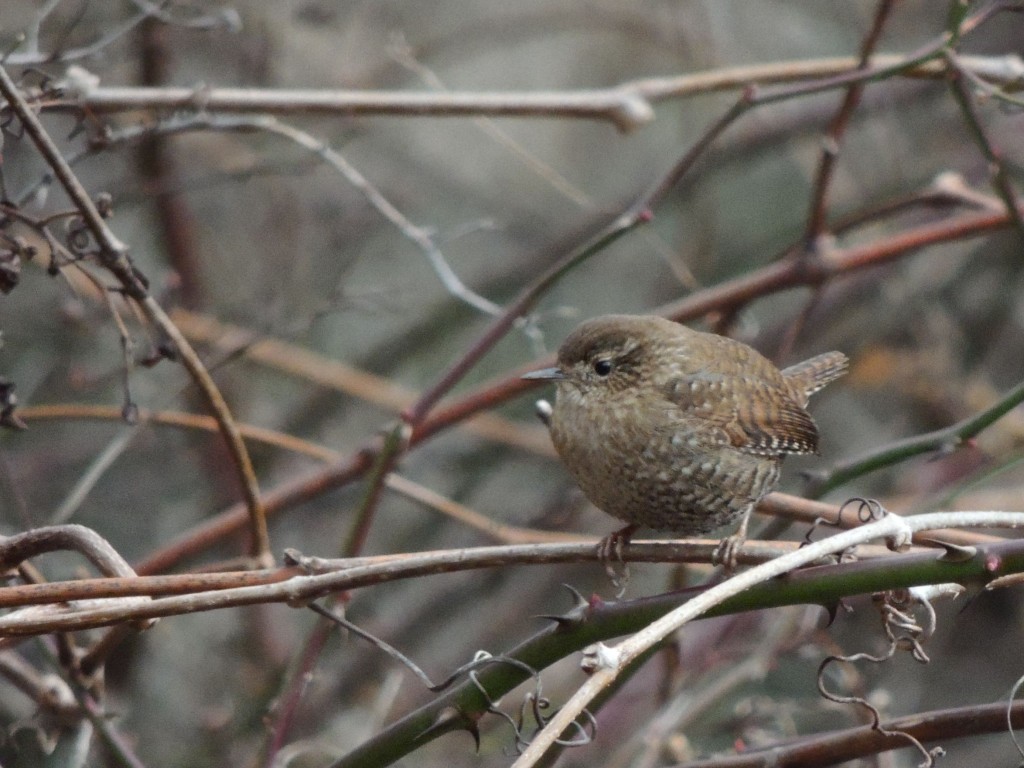
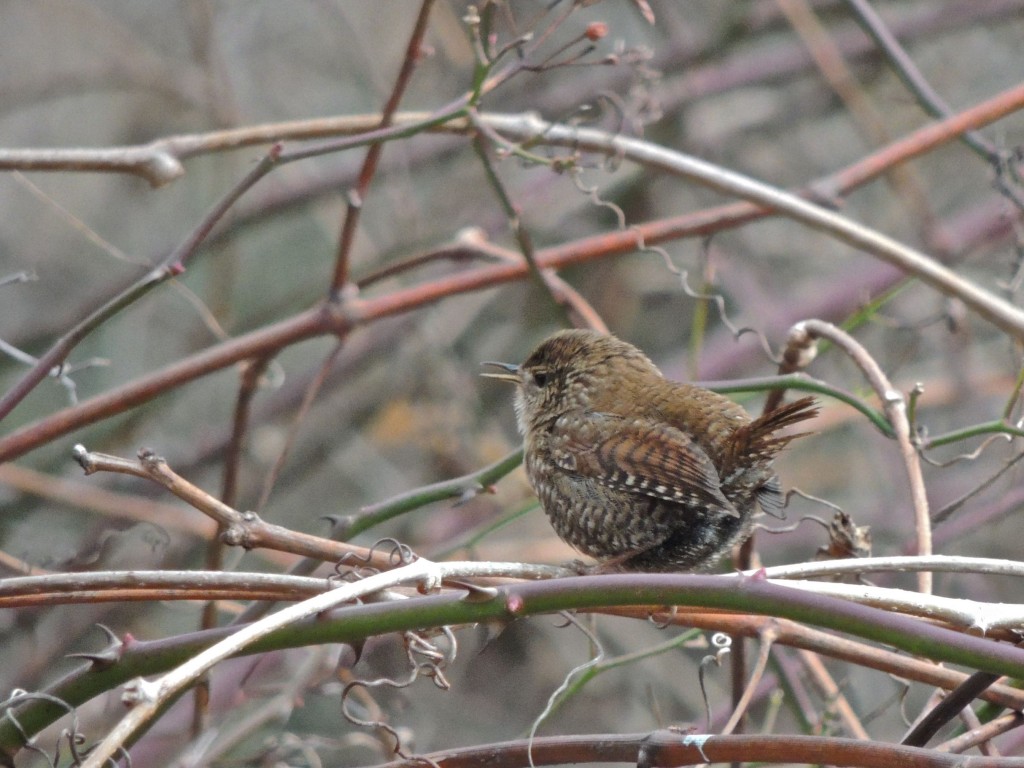
Winter Wren
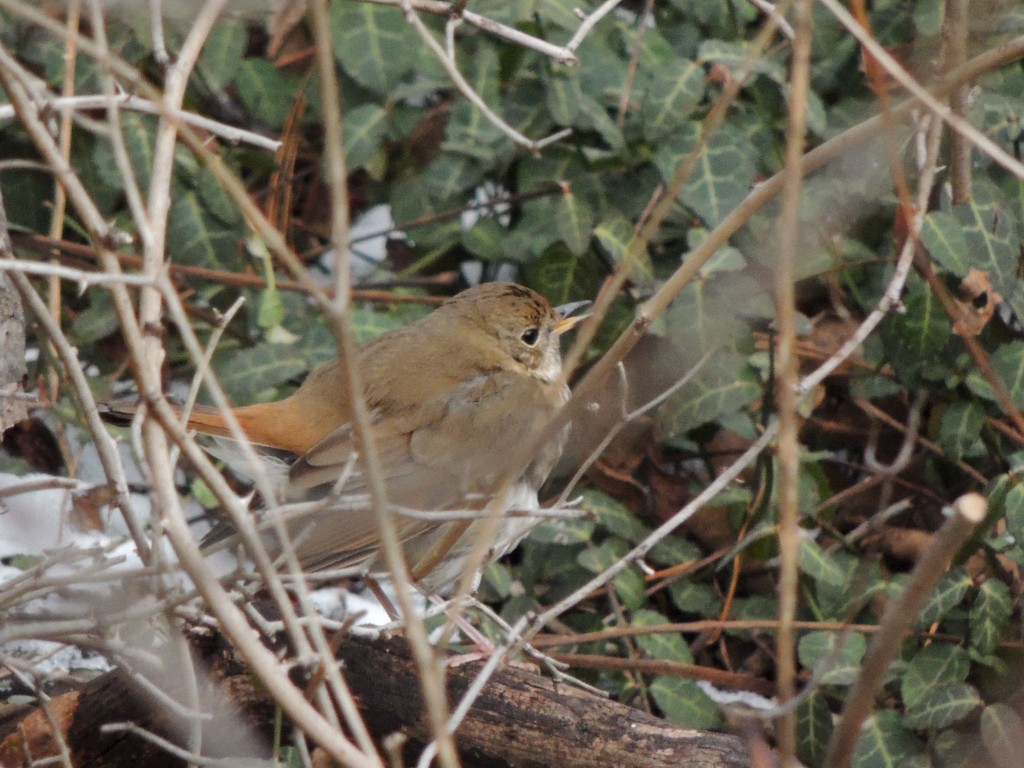
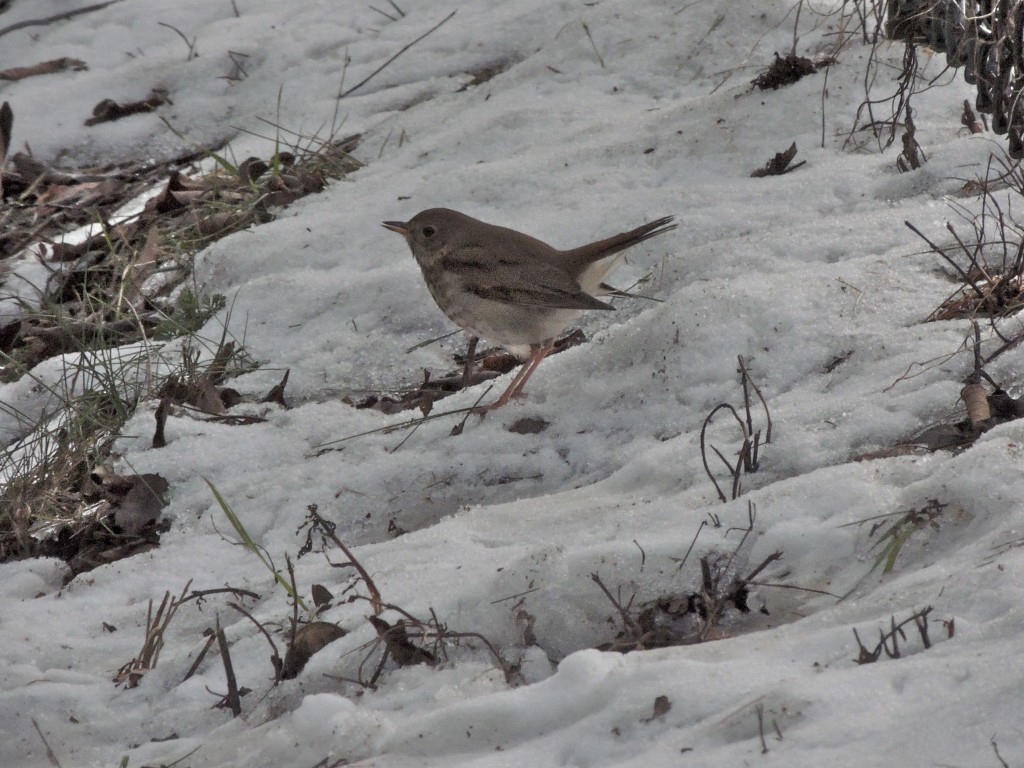
My two hours there in knuckle-stiffening cold, produced several nice little birds: two Winter Wrens, a Western Palm Warbler, two (maybe three) White-throated Sparrows, a Ruby-crowned Kinglet and a pleasingly bright Orange-crowned Warbler among them. Perhaps the Orange-crowned Warbler should have been bird of the day, but somehow it was upstaged by a Hermit Thrush staying low and skulking through thickets of old grape, blackberry and ivy. When it thought no-one was looking it dashed out for a shot at whatever insects may be around.
I’m not sure quite why the Hermit Thrush stole the show, but it did. Quite simply it made me exclaim wow! (inwardly anyway); and that’s all it takes. They are modest birds, not showy and never overtly seeking attention yet, when it comes to spring song, they’ll stop you in your tracks with their brief cascade of liquid fluted notes.
30 December 2015. Hendrie Valley, Burlington ON. After what must have been a record-breaking run of warm, December weather, snow finally came. It arrived two nights ago, wet and splattering in a driving storm that blew in from the southern U.S. The temperature fell just enough to make snow and not rain, then last night it all warmed up and everything turned slushy.
I walked the final census of the year and found the familiar landscape subtly changed; it was trying to lie as quietly as a winter landscape should, but neither the snow nor the cold was quite deep enough. The many ponds and inlets had tried to freeze over but it was all fake ice, thin and soft, and where a beaver had paddled around there were wide, open-water trails.
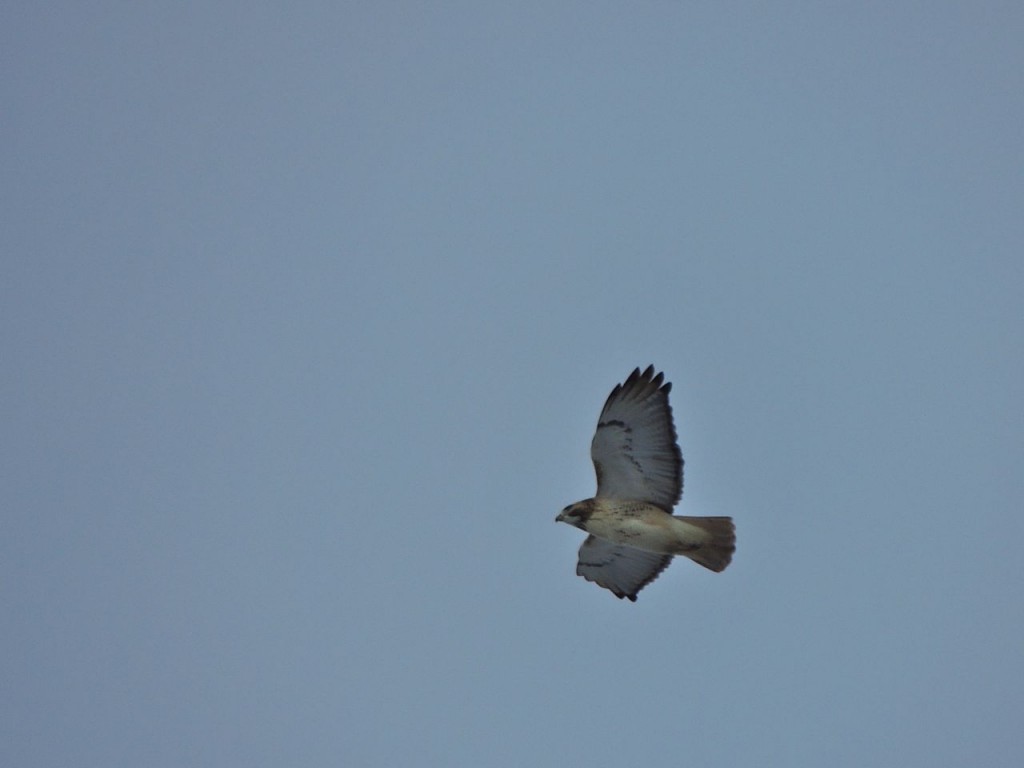
Wind blown Red-tailed Hawk
A Red-tailed Hawk flew heavily from an overhead tree and was promptly harassed by a small murder of American Crows. (Murder’ an appropriate collective noun; they didn’t but I think they’d have liked to.) Black-capped Chickadees followed my progress and pestered me, hungry, and fluttering in front of my face like mid-summer mosquitoes.
I stopped and listened for a long time at my turn-around point, a metal bridge spanning the fast-flowing creek. Where usually I’d be joined by chickadees and hear from cardinals and woodpeckers, it was very quiet. A minute or so passed and then, some indeterminate distance upstream, I could just pick out the uncertain, thread-like song of a Winter Wren, a song that can sometimes sound like a thin, tinkling stream of water. I celebrated inwardly, I remember spotting one near here several early springs ago, and maybe my Winter Wren will stay to earn its name in this sheltered little corner.
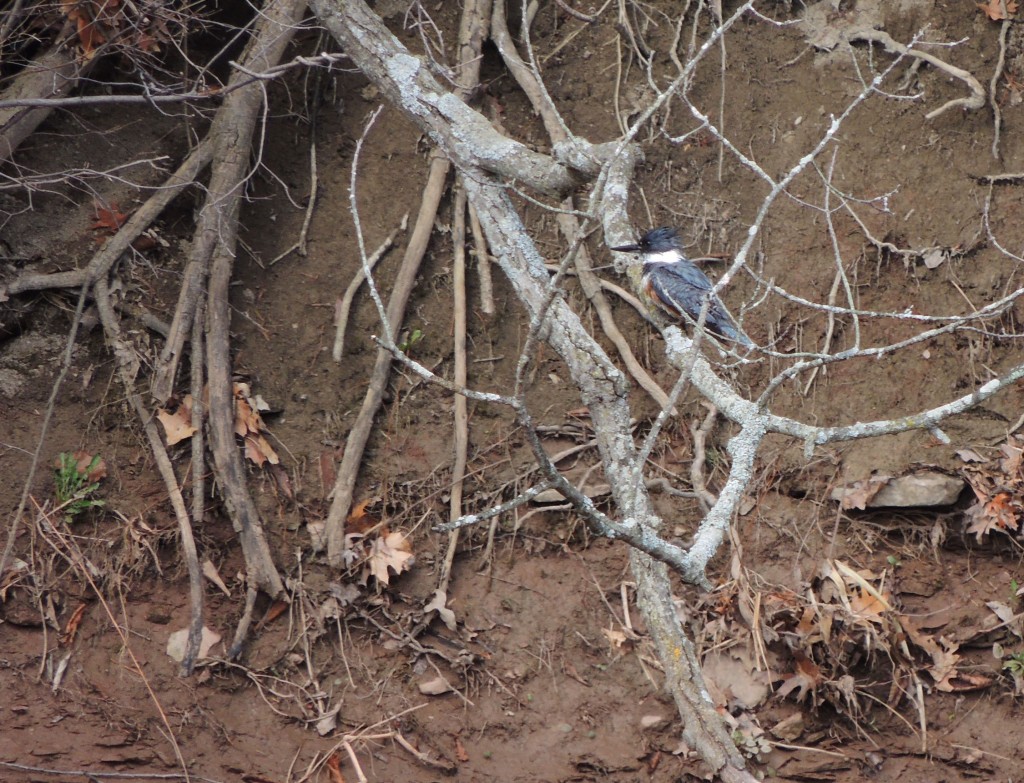
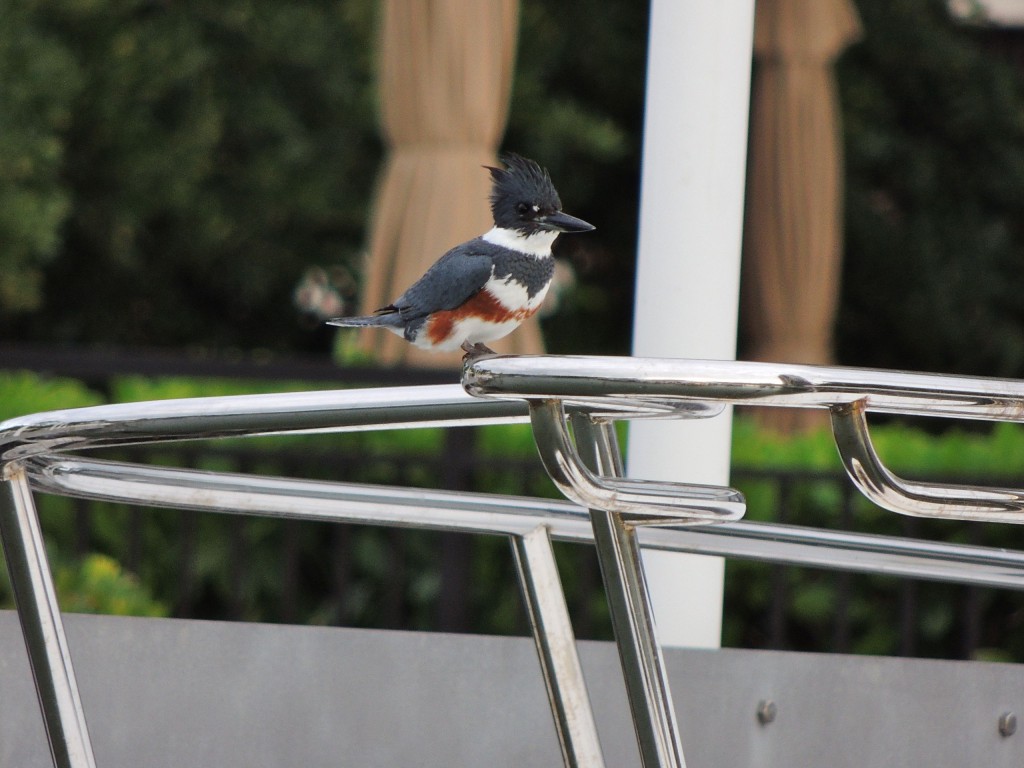
For a while the wren was best of the day and would have been Bird of the Day had it not been for a male Belted Kingfisher. I heard him twice, once far away but then, just as I was wrapping up the census, I heard it again much closer. A quick binocular sweep and I found it perched on a low branch peering straight down at the creek below. It departed as I readied my camera so I have nothing for the record, but the picture below of another Belted Kingfisher, a female, was taken last April in exactly the same spot, same branch. Maybe, just maybe, today’s bird was one of the pair who bred on this stretch of water last summer, and who knows, maybe the female will return in spring; but that’s a long way off yet. For now, today’s male Belted Kingfisher was my Bird of the Day.
26 December 2015. Ancaster, ON. A new experience for me today, I took part in a Christmas Bird Count. Every year across North America, in the weeks surrounding Christmas, various bird-centric clubs make a disciplined count of birds in their area; the increasingly valuable compiled results show continental population trends. Our local naturalist club has always participated in the count, this year for the 95th time. We cover a defined area, a circle having a radius of 7.5 miles centred on a nineteenth-century castle and covering a varied mix of landscapes and habitats. Much of it is very urban: industry, houses, shopping centres and sprawl in general. But probably half of the area is natural (after a fashion) including open water, marshes, woodlands, abandoned fields and farmland; in the olden days it would have been a mix of quite different proportions and characteristics.
I was assigned an area that I was mostly unfamiliar with. Before setting out I spent an hour or so of map-time trying to understand what to expect and the count moderator gave me some helpful advice.
After an hour and a half slogging up and down some disarmingly steep slopes and following a winding forest trail on difficult footing, I’d seen very little. Ninety minutes work and little more than two Carolina Wrens, A White-breasted Nuthatch and a couple of Downy Woodpeckers for my trouble. Moving on I traced the boundary of my patch following scenic roads but saw almost nothing. Just typical December birding.
With the morning running out and afternoon commitments in mind, I made my last stop, an arrow-straight, disused rail line that cut through a mature residential area. It was flanked by a rather unkempt park and was not far from a huge private golf course. The rail trail turned out to be very productive; a few adjacent homes had bird feeders and the unkempt park included a side trail that followed a dense and brushy watercourse. Water and thick cover are good places to find birds so I diverted to follow the side trail and soon came across a pair of Hairy Woodpeckers chattering noisily, a Red-bellied Woodpecker minding its own business and a group of five American Robins. While you might think robins are pretty commonplace, in fact, except in very sheltered places they are anything but in winter months; this scruffy little corner offered them hope for a well-fed winter.
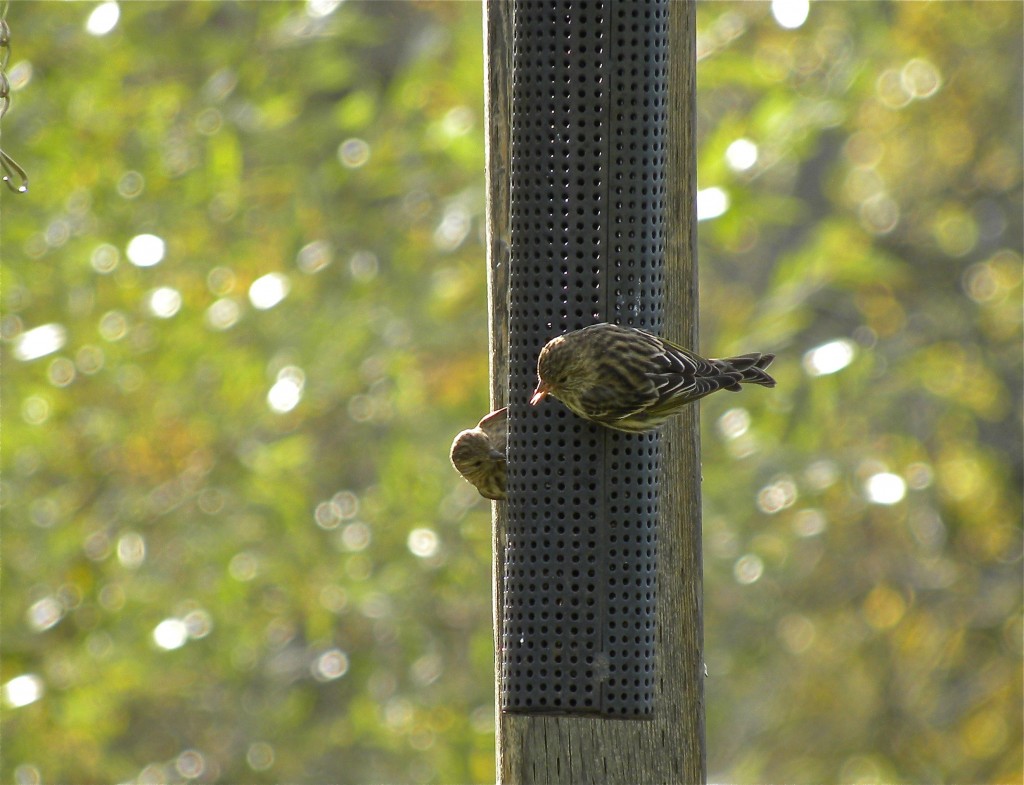
Pine Siskins
My Christmas count list was growing. Along the trails I added more Carolina Wrens, Black-capped Chickadees and Dark-eyed Juncos. But I was also getting chilled and lunch started to call, so turning back, I stopped again to watch a very active and well-filled feeder in a small spruce-sheltered back yard. It took a while for a noisy, multi-generational, family group to move farther along the trail, but when they did the birds returned: American Goldfinches and juncos and then my birds of the day: first a trio of Pine Siskins which puzzled me for a moment because the first one I spotted looked a bit like a streaky goldfinch, but soon there were three of them and I was inwardly exultant – birds of the day! And then to cap it off a Red Breasted Nuthatch arrived. I didn’t linger, I was feeling a little nervous about being seen to be peering purposefully towards someone’s dining-room window. But I’d topped off my day and my Christmas Bird Count list with a couple of really nice sightings.
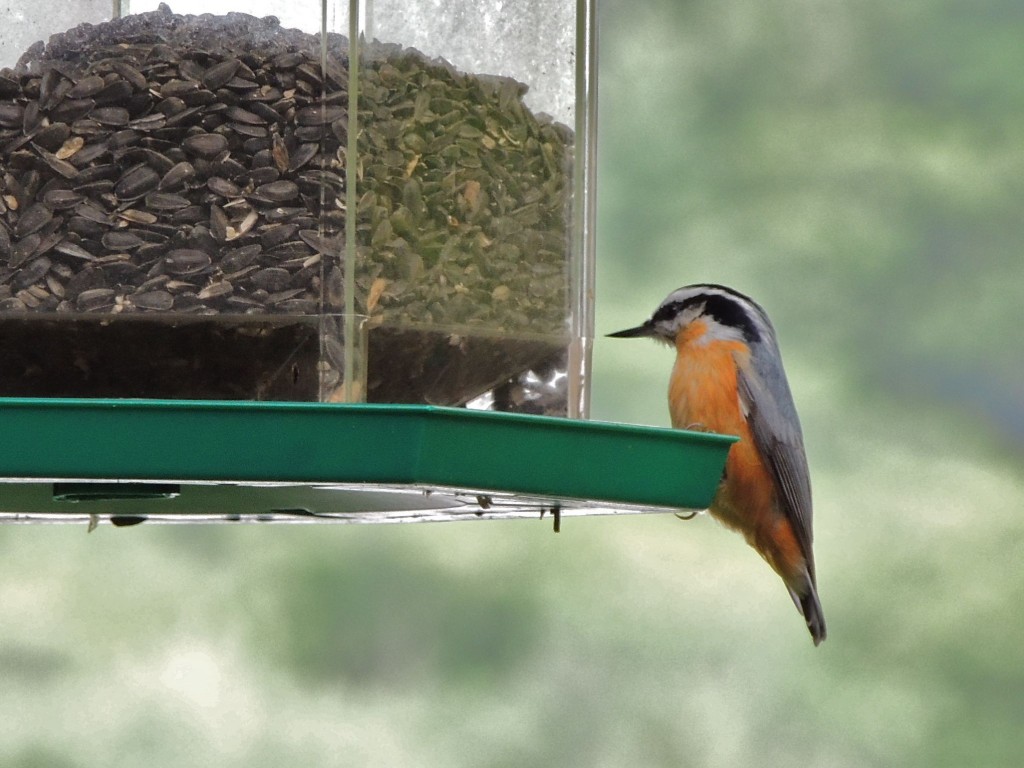
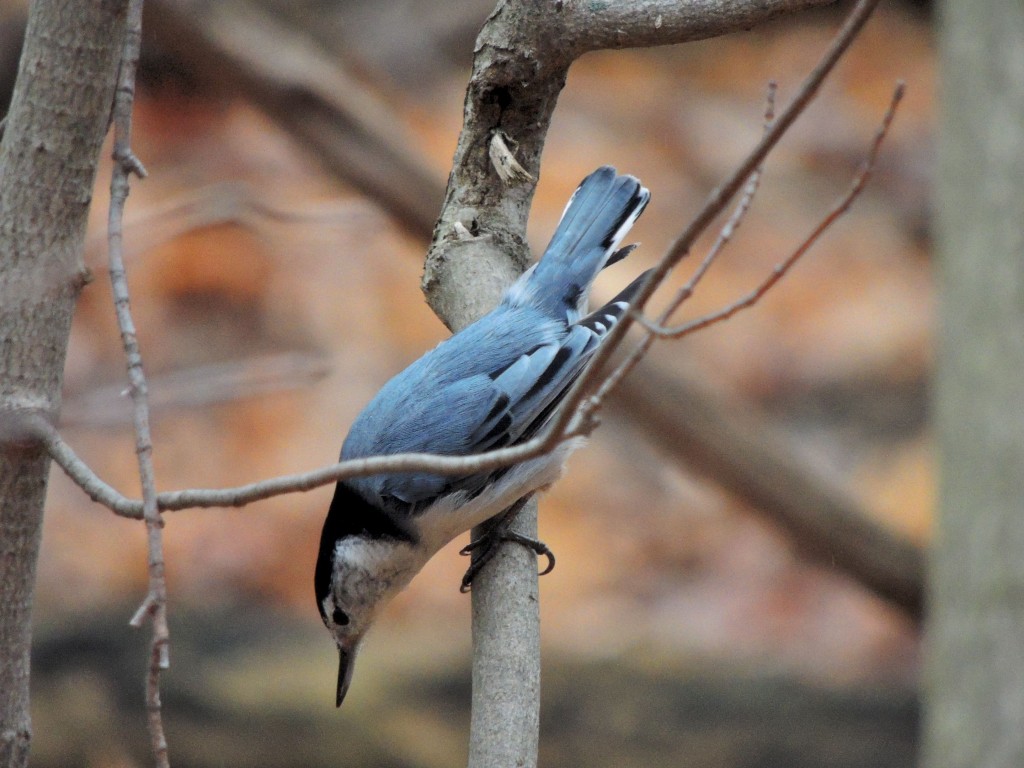
Red-breasted NuthatchWhite-breasted Nuthatch
Pine Siskins are winter visitors and because they are patchy in their distribution, sighting them is ho-hum, old-hat to some and a minor event to others (I fit in the second category). Likewise, Red Breasted Nuthatches too can be a bit hit and miss. They prefer coniferous over broadleaf trees, are a bit more inclined to head south in winter and are smaller than their White-breasted Nuthatch cousins. Nuthatches, white or red, are nifty little birds, I never tire of the antics of the White-breasted ones that I see without fail on every census walk. I think you could call the White-breasted Nuthatch handsome, almost business-like in grey and white while the Red Breasted Nuthatches is a prettier bird, less business-like more coquettish. You be the judge with these photos.
23 December 2015. Hendrie Valley, Burlington ON. These are record-breaking warm temperature days. Daytime highs are around 12 Celsius, I see lawns greening up, daffodils emerging, even a dandelion in flower today; but almost no birds. I speculate that it’s because there is so much openly available natural food, food that normally might inaccessible under ice or snow, there is no pressure on either local or more northern birds to seek the relatively easy pickings of these urban areas.
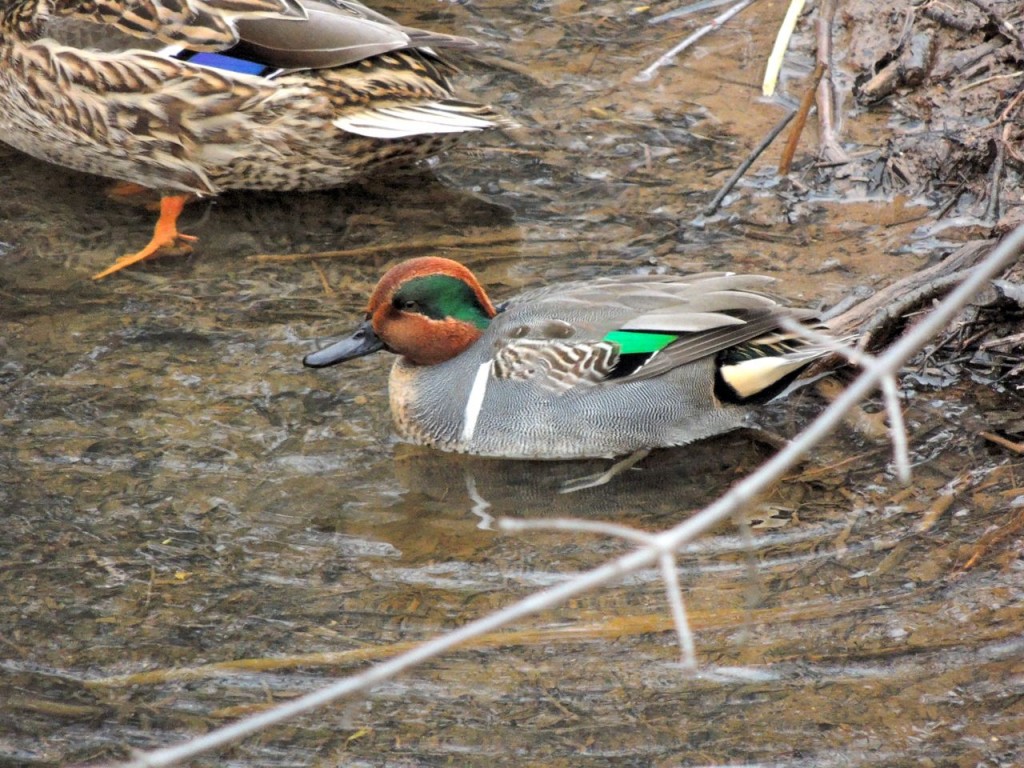
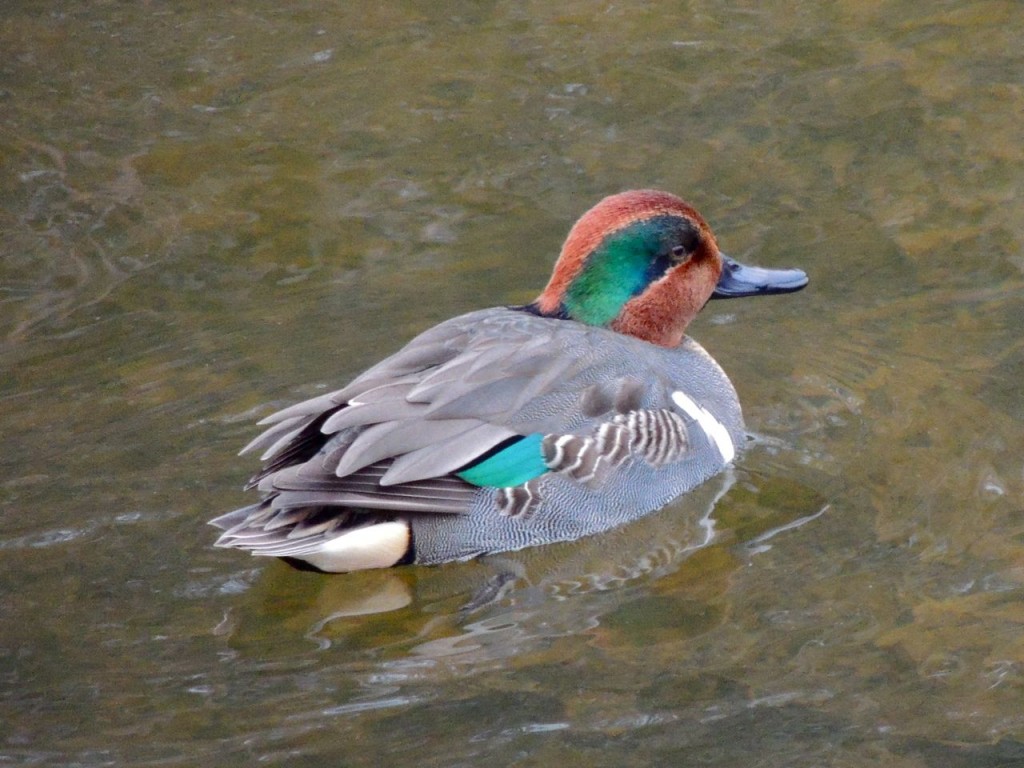
I walked around my census route with my daughter’s dog (on a leash – difficult at times) as company. The species count was low but not without its high points. Bird of the Day was a male Green-winged Teal muddling about in a narrow creek with some Mallards. That in itself was a bit unusual; at this time of year I usually see teal in groups and in more open waters. I’ve never really been satisfied with my necessarily long-shot photos. Today’s duck though was close enough to examine, and he’s truly gorgeous. Like many related species, the fine grey barring on its flanks and neck serve to emphasize all the handsome bits, like the chestnut and green head, the pure iridescent-green wing flash and the cream tail. He is still wearing a few fluffy cream/brown feathers on his flanks, left over, I suspect, from his pre-adult browns.
It’s hard to get a sense of his size, but as I’ve noted before, and quoting from a post a month ago. “ Although not apparent from my photos, Green-winged Teals are quite small ducks, when seen mingling with Mallards they appear to be half the size. Indeed according to the Sibley Guide to the Birds, a Mallard weighs in at around 1100 grams and a Green-winged Teal at 350 grams, a third of the weight.”
These photos happily support this Green-winged Teal as Bird of the Day.
May 21 2014 and others. Before anyone gets too excited, note that this is a dip into my archives. I write this on December 21, the shortest day of the year and irrefutably the gloomiest, with drizzle out of low clouds all day. Let’s reflect on some bursts of May sunshine.
I have been housekeeping my photo files, there are just too many virtually identical shots, too many bad photos. It’s a winter evening pursuit which brings back many vivid memories.
Last year’s May was cool and unfolded slowly. Over the years I have come to expect full leaf-out of deciduous trees any time between the 3rd and the 13th of May. Last year it was the 24th. before I felt it was complete, a full ten days late. While the laggard spring was discouraging to anyone longing for summer to get on with it, it actually resulted in some spectacular birding. The spring waves of neo-tropical migrants, warblers, vireos and the like, continued northwards on a schedule dictated by their internal clocks. It was our treat to enjoy these usually bashful birds cavorting among skimpily dressed trees.
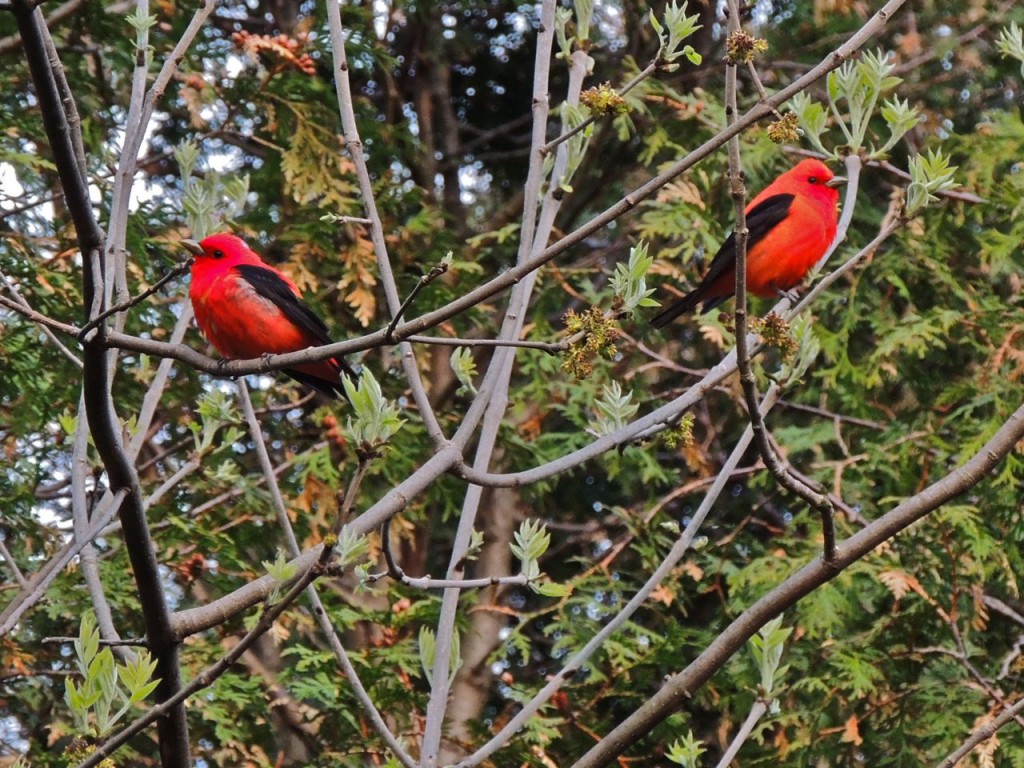
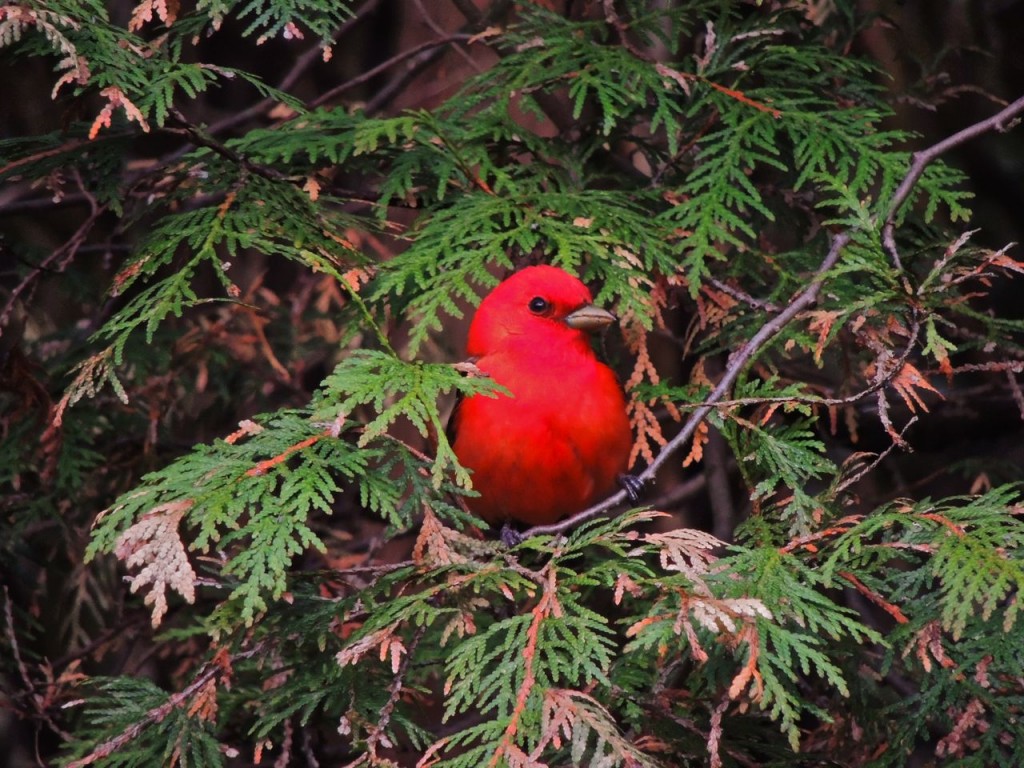
These Scarlet Tanagers were among many that arrived on May 21st. Ordinarily they would have been fairly hard to find; but an exciting treat if you did. But in 2014 they were easy picking. My full page of notes for that same day and place also included: Bay-breasted, Black-throated Blue and Magnolia Warblers, all glorious finds. I had featured Scarlet Tanager as My Bird of the Day just three days earlier, you can read more and indulge in a little more spring by following this link.