Winter Wren

18 March 2016. Hendrie Valley, Burlington ON. Although day-to-day tropical birding is firmly behind me I’m still sifting through four weeks of field notes and photos. I’ve been able to uncover a couple of ‘new’ species, birds I’d misidentified first time around. But back in Ontario, spring is clearly underway. A two-week burst of sustained warm weather has brought in waves of Tundra Swans, Red-winged Blackbirds, Common Grackles, Song Sparrows and Turkey Vultures. They must spend the late winter anticipating and watching for a break in the weather as their green light to head north. In contrast many other species, those who spend the winter in the tropics including as far as the Amazon Basin, would have no clue about the northern winter, whether it’s let go or not, and must take their cues from the sky, the spring equinox perhaps.

Today, for the first time since January 8th, I walked around my census route. As I’d expected there were lots of changes, perhaps one of the most noticeable was the clamour of bird calls, mostly Red-winged Blackbirds and Canada Geese but Northern Cardinals and Carolina Wrens were working hard at claiming their piece of real estate too.
Winter Wren - Hendrie valley
Winter Wren – Hendrie valley

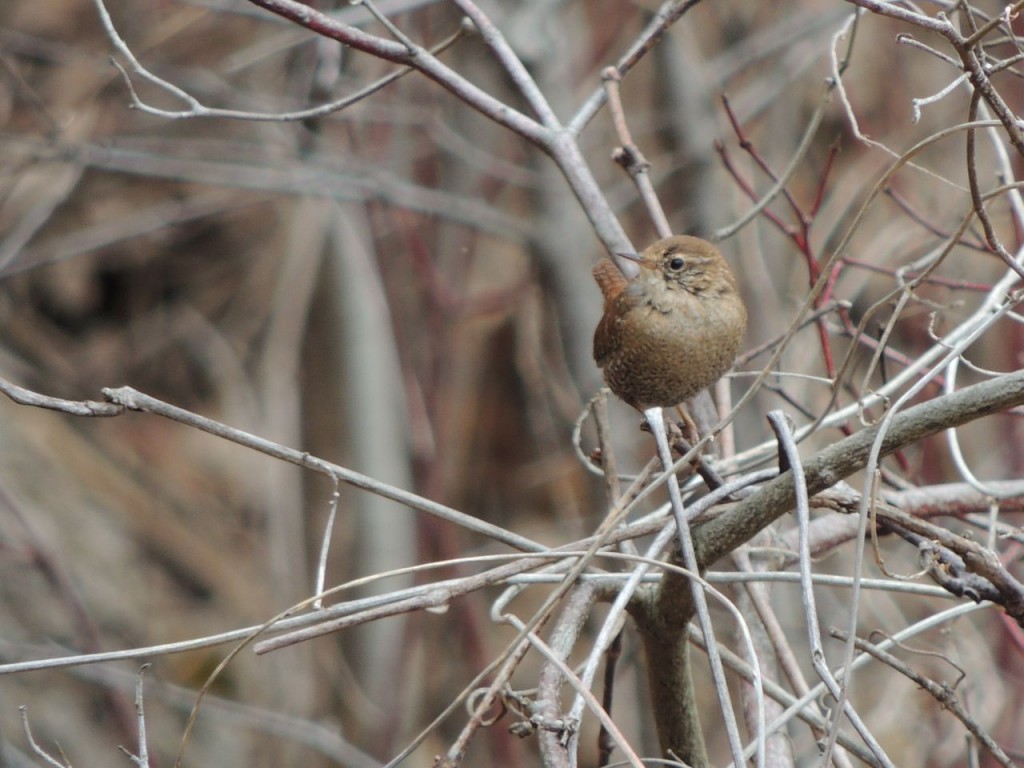
My greatest pleasure came from hearing some tiny wisps of Winter Wren song. I thought my chances of seeing them would be slim, they’re so small and work hard at staying low, but one hopped up a few metres away and stayed long enough for me to capture a few photos. It’s possible they had over-wintered here, it’s sheltered and winter has been very mild. By the end of my walk I’d seen or heard four of them.
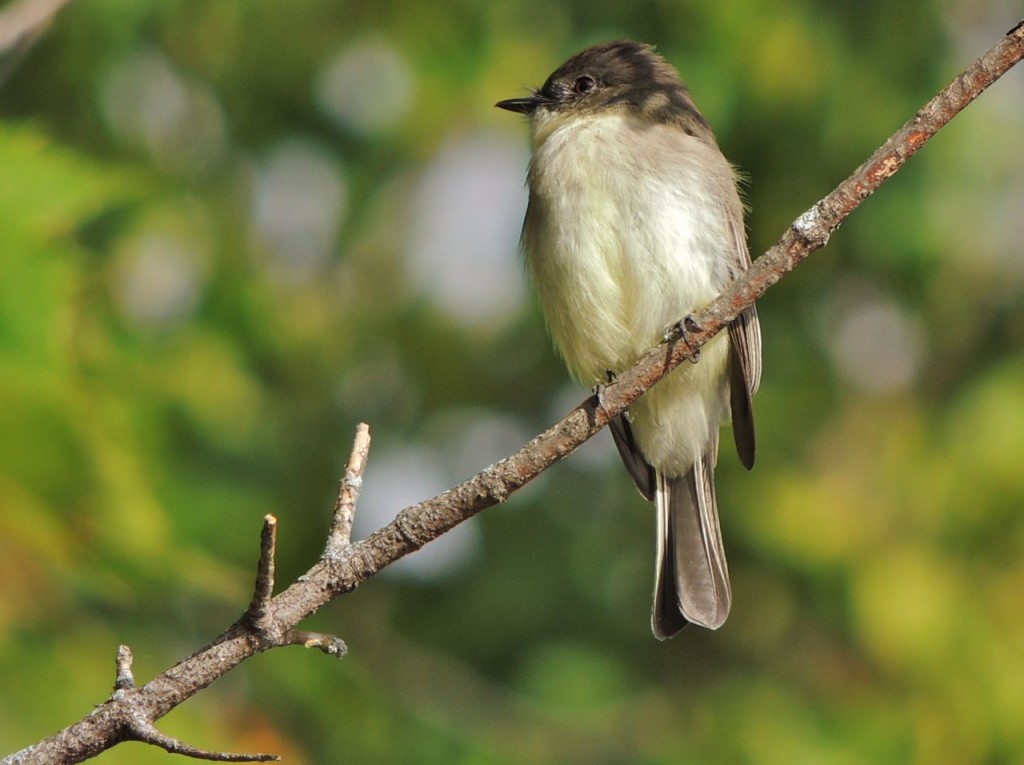
Eastern Phoebe (in October)

A little later I spotted an Eastern Phoebe, undoubtedly a new arrival. They are one of the landmark arrivals of the spring migration. It’s always the return of the Tundra Swans, Red-winged Blackbirds etc. that we celebrate first and then, just as they’re becoming old hat, the first Eastern Phoebe shows up; and not far behind it a Tree Swallow or two.

My day ended with twenty-six species, a pretty good total.  It included a handful of American Robins, Blue Jays and Hairy Woodpeckers – nothing out of the ordinary there, but a dozen American Tree Sparrows singing with enthusiasm for spring, a Trumpeter Swan claiming ownership of a stretch of pond, an overhead Turkey Vulture, Hooded Mergansers and Wood Ducks (six of each) were all refreshing to see.  I’ll be looking for that first Tree Swallow but a week of cooler weather is forecasted; we’ll see how it goes.
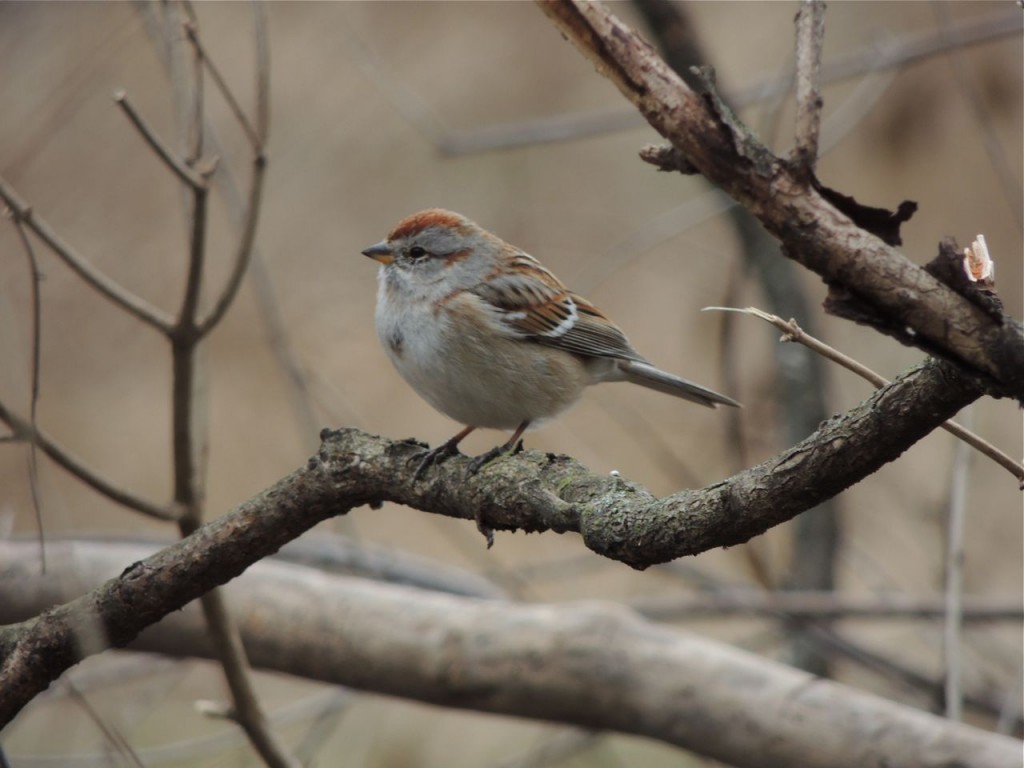
American Tree Sparrow

Turacos

February 2016. Rubugali. Kisoro District, Uganda. There is a patch of hilltop land near here called Heaven; aptly named in its own way. The way up is long and taxing.  You start by slogging up a very rough, rocky and shade-less track for a kilometre or so. It’s all climbing, no flat spots. The Ugandans have the right approach, walking uphill is not a challenge, it’s something you do in measured, one-at-a-time easy steps; no one is timing your ascent. After the first kilometre the track ends at an open, grassy saddle between two hills; it’s a good resting stop.

Heaven itself awaits yet another kilometre higher, but this time the trek is along an erratic, single file path. Plodding on, then pausing, you look down over fields of beans, maize and potatoes to the valley bottom far below and nearly lost in blue haze.

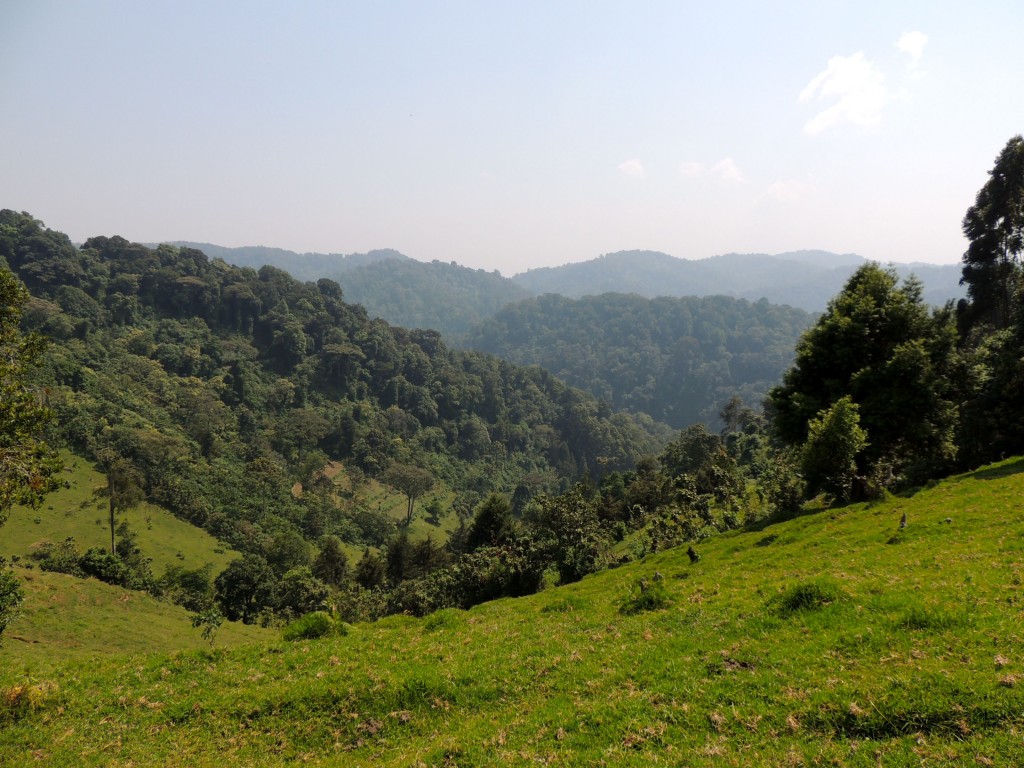
The top is a quite different world, cooler, quieter and more open, mainly a wide expanse of tree-dotted cattle pasture. Were it not for the occasional fence or cattle shed you might think it is an English country park.  Behind is the valley we’ve just left: occupied, cultivated from top to bottom and threaded with the distant echoes of people and their animals. In front of us lies original Africa: Bwindi Impenetrable Forest rolling away into the blue distance, from treetop to treetop it’s all green: towering trees draped in orchids, ferns and vines, and underlain with thick mattressy undergrowth scratched over in patches with geometric tree- ferns. This is where Mountain Gorillas live and where the resonant calls of birds or the grunting barks of monkeys quite simply belong.

Bwindi side of Heaven's top
Bwindi side of Heaven’s top

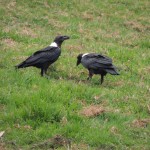
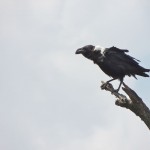
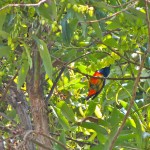
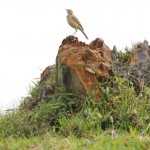
We actually made two day trips up to Heaven, both produced some fine and novel bird sightings: A Grassland Pipit standing erect on a rock, looking around as if it was on sentry duty; White-naped Ravens flipping over pats of cattle dung looking for beetles and grubs; and a rather sensational Black-shouldered Kite, pale grey and slender and whose flight the field guide accurately describes as soft and elegant. We struggled to identify what turned out to be a Regal Sunbird, it kept vanishing in some dense treetops but when we did finally get to look at it, it was neck-breakingly right overhead. I managed to get this Regal-Sunbird-from-underneath photo, which without explanation you’d wonder what on earth you’re looking at.

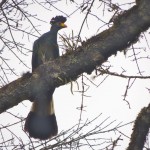
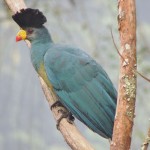
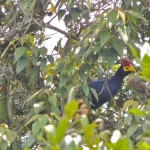
For me there were so many new discoveries that it is hard to pick out a best bird, but perhaps the most breath-taking would be Turacos. We heard Great Blue Turacos chattering in the forest and watched a couple of Ross’s Turacos feeding in the upper layers of a fig tree. Turacos are large (chicken-size) birds, rather ponderous and breathtakingly showy. When you spot them you can usually rely on them staying where they are for a while. The Great Blue Turaco in the photo below was busy preening itself perhaps in a deliberate show of nonchalance. The Ross’s Turacos were harder to photograph and I only managed some rather coy shots. When they left the relatively open spaces of Heaven and flew back to the forest the Ross’s showed off wide expanses of crimson upper-wings.

This post contains photos in galleries visible only on the website, not if you’re reading this as an email.

Tundra Swans

March 4 2016.Burlington, ON. With my head still spinning a little from thirty days spent eight time-zones east and forty-six warm degrees of latitude south of home; I’m still adjusting. Six inches of snow underfoot and temperatures thirty Celsius degrees colder don’t help.

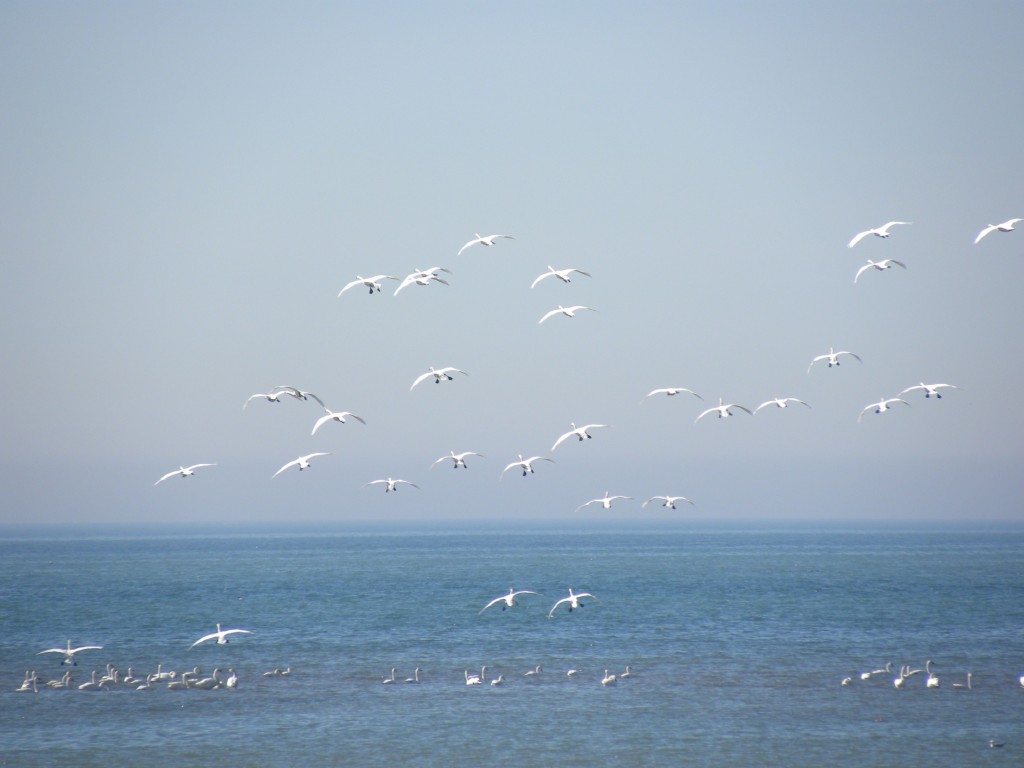
Today I heard the first Tundra Swans of the season. Well heard is maybe not quite the right word. You know how it is when you’re somewhere and there’s all kinds of stuff going on around you: noise, distractions, traffic and people chattering, and somehow you hear someone say your name. It’s not that you hear it so much as become aware that you’ve been tagged, and, like nudging your computer mouse, some inner micro-processor wakes up, you look around and there really is someone trying to get your attention. That’s how I heard the Tundra Swans – a faint sound cut through the clutter and something inside me said, “Hey! That might be Tundra Swans – better look up, see if you can find them.” And there, quite high against a scruffy grey cloud, a small wind-tossed group of about twenty swans, flashing white as they struggle to make headway.

They were a little earlier than usual by my informal reckoning but by no means exceptionally early according to official record keepers. They’ve probably made a couple of days journey from the Atlantic coast, the start of a long trek, optimistically following the retreat of winter, to the Hudson Bay coastal lowlands. The earlier they arrive on their nesting ground the better their choice of nest site.

Tundra Swans were definitely Bird of the Day; they always captivate me but in truth they were probably the only birds I noticed today.

Tundra swans Lake Erie March 17 2009

This photo was taken on St Patricks Day several years ago.

Cuckoos in Africa

February 2016. Rubugali. Kisoro District, Uganda. Wherever you find them cuckoos are curious birds. Growing up I knew only of the European Cuckoo and its reputation as a sure sign of spring (good) and an obligate nest parasite (bad). Moving to North America I learned about Black-billed Cuckoos and Yellow-billed Cuckoos, neither of which is a nest parasite but both are elegant, long-winged and rather secretive birds with funny clucking and gulping calls. Then a couple of years ago, in Mexico, I encountered some southern cuckoos and their relatives and they really made me sit up and pay attention; read about the Lesser Ground Cuckoo here and the Groove-billed Ani here.

Not surprisingly Africa has cuckoos of many shapes and sizes. My now well-worn field guide, Birds of East Africa, describes eighteen cuckoo species and six closely-related coucals; and that’s just east Africa. Around Rubugali I saw or heard four or five species: Klaas’s Cuckoo, African Emerald Cuckoo, Black and White Cuckoo, Levaillant’s Cuckoo and Blue-headed Coucal.

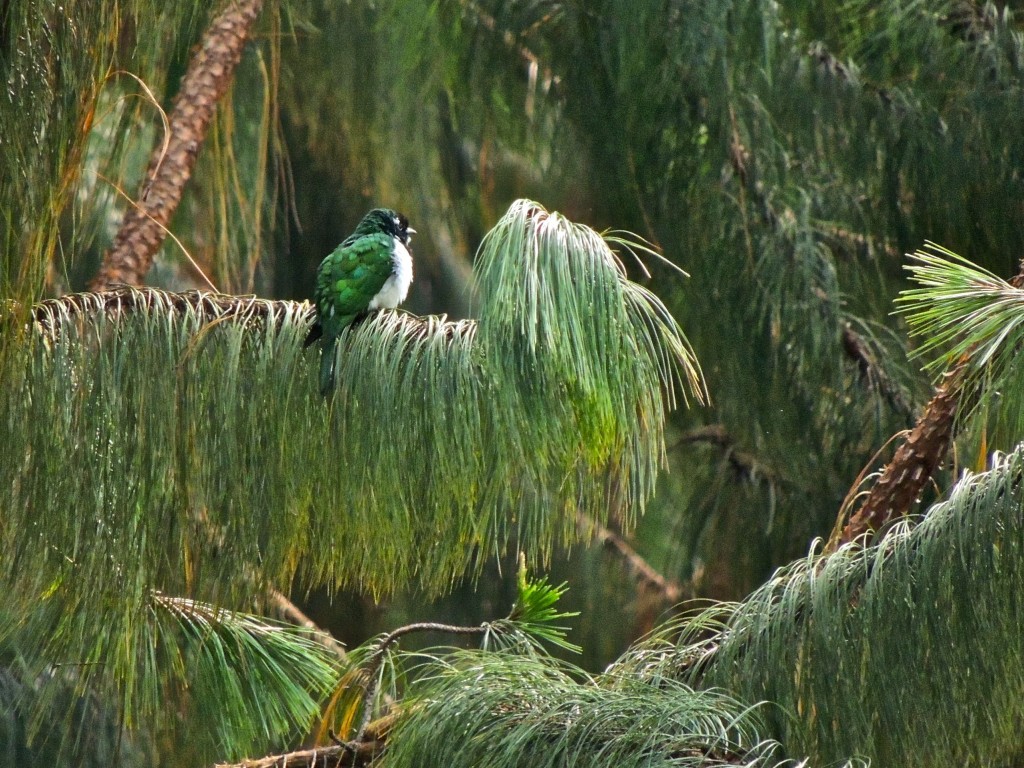
A Klaas’s Cuckoo or an African Emerald Cuckoo is a real prizes if you’re actually able to see one. They’re both quite vocal and my Ugandan birding companions were clever mimics, they could carry on a two-way exchange with the birds for long periods trying to draw them in.   We know they came close, but the problem was that both species’ plumage is clear green, which works well for them but badly for us. At the end of my last day in the field we finally saw a Klaas’s Cuckoo, bright forest-green (what else?) above and snowy white below, a distinguished-looking bird.

Klaas's Cuckoo
Klaas’s Cuckoo

Blue-headed Coucals, (locals make no discernable difference in pronunciation between cuckoo and coucal) are quite large, clumsy, chestnut and white birds. Clumsy may not the best choice of words but the first one I saw appeared rather awkward as it clambered around, but another, seen a couple of weeks later, was very quick to take flight and vanish. But vanished or not you often hear coucals calling. Local lore says that a calling coucal is a sure sign that it’s going to rain – which it does frequently anyway. Their call is a series of resonant, gulping ‘whooot’s; it starts with two assertive notes and is followed by a short, less certain series decreasing in volume. It’s a call that carries far in the deep hazy valleys and reinforces a sense of mystery to this little appreciated corner of Africa .

I caught little more than glimpses of a Black and White Cuckoo but a young Levaillant’s Cuckoo in a small bamboo clump stayed obligingly close to me. I had some but limited success photographing it under difficult light conditions.

Levaillant's Cuckoo
Levaillant’s Cuckoo

Sunbirds

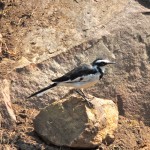
Rubugari, SW Uganda. February 2016. One of my tasks while I’m here is to seek out Bakiga folklore and mythology related to birds. So far it’s surprised me to find relatively little; I would have thought that people who live so close to the land would have many tales to tell. There are a few: a noisy bird, the Hadada Ibis, is said to embody the soul of a baby trying to escape from an unlucky transformation.  It cries a penetrating and mournful ‘Wa-aaaaaaa!’ as it flies.  The presence of an African Pied Wagtail alongside you as you cultivate the fields is a happy sign, it ensures a good harvest to follow.  The hollow-gulping call of a Blue-headed Coucal means rain is on the way. (Not infallible, it didn’t rain when we saw and heard my first one.)


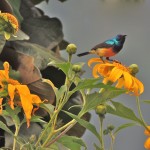
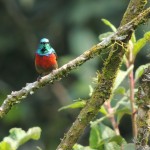
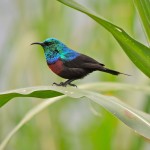
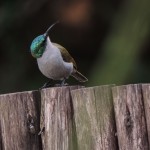
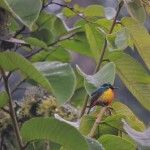
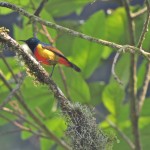
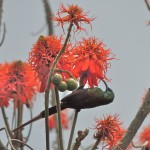
I would have thought the sunbirds would carry more meaning. Sunbirds are glorious glittering show offs (the males anyway, I suppose the females are too busy toiling in the fields). Where the New World has hummingbirds, Africa has Sunbirds. As I type this a Bronze Sunbird is working over the flowers of a nearby Flame Tree. The Bronze Sunbird is actually one of the less showy ones being an iridescent bronzy-green (as you might expect) all over, it has a needlessly long tail and in common with all sunbirds a down-curved sickle bill. Just yesterday in the company of several enthusiastic members of a birding club we found two breathtakingly spectacular sunbirds: Regal Sunbird, splashed and daubed in red, orange, yellow, and iridescent blues, violets and greens, it had our group gasping. And not far away, a Purple- breasted Sunbird sat out in the open, another long- tailed creature but this one was dressed all over in purple, blue or violet depending on how the sun caught it.

Here is a gallery of selected sunbird shots.  It’s visible only on the website, not if you’re reading this as an email.