Broad-winged Hawk

September 10 2012. I live just a couple of hundred meters from the north shore of Lake Ontario, it’s a very strategic location at this time of year.  Many (and there would be millions) of the fall migrants draining southwards out of the land to the east and north of the Great Lakes, find their way south blocked by Lakes Ontario and Erie, so they turn to the southwest following the shorelines until eventually they stream out of south-western Ontario into Michigan and Ohio. Anywhere along this pathway, especially along those major shorelines can produce some very busy birding days.

There are a few days in the year when Broad-winged Hawks put on a show: a week or two in mid-April and a day or two or three, in September.  Today was one of them.  After weeks of solid summer weather things have changed, the hot still days have given way to pure-bred September with cold starts, clear days and small cumulus clouds hanging against a blue sky.  It’s this sort of change in the weather that sets the Broad-winged Hawks heading south, and they do it in massed flights.

I started the day with a beautiful morning at the bird observatory.  On the daily census I found two Yellow-billed Cuckoos high in a Black Locust tree, surprised a single Carolina Wren working its way through a thicket of old grapevines, and enjoyed the identification challenges of Swainson’s and Gray-cheeked Thrushes. 

Around midday I returned home to find a message that the Broad-winged Hawks were on the move. Binoculars in hand I went back outside and looked up to the undersides of puffy cumulus clouds, and after a few moments of scanning around found a group of 6 or 7 Broad-wings sailing by but moving very quickly out of sight.  Minutes later a single bird picked up the lift from a nearby column of rising air, it was wheeling around and sometimes skidding sideways fighting the breeze. Seen like this you can often make out the wide tail bands and light patches at the ends of their wings and when they settle into a glide they’ll sometimes show a bow-fronted profile. Twenty minutes later, way up beyond the stretch of the naked-eye, I found a stream of perhaps 50 or 60 Broad-winged Hawks gliding along an invisible westbound highway, changing lanes and making room for merging traffic as they went.

For every Broad-winged Hawk there were perhaps a dozen large dragonflies, mostly Common Green Darners and Black Saddlebags, also migrating, but they were much lower and not quite as dreamily in flight, just skimming busily along at rooftop height.
Blue-winged Teal

September 5 2012. Ruthven Park, Cayuga, ON.  At the bird observatory this morning we enjoyed a wide variety of birds, both seen and/or banded.  They included: Philadelphia, Warbling and Red-eyed Vireos, Black-throated Green, Magnolia and Wilsons Warblers as well as single Northern Parula, American Redstart and Nashville Warbler.  Quite a day.

We also faced two of the toughest fall identification challenges: Baybreasted and Blackpoll Warblers. (See photo and comment here)   They and the Pine Warbler taken together, look very much alike at this time of year, which is utterly maddening because there’s no way you’d confuse them in the spring.  All three species undergo a late summer molt to become a non-descript beige-breasted-streaky-backed-wing-barred-warbler, which puts them firmly in the I-give-up category for many bird enthusiasts.

Down by the river a young Bald Eagle was stirring things up sending a bunch of Killdeers and a small group of terrified ducks dashing for cover.  The eagle, indifferent to the chaos he’d left behind, flew off upstream and in the calm that followed we enjoyed the company of two or three Ospreys, a pair of Belted Kingfishers, some patrolling Caspian Terns and even a couple of Doublecrested Cormorants.

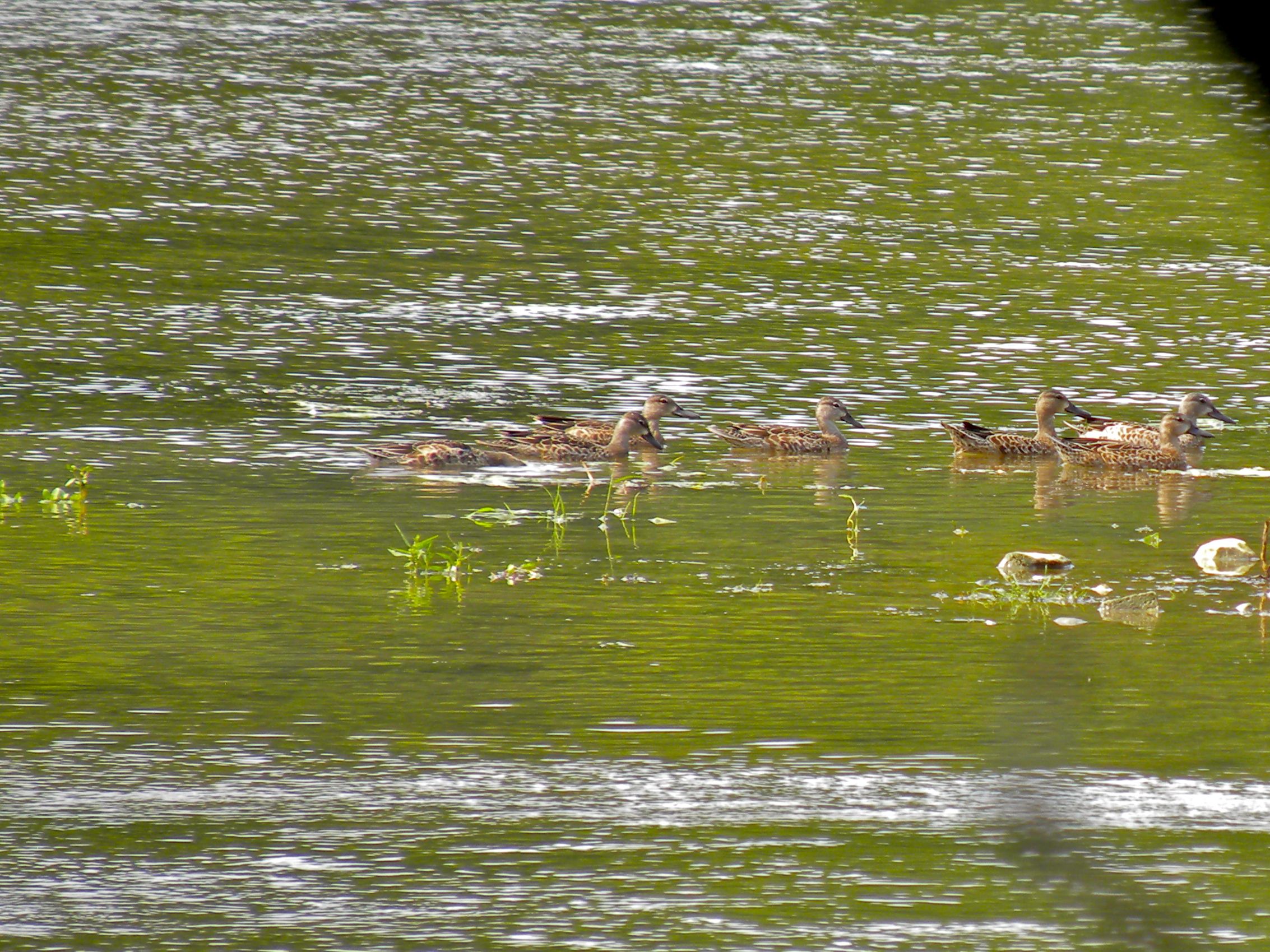
Later we spotted the ducks gathered on a mid-stream gravel bar.  Unsure of what they were we approached them slowly and managed to get a number of photos before they once again flew off in a panic.  In the short moments we had them in our sights we could tell they were Blue-winged Teal. I was pleased to see that my quick-fire photos turned out quite well.  Blue-winged Teal are easily identified when you see a male in breeding plumage, but this is the wrong time of year for that, so the key field marks are a long, low profile, long flattish bills, white crescent over the eye and a pale patch at the base of the bill.  And when they flew away the wide wing patches of blue bordered with bright white were easy to see.  The teal were quite unexpected and really quite refreshing, so despite the competition from all those challenging migrant warblers they were my Bird of the Day.

Blue-winged Teal.


Vireos (lots of them).

September 5 2012. Ruthven Park, Cayuga ON.  At the end of a day I’ll often ask myself: What was the one bird, above all others, that made me think Wow?  What was the Bird of the Day?  Well, today it was vireos: Warbling, Philadelphia, Redeyed and Yellowthroated; we encountered them all and they all made me smile.

For reasons that I can’t quite explain, I like the vireos, maybe because they can be so challenging to identify visually, maybe because of their endless summertime songs, or maybe it’s their “I may not be very colourful but I’m here.’ approach to life.

Yesterday’s unsettled weather, which produced torrential rains not very far from us, moved out overnight.  At first light this morning patchy fog hung low over the bird observatory and we wondered what species might have left and what might have come in to replace them overnight .

Quite early while the fog still hung low, we could hear a Yellowthroated Vireo singing in the woods behind the banding lab.  They have a rather hoarse and throaty song that is ably described in Pete Dunne’s excellent book as: Lazy whistled song is a series of alternately higher then lower two-(sometimes three)note phrases separated by a pause. Tweeree (rising) heyew (falling); tweelree(rising) or heyew.the overall quality is hoarse and slurred a vireo with a sore throat.”  We always have a few Yellow-throated Vireos nesting in the wooded ravines near the observatory, they kind of anchor the woodland.

Later on this morning we started seeing Redeyed Vireos and ended up banding a dozen or more, all youngsters hatched this year.  This is a bird that dresses like a hung-over courtroom lawyer, somber grays, beiges and off white, with red eyes framed by immaculately trimmed eyeliner; very handsome.  On territory it sings endlessly all day and continues well into August.  To me, like sweet corn and peaches, the Red-eyed Vireo is a part of summer.

The Red-eyed Vireo’s song is almost identical to that of the Philadelphia Vireo, a rather hard to see, hard to find little bird. We agreed that the Philly’s plumage is so unremarkable, so devoid of defining field marks except for a beautiful wash of pale yellow on the breast, that sometimes a yellowish summer bird with nothing much to distinguish it may turn out to be a Philadelphia Vireo.

Lastly, Warbling Vireos were singing as if it were June.  We banded one or two this morning, but I encountered several while doing the daily census.  The census trail leads along the bank of a wide, shallow river and at one time I could pick out 2 or 3 Warbling Vireos singing from the bordering Hackberry trees.  Their song is a frantic scramble of sweet notes, very hard to describe, but a friend once sent me this description of it: “If I sees ya I will squeeze ya an Ill squeeze ya till ya hurt.  Say that a few times fast (there’s no punctuation, so no pauses) and you’ll get something like the cadence of their song.

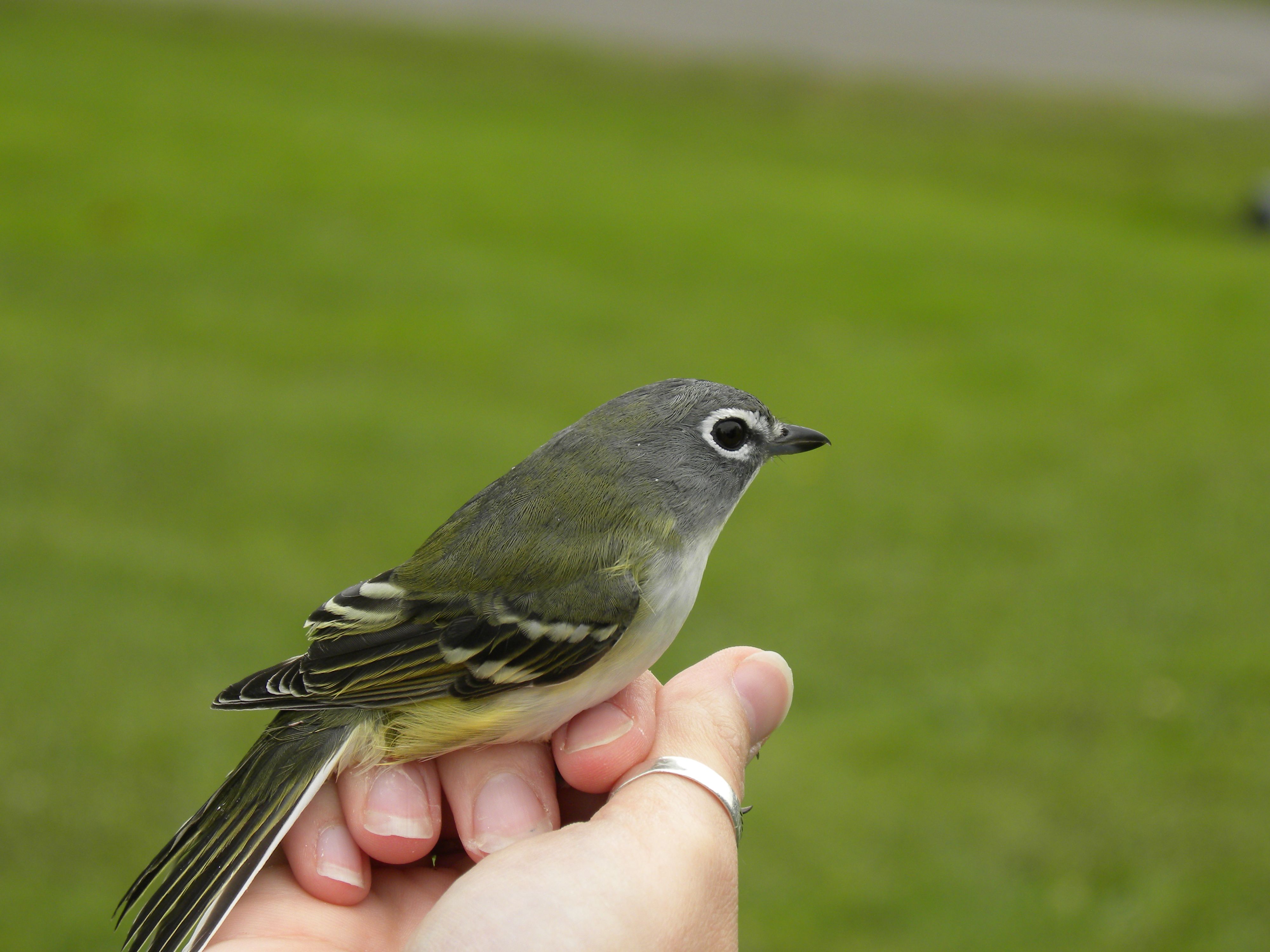
The only likely Ontario vireo missing today was the Blue-headed Vireo,  probably the most strikingly marked of the lot.  But it’s the only vireo for which I have a photo, so here it is from two years ago.  Just banded and about to be set free.

Blue-headed Vireo.

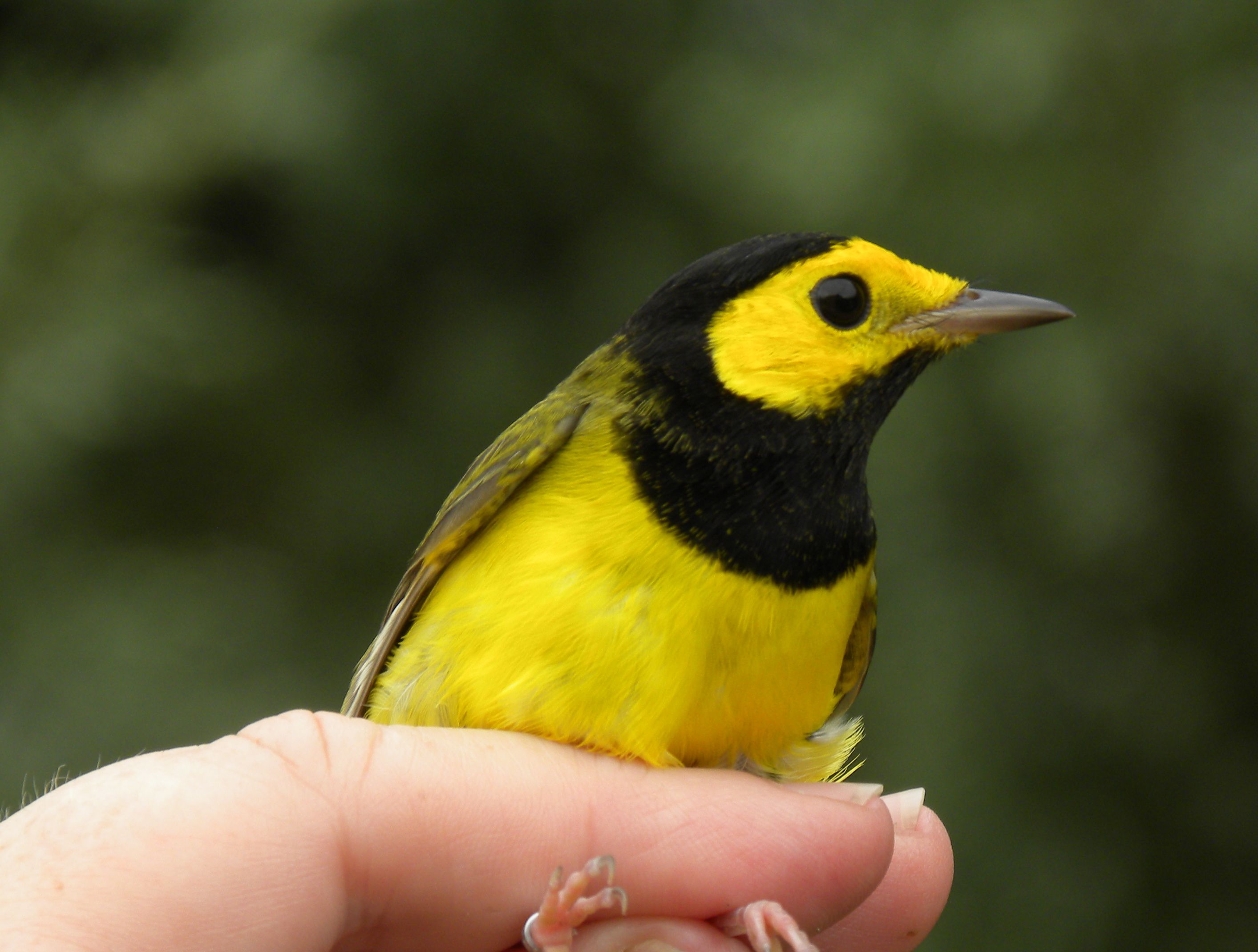
Hooded Warbler

September 4 2012. Ruthven Park, Cayuga ON. Back early to the bird observatory today, they’re a little short handed and well, it’s interesting and always challenging.  The weather had deteriorated since the summer glories of the past week or so, rain threatened all morning today and even went so far as to dampen us with a mid morning shower; a nice warm one though.

I started the census at 08.45 but had to abandon it after half an hour or so when the shower struck.  The birds must have known something was up and left town because in that half an hour I only counted 11 species. Once the rain had passed over I restarted and turned up 29 species including a couple of Purple Finches, a small and agitated group of Philadelphia Vireos high in the treetops and a nice Eastern Kingbird sitting atop a dead tree watching over the world below.

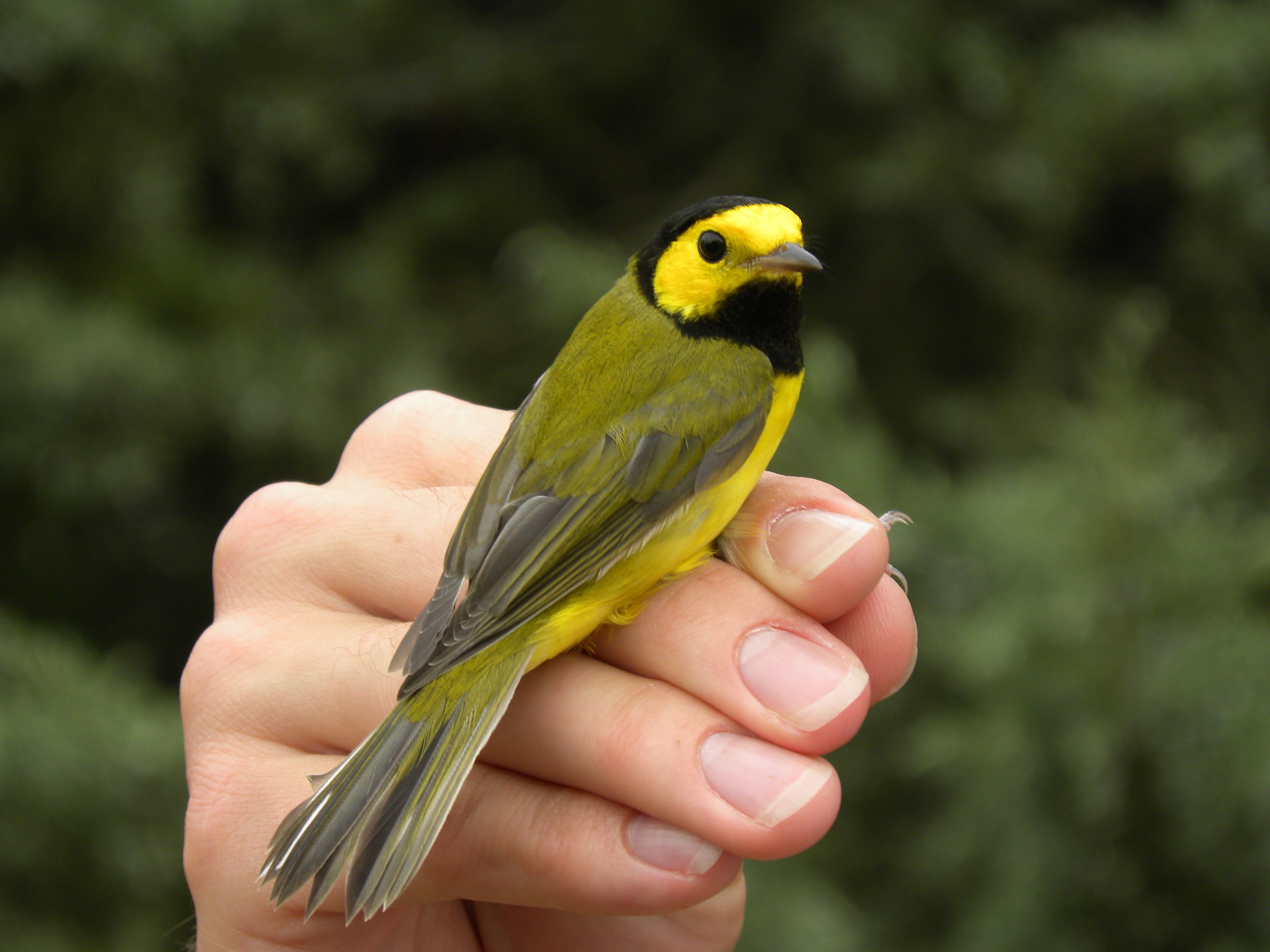
Towards the end of the morning we found and banded a young male Hooded Warbler.  He was without doubt my Bird of the Day because absolutely nothing else today, not even a couple of Blackpoll Warblers, Common Yellowthroats or Wilsons Warblers, came close to delivering the same OMG impact.  (Take a look at the observatory’s blog here) Hooded Warblers are uncommon in Ontario, there are small pocket populations around the west end of Lake Ontario and along the north shore of Lake Erie.  But in the central eastern states of the U.S.A it is a fairly common breeding bird.

Any human as striking and stunningly pretty as this bird would surely quickly make his way to become a preening and self-important celebrity.

Young male Hooded warbler. The faint flecking on the black hood indicates that it’s a ‘Hatch Year’ bird.
Young male Hooded Warbler. Breathtaking.

Chimney Swift

September 3 2012. Ruthven Park, Cayuga ON. I had quite forgotten what a richness of bird species there is to enjoy on a good day at a good bird observatory.  Today was my first opportunity to return to my favourite bird observatory to lend a hand this the fall season.  Bird observatory activities including census taking, mist-netting and banding continues daily throughout September and October.

To refresh, the observatory is located in the grounds of a splendid 19th Century neo-classical country house that would look quite National Trustish in England but is little short of jaw-dropping in 21st Century Ontario. The grounds include several acres of wide alluvial river flats, a network of heavily wooded creek valleys, open farm fields and upland forests. This is perforce a very brief introduction; you can read lots more about it and get completely absorbed for hours by visiting its website here and nature blog here.

On my arrival early this morning it was already busy and I was put to work banding a young Scarlet Tanager.  Then a check of the nets turned up Redeyed Vireo, Philadelphia Vireo, Winter Wren, Yellowbilled Cuckoo, Magnolia Warbler and Ovenbird to name but a few of what I remember.

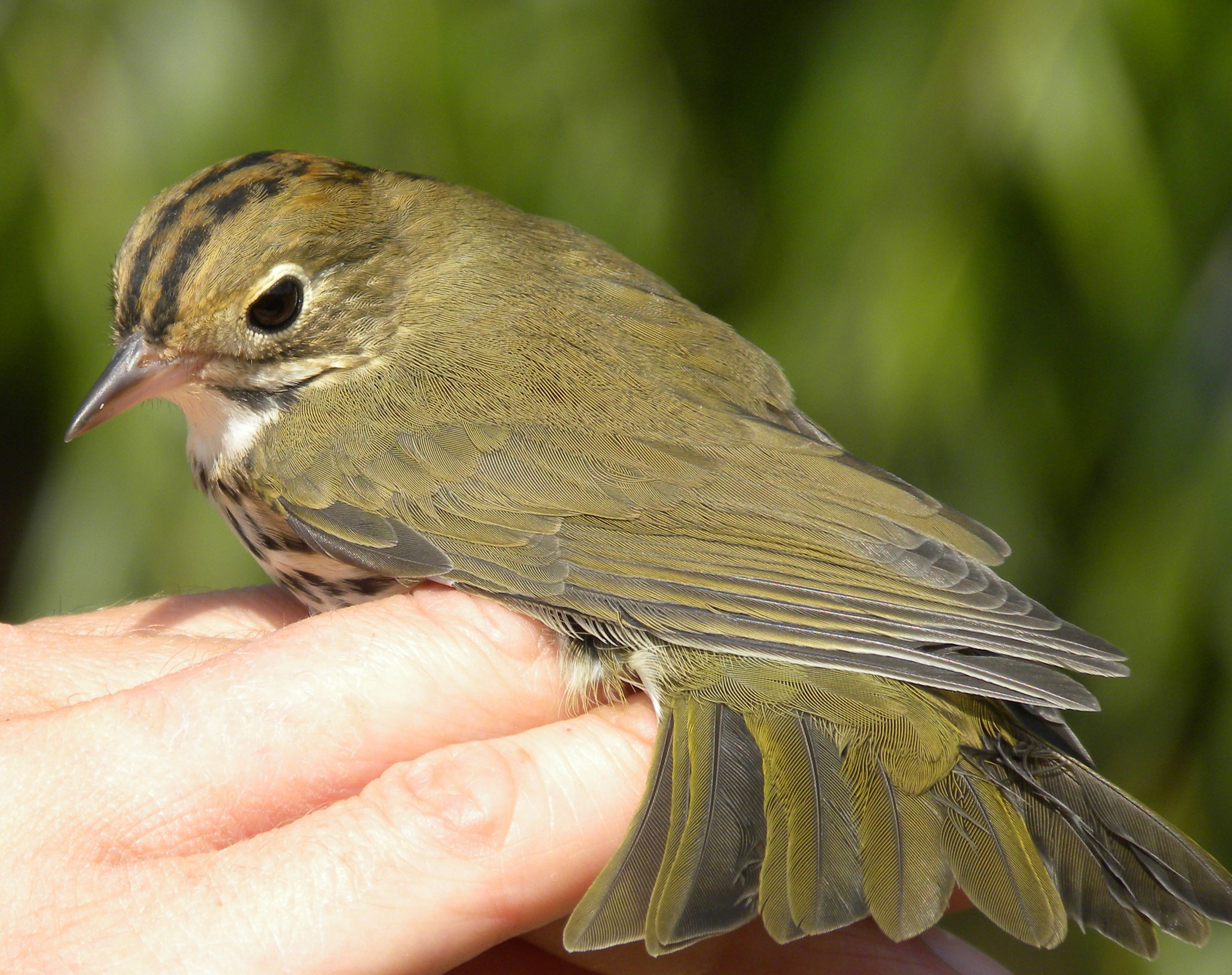
Ovenbird. Just banded and about to be released.

It sometimes/ often / usually /always falls to me to do the daily census.  A task that keeps me out of harm’s way for a couple of hours and fills a page or two with a list of all birds seen or heard on a walk around a prescribed route.  I am usually accompanied by visitors, sometimes they’re birders, sometimes not, but many eyes and ears are always helpful.

Today we had some great sightings; a single Yellowbilled Cuckoo (not the one banded just before we left the banding lab), many Eastern Wood Peewees singing.  A couple of Redeyed Vireos were in the sparse branches of a dead spruce and close to about 20 Cedar Waxwings feeding on the abundant blue-grey fruit of a Red Cedar. Along the river a family of four, maybe five, Osprey were patrolling up and down, the parents looking for food to keep their insistent youngsters happy.  A pair of Wood Duck flew by and then shortly afterwards three Green-winged Teal.  On a gravel-bar in the river were 16 Killdeer, 2 Lesser Yellowlegs and a single Spotted Sandpiper.  Then, perhaps the event of the day, an adult Bald Eagle closely chased one of the Ospreys pressing home a point of proprietorship that I never did figure out.

My Birds of the Day were three Chimney Swifts seen circling above the banding lab. Swifts always make me stop and stare because they are irrefutably birds of summer, always flying in high-wheeling chase above us, twittering busily and living a perpetually airborne life.  If given the chance I think I’d like to be reincarnated as a swift.