Field Sparrow

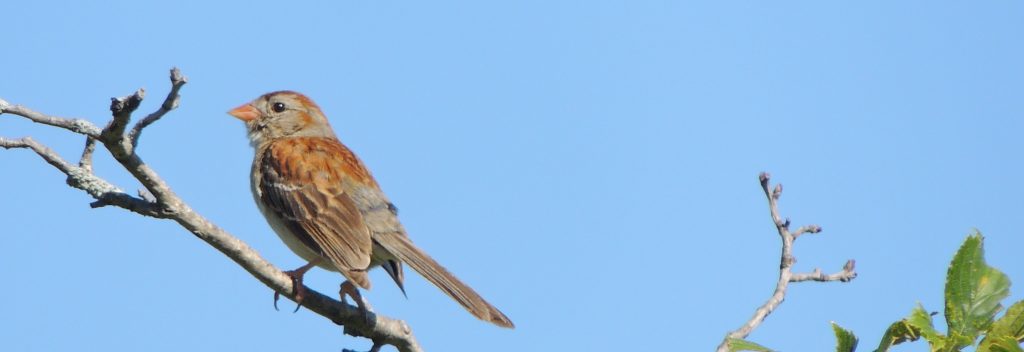
July 15 2016. Flamborough OnTwenty years on and I clearly remember this bird. Circumstances have me anchored at home this month, unable to go very far and while idly spinning back through years of photographs I landed on several of this Field Sparrow. Taken nearly ten years ago it came right back to mind. I thought I’d share it.

Mid July and a hot summer day, I had hauled my way to the top of a large hill that overlooks a village crossroad. The hill is not very high but rises abruptly. It is open-topped with a spectacular all-around view that has you tracing roads and trying to put names to places that have become bare smudges on the horizon.
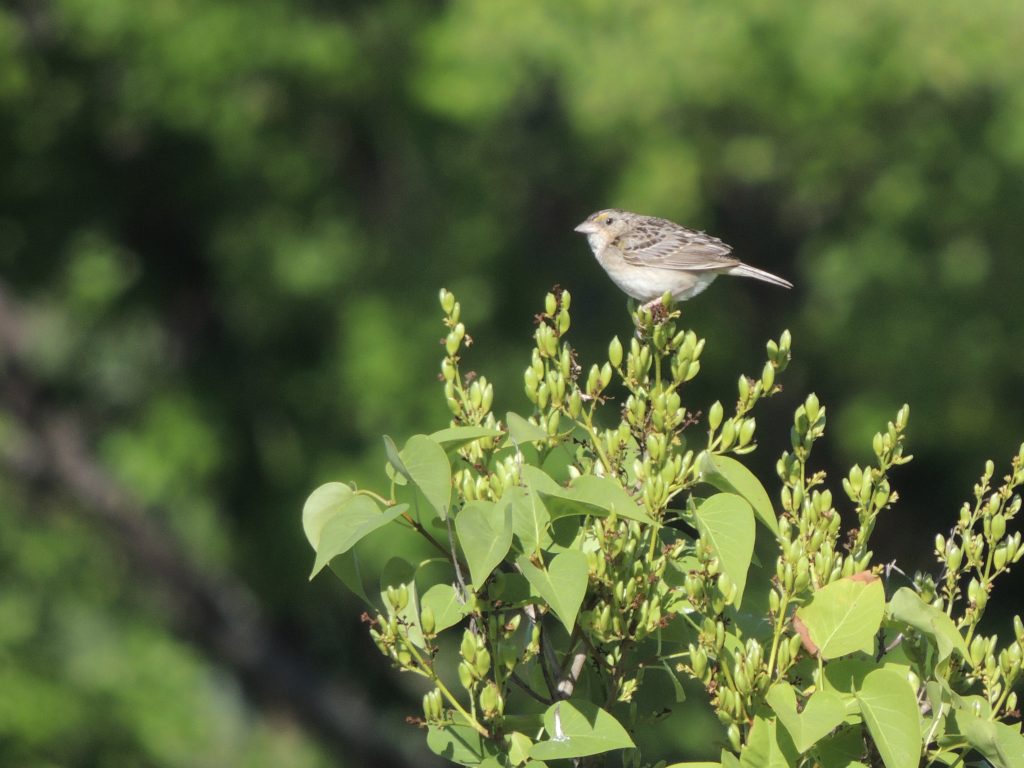
Grasshopper Sparrow

I know this was not my first visit to this hill, it’s a longish drive from home but a peaceful retreat on a summer afternoon and the birding makes the climb worthwhile.  It’s a sure place for Grasshopper Sparrows where the vegetation is parched and thinnest, Song Sparrows almost anywhere and this singing Field Sparrow who was working the length of a hawthorn hedge, up and down, making sure we knew the limits of his territory.
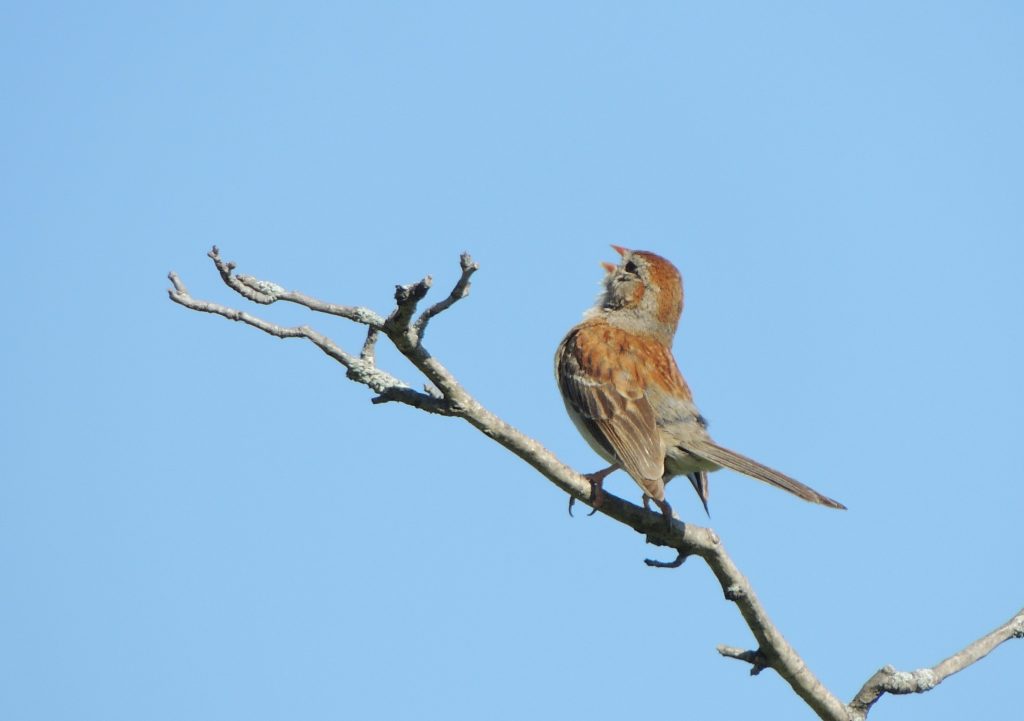
When we hear a Field Sparrow’s trailing song, like a ping-pong ball bouncing to a rest,  we know to check woody or brushy edges. I only feature him here because he made a lasting impression and at this time of year with snow squalls a possibility, is a summer bird memory to hold on to.
Phalarope – Wilson’s becomes Red

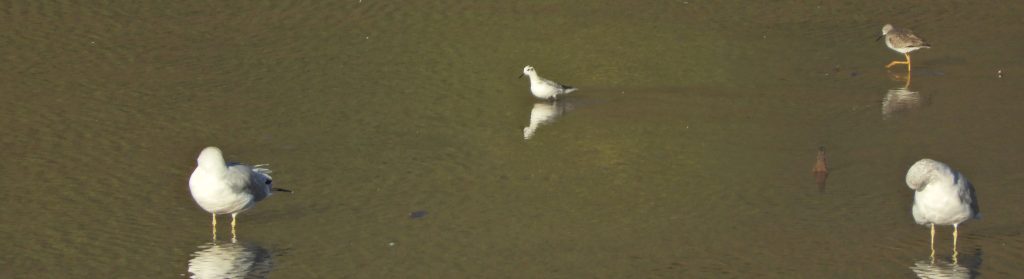
Wilsons Phalarope – Valley Inn

October 14. 2025. Valley Inn. Royal Botanical Gardens, ON. Canada.  Word reached me that a Wilson’s Phalarope was hanging around a shallow-water mudflat not far from home. I wanted to see it. Phalaropes are dainty shorebirds, rather ballerina-like and particularly pretty in spring and summer plumage, certainly worth taking the time for, even if now out of its breeding plumage.

The site is well known to the local birding community and although I skipped breakfast and arrived early, a few birders had already settled in. Most hefted cameras with lots of reach, but I wasn’t there for the photograph, I just wanted to see the bird. My camera is light and adaptable, but I only carry it for moments when luck is with me. This bird was about 200M. away, hard to pick out lit by the strong morning sun and easily lost among many gulls.

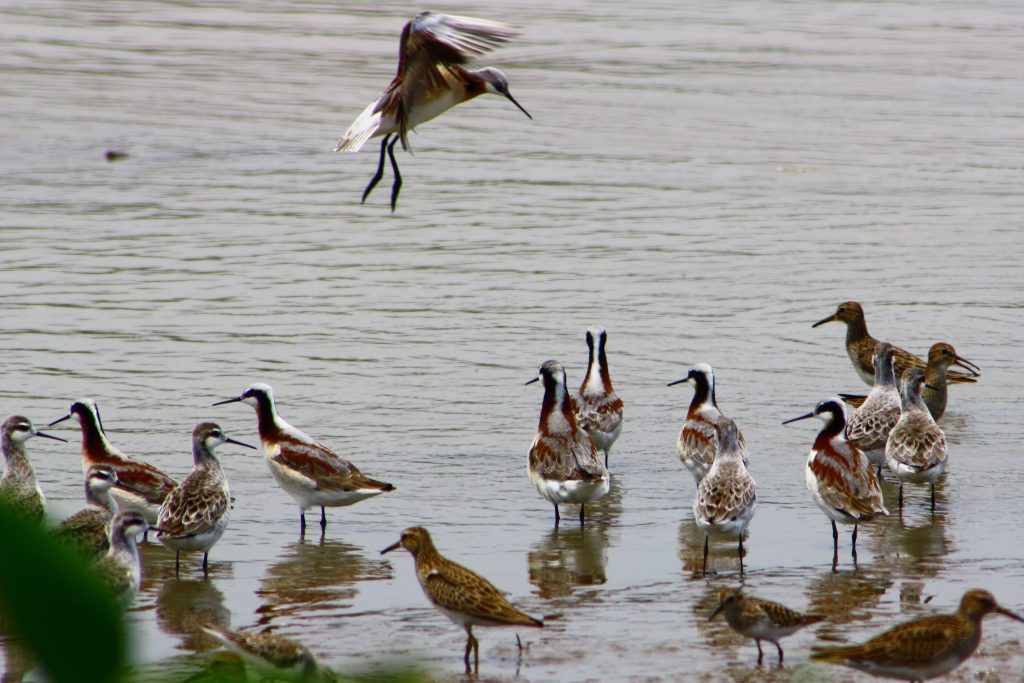
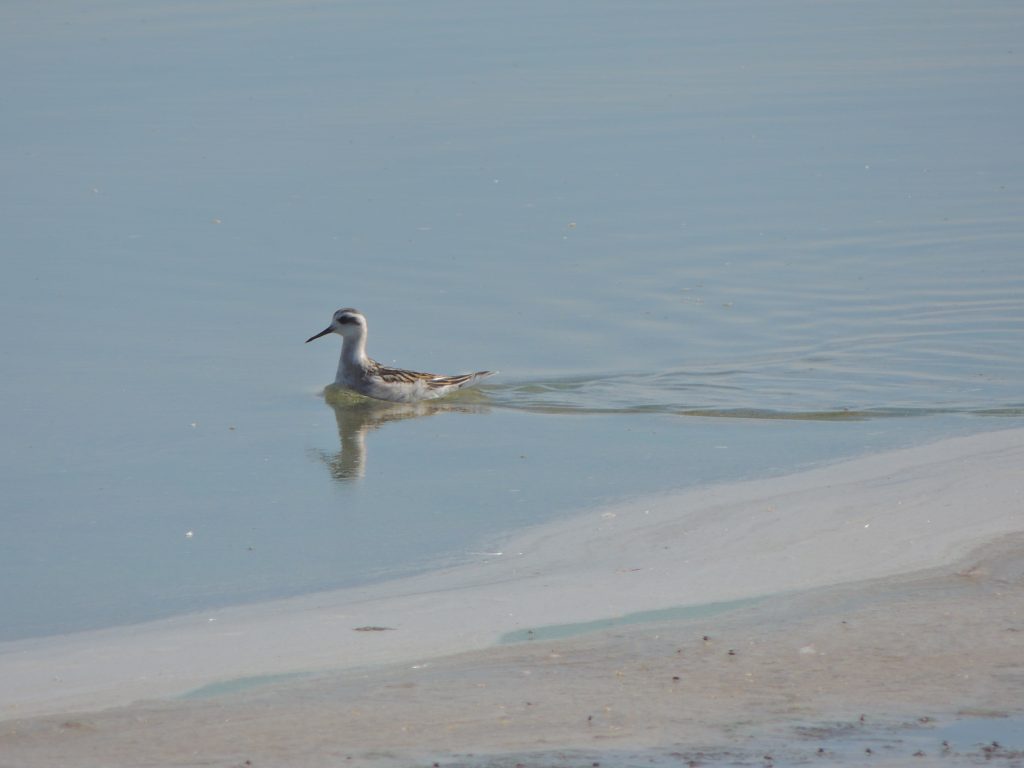
Red-necked Phalarope. September in Kazakhstan

The mudflat is rather long and narrow with open water left, right and beyond, it is flanked by steep sides, a busy railway to the right and a road and municipal cemetery to the left.  I could see the phalarope, tiny distant and white in the sun, if a tick on a list was important, it was in the bag. But enjoying the bird was what I’d come for, tiny and distant was not nearly good enough.

It’s an odd name phalarope, I could have gone through life none the wiser but age, accumulation and technology bring so much close to hand and I soon found that phalarope means coot-footed, a reference to their lobed coot-like toes.

I made my way up a service road towards the rail line, it took me a little closer and much higher but now I was facing east and looking down for a bird lost somewhere in the sun’s wide reflection and glare, no enjoyment to be had here.

Fearing that the cause was lost I headed back now to the east side, where my car waited for me anyway.  Knowing this other side, the cemetery side, to be rather densely treed I gambled on finding a window to the water, worth a try.  If not I’d head home for breakfast.

I did find that window, beyond the headstones and a little way down the rather scruffy fringe of trees. Perched and peering through the opening I could see my bird, my phalarope, coot-footed, reasonably close and scurrying busily among the gulls, yellowlegs and urban debris. Really not very pretty, but seen and enjoyed for what it was, a Wilson’s Phalarope.

(p.s November 14 2025) Significant to some, but not to me, is that further work by those with time and some of the better expensive equipment determined that this bird was a Red Phalarope.  I’m not sure that I’d seen a Red Phalarope before, not knowingly anyway. I had fun and that’s birding.

Wilson’s Phalaropes El Salvador. Breeding plumage

Carolina Wren

October 1 2025. Our house, Burlington, Ontario. By design, our late season back yard has drifted into colourful chaos.  It’s thick and verging on overgrown in places.  We love it, birds do too as well as a couple of neighbourhood cats.  I don’t much care for cats, outdoor cats but supposedly domestic, particularly those that use our place as their toilet; and sometimes snare birds.  I’ll accept though that they probably exert some control on unwanted rodents.
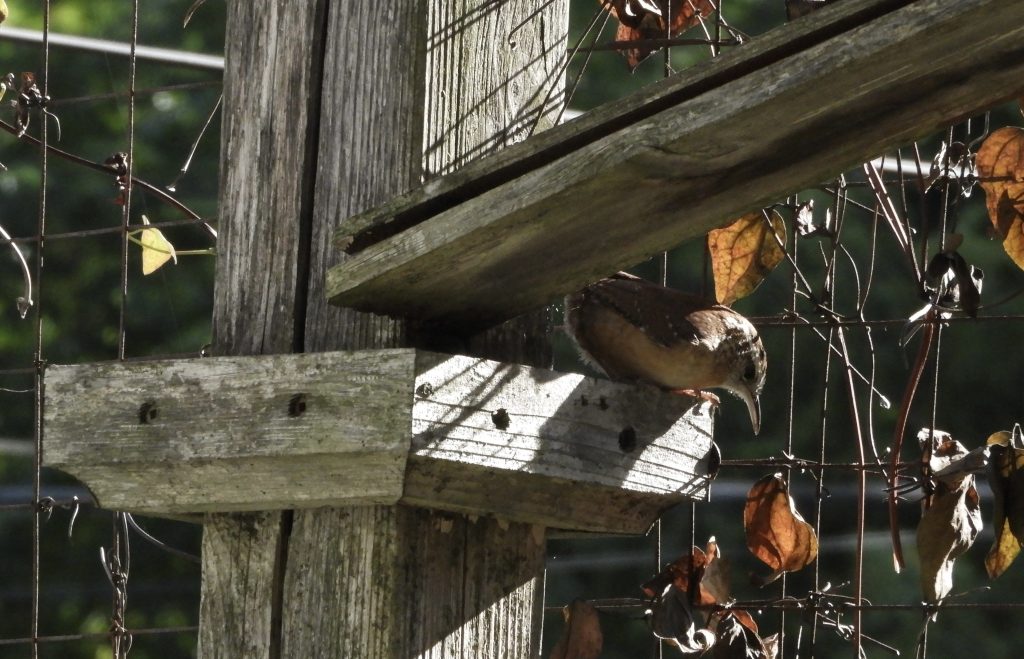
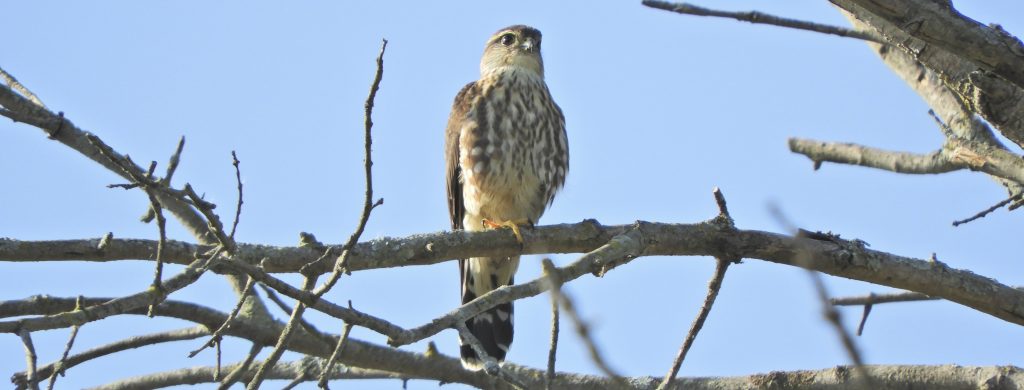
At my desk, sorting photos this afternoon, I became aware of a harsh chatter from just outside the back door. It sounded like a bird, not in distress but emphatic and persistent.  This could be interesting I thought, grabbing my camera and heading for the door. I impressed myself by quickly checking and readying it, set for what just might turn out to be a great photo op. Good call, it was a Carolina Wren, agitated by something and not in the least bit concerned by my sudden appearance.  It was making its way around the posts of our back door arbour or trellis, I’m never quite sure what it’s called, back-lit by the afternoon sun.  I got a couple of evocative photos and then saw a big furry cat scuttle away, out from beneath the clematis tangle.  It was the reason for the ruckus, but I have no idea what it had been doing to so infuriate the wren.

Carolina Wrens have a busybody way about them.  They can be opinionated and vocal often reporting on the affairs of others.  They also like to explore dark corners; places others might avoid.  Some years ago, a Carolina Wren flew into the relative darkness of my office through a window that was barely open.  It was a little baffled but not panicked by the unexpected result.

Today’s Carolina Wren was My Bird of the Day, really the only bird of the day but it made for an interesting few minutes.

Merlin and Cooper’s Hawks

Merlin. Sept 21 2025

September 21. 2025. Hendrie Valley. Royal Botanical Gardens, Burlington, ON. Canada. An unseasonably warm late September morning and three of us made the rounds of the valley on a transect.  Bird variety was not high, 30 species, but it came loaded with interesting moments.

Standing at a small woodland opening, I pointed out two Ruby-throated Hummingbirds to my companions.  I knew they’d be interested, hummingbirds are always worth the time of day, but their interest was nothing compared to the excited squeals of a passing mother and daughter who happened to overhear us. We probably spent too much time talking hummingbirds with them, but eventually, having enriched their day, we continued and added Brown Creeper, Philadelphia Vireo and Swainson’s Thrush to our notes.

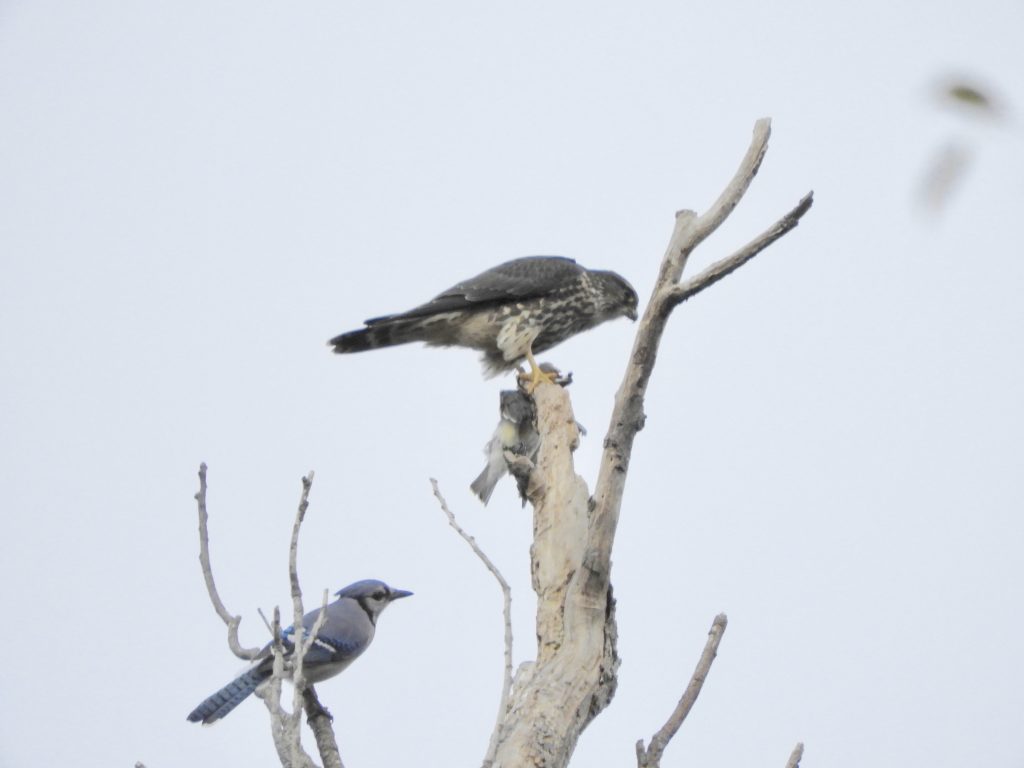
A little later, I spotted the fast and low fly-by of a falcon, more likely Merlin than kestrel I thought, my companions had to take my word for it. Minutes later we arrived at a platform with a wide view over a lake and there we re-found the falcon. It was a Merlin, and it had taken up a spot halfway up a stark dead tree and had the attention of a Blue Jay who bravely tried a couple of taunting passes. This is not the first time I’ve witnessed a Jay vs. Merlin, cat and mouse game.

Merlin with Cedar Waxwing. Blue Jay disapproval.

The play goes like this: Several Blue Jays as teasers perch conspicuously around the branches of a bare or sparsely-leaved tree, a Merlin alights on a strategic perch and surveys the Jays as possible meals and soon makes a dive or maybe a feint for one of them. The Jays scatter, shrieking like 7-year-olds, the Merlin returns empty-handed and the Jays soon reconvene. Then they do it all over again – and again.  It’s the avian version of What time is it Mr. Wolf?  Wolf, the Merlin in this case, is a predator who lives on a diet of smaller birds snatched in fast pursuit. A Blue Jay would make a good meal for a Merlin.

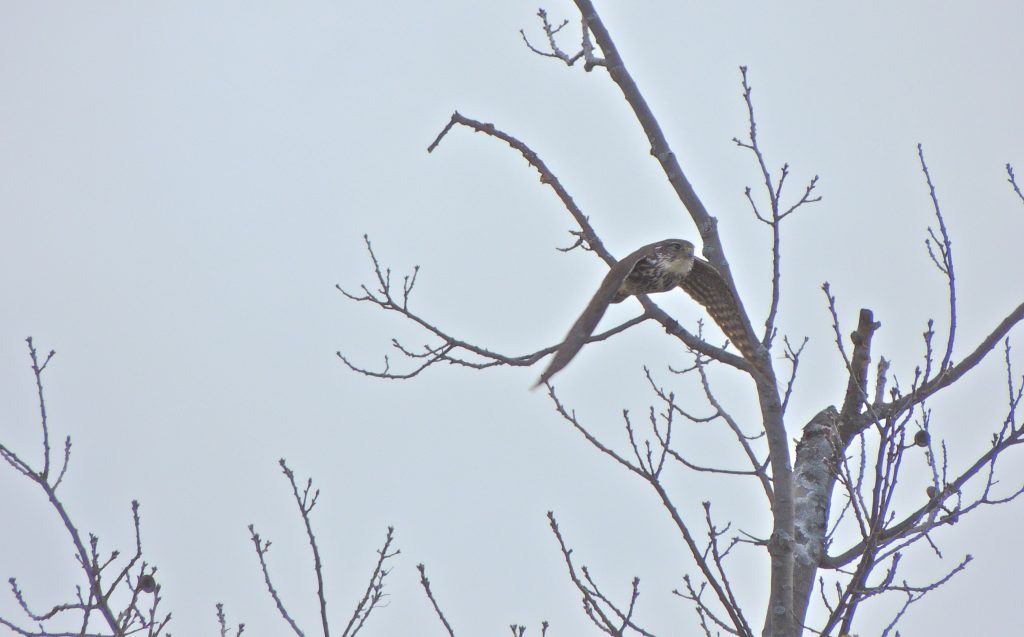
Merlin takes flight

Much later, hot and weary, we watched two large birds soaring in mutual display over a forested area. They were Cooper’s Hawks, probably the pair who nested here this past summer.  Their soaring flight wove in swoops; it was clear there was no antagonism.  We enjoyed several luxurious minutes following them and I shared their distinguishing features with my companions, noting in particular their size difference, the female is always considerably larger than the male. As I tried to convince my friends of the rather rounded wing profile of these accipiters (the family group to which Cooper’s Hawks belong) and descriptively compare them to the streamlined fighter-jet wings of falcons, a Merlin swept in to join the display and perfectly illustrate the lesson.

Cooper’s Hawks and Merlins shared first place in my mind as My Birds of the Day.

On goatsuckers, nightjars and nighthawks

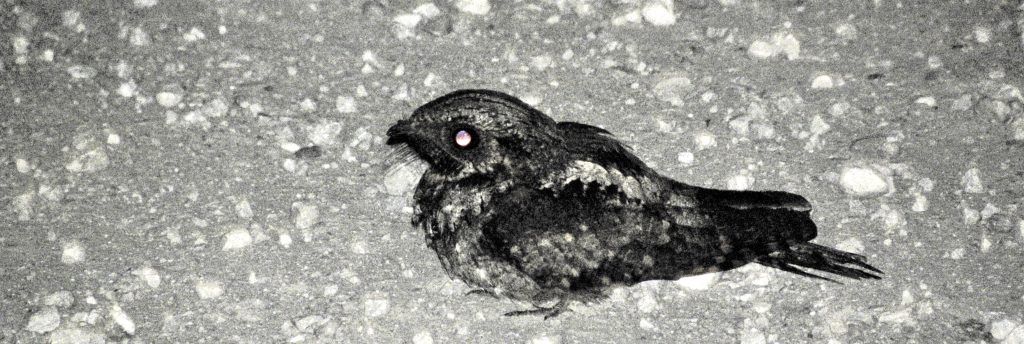
Whip-poor-will by car headlights

September 4. 2025. Churchill Park, Hamilton, ON. Canada.  My encounter with Common Nighthawks a couple of weeks ago inspired me to see if I could find more.  I know enough about them, their migration and flight times, to be reasonably assured of finding them, or at least of tipping the odds in my favour.   This park is well positioned along a probable flight path, is wide and grassy and not at all a bad place to sit and watch the evening sky. Tonight, just as the undersides of clouds had started to redden, the first nighthawks appeared over the tree line, heading west and swooping, soaring and swerving; seizing insects  to fuel the journey. By the time the sun’s last light faded I had seen perhaps twenty.

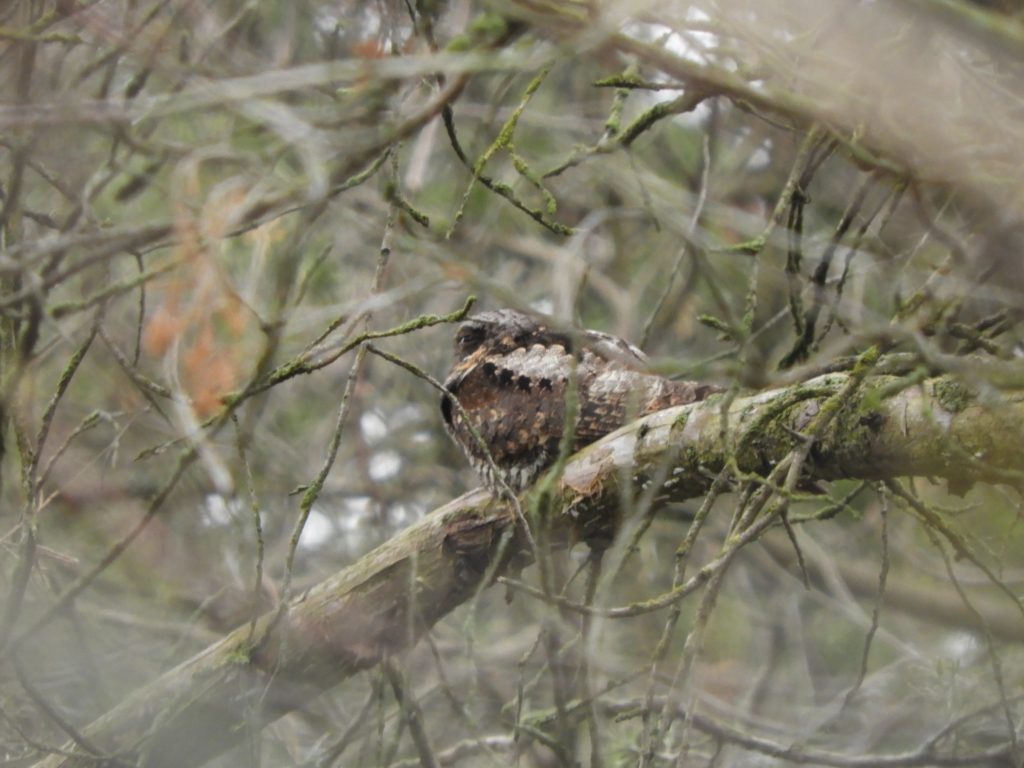
Whip-poor-will. On migration and resting during daylight.

I was conspicuously out of place among the many joggers, dog-walkers and soccer players. To the oft asked question, what are you seeing? I had no short answer, these are birds around which myths and legends have grown; strange birds, goatsuckers, nightjars, nighthawks. Here are a few fragments.

There are about 100 related Caprimulgid species worldwide, broadly they are nightjars. They all share the same characteristic cryptic plumage, enormous moth-catching mouths and sometimes jarring calls which have earned them the common names of nightjars.

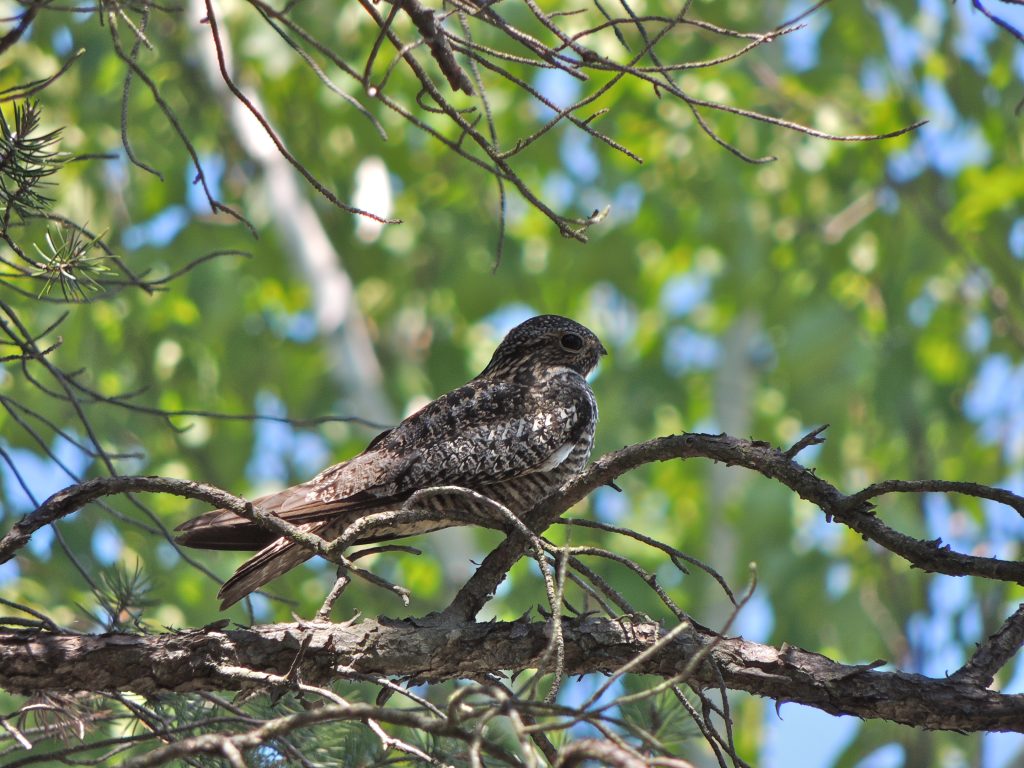
Common Nighthawk. Just disturbed and now waiting for us to leave

A couple of North American nightjars are onomatopoeically named to describe their almost bewildering, sometimes wearying, night-long songs: Chuck-wills-widow and Whip-poor-will. Our Common Nighthawks are not known for their song, their brief, nasal Peent is distinctive and unremarkable and sounds very similar to the territorial grunt of an American Woodcock (if that helps).

Europe’s Common Nightjar convinced observers of Ancient Greece that their proclivity for catching moths around domestic sheep and goats surely meant they also stole their milk. It earned them the name of goatsuckers which gave rise to the generic name Caprimulgus, the Latin roots of which are capra (nanny goat) and mulgere (to milk).

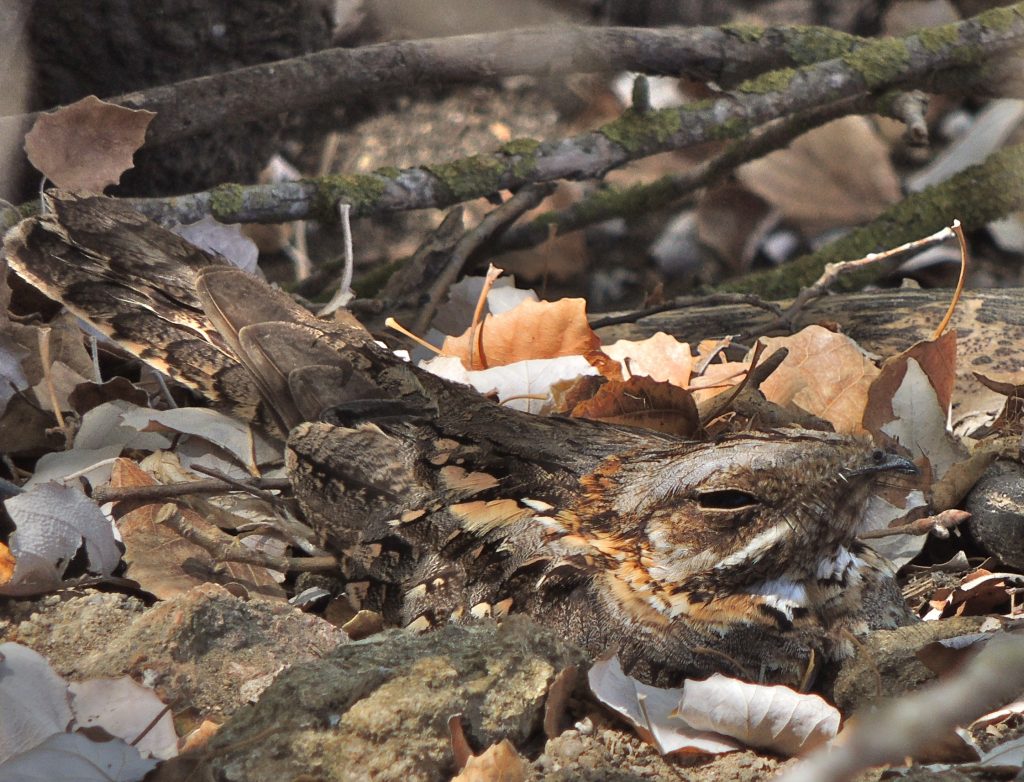
Nightjars are birds of the half-light, insectivores and almost impossible to distinguish from the leaf litter or branch where they choose to rest by day. This tight-sitting, Rednecked Nightjar was shown to a small group of us, I had little problem making it out, but one or two of the group never did.  

Red-necked Nightjar. La Janda, Spain.