Broad-winged Hawks

April 22 2026.  Princess Point, Hamilton ON.   Every now and then I get a reminder that some events in nature’s avian rhythms happen with tight, almost set-your-watch-by-it, regularity.  One of them is happening right now, the spring passage of Broad-winged Hawks (4th week of April).  Another, coming soon, is the arrival here of Baltimore Orioles (May 3rd.). The broadwings sail silently over and you can easily miss them, orioles on the other hand arrive, en masse, to their own of fanfare of noisy whistles.

So, this is the broadwing week and I might have missed it, missed them, but for my birder’s eye for movement.  I was walking a forest trail, a still leafless Red Oak woodland, when a moving shadow made me look up. And there, a small group of four or five Broad-winged Hawks circling low overhead.  I tried for a photo, but they were moving too fast and I had no hope of a cleanly focused image through branches.  So, I watched them slide by enjoying their clean, dark-outlined wings and boldly barred tails showing crisply against a perfect spring blue sky.  I savoured the moment remembering that this is the time, the fourth week of April. They drifted out of sight and I walked on.
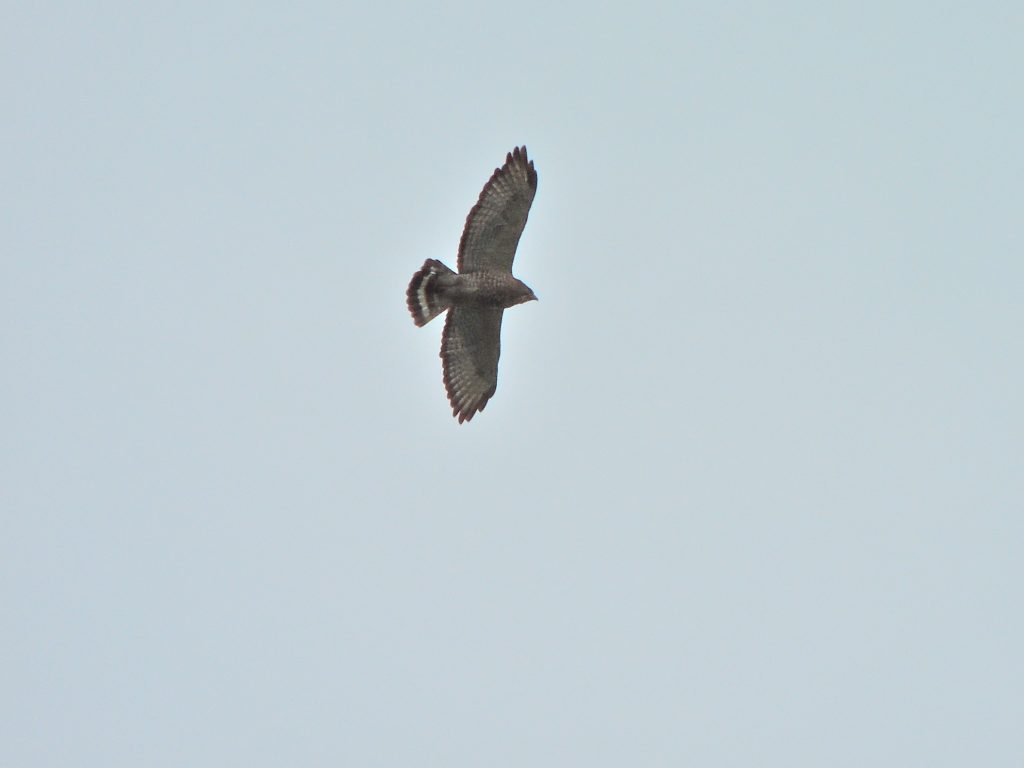
Broad-winged Hawk

As I finished my circuit I keep checking the open sky.  The broadwing’s direction of flight made sense, they were coming from an escarpment ridge and heading northwest, a line that will take them to the boreal forest. By the time I returned to my car I spotted two more small groups of broadwings, all following the same flight line.

Broad-winged Hawks are one of many birds of the season and today my Bird of the Day.
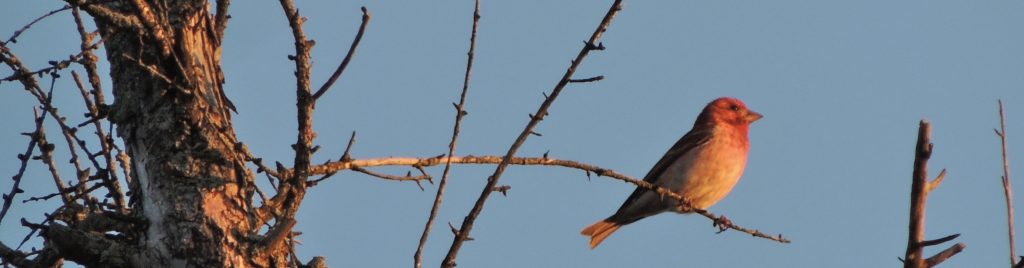
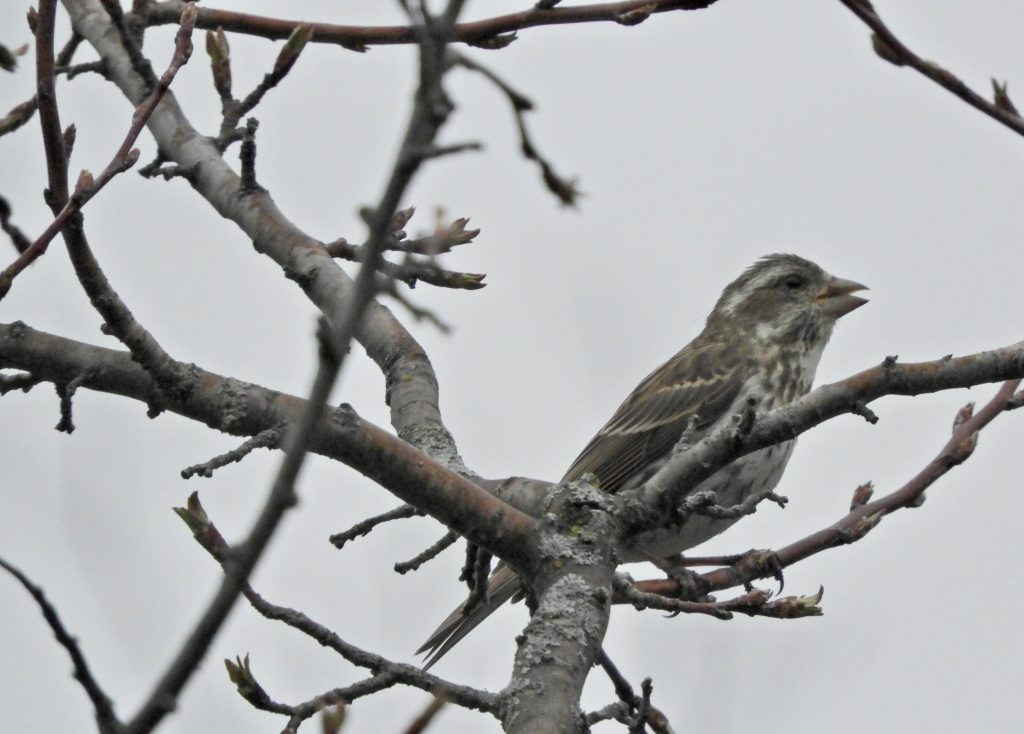
Purple Finch

Purple Finch

April 12 2026.  Royal Botanical Gardens Arboretum, Hamilton ON.   We found a small flock of Purple Finches today, it took a moment to i.d them because I had to do a mental roll call first: Goldfinch No, Pine Siskin No, House Finch Maybe, then… Purple Finch – Yes.  Confirmed at the same instant by a clear burst of song from behind; described succinctly by Pete Dunne in his excellent Essential Field Guide Companion as , “ a hurried mumbled run-on warble that is sweeter and less histrionic than House Finch.”

Female Purple Finch

I was very pleased, it’s been a long time, since I last saw one.  I’m not sure that my two companions quite understood what was so special about them. Perhaps they viewed them as little more than House Finches, an easy mistake because the females, which all but one of them were, can easily be mistaken, and House Finches are quite common and widespread.

It’s not that Purple Finches are rare but at the same time, neither are they common. Most Purple Finches spend their winters a little bit south of us and their summers a little bit north, making us just somewhere along the way, somewhere to fly over.  Various references say that they prefer moist coniferous forests particularly during the breeding season and just about anywhere at other times including mixed woodlands and backyard feeders. Interestingly, Cornell Lab of Ornithology notes of Purple Finch that “Although widespread and regularly seen, this bird is one of the least-studied finches in North America because it is neither common enough to be easily studied nor rare enough to be threatened with extinction.” Falling between two stools.

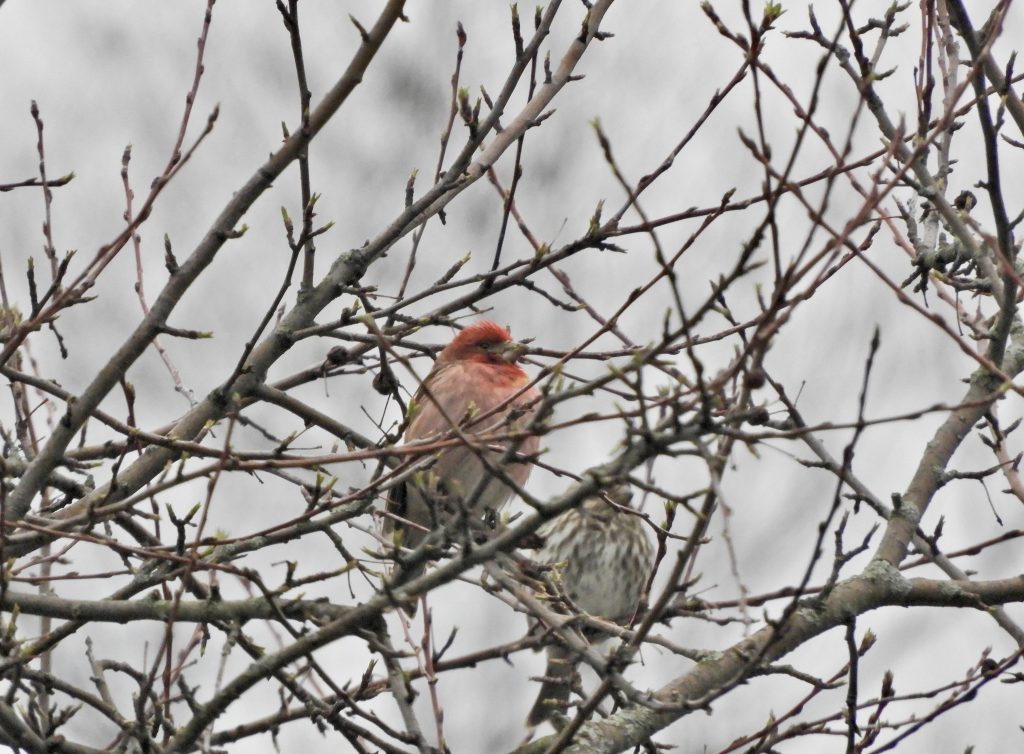
Purple Finch m & f

This all happened at the start of our transect and we had to keep moving. But I came back later and they were still where we’d found them, feasting on desiccated fruit from the tops of some winter weary, crab apple trees. The passage overhead of a Sharp-shinned or Cooper’s Hawk flushed the flock, and I was able to estimate its size at about twenty, and for all the time I spent following them I could only be sure of one male. Here he is with part of his harem,  and at the top of the page is an evening photo of male who I think was overseeing his territory.

And the rest of the transect? A cold east wind took some of the fun out of it, but we watched a small group, gathering numbers, of recently returned Tree Swallows spiral up in and overhead for no accountable reason, and, as we watched the skies above two long and straggling strings of migrating waterfowl passed over, very high and far beyond identification.

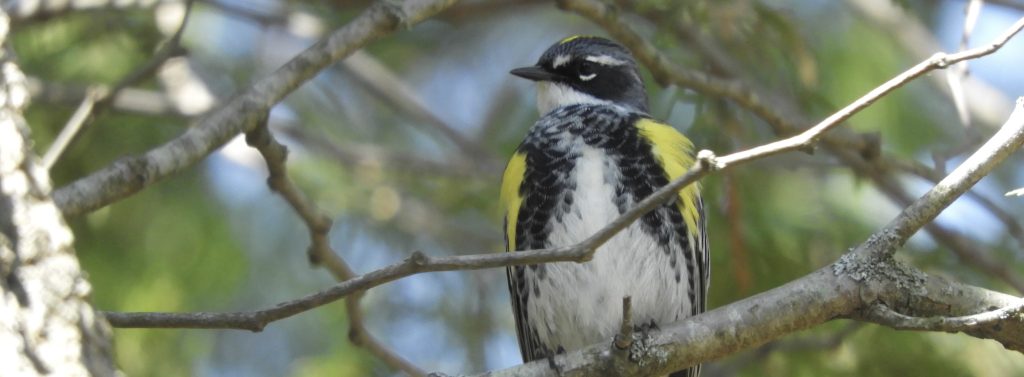
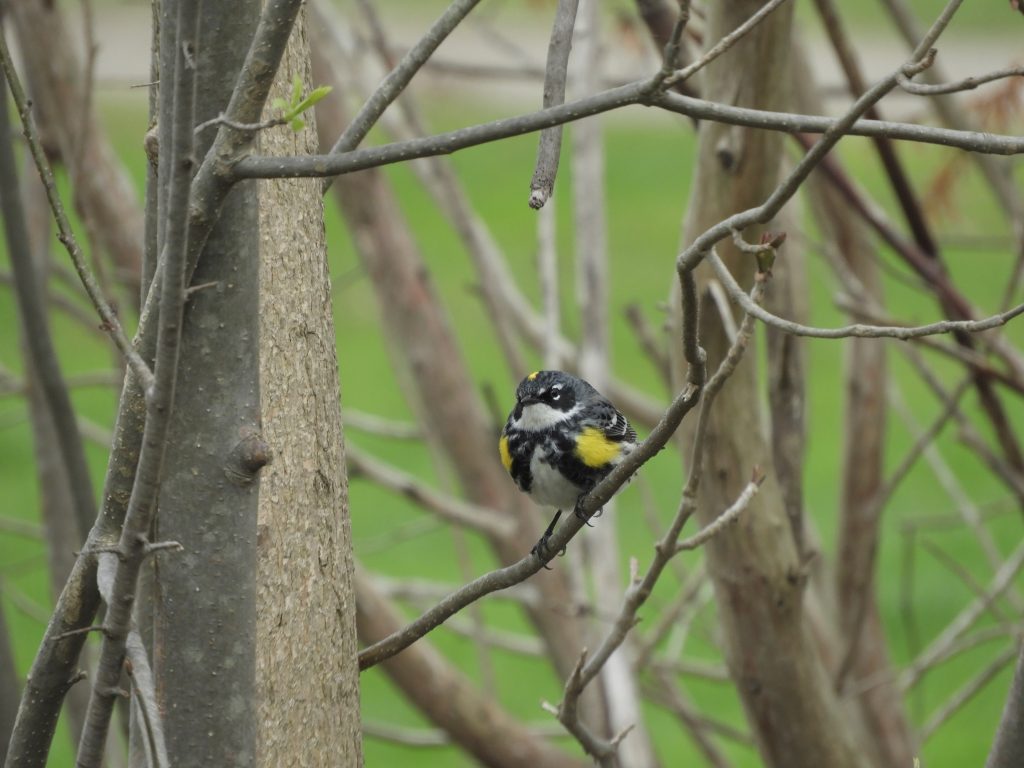
Yellow-rumped-Warbler

Yellow-rumped Warbler

April 5 2026. Hendrie Valley Burlington ON.  Our winter months of almost unrelenting cold made me think an above-freezing 6゚C. transect would feel comfortable. But it wasn’t at all, a steady, cold west wind sweeping the valley took much of the fun out of it. Still, the birding was interesting.  This was my second transect of spring and maybe a quick refresher about transects might be helpful.

I am one of a team of capable birders who gather data on bird populations on the natural lands of Canada’s Royal Botanical Gardens, (RBG). Our task, April, May, September and October, is to walk the length of one of four defined routes recording all birds seen and heard; simple, a transect.  When completed we upload a report to a compiler.

Today’s route, Hendrie Valley, takes us along trails in a loop through hardwood forest, across a narrow river valley, skirts three woodland-enclosed ponds and follows a lightly treed riverbank. It is a very beautiful walk any day and the habitat is so varied that the birding is about as good as it gets. Hendrie is one of four such routes, all different but just as varied and interesting.

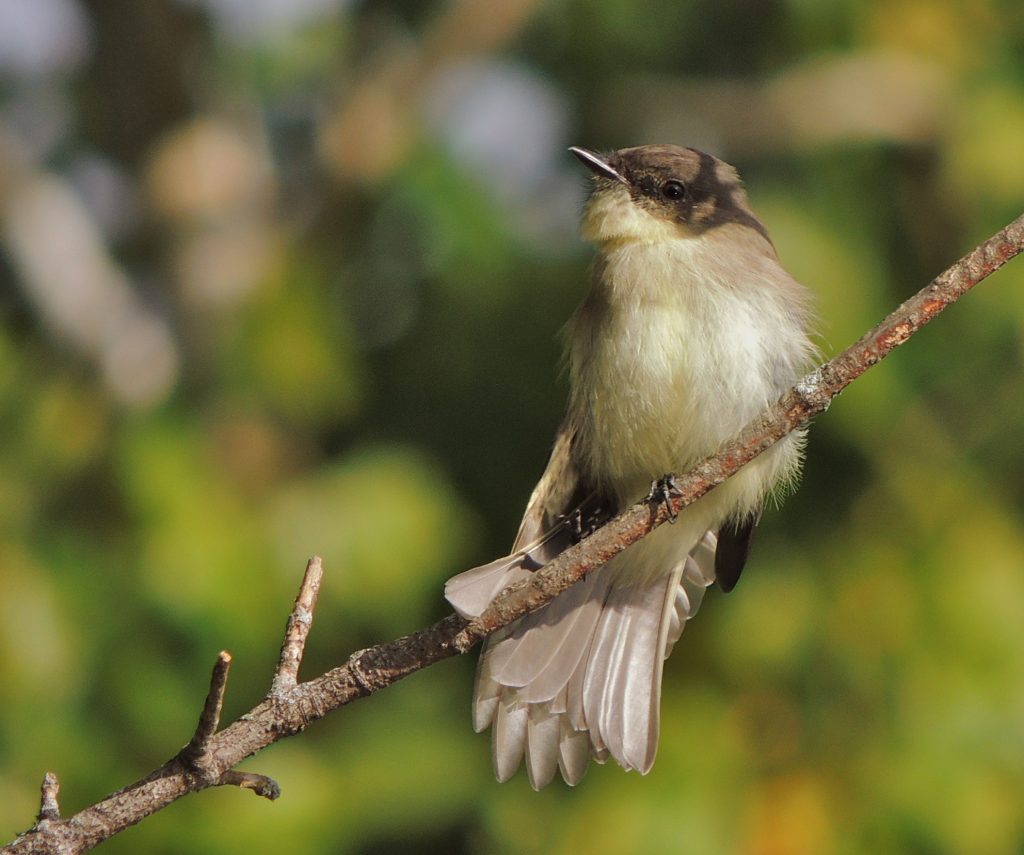
Eastern Phoebe

It’s always notable, sometimes exciting, to see a first-of-the-year (FOY) migrant and this morning a couple of Eastern Phoebes, an Osprey, two Tree Swallows and a smartly plumaged, male YellowrumpedWarbler were those firsts. There will be more each transect as spring progresses.

But there’s more to life than FOYs.  Our cold morning included a fast-moving Merlin, making flying look easy, swept high overhead and vanished beyond the skyline.  In contrast a Bald Eagle seemed to lumber by, giving us long enough to see that it was all dark below so probably a one-year-old bird, and to wrap up our day we loved a Cooper’s Hawk carrying twigs to the same nest site it has used for the past two years.

The acid test for My Bird of the Day is the bird who makes me think, wow!  Today that was the YellowrumpedWarbler. Suddenly right in front of us, low and searching slowly for insect food that was probably scarce. We absorbed its brilliant and crisp spring dress, rather like this one below, but succeeding in showing off the yellow patch on its rump from which it gets its name.

Yellow-rumped Warbler

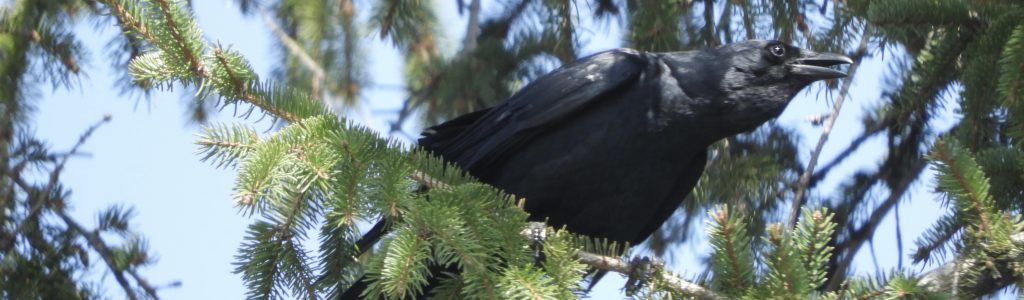
Fish Crows

March 23, 2026.  Bronte, ON.   A week or so ago a Florida politician was talking about the pressing need to bomb another country. It was a news clip, a fragment in a much larger story about evil empires and regime change.  But from somewhere behind his platform, I heard two or three distinctive notes, a Fish Crow’s grunt-coughs.  Fish Crows are strangers around here, they’re of the coastal and tidewater regions of southeast U.S, including Florida.  Hearing it in that context was a momentary micro-birding pleasure that made me smile,  I like to think others had a micro-birding moment too.
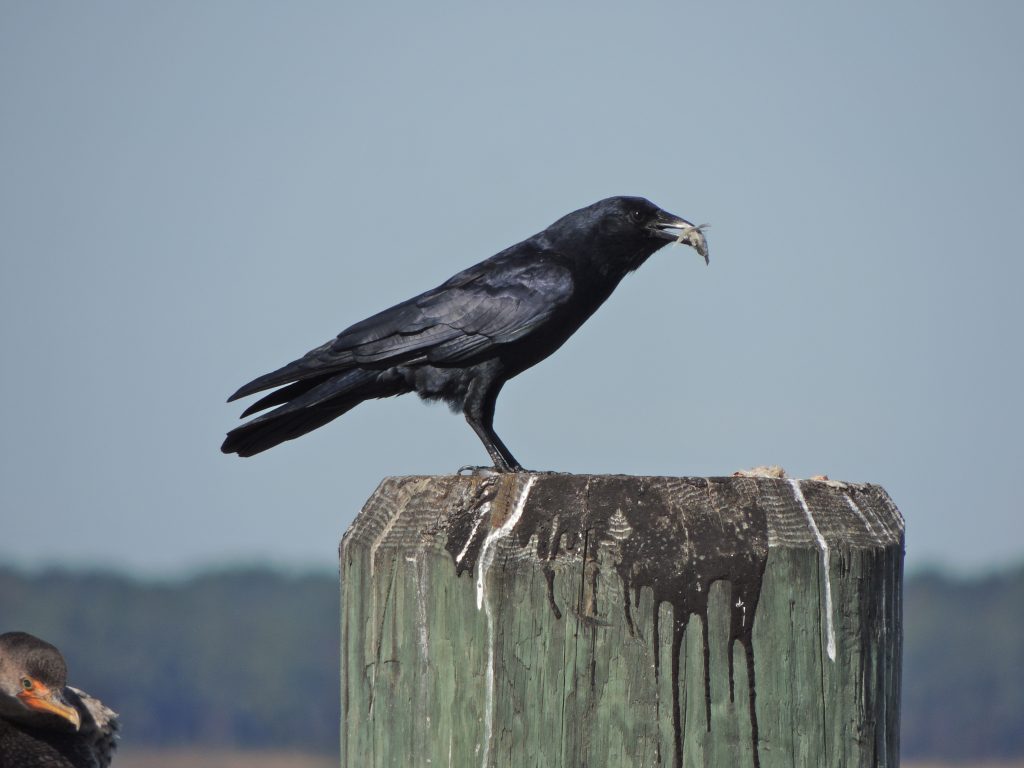
Fish Crow. James R. VA.

Today I visited a large marina in a neighbouring lakeside community.  I was there curious to know whether pairs of Red-necked Grebes had returned yet, it’s early but the ice has gone and they would be nice to see.

As I left my car, winter coat on now because discouragingly it had started to snow, I was startled then to hear the familiar grunt-coughs of a Fish Crow.  I watched as one passed overhead and landed atop a large pavilion.  I inwardly noted that had I not heard that Fish Crow note, had it flown silently, I’d have assumed it was just a familiar old American Crow. But it did speak up and reminded me of one spring, some seven or eight years ago when a couple of Fish Crows unexpectedly showed up not very far from where I was this morning.  They were a surprise, quite out of place and a novelty and in due course there was every reason to suspect they stayed around to breed.   They left at year’s end only to return the next year, still a novelty; and it went on that way for a while. I lost track of them, my fascination faded, perhaps they became established, seasonally anyway.  I gave them little thought until today.

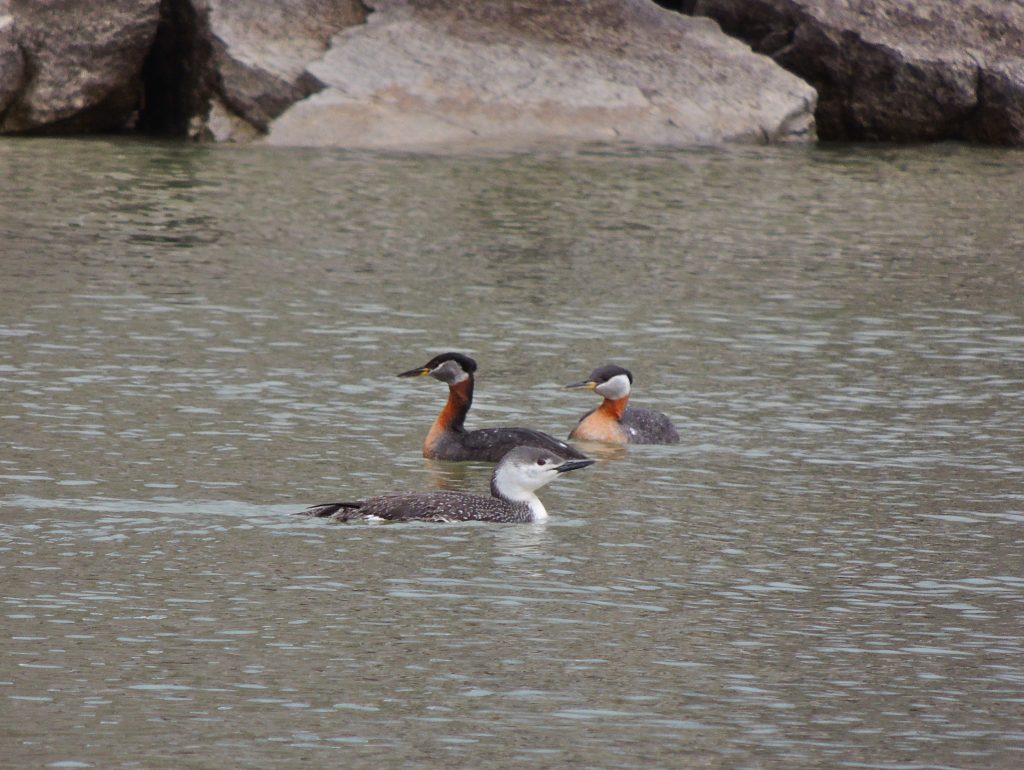
By the time I walked the length and breadth of the marina I’d found at least two pairs of Red-necked Grebes.  They are quite fascinating (to me anyway). Red-necked Grebes winter along the Atlantic and Pacific coasts and by far the majority nest on lakes and ponds across northern Ontario, Canada’s prairie provinces and the northwest corner of the continent. But a small, disjunct population (probably no more than a dozen pairs) chooses to breed right here along a very short stretch of the shore of Lake Ontario, favouring marinas and other anthropogenic backwaters.  So, today’s early returning grebes are an encouraging start and along with them I am pretty sure I counted or heard four or five Fish Crows in the neighbourhood

Red-necked Grebes and a Red-throated Loon. Mid April on Lake Ontario. The loon’s red throat is still a few weeks away.

I think the Fish Crows hit the My Birds of the Day chord by grabbing my attention, being quite unexpected, a minor curiosity and a reminder of a probable range extension.  I’m more likely though to spend my time and energy following the fortunes of the marina’s Red-necked Grebes, there’s much in the way of courtship and parental care behaviour to be enjoyed.

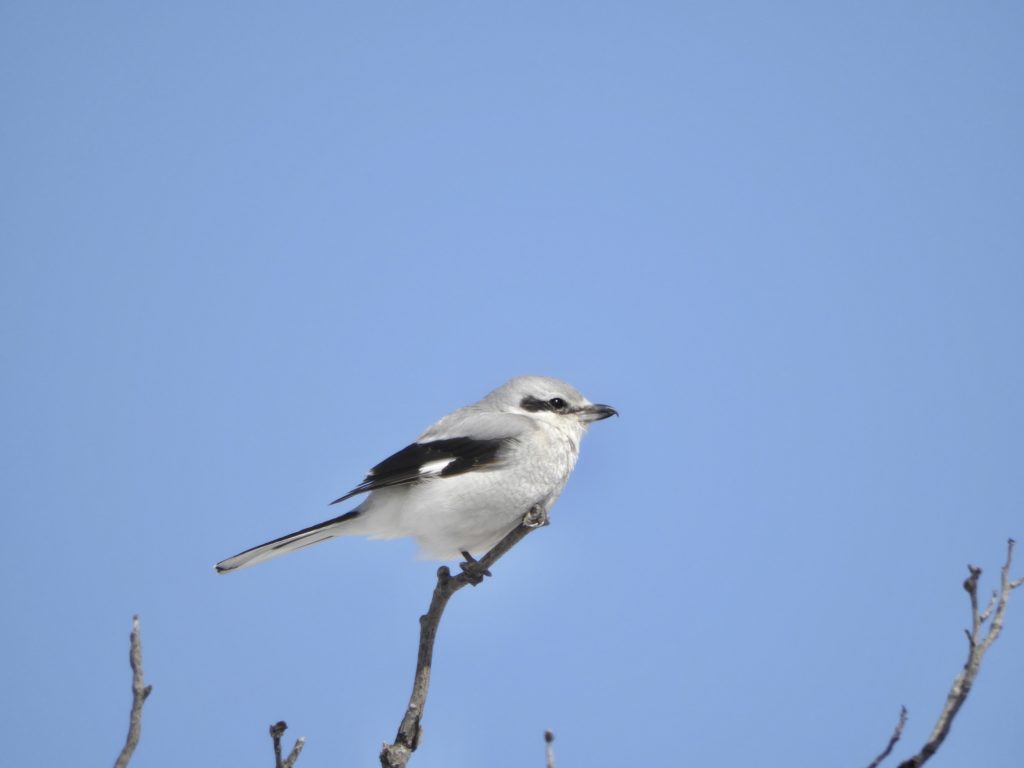
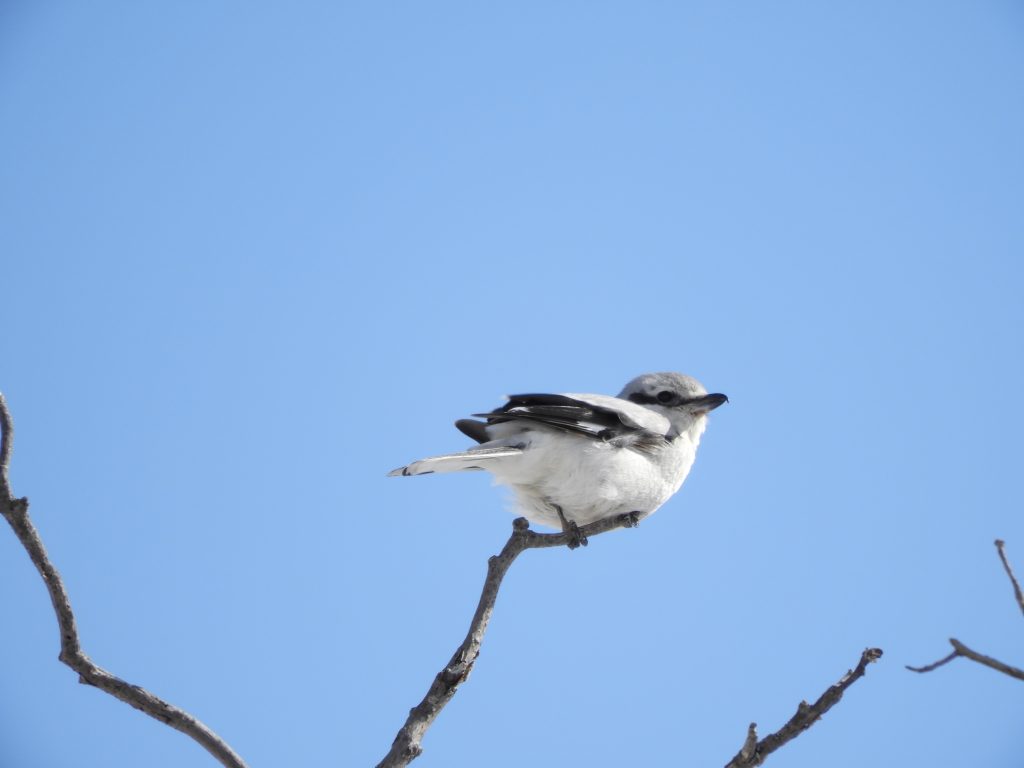
Northern Shrike

Northern Shrike

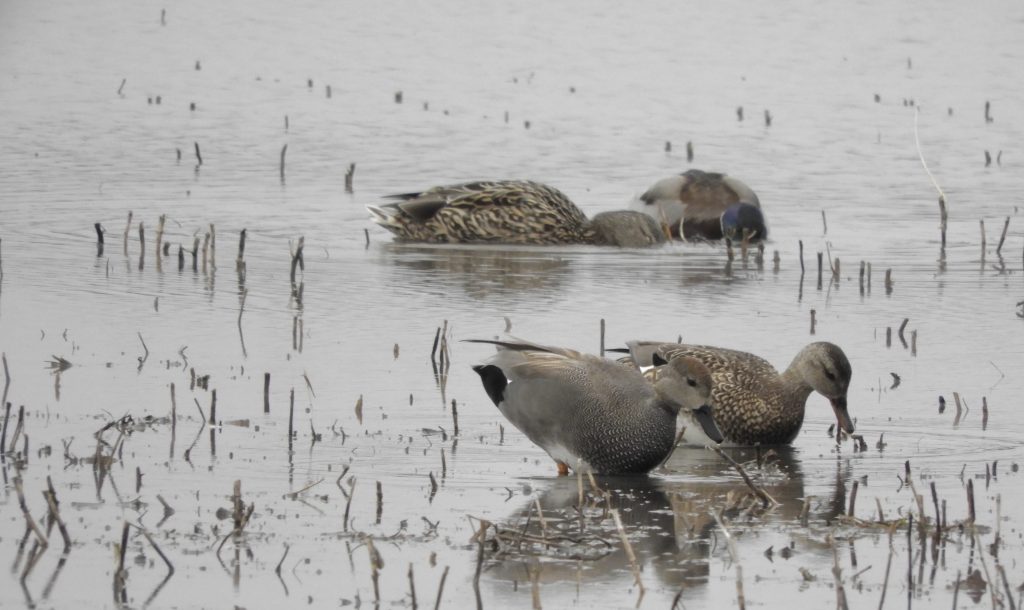
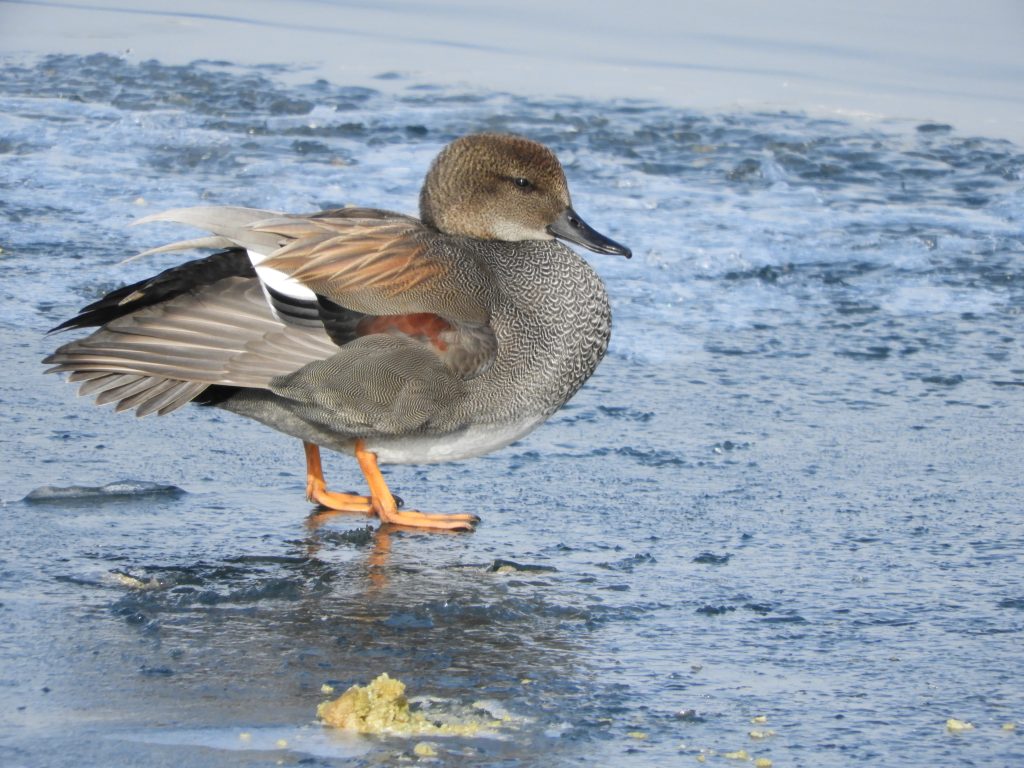
March 13, 2026.  Vinemount, ON.  Wet snow kept me indoors all morning but by 2-ish I needed to get out so, I decided to follow up on a speculation that some low-lying fields a short drive from home just might harbour early migrant ducks.  I was right on that count and enjoyed watching a dozen or so Gadwall and Mallards shuffling around the snow-fringed floodwaters.  You can see Mallards any time, but a few pairs of Gadwall were a nice surprise.  It was a rather gloomy setting, and perhaps better light would have shown off the fine silvery gold feathers on the back of the male Gadwall.

Gadwall pair and Mallards behind
Male Gadwall one frozen January day.

My Bird of the Day came a little later as I drove a straight country road which birders have come to know as a place of surprises.  A few moments reflection and I can recall seeing, Ring-necked Pheasants, Short-eared Owls,  Common Ravens, Peregrine Falcons, Eastern Meadowlarks and Northern Shrikes at some time along this short road, all of which were and still are, noteworthy at any time.

Northern Shrike

So, although it was not a complete surprise, I still count myself lucky to have found a Northern Shrike.  A fleeting glimpse would have been enough, but almost never do we get such good views as this one today.  It was perched high and conspicuously atop a bare roadside tree and rocked a little in the cold buffeting wind.  It watched me with some concern as, without getting out of my car, I reached and squirmed to get what I thought would be some easy and great photos.  My confidence was a little misplaced, I thought I knew my camera well and could easily adjust, adapt, point and shoot, however I was a little disappointed.  These are my best shots.  Perhaps it was the wind, perhaps it was careless focusing, good enough as record shots and I can do better. But still My Bird of the Day.