Warbling Vireo

August 28, 2016. Shoreacres Park, Burlington, ON. One of the things that birders get to understand and even anticipate is the waves of migrant movements. We expect spring’s Baltimore Orioles to arrive in the first week of May, Whimbrels around May 24th and the departure of Yellow Warblers by August 15th; plus or minus.
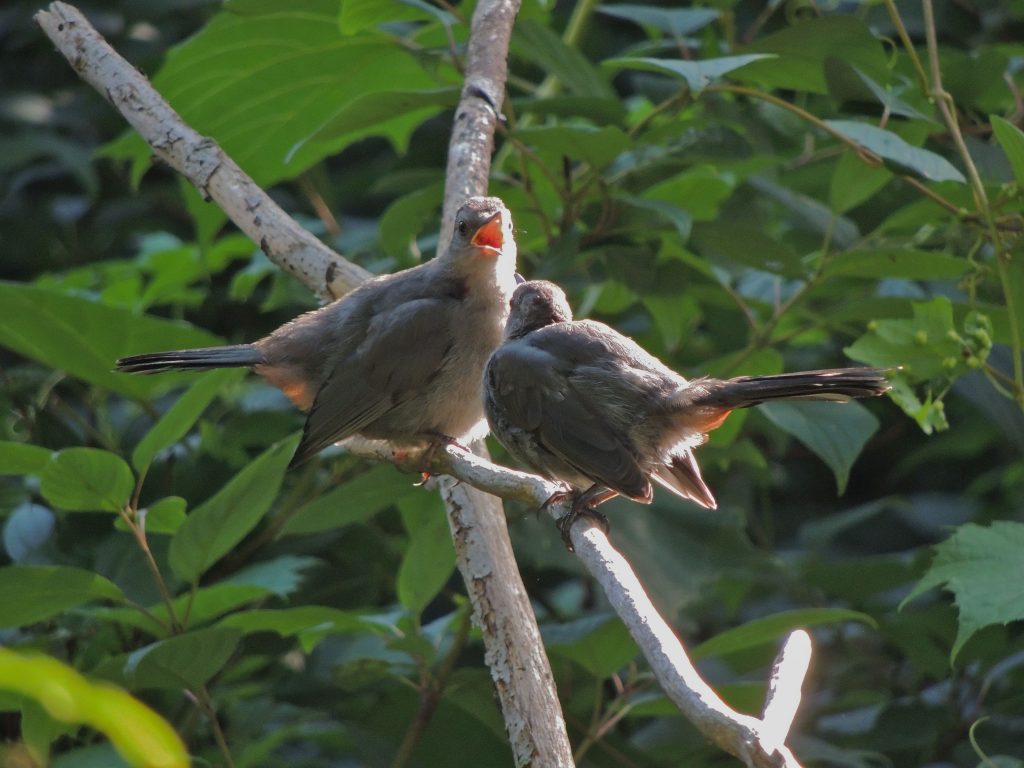
hungry young Gray Catbird and parent

I was out this morning just to see what might be hanging around one of our leafier parks. Earlier this week it had been very busy with countless here-today-gone-tomorrow migrants, but not today. Oh, there were a few: American Redstarts, a much photographed Yellow-billed Cuckoo and a young Gray Catbird pestering its parent, but best of all lots of Warbling Vireos.
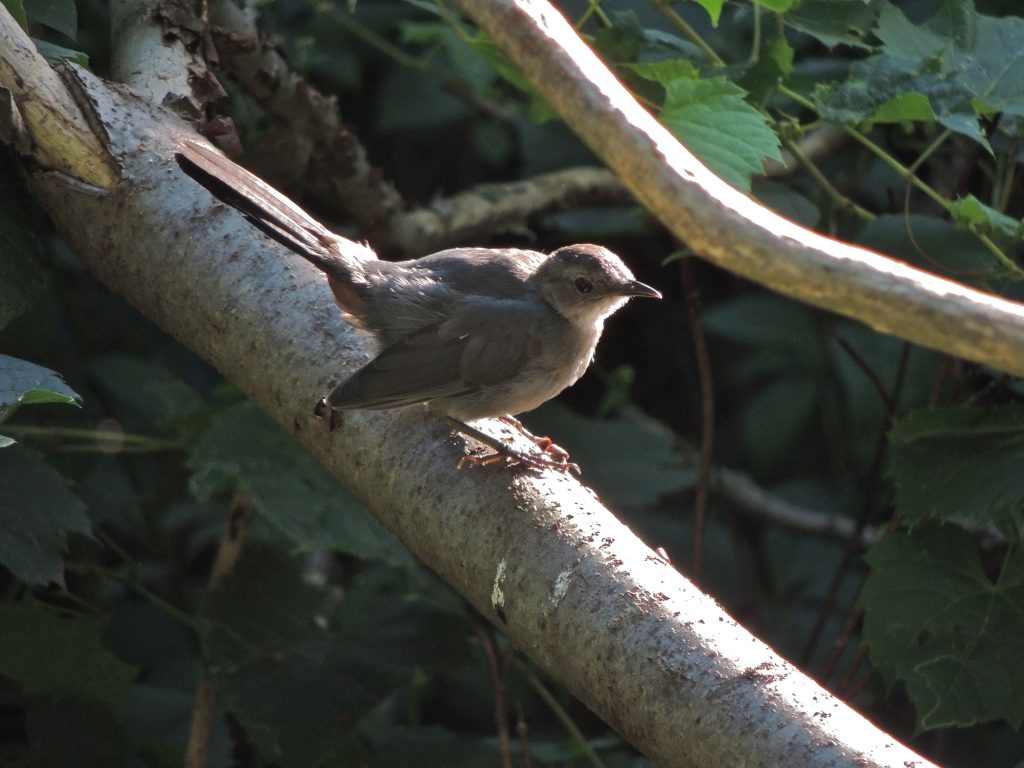
Gray Catbird
Gray Catbird

Many would think the Yellow-billed Cuckoo must surely be my Bird of the Day, but it was way too high to really enjoy and I got more pleasure listening to the Warbling Vireo’s cascading, throwaway song. Lasting two or three seconds, it’s a lazy summer sound that drifts endlessly in the urban forest canopy, a counterpoint to the electric buzz of cicadas.

Regular readers of this will remember that I have a soft spot for all vireo species. They are rarely flashy, usually unassuming and faintly predatory. Of all of them the Warbling Vireo is the least boldly marked or colourful, it is overall a plain olive to beige, nothing eye-catching.
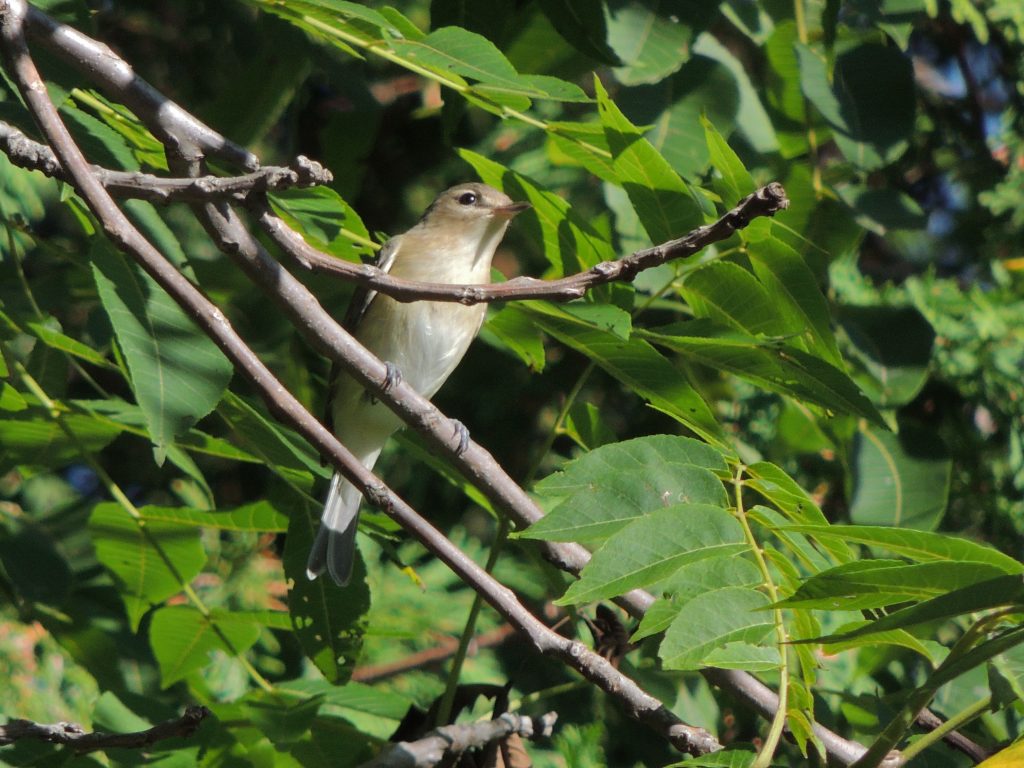
Warbling Vireo
Warbling Vireo

At the park this morning I could hear Warbling Vireos singing from every quarter, they were so numerous that I felt sure I was in the midst of a migratory wave. A check of a couple of references showed that they start their southward move in early August and are all gone (more or less) by mid September. Best to make the most of them now.

And as for cuckoos? See July 19th.
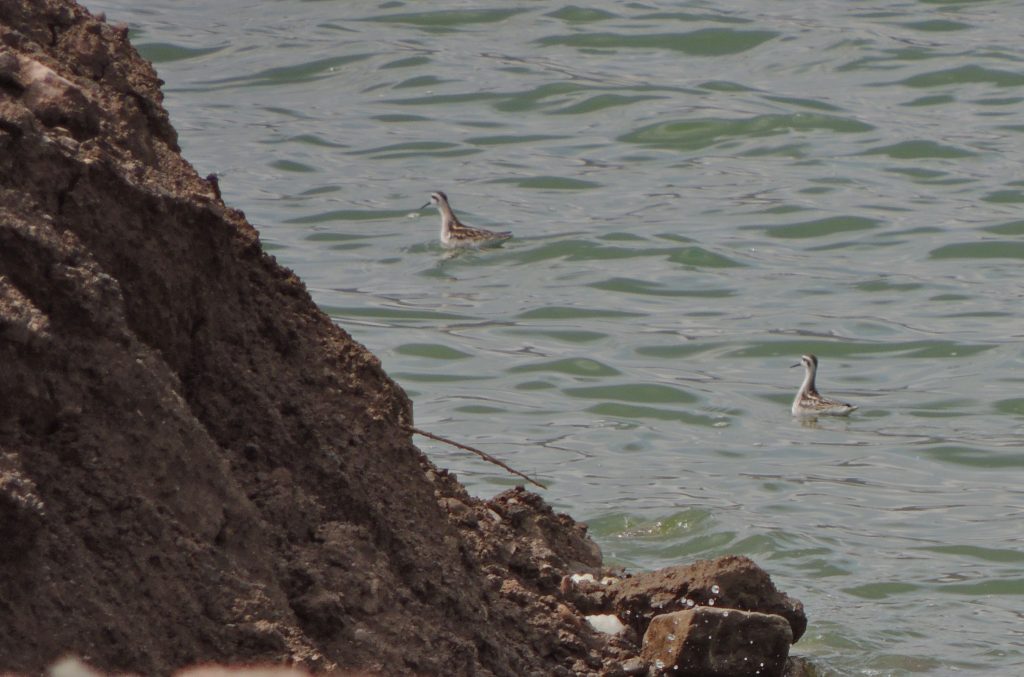
Red-necked Phalarope

August 25, 2016. Eastport Dr, Hamilton, ON. I enjoyed watching three Red-necked Phalaropes today; they easily pushed a Lesser Scaup, some Ruddy Ducks and a distant telescope view of a Stilt Sandpiper aside to be my Birds of the Day.

There are only three phalarope species in the world: Red, Red-necked and Wilson’s. The first two breed in the Arctic latitudes of Eurasia and North America, while the Wilson’s breeds across the central and north plains of North America. All spend the winter in equatorial regions. Red Phalaropes are rarely seen inland but the other two make regular but often-overlooked appearances in Ontario; for that I count us lucky because, as I’ve noted before, pharalopes are in the fine china category of shorebirds.

There is something very compelling about phalaropes. They are shorebirds, but unlike most of their relatives they swim rather than parade, pick and poke along the waters-edge. And then there’s the name – phalarope; a touch aristocratic sounding like pharaoh. But my handy authority on bird names says it’s from the Greek “…. phalaris, “ a coot”: Gr. pous, “foot”; hence “coot-footed” for the lobes on the toes like the foot of a coot.” Oh well, maybe not so aristocratic.

There were reportedly six or maybe eight of them in a large enclosed pond adjacent to the nearby industrial harbour. When I showed up most of them were out of sight, sheltered behind a large pile of earth and debris but I managed to get one or two passable shots. Here’s the best of them.

Red-necked Phalaropes

Common Ringed Plover

August 21, 2016. Leslie Street Spit, Toronto ON. I took the bait to go and chase a rare species today. That’s twice in a little over a month: in July it was for Black-bellied Whistling Ducks, today for a Common Ringed Plover. I wasn’t all that excited about the plover since I’d seen some a few years ago in England, but a gentle arm-twisting got me out of the house despite a bit of weariness lingering from a long late-night drive.

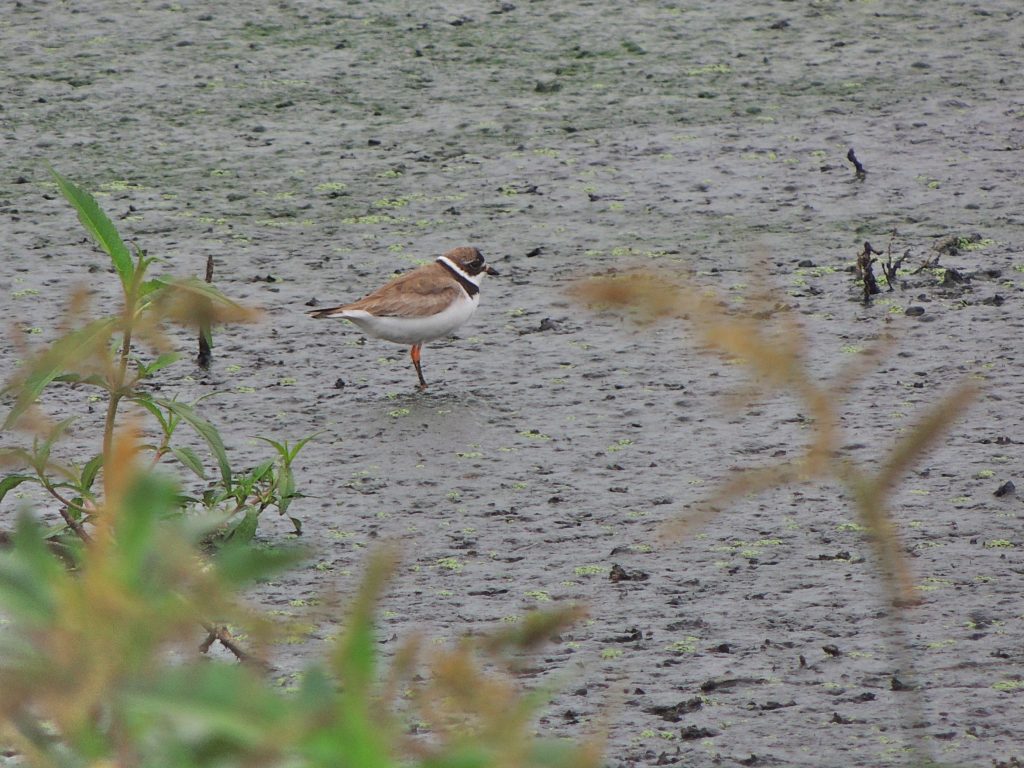
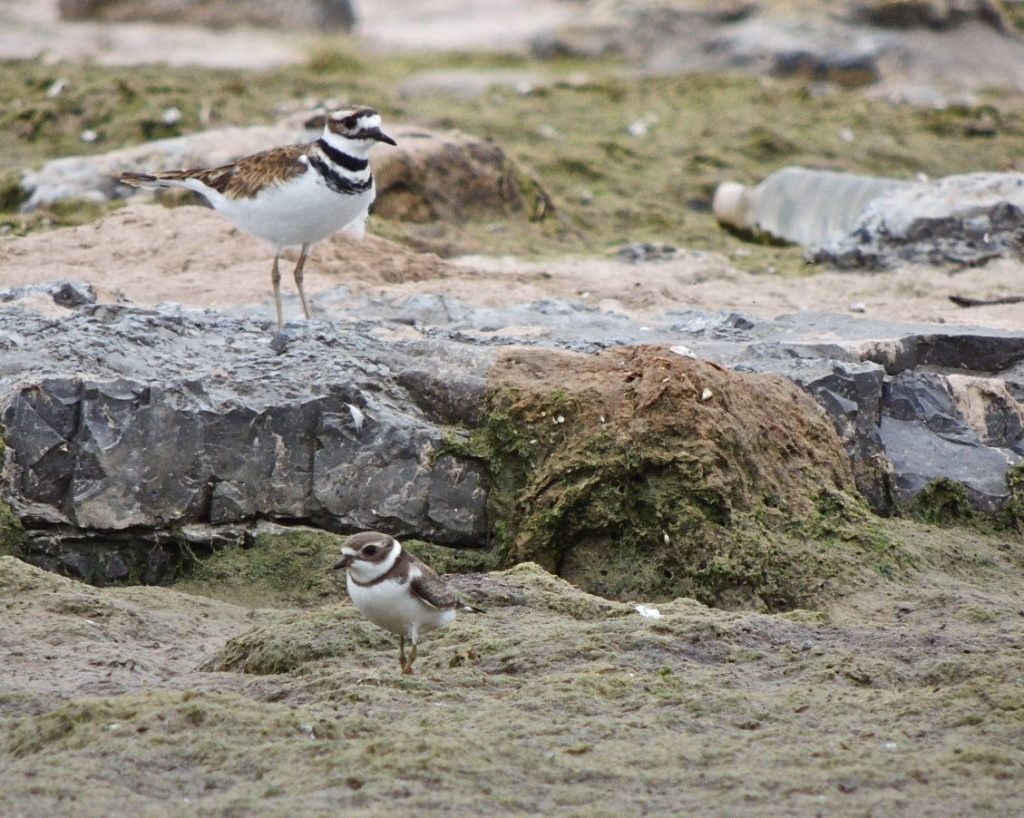
Common Ringed Plovers are, as their name suggests, very common, just not here. They are a Eurasian species that looks very much like our Semi-palmated Plover, shown in the photos below (and a Killdeer for comparison and scale).  Semi-palmated Plovers are frequent passage migrants on their way to overwinter along the shores of the Atlantic and Caribbean.

Semi-palmated Plover
Killdeer (supervising) & Semipalmated Plover (foreground)

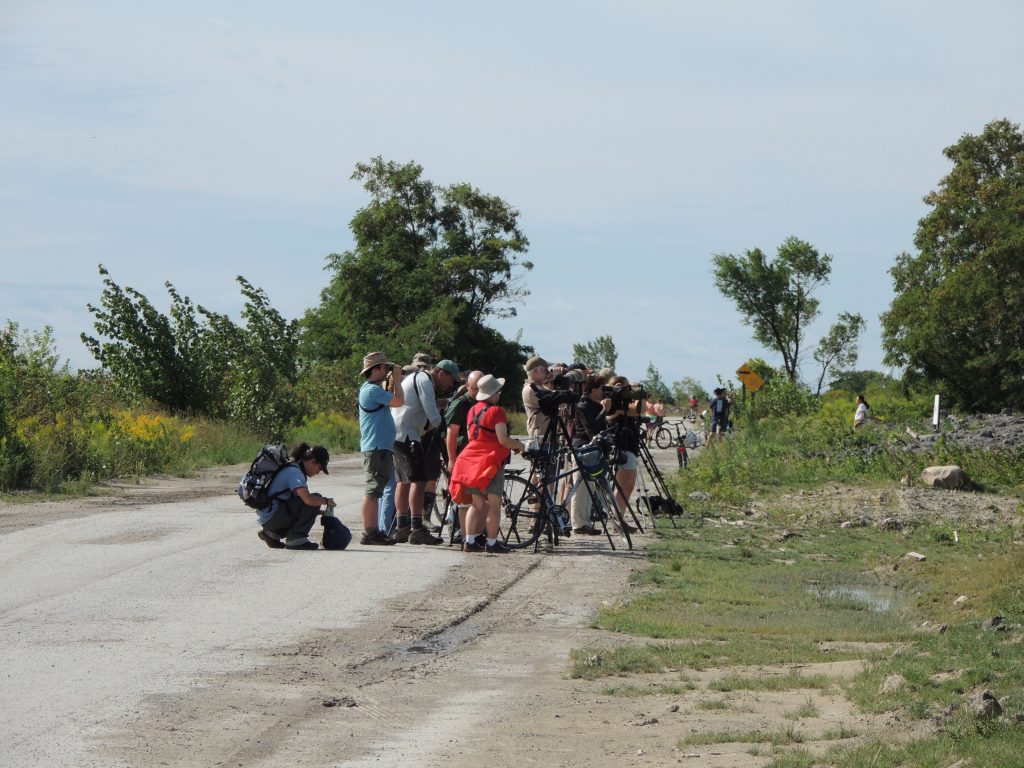
Several dozen gregarious birders and I gathered in a knot watching the Ringed Plover about a hundred meters distant. It’s a small bird and was hard to make out as it skittered around socializing with Least Sandpipers, Killdeers and the odd yellowlegs. I’m a little embarrassed to admit that I didn’t pay a lot of attention to the other shorebirds, and I’m not sure anyone else did either; I suppose we were too distracted by this Bird of the Day.

DSCN0640

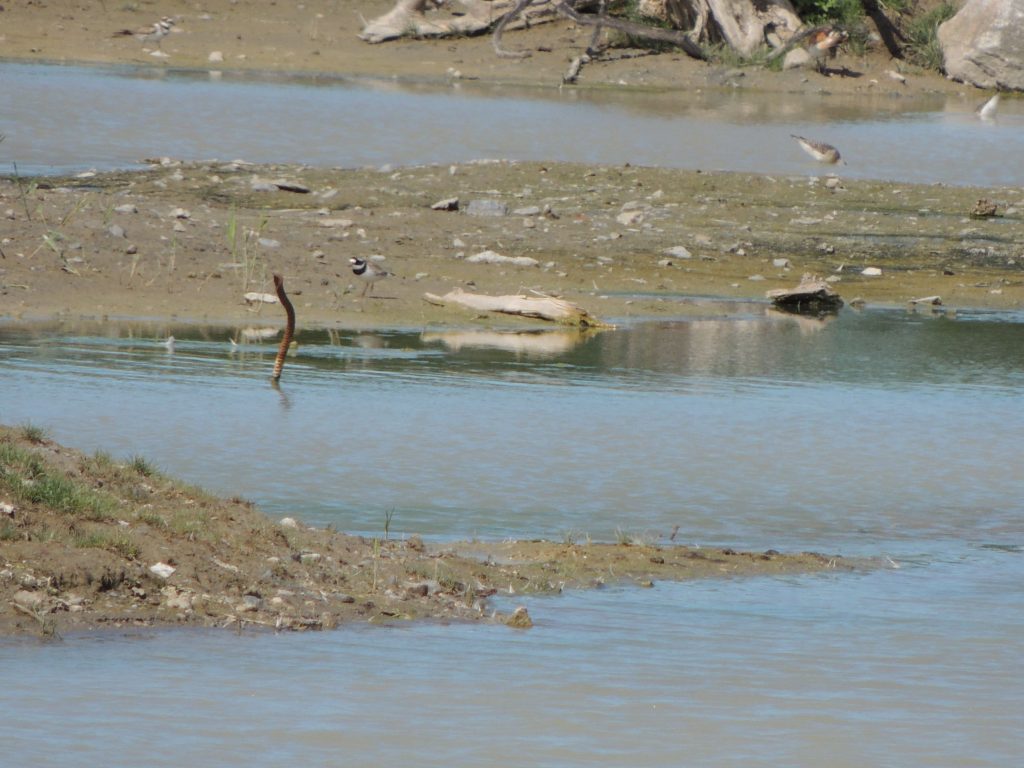
Ringed Plovers nest across the northern-most reaches of Eurasia, on the coast of Greenland and on the far reaches of Canada’s Baffin Island; they winter in Africa. It makes sense to assume that today’s Ringed Plover was a Baffin Island nester that has made a gross navigational error and finds itself some 90 degrees off course. I took many photos, mostly for the record, but a strong wind and the distance involved made for a large batch of ‘deletes’.  The one below is barely good enough to include (try clicking on the photo to enlarge it) but you’ll get the general idea from the Semi-palmated Plovers pictures above.

Common Ringed Plover. (to right of the iron bar sticking out of the water's edge)
Common Ringed Plover. (to right of the iron bar sticking out of the water’s edge)

The setting for this gathering to examine a wandering bird-turned-extreme-rarity was a long spit of reclaimed land anchored at its east end to a corner of Toronto’s old industrial heartland and reaching out into Lake Ontario. The Spit, as it’s known, continues to grow as construction debris and excavated sub-soils arrive. As the trucks leave so trees and grasses take root making it a very green and leafy place popular with runners, cyclists and birders. It is a natural shoreline conduit for migrating birds and we noted many Eastern Kingbirds, Tree Swallows and Barn Swallows making their way heading south and west, and there was a brief flurry of excitement among the smaller birds as a Sharp-shinned Hawk cruised overhead, I half expected the Ringed Plover to fly away never to be seen again; but it stayed, making a day-long parade of birders happy.

Black-throated Green Warbler

17 August 2016. Clear Lake, Young’s Point, Ont.  I think the tide has turned. Yesterday a big, fat blanket of all-day rain, originating in the Gulf of Mexico, swept across the north east soaking the parched land and ending a six week stretch of debilitating heat and humidity. Behind the storm a cold front has slipped down from the northwest and brought with it fair warning to the millions of summer birds in the northern forests that it’s time to think about moving on; that summer has served its purpose.
We are enjoying a family week on the shore of one of Ontario’s many delightful recreational lakes. Our days are largely taken up with the dramas, management and feeding demands of one, four and seven year-olds but it does allow some time to keep an eye open for birds; for the patriarch at least.
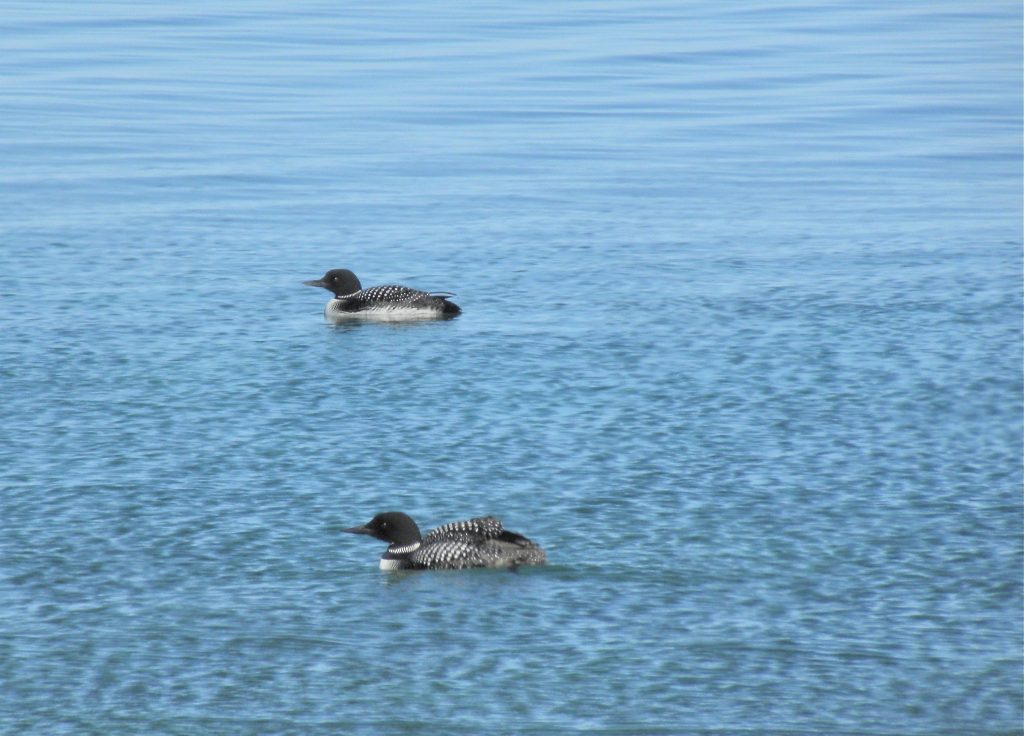
Probably the signature birds of this lake are Ospreys and Common Loons. Everyone loves loons, their mournful, stuff-of-ghost-stories call, long and echoey like a deranged wolf-howl, ensures their appeal. Gift shops thrive on loon bric-a-brac, the many inaccuracies in their portrayal mattering not at all.  Ospreys have their place too but without a campfires-worthy call it’s just some kind of fish-catching hawk to many people.

Common Loons
Common Loons
Ospreys mean more to me than loons, they figured large in my childhood when they returned to to breed in Scotland after an absence of some sixty years. Their return meant that I had at least a chance of seeing one when I grew up. What I didn’t know then was that the Osprey is very widespread, present on every continent except Australia.  In time I’d get to see many of them, especially here in North America. I never take them for granted though. What those nineteenth century gamekeepers and gillies, charged with the custody of expensive fishing rivers, managed to do was confer great value on Ospreys when they eventually returned from extirpation.
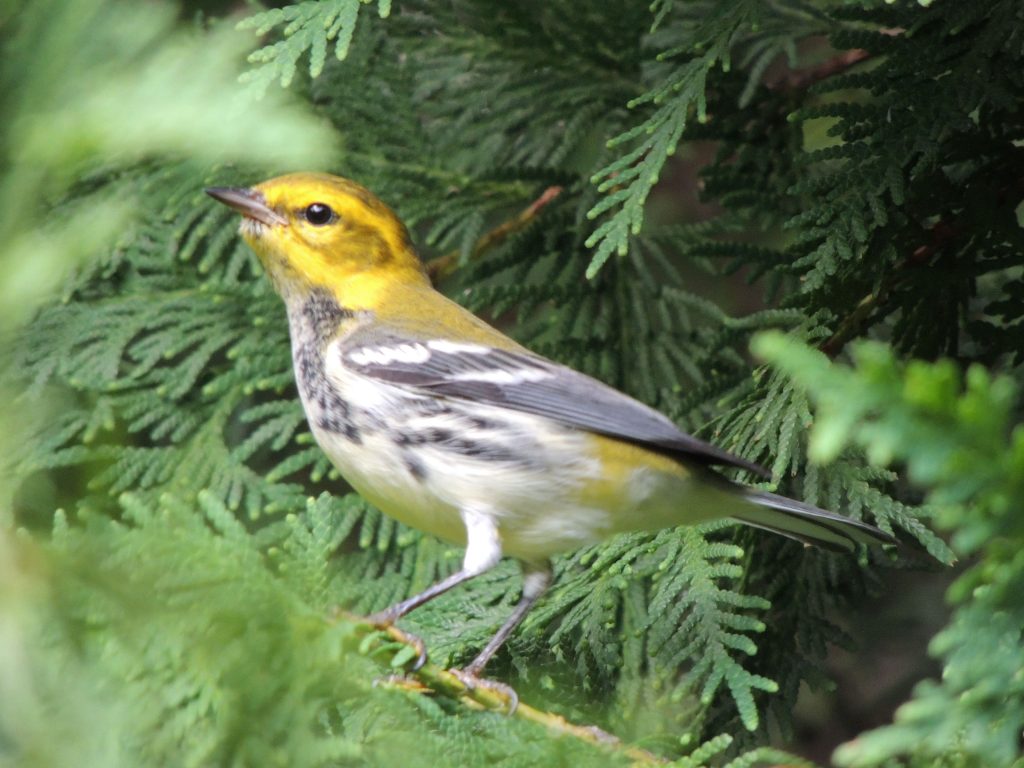
But I was reflecting on Ospreys as my birds of the day, when I noticed several much smaller birds actively foraging and gleaning insects from the lower branches of the many Eastern White Cedars that surround this vacation cottage. I wondered if they could be migrant warblers, partly because a friend had very recently reported swarms of active warblers around his cottage some distance north and because of the change in weather.  When later I got the chance to follow up I found that they were indeed migrant warblers, actually Black-throated Green Warblers; so the fall migration has begun, the tide has turned.
Black-throated Green Warbler
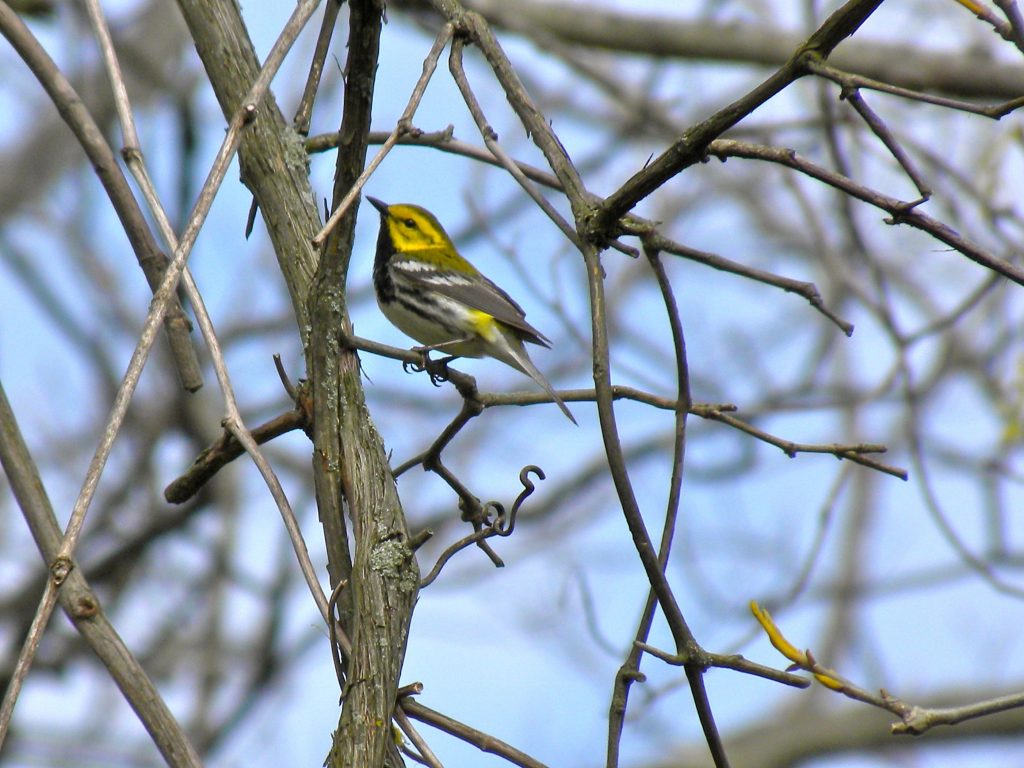
Here are a couple of photos, the one above taken today of what is probably a young male Black-throated Green Warbler.  Not the best of photos but since it was my Bird of the Day I include it in recognition.  The one below taken in May four years ago, a much nicer looking adult male.

Black -throated Green Warbler May 2 2012

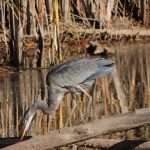
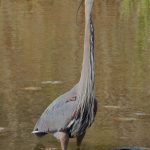
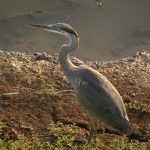
Great Blue Heron

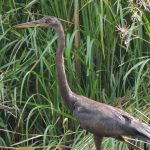
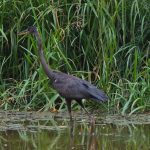
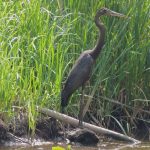
August 11 2016. Valley Inn Hamilton ON. There has been quite a bit of buzz in the local birding community about a Great Blue Heron – a melanistic Great Blue perhaps. Or did it get dunked in old oil somehow ? That was the question. A debate followed for a day or two and in the end I think the consensus was for melanism over motor oil. “ Melanism is a development of the dark-coloured pigment melanin in the skin or its appendages and is the opposite of albinism. “ Thanks internet.

Oiled versus melanism has a bit of history among birders. Every now and then a puzzle of a bird turns out to have been oiled somehow. Goodness knows we’ve all seen sad pictures of hapless waterfowl who unwittingly (and usually terminally) become engulfed in oil. Ken Kauffman, eminent American birder and author of one of the best field guides to North American birds, tells about rushing to Brigantine Wildlife Reserve, New Jersey, to see a Spotted Redshank, a lanky, dark-plumaged European shorebird which would be a rare treat for those who work hard at catching up with random rarities. On arrival at Brigantine (by hitchhiking – it was 1973) Kauffman was surprised to find no other birders; something was clearly wrong. Was the redshank long gone? Checking the guest book at the visitor information centre, he found and read a long, painstakingly careful analysis by one of America’s pre-eminent ornithologists of the day concluding that the Spotted Redshank was actually a Greater Yellowlegs (not a rarity) that had somehow settled into an oily pond and besmeared its plumage.

I spent a bit of time watching our unusual heron today and my preference is for an unspoiled bird that is just a little darker than normal; I don’t think it has had an oily mishap. All of its feathers appear to be clean and in good condition, not matted or misshapen; Its face and bill are the right colour for a Great Blue Heron, not in the slightest bit discoloured and; It appears to be behaving normally. Melanistic yes, oiled no.

So what do we have, other than an intriguing bird of the day? Certainly a young heron hatched this year; it is probably less than four months old and still dressed in its first basic plumage. Young Great Blue Herons are normally a dark, rather monochromatic, brownish. Today’s bird is not so different from ‘normal’, it’s a bit darker than average and lacking some of the pale brownish definition on feathers of the neck and wing that might otherwise make it more mottled. By late this year the grey-blue adult feathers will start to appear. It will be interesting to see if this bird survives the winter to return to this area and if it does, whether it shows any discernable darkness in its adult plumage.


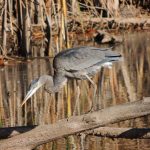
This gallery (visible only on the website, not if you’re reading this as an email.) holds a number of shots of today’s bird and a couple of other youngsters and (for interest’s sake) some mature adults. See if you like my conclusions.