White-rumped sandpiper

May 18 2016. Townsend Ontario. A day of many interesting sightings. Two of us completed a census taking three and a half hours to do what normally takes two. It was full of surprises and pleasures and we ended up with a list of fifty-eight species. Stand-outs in my view, although my companion Barry may have other ideas, were hearing many Tennessee Warblers, finding a neck-breakingly high overhead Blackburnian Warbler, two Cooper’s Hawks patrolling the area on languid wingbeats reminiscent of a Short-eared Owl’s floppy flight style, a female Wood Duck with a brood of eleven day-old ducklings and finding ourselves in close proximity to a male Scarlet Tanager. I have gushed about Scarlet Tanagers often enough but sometimes bemoan the fact that I find them difficult to photograph. Today’s was enjoyed by a gathering crowd of walkers and my camera did well to get some quite good photos; here are a couple. (In a gallery visible only on the website, not if you’re reading this as an email.)
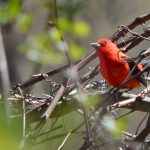
With our census done we went in pursuit of shorebirds at some distant sewage lagoons. Birders like sewage treatment areas, I won’t go into details; it’s one of our peculiarities.

It was quite good birding. The lagoons held large numbers of Dunlin, Least Sandpipers and Semi-palmated Plovers. It brought back memories of this time last year along the shores of New Jersey. We found one White-rumped Sandpiper which was interesting, more to Barry than to me I think. He scrutinized it at length, checked its field marks (streaky breast, wing length and slightly drooping bill) mulled over its purported body length in comparison to other sandpipers and gave it his conclusive stamp of approval.

Shorebirds can be excruciatingly difficult to sort out, I’m pretty comfortable with the ones we see most commonly; but a White-rumped Sandpiper is rare enough that I find that they just add to my confusion.

Back home I did a little more research and here’s where it gets really interesting: White-rumped Sandpipers migrate between the extreme southern end of South America, Patagonia in particular, to the extreme northern end of North America, the shores of the Arctic Ocean and Baffin Bay, to breed. A journey of 13,000 kilometers made in a few, long, non-stop flights which can last as long as 60 hours and cover up to 4,000 kilometers. All of this on reserves of body fat as fuel. Pause and think about all of that: a metabolism that converts some forty grams (around one ounce) of yellow, greasy fat into fuel enough to fly from Surinam to Ontario in one go; guided by an internal navigation system that relies on… what: Stars, Earth’s magnetic fields, the Sun? Who knows? Cool bird; Bird of the Day

Swallows

May 15th 2016. Cootes Paradise, Hamilton ON. Canada is sometimes understood to be a country of ice and snow and log cabins and dark pine trees; a impression richly undeserved. It is a picture that today’s hi-speed, hi-definition world should be able to dispel; but fails to. It doesn’t help that every now and then we get a day like this: cold, wet and with sleet and snow in the air; winter just letting us know it hasn’t forgotten us. It was perhaps the coldest May day in history.

I walked one of our census routes. It was raw but the birds still have to live and many could only find food on the ground; flying insects having either died or hunkered down somewhere. I encountered a flock of Cedar Waxwings, an Eastern Kingbird and a solitary Swainson’s Thrush all foraging low along a well used path. I could hear Nashville Warblers, Warbling Vireos and a Northern Waterthrush, all insectivors and probably struggling.

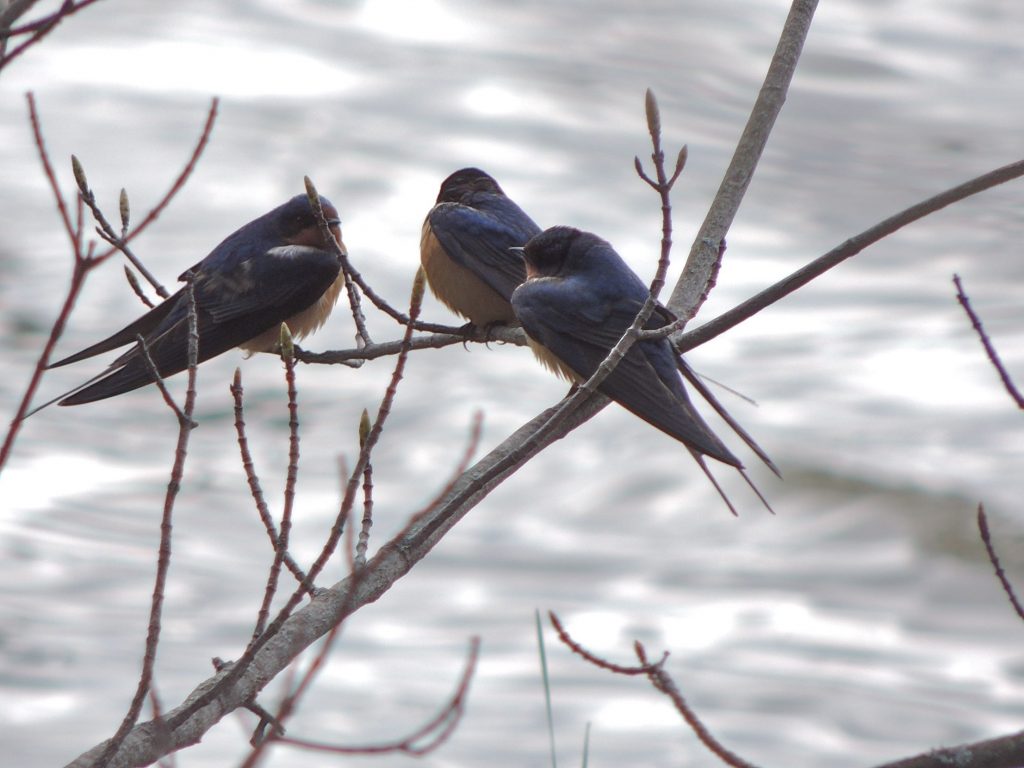
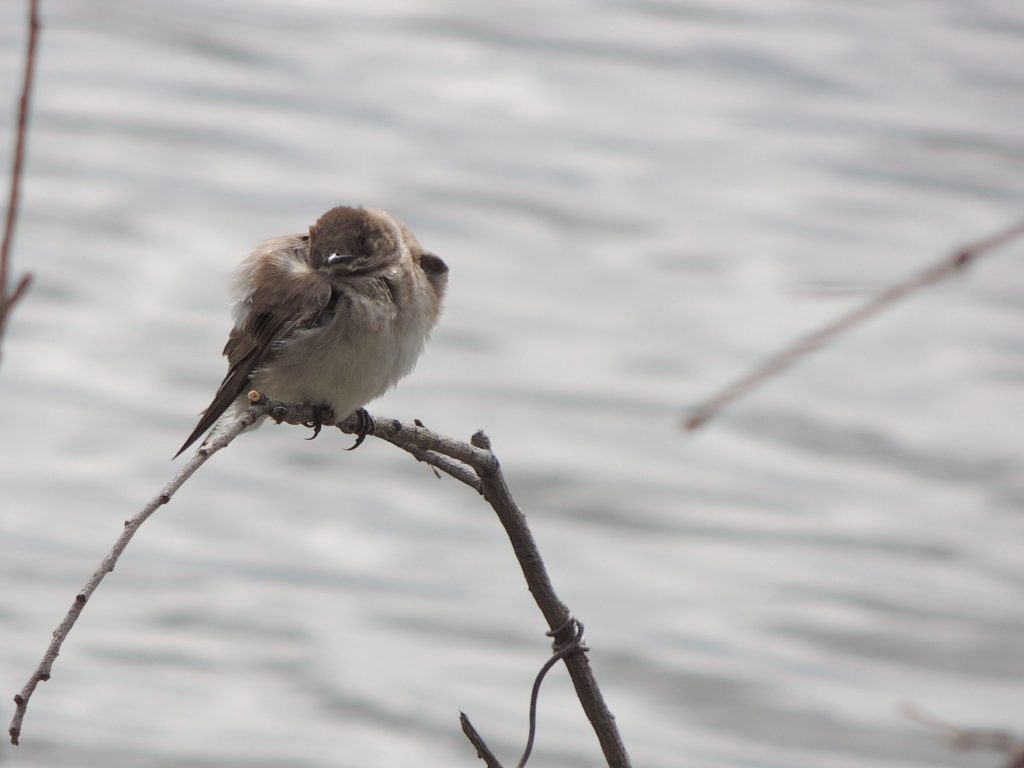
Along the margins of a large lake, Tree, Barn and Northern Rough-winged Swallows were chasing what few flying insects there were, both low, almost at surface level, and just inland in sheltered coves and along marshy tributaries. It may sound unremarkable but swallows normally fly high, swooping, aerial loops picking flying insect at all levels ; today’s birds had been forced down and concentrated in those marginally warmer corners. Many birds had stopped flying, stopped wasting energy in a fruitless pursuit and chose instead to perch, fluffed up to keep warm; whether they were beyond a fatal point of no return I can only speculate on. I’m sure this turn of events was deadly to many insectivorous birds, particularly hatchlings dependent upon parents delivering an endless supply of food.

Barn Swallows in the cold

Here are a couple of shots of swallows: three Barn Swallow above and a Northern Rough-winged Swallow below, waiting for better times.

N Rough-winged Swallow in the cold.

Indigo Bunting

May 13th 2016. Cootes Paradise, Hamilton ON. I walked a census route today and enjoyed a few bird encounters that were either landmarks or lessons. I think a female Indigo Bunting stands out as most memorable and instructive and a Yellow-bellied Sapsucker, Scarlet Tanagers, Swainson’s Thrushes and a Ruby-throated Hummingbird all added to the lively 45-species census.

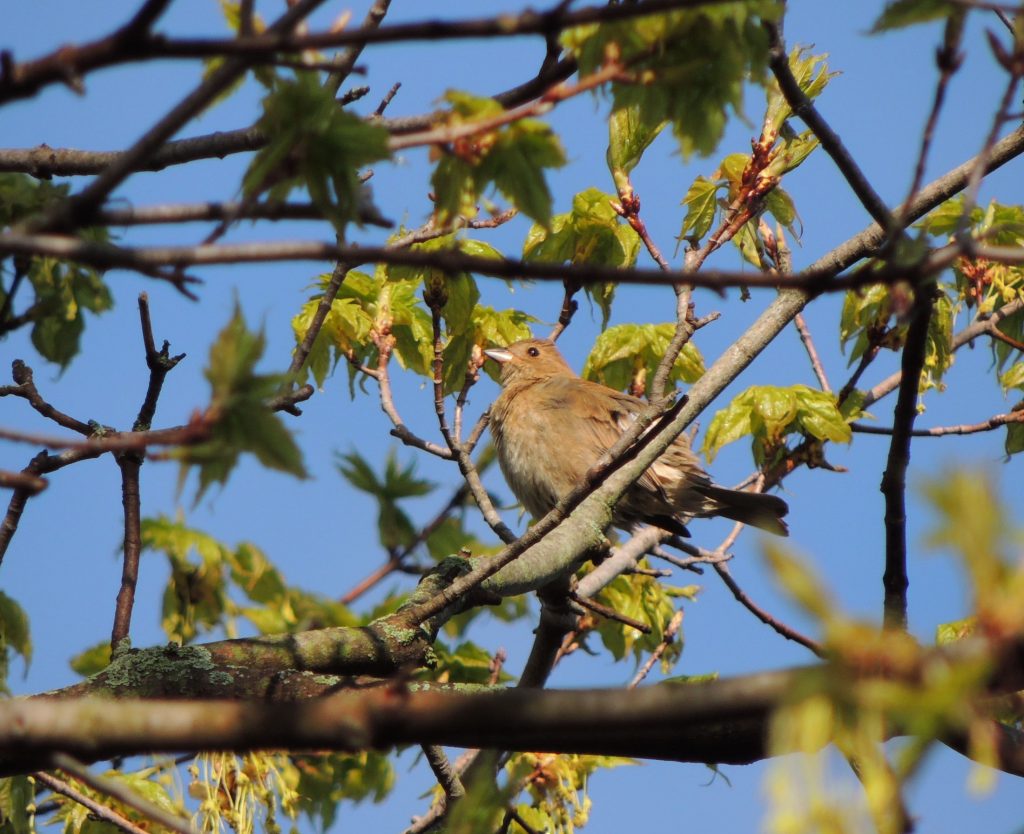
Female Indigo Bunting

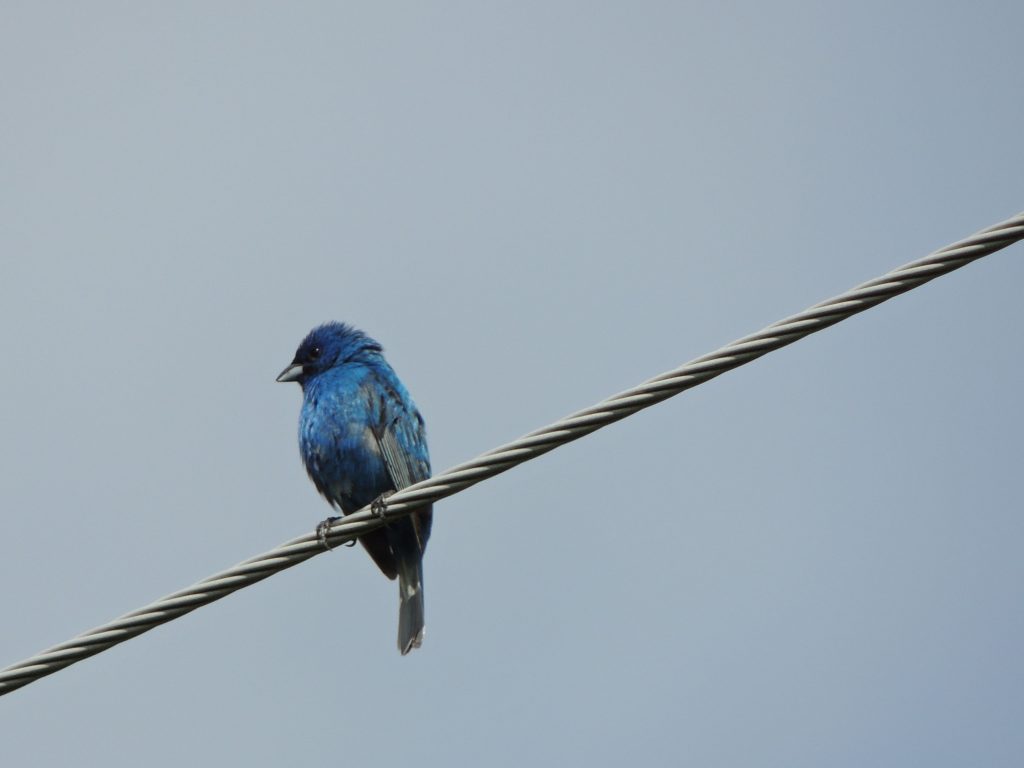
The photo above is the Indigo Bunting, a female. She flew up from the trail in front of me and perched obligingly just overhead allowing me enough time to get a couple of shots. It took me a few minutes to figure out just what I was looking at and I needed to check a good field guide later to confirm my suspicions. This bird is drab and almost devoid of key field marks, but what caught my eye and led me in the right direction was the faintest hint of blue around the base of the wing. Clearly she bears no resemblance to the dazzling male (photo below). But his foppish glory is short-lived, once the breeding season is over he will become a mottled blend of browns and muddy blue –“…and we all do fade as a leaf”.

Male Indigo Bunting
Male Indigo Bunting

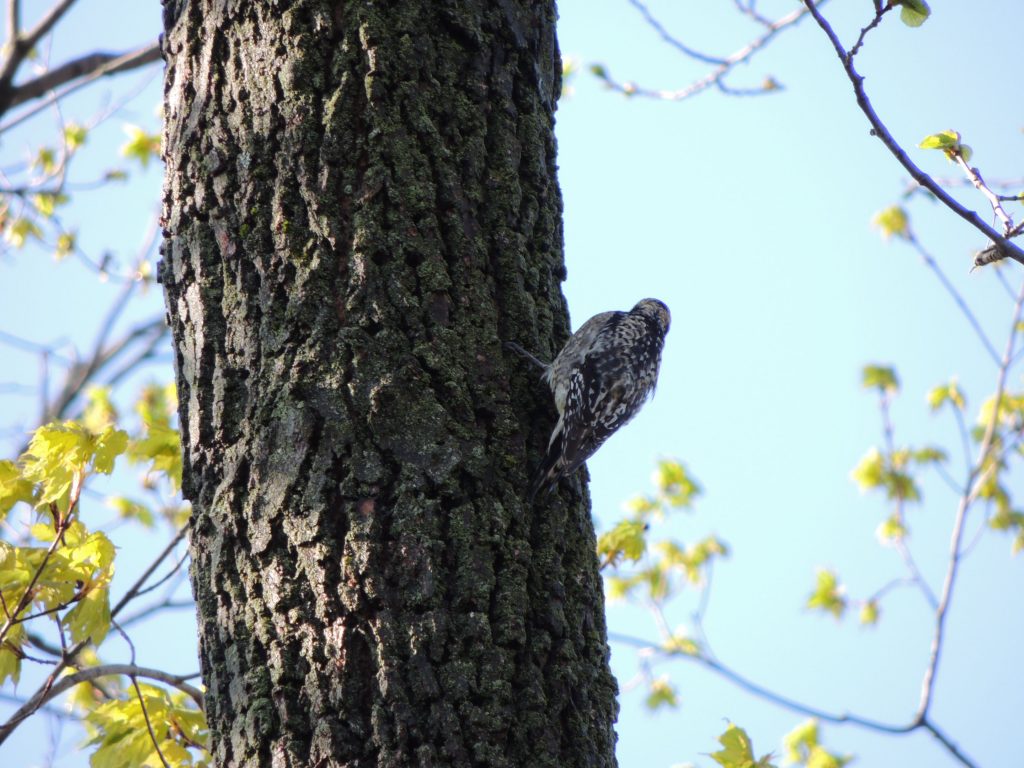
Speaking of dowdy, a Yellow-bellied Sapsucker was also instructive. Of all the woodpeckers, this species seems to care least about appearances. A well-turned-out sapsucker dresses like an underpaid TV detective, while a dowdy one, like today’s, more like a farmhand.

Yellow-bellied Sapsucker

The forest was noisy with the songs of half a dozen or more Scarlet Tanagers. Their song is often described as sounding like a robin with a sore throat, which is not a bad description, although I think robins put a bit more heart into it. Perhaps they don’t need to impress with song because seeing a Scarlet Tanager at close quarters is quite enough, almost a shock to the eyes.

Two Swainson’s Thrushes, like all thrushes, kept their distance. I watched them for a while and rarely did I see much more than their backs. Like the Hermit Thrush (See April 30th below) they always seem to be getting ready to leave.

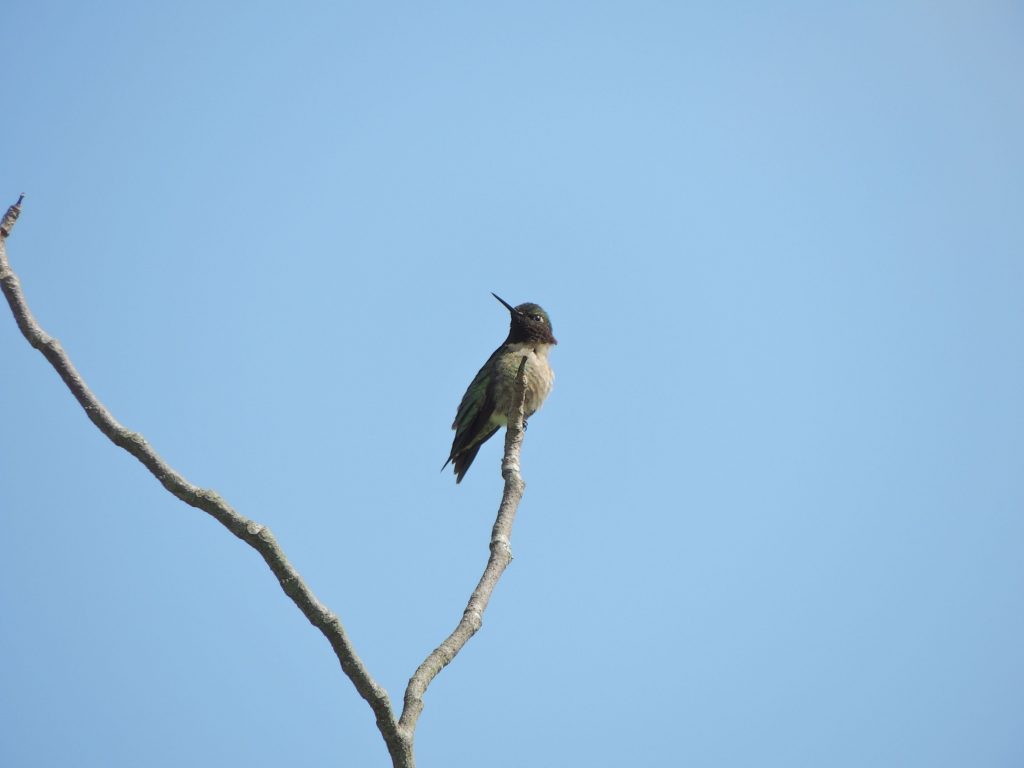
My last and landmark sighting was a male Ruby-throated Hummingbird watching a crowd of school-children from atop a dead tree. His flash of ruby on the throat is not apparent in this light, you’ll have to forgive him; he’s just arrived after a solo flight from Panama. There’s a lot more to a four-gram hummingbird than flashy feathers and a long bill.

Ruby-throated Hummingbird

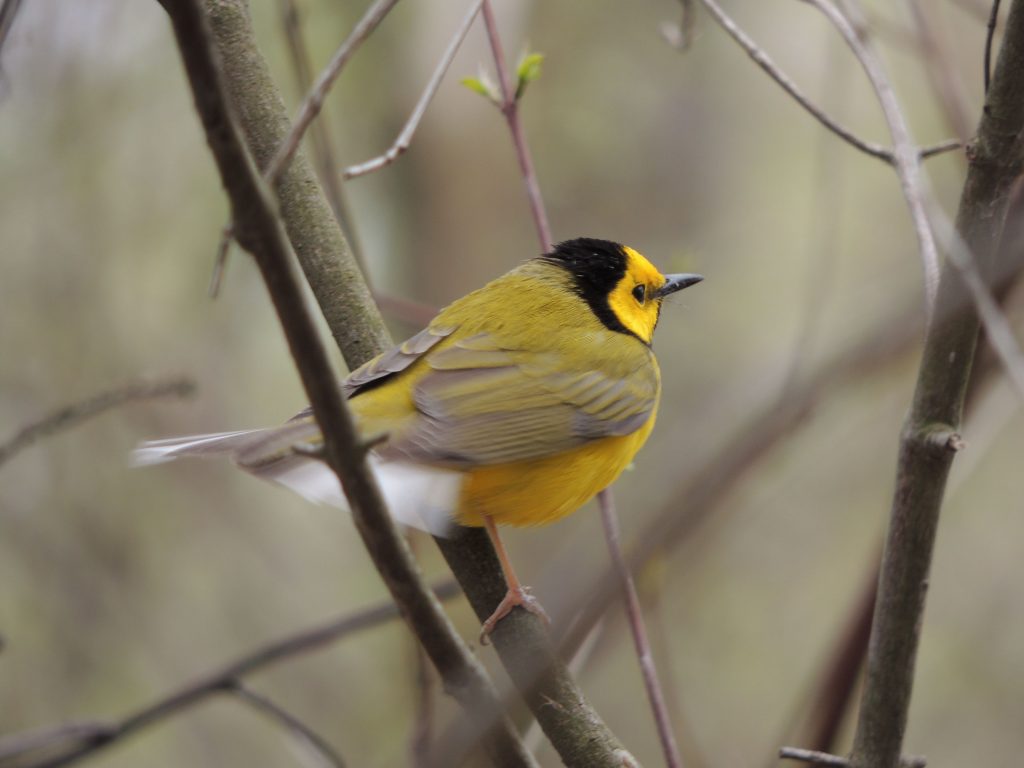
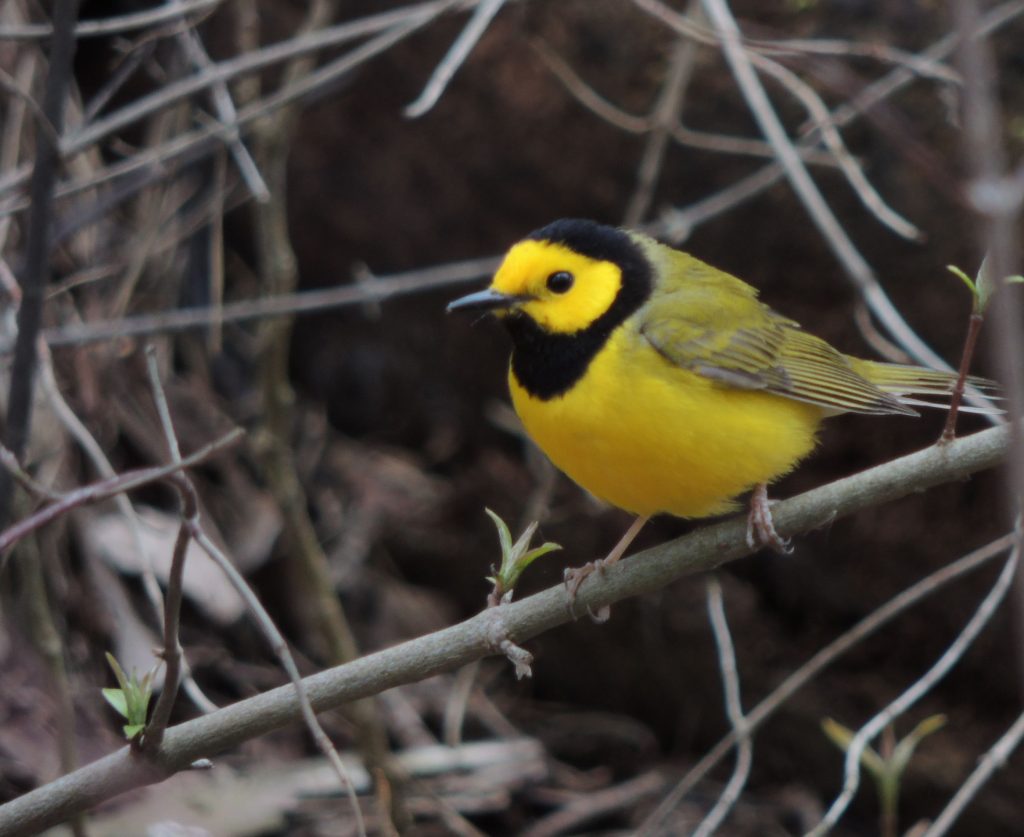
Black-throated Blue Warbler and Hooded Warbler.

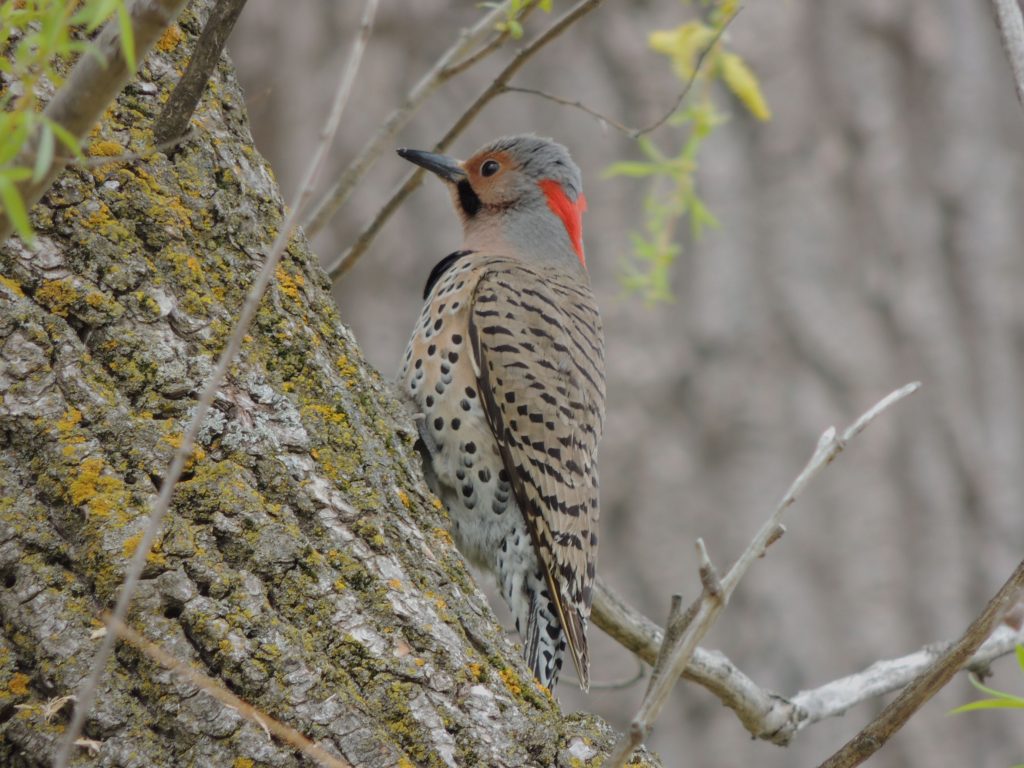
May 11 2016. Long Point Ontario. Apparently persistent north-east winds of the past few weeks are holding back many of our expected migrants. Among those who gauge the warbler migration of May migration in superlatives and hysteria, today was just an okay day; but I was perfectly happy with it. A companion and I revisited the Long Point area (see May 4) and once again tallied a very varied and respectable list. Some first-of-the-years were: Least Flycatcher, American Redstart, Veery and Red-eyed Vireo. Notable (just because) were a Broad-winged Hawk, several Scarlet Tanagers, a handsome Northern Flicker, and Chestnut-sided, Nashville, Yellow-rumped, Magnolia and Black-throated Green Warblers.

Northern Flicker
Northern Flicker

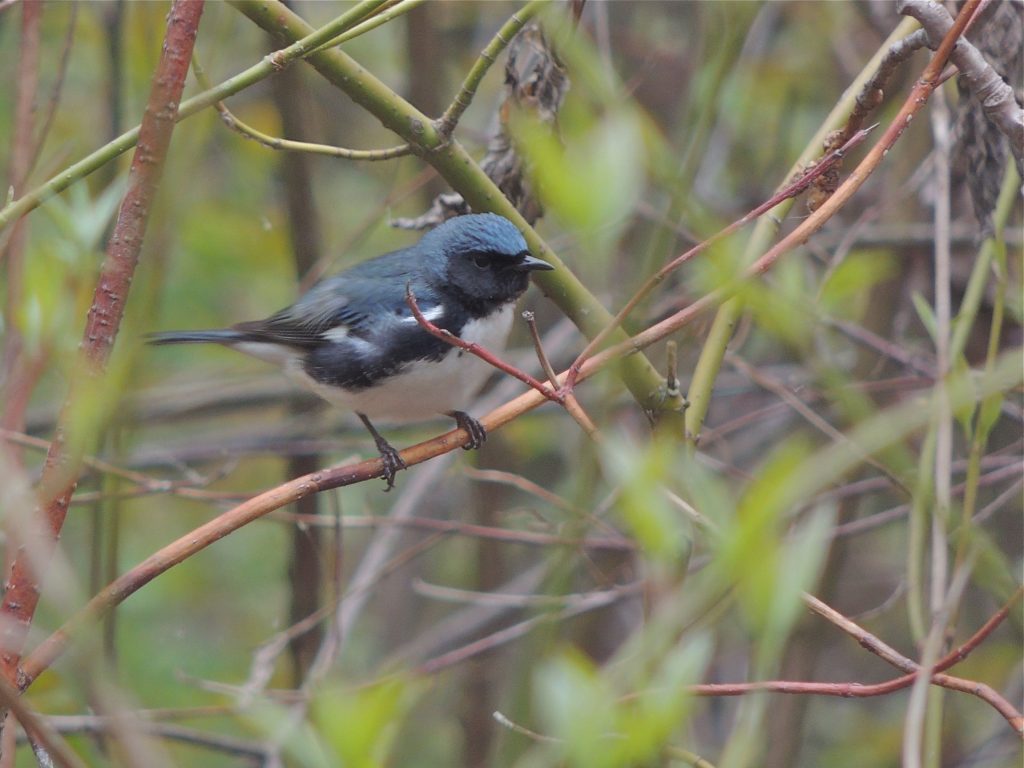
We found ourselves on the opposite side of a thicket of brambles, dogwood and grape from a large knot of anxious birders who were desperately trying to find the Black-throated Blue Warbler they could hear but was avoiding them. Their problem was that while they were on the west side of the thicket, we and the bird were getting along nicely on the east side.  I was able to get a few photos, here’s the best of them.Black-throated Blue Warbler. Old Cut, LP

For a long time the Black-throated Blue Warbler was unassailable as Bird of the Day, that is until we were directed to a splendid male Hooded Warbler that was hopping and flitting quickly around a tangle of downed branches. It shone in the relative gloom and had us all gasping in admiration, one look makes you an instant fan. Hooded Warblers’ distribution in Ontario is very limited, generally close to Lake Erie and towards the west end of Lake Ontario; it’s a privilege to count them among our breeding birds. And incidentally, it easily matched the Black-throated Blue Warbler in eye-popping appeal. Co-Bird of the Day.

Hooded Warbler
Hooded Warbler
Hooded Warbler
Hooded Warbler

Bay-breasted Warbler and Yellow-throated Vireo

May 9 2016. Ruthven Park, Cayuga ON. Another one of those cascading-warblers days. I left home long before most mortals were awake but checked the radar beforehand; the image was pulsating with migrants on the move. It takes fifty minutes to get to the bird observatory and the sun was up when I arrived, the woods were ringing with bird song and there was the lightest touch of frost on the grass.

Charged with the mission of doing the daily census I was soon overwhelmed: Chipping Sparrow, Wood Thrush, Song Sparrow, Warbling Vireo, American Robin, Yellow Warbler, say them to yourself quickly and you’ll have some idea of the fury. Black-capped Chickadee, Blue Jay, Baltimore Oriole, American Goldfinch and Tufted Titmouse – and on it went. I quickly filled two columns of a page of my notebook – forty-six entries.

I stared up at the sunlit side of some towering Norway Spruces and found a Ruby-crowned Kinglet, two flame-faced Blackburnian Warblers, a Magnolia Warbler , a Yellow Warbler and a couple of Black-throated Green Warblers. From the top came a clear fluting song that I thought I knew, I had the wrong species in mind but was nevertheless pleased to make the connection with an Orchard Oriole. (Here is a gallery of some of those birds, visible only on the website, not if you’re reading this as an email.)
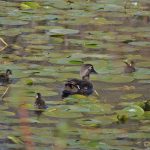
Much farther along, with my brain, binoculars and notebook all working flat out, I looked up at a small bird working over the tops of a Hackberry, it was a Bay-breasted Warbler. Wow! That’s early by a week or two, I thought. Bird of the Day for that reason alone, but also because Bay-breasteds can be a bit hit and miss, a species that is prone to population swings and, to my mind, often neck-twistingly high overhead.

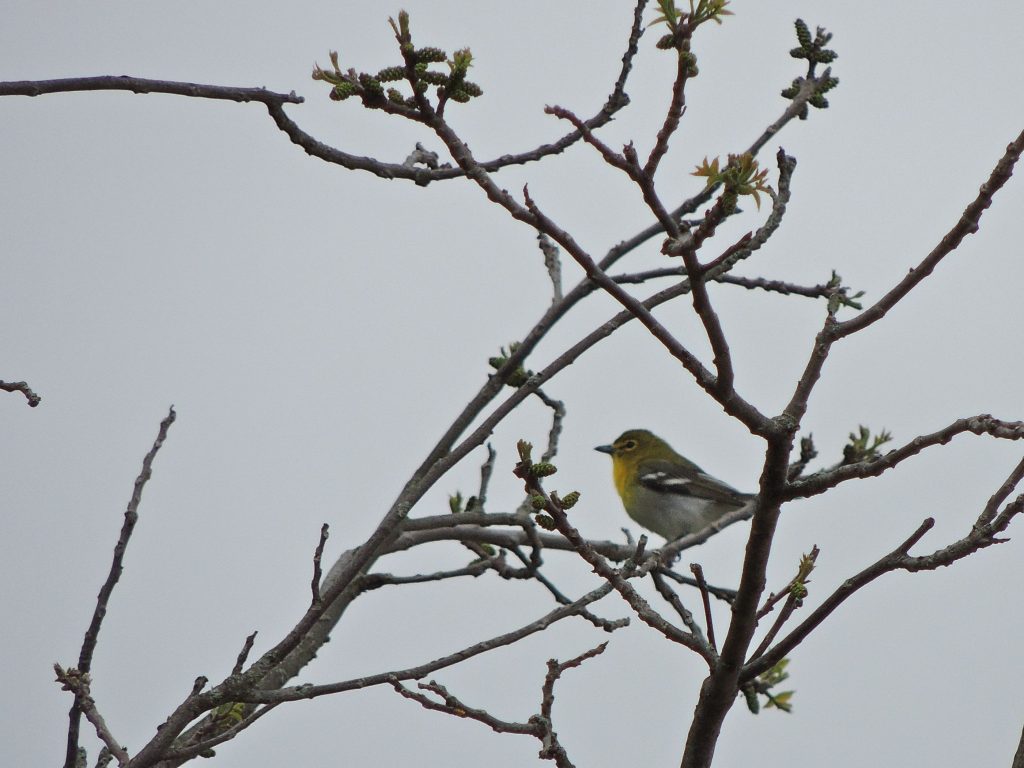
I watched it and others for a while and then became aware of the unmistakable tree-top call of a Yellow-throated Vireo; I just love these guys and here they are back for another summer’s fun. Their song is a repeated, hoarse, two-phrase whistle; ‘Whee – up’ that sounds a bit the worse for wear as though last night was a late one with too many drinking games. And come to think of it, that whole image of a dissolute party-goer rather fits the nonchalantly pugnacious demeanor of the Yellow-throated Vireo. A quick search of this site will turn up many entries about vireos, all of them in praise of.

Yellow-throated Vireo

I spent three hours on the census, a job that usually takes half that time, and tallied sixty-two species. A high count that could have been higher, I missed a couple of birds that really should have been dead certainties but there it is; after a while birdy days like this can become an over-saturated blur – if happy one.